
Key Considerations When Evaluating your ERP system’s Forecasting Capabilities

The Smart Forecaster

 Pursuing best practices in demand planning,

forecasting and inventory optimization


1. Built-in ERP functionality is baked into Order Management.

Consider what is meant by “demand management”, “demand planning”, and “forecasting”. These terms imply certain standard functionality for collaboration, statistical analysis, and reporting to support a professional demand planning process.  However, in most ERP systems, “demand management” consists of executing MRP and reconciling demand and supply for the purpose of placing orders, i.e., “order management.” It has very little to do with demand planning which is discrete process focused on developing the best possible predictions of future demand by combining statistical analysis with business knowledge of events, promotions, and sales force intelligence.   Most ERP systems offer little statistical capability and, when offered, the user is left with a choice of a few statistical methods that they either have to apply manually from a drop-down list or program themselves. It’s baked into the order management process enabling the user to possibly how the forecast might impact inventory.  However, there isn’t any ability to manage the forecast, improve the quality of the forecast, apply and track management overrides, collaborate, measure forecast accuracy, and track “forecast value add.” 

2. ERP planning methods are often based on simplistic rules of thumb.

ERP systems will always offer min, max, safety stock, reorder point, reorder quantity, and forecasts to drive replenishment decisions.  But what about the underlying methods used to calculate these important drivers?   In nearly every case, the methods provided are nothing more than rule-of-thumb approaches that don’t account for demand or supplier variability.  Some do offer “service level targeting” but mistakenly rely on the assumption of a Normal distribution (“bell-shaped curve”) which means the required safety stocks and reorder points recommended by the system to achieve the service level target are going to be flat out wrong if your data doesn’t fit the ideal theoretical model, which is often gravely unrealistic.  Such over-simplified calculations tend to do more harm than good.  

3. You’ll probably still use spreadsheets for at least 2 years after purchase.

Most often, if you were to implement a new ERP solution, your old data would be stranded.  So, any native ERP functionality for forecasting, setting stocking policy such as Min/Max, etc., cannot be used, and you will be forced to revert back to cumbersome and error-prone spreadsheets for at least two years (one year to implement at earliest and another year to collect at least 12 months of history).  Hardly a digital transformation.  Using a best-of-breed solution avoids this problem.  You can load data from your legacy ERP system and not disrupt your ERP deployment.  This means that on Day 1 of ERP go-live you can populate your new ERP system with better inputs for demand forecasts, safety stocks, reorder points, and Min/Max settings.

4. ERP isn’t designed to do everything

The “Do everything in ERP/One-Vendor” mindset was a marketing message promoted by ERP firms, particularly SAP, to get you, the customer, to spend 100% of your IT budget with them.  That marketing message has been parroted back to users by analyst groups, IT firms, and systems integrators, drowning out rational voices who asked “Why do you want to be so dependent on one firm to the point of using inferior forecasting and inventory planning technology?”  The sheer number of IT failures and huge implementation costs have caused many companies to rethink their approach to ERP.  With the advent of specialized planning apps born in the cloud with no IT footprint, the way to go is a “thin” ERP focused on the fundamentals – accounting, order management, financials – but supported by specialized planning apps. 

The expertise of ERP consultant’s lies in how their system is designed to automate certain business processes and how the system can be configured or customized.   Their consultants are not specialists in on proper approaches to planning stock, forecasting, and inventory planning.  So if you are trying to understand what demand planning approach is right for your business, how should you buffer properly, (e.g., “Should we do Min/Max or forecast-based replenishment?” “Should we use forecasting method X?”), you generally aren’t going to find it and if you do that resource will be spread quite thin. 


Leave a Comment

Related Posts

Innovating the OEM Aftermarket with AI-Driven Inventory Optimization

Innovating the OEM Aftermarket with AI-Driven Inventory Optimization

The aftermarket sector provides OEMs with a decisive advantage by offering a steady revenue stream and fostering customer loyalty through the reliable and timely delivery of service parts. However, managing inventory and forecasting demand in the aftermarket is fraught with challenges, including unpredictable demand patterns, vast product ranges, and the necessity for quick turnarounds. Traditional methods often fall short due to the complexity and variability of demand in the aftermarket. The latest technologies can analyze large datasets to predict future demand more accurately and optimize inventory levels, leading to better service and lower costs.

Forecast-Based Inventory Management for Better Planning

Forecast-Based Inventory Management for Better Planning

Forecast-based inventory management, or MRP (Material Requirements Planning) logic, is a forward-planning method that helps businesses meet demand without overstocking or understocking. By anticipating demand and adjusting inventory levels, it maintains a balance between meeting customer needs and minimizing excess inventory costs. This approach optimizes operations, reduces waste, and enhances customer satisfaction.

Make AI-Driven Inventory Optimization an Ally for Your Organization

Make AI-Driven Inventory Optimization an Ally for Your Organization

In this blog, we will explore how organizations can achieve exceptional efficiency and accuracy with AI-driven inventory optimization. Traditional inventory management methods often fall short due to their reactive nature and reliance on manual processes. Maintaining optimal inventory levels is fundamental for meeting customer demand while minimizing costs. The introduction of AI-driven inventory optimization can significantly reduce the burden of manual processes, providing relief to supply chain managers from tedious tasks.

Recent Posts

  • Managing Spare Parts Inventory: Best PracticesManaging Spare Parts Inventory: Best Practices
    In this blog, we’ll explore several effective strategies for managing spare parts inventory, emphasizing the importance of optimizing stock levels, maintaining service levels, and using smart tools to aid in decision-making. Managing spare parts inventory is a critical component for businesses that depend on equipment uptime and service reliability. Unlike regular inventory items, spare parts often have unpredictable demand patterns, making them more challenging to manage effectively. An efficient spare parts inventory management system helps prevent stockouts that can lead to operational downtime and costly delays while also avoiding overstocking that unnecessarily ties up capital and increases holding costs. […]

  • 5 Ways to Improve Supply Chain Decision Speed5 Ways to Improve Supply Chain Decision Speed
    The promise of a digital supply chain has transformed how businesses operate. At its core, it can make rapid, data-driven decisions while ensuring quality and efficiency throughout operations. However, it's not just about having access to more data. Organizations need the right tools and platforms to turn that data into actionable insights. This is where decision-making becomes critical, especially in a landscape where new digital supply chain solutions and AI-driven platforms can support you in streamlining many processes within the decision matrix. […]

  • Two employees checking inventory in temporary storage in a distribution warehouse.12 Causes of Overstocking and Practical Solutions
    Managing inventory effectively is critical for maintaining a healthy balance sheet and ensuring that resources are optimally allocated. Here is an in-depth exploration of the main causes of overstocking, their implications, and possible solutions. […]

  • FAQ Mastering Smart IP&O for Better Inventory ManagementFAQ: Mastering Smart IP&O for Better Inventory Management.
    Effective supply chain and inventory management are essential for achieving operational efficiency and customer satisfaction. This blog provides clear and concise answers to some basic and other common questions from our Smart IP&O customers, offering practical insights to overcome typical challenges and enhance your inventory management practices. Focusing on these key areas, we help you transform complex inventory issues into strategic, manageable actions that reduce costs and improve overall performance with Smart IP&O. […]

  • 7 Key Demand Planning Trends Shaping the Future7 Key Demand Planning Trends Shaping the Future
    Demand planning goes beyond simply forecasting product needs; it's about ensuring your business meets customer demands with precision, efficiency, and cost-effectiveness. Latest demand planning technology addresses key challenges like forecast accuracy, inventory management, and market responsiveness. In this blog, we will introduce critical demand planning trends, including data-driven insights, probabilistic forecasting, consensus planning, predictive analytics, scenario modeling, real-time visibility, and multilevel forecasting. These trends will help you stay ahead of the curve, optimize your supply chain, reduce costs, and enhance customer satisfaction, positioning your business for long-term success. […]

    Inventory Optimization for Manufacturers, Distributors, and MRO

    • Managing Spare Parts Inventory: Best PracticesManaging Spare Parts Inventory: Best Practices
      In this blog, we’ll explore several effective strategies for managing spare parts inventory, emphasizing the importance of optimizing stock levels, maintaining service levels, and using smart tools to aid in decision-making. Managing spare parts inventory is a critical component for businesses that depend on equipment uptime and service reliability. Unlike regular inventory items, spare parts often have unpredictable demand patterns, making them more challenging to manage effectively. An efficient spare parts inventory management system helps prevent stockouts that can lead to operational downtime and costly delays while also avoiding overstocking that unnecessarily ties up capital and increases holding costs. […]

    • Innovating the OEM Aftermarket with AI-Driven Inventory Optimization XLInnovating the OEM Aftermarket with AI-Driven Inventory Optimization
      The aftermarket sector provides OEMs with a decisive advantage by offering a steady revenue stream and fostering customer loyalty through the reliable and timely delivery of service parts. However, managing inventory and forecasting demand in the aftermarket is fraught with challenges, including unpredictable demand patterns, vast product ranges, and the necessity for quick turnarounds. Traditional methods often fall short due to the complexity and variability of demand in the aftermarket. The latest technologies can analyze large datasets to predict future demand more accurately and optimize inventory levels, leading to better service and lower costs. […]

    • Future-Proofing Utilities. Advanced Analytics for Supply Chain OptimizationFuture-Proofing Utilities: Advanced Analytics for Supply Chain Optimization
      Utilities in the electrical, natural gas, urban water, and telecommunications fields are all asset-intensive and reliant on physical infrastructure that must be properly maintained, updated, and upgraded over time. Maximizing asset uptime and the reliability of physical infrastructure demands effective inventory management, spare parts forecasting, and supplier management. A utility that executes these processes effectively will outperform its peers, provide better returns for its investors and higher service levels for its customers, while reducing its environmental impact. […]
    • Centering Act Spare Parts Timing Pricing and ReliabilityCentering Act: Spare Parts Timing, Pricing, and Reliability
      In this article, we'll walk you through the process of crafting a spare parts inventory plan that prioritizes availability metrics such as service levels and fill rates while ensuring cost efficiency. We'll focus on an approach to inventory planning called Service Level-Driven Inventory Optimization. Next, we'll discuss how to determine what parts you should include in your inventory and those that might not be necessary. Lastly, we'll explore ways to enhance your service-level-driven inventory plan consistently. […]
      The 3 Types of Supply Chain Analytics

      The Smart Forecaster

       Pursuing best practices in demand planning,

      forecasting and inventory optimization

      There’s a stale old joke: “There are two types of people – those who believe there are two types of people, and those who don’t.” We can modify that joke: “There are two types of people – those who know there are three types of supply chain analytics, and those who haven’t yet read this blog.”

      The three types of supply chain analytics are “descriptive”, “predictive”, and “prescriptive.” Each plays a different role in helping you manage your inventory. Modern supply chain software lets you exploit all three.

      Descriptive Analytics

      Descriptive Analytics are the stuff of dashboards. They tell you “what’s happenin’ now.” Included in this category are such summary numbers as dollars currently invested in inventory, current customer service level and fill rate, and average supplier lead times. These statistics are useful for keeping track of your operations, especially when you track changes in them from month to month. You will rely on them every day. They require accurate corporate databases, processed statistically.

      Predictive Analytics

      Predictive Analytics most commonly manifest as forecasts of demand, often broken down by product and location and sometimes also by customer. These statistics provide early warning so you can gear up production, staffing and raw material procurement to satisfy demand. They also provide predictions of the effect of changes in operating policies, e.g., what happens if we increase our order quantity for Product X from 20 to 25 units? You might rely on Predictive Analytics periodically, perhaps weekly or monthly, when you look up from what’s happening now to see what will happen next. Predictive Analytics uses Descriptive Analytics as a foundation but adds more capability. Predictive Analytics for demand forecasting requires advanced statistical processing to detect and estimate such features of product demand as trend, seasonality and regime change.  Predictive Analytics for inventory management uses forecasts of demand as inputs into models of the operation of inventory policies, which in turn provide estimates of key performance metrics such as service levels, fill rates, and operating costs.

      Prescriptive Analytics

      Prescriptive Analytics are not about what is happening now, or what will happen next, but about what you should do next, i.e., they recommend decisions aimed at maximizing inventory system performance. You might rely on Prescriptive Analytics to best posture your entire inventory policy. Prescriptive Analytics uses Predictive Analytics as a foundation then adds optimization capability. For instance, Prescriptive Analytics software can automatically work out the best choices for future values of Min’s and Max’s for thousands of inventory items. Here, “best” might mean the values of Min and Max for each item that minimize operating cost (the sum of holding, ordering, and shortage costs) while maintaining a 90% floor on item fill rate.

      Example

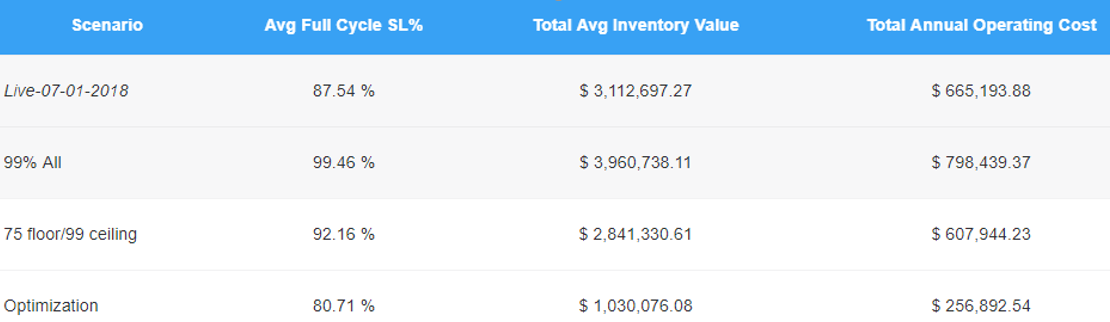
      The figure below shows how supply chain analytics can help the inventory manager. The columns show three predicted Key Performance Indicators (KPI’s): service level, inventory investment, and operating costs (holding costs + ordering costs + shortage costs).

       Figure 1: The three types of analytics used to evaluate planning scenarios

      The rows show four alternative inventory policies, expressed as scenarios. The “Live” scenario reports on the values of the KPI’s on July 1, 2018. The “99% All” scenario changes the current policy by raising the service level of all items to 99%. The “75 floor/99 ceiling” scenario raises service levels that are too low up to 75% and lowers very high (i.e., expensive) service levels down to 95%. The “Optimization” scenario prescribes item specific service levels that minimizes total operating costs.

      The “Live 07-01-2018” scenario is an example of Descriptive Analytics. It shows the current baseline performance. The software then allows the user to try out changes in inventory policy by creating new “What If” scenarios that might then be converted to named scenarios for further consideration. The next two scenarios are examples of Predictive Analytics. They both assess the consequences of their recommended inventory control policies, i.e., recommended values of Min and Max for all items. The “Optimization” scenario is an example of Prescriptive Analytics because it recommends a best compromise policy.

      Consider how the three alternative scenarios compare to the baseline “Live” scenario. The “99% All” scenario raises the item availability metrics, increasing service level from 88% to 99%. However, doing so increases the total inventory investment from $3 million to about $4 million. In contrast, the “75 floor/99 ceiling” scenario increases both service level and reduces the cash tied up in inventory by about $300,000. Finally, the “Optimization” scenario achieves an 80% service level, a reduction from the current 88%, but it cuts more than $2 million from the inventory value and reduces operating costs by more than $400,000 annually. From here, managers could try further options, such as giving back some of the $2 million savings to achieve a higher average service level.

      Summary

      Modern software packages for inventory planning and inventory optimization should offer three kinds of supply chain analytics: Descriptive, Predictive, and Prescriptive. Their combination lets inventory managers track their operations (Descriptive), forecast where their operations will be in the future (Predictive), and optimize their inventory policies in response in anticipation of future conditions (Prescriptive).


      Leave a Comment

      Related Posts

      Innovating the OEM Aftermarket with AI-Driven Inventory Optimization

      Innovating the OEM Aftermarket with AI-Driven Inventory Optimization

      The aftermarket sector provides OEMs with a decisive advantage by offering a steady revenue stream and fostering customer loyalty through the reliable and timely delivery of service parts. However, managing inventory and forecasting demand in the aftermarket is fraught with challenges, including unpredictable demand patterns, vast product ranges, and the necessity for quick turnarounds. Traditional methods often fall short due to the complexity and variability of demand in the aftermarket. The latest technologies can analyze large datasets to predict future demand more accurately and optimize inventory levels, leading to better service and lower costs.

      Forecast-Based Inventory Management for Better Planning

      Forecast-Based Inventory Management for Better Planning

      Forecast-based inventory management, or MRP (Material Requirements Planning) logic, is a forward-planning method that helps businesses meet demand without overstocking or understocking. By anticipating demand and adjusting inventory levels, it maintains a balance between meeting customer needs and minimizing excess inventory costs. This approach optimizes operations, reduces waste, and enhances customer satisfaction.

      Make AI-Driven Inventory Optimization an Ally for Your Organization

      Make AI-Driven Inventory Optimization an Ally for Your Organization

      In this blog, we will explore how organizations can achieve exceptional efficiency and accuracy with AI-driven inventory optimization. Traditional inventory management methods often fall short due to their reactive nature and reliance on manual processes. Maintaining optimal inventory levels is fundamental for meeting customer demand while minimizing costs. The introduction of AI-driven inventory optimization can significantly reduce the burden of manual processes, providing relief to supply chain managers from tedious tasks.

      Recent Posts

      • Managing Spare Parts Inventory: Best PracticesManaging Spare Parts Inventory: Best Practices
        In this blog, we’ll explore several effective strategies for managing spare parts inventory, emphasizing the importance of optimizing stock levels, maintaining service levels, and using smart tools to aid in decision-making. Managing spare parts inventory is a critical component for businesses that depend on equipment uptime and service reliability. Unlike regular inventory items, spare parts often have unpredictable demand patterns, making them more challenging to manage effectively. An efficient spare parts inventory management system helps prevent stockouts that can lead to operational downtime and costly delays while also avoiding overstocking that unnecessarily ties up capital and increases holding costs. […]
      • 5 Ways to Improve Supply Chain Decision Speed5 Ways to Improve Supply Chain Decision Speed
        The promise of a digital supply chain has transformed how businesses operate. At its core, it can make rapid, data-driven decisions while ensuring quality and efficiency throughout operations. However, it's not just about having access to more data. Organizations need the right tools and platforms to turn that data into actionable insights. This is where decision-making becomes critical, especially in a landscape where new digital supply chain solutions and AI-driven platforms can support you in streamlining many processes within the decision matrix. […]
      • Two employees checking inventory in temporary storage in a distribution warehouse.12 Causes of Overstocking and Practical Solutions
        Managing inventory effectively is critical for maintaining a healthy balance sheet and ensuring that resources are optimally allocated. Here is an in-depth exploration of the main causes of overstocking, their implications, and possible solutions. […]
      • FAQ Mastering Smart IP&O for Better Inventory ManagementFAQ: Mastering Smart IP&O for Better Inventory Management.
        Effective supply chain and inventory management are essential for achieving operational efficiency and customer satisfaction. This blog provides clear and concise answers to some basic and other common questions from our Smart IP&O customers, offering practical insights to overcome typical challenges and enhance your inventory management practices. Focusing on these key areas, we help you transform complex inventory issues into strategic, manageable actions that reduce costs and improve overall performance with Smart IP&O. […]
      • 7 Key Demand Planning Trends Shaping the Future7 Key Demand Planning Trends Shaping the Future
        Demand planning goes beyond simply forecasting product needs; it's about ensuring your business meets customer demands with precision, efficiency, and cost-effectiveness. Latest demand planning technology addresses key challenges like forecast accuracy, inventory management, and market responsiveness. In this blog, we will introduce critical demand planning trends, including data-driven insights, probabilistic forecasting, consensus planning, predictive analytics, scenario modeling, real-time visibility, and multilevel forecasting. These trends will help you stay ahead of the curve, optimize your supply chain, reduce costs, and enhance customer satisfaction, positioning your business for long-term success. […]

        Inventory Optimization for Manufacturers, Distributors, and MRO

        • Managing Spare Parts Inventory: Best PracticesManaging Spare Parts Inventory: Best Practices
          In this blog, we’ll explore several effective strategies for managing spare parts inventory, emphasizing the importance of optimizing stock levels, maintaining service levels, and using smart tools to aid in decision-making. Managing spare parts inventory is a critical component for businesses that depend on equipment uptime and service reliability. Unlike regular inventory items, spare parts often have unpredictable demand patterns, making them more challenging to manage effectively. An efficient spare parts inventory management system helps prevent stockouts that can lead to operational downtime and costly delays while also avoiding overstocking that unnecessarily ties up capital and increases holding costs. […]
        • Innovating the OEM Aftermarket with AI-Driven Inventory Optimization XLInnovating the OEM Aftermarket with AI-Driven Inventory Optimization
          The aftermarket sector provides OEMs with a decisive advantage by offering a steady revenue stream and fostering customer loyalty through the reliable and timely delivery of service parts. However, managing inventory and forecasting demand in the aftermarket is fraught with challenges, including unpredictable demand patterns, vast product ranges, and the necessity for quick turnarounds. Traditional methods often fall short due to the complexity and variability of demand in the aftermarket. The latest technologies can analyze large datasets to predict future demand more accurately and optimize inventory levels, leading to better service and lower costs. […]
        • Future-Proofing Utilities. Advanced Analytics for Supply Chain OptimizationFuture-Proofing Utilities: Advanced Analytics for Supply Chain Optimization
          Utilities in the electrical, natural gas, urban water, and telecommunications fields are all asset-intensive and reliant on physical infrastructure that must be properly maintained, updated, and upgraded over time. Maximizing asset uptime and the reliability of physical infrastructure demands effective inventory management, spare parts forecasting, and supplier management. A utility that executes these processes effectively will outperform its peers, provide better returns for its investors and higher service levels for its customers, while reducing its environmental impact. […]
        • Centering Act Spare Parts Timing Pricing and ReliabilityCentering Act: Spare Parts Timing, Pricing, and Reliability
          In this article, we'll walk you through the process of crafting a spare parts inventory plan that prioritizes availability metrics such as service levels and fill rates while ensuring cost efficiency. We'll focus on an approach to inventory planning called Service Level-Driven Inventory Optimization. Next, we'll discuss how to determine what parts you should include in your inventory and those that might not be necessary. Lastly, we'll explore ways to enhance your service-level-driven inventory plan consistently. […]
          The Top 5 Myths about Demand Planning Implementations

          The Smart Forecaster

           Pursuing best practices in demand planning,

          forecasting and inventory optimization

          1. The setup will be straightforward.

          We just need to feed our demand histories into our new statistical methods, and we can start planning more effectively.  Not quite: it’s about the technology and the process. You are investing in a new business process to develop forecasts for driving business strategy and inventory planning decisions. It will take time to get all stakeholders involved: sales, marketing, procurement, operations, and maintenance/technicians (for spare parts inventory).  Who owns the forecast? What will your items’ forecast hierarchy look like?  Where will the most business knowledge come from?  Is there a consensus process that will use the business knowledge to customize the forecasts to your particular situation? Does everyone understand the statistical methods?   Is there agreement on the underlying values that balance holding, ordering and (especially) shortage costs? Are you prepared to make choices along the crucial tradeoff curve relating inventory costs to customer service levels?  How do you plan on measuring forecasting accuracy/error? Does management understand the concept of “forecast value add” whereby you track the error with each version of the forecast (statistical error vs. sales forecast error vs. consensus error).  Without this context and agreed upon participation from key stake holders, the system will still be implemented but used in silo

          2. All I need is historical demand data, and then I can start forecasting.

          Almost.  Getting good data isn’t easy.  Are your demand history data complete and correct? Are your supplier data (e.g., lead times) also complete and correct? Have you recognized the special needs of new and end-of-life items? Sure, IT could export a file of aggregated demand data (weekly or monthly), but how do you know it is correct?  When orders and shipments are booked, they fall under a variety of different transactions codes.  You have to be able to know how to compose your demand signal.  Orders or shipments? Include or exclude returns? What about warehouse transfers?  What about returns that occur many periods after initial shipment?  How will my ERP interpret the forecast?  But wait…we are using a solution with an ERP connector that promises data will flow back and forth seamlessly.  An ERP connector will certainly cover the transfer of historical data and forecast results between systems but it won’t improve bad data quality.  You also have to make sure the ERP connector has the flexibility of determining how to compose your demand history.  For example, if it is hard coded to pull certain transactions types that you may not want or require different transactions it doesn’t include, you’ll need customizations.  There is also the problem of product supersession and/or location changes – i.e., Product A gets phased out and becomes Product B, or now Product A ships from a different warehouse.   Sounds simple, but if this happens often across thousands of items then it must be accounted for as part of an automatic forecasting process.  Otherwise, your users are required to manually manage this constant updating. Then you lose economies of scale. More “data wrangling” means more hassle, more errors, and missed decision deadlines. Less frequent updates can mean less accurate forecasts, which leads to excess inventory for some items and insufficient inventory for others

          3. If we get a better forecast, we’ll have the right inventory, reduce stockouts, and increase service.

          The demand forecast is one component of a larger process.  If you have another department that applies incorrect buffers (too much or too little safety stock), then a lot of the benefit of a more accurate forecast goes out the window.  You have to look holistically at forecasting within the context of inventory management. You can’t get maximum benefit (and in some cases, any benefit) unless you account for all components including buffer levels such as safety stock and reorder points, ordering rules, and managing supplier/internal lead times. It is not uncommon for buyers to implement rules of thumb inventory policies such as ordering early or inflating the forecast to reduce the risk of running out.  The opposite behavior where an order signal triggered by the forecast is deferred to a later date to prevent an order from being placed “too early” is equally prevalent.  This type of behavior is based on a pain avoidance response that occurs within companies that have an ad-hoc inventory planning process that doesn’t holistically connect the forecast to inventory strategy.  

          4. The more forecasting models the better.

           This is true in some cases. In an ironic twist, the more models to choose from sometimes means you’ll have a greater chance of picking the wrong one.  This occurs even when there is an automated system selecting the right method.  This is because most automated forecasting systems still make the mistake of selecting methods based on best fit to past demand. This backward-looking approach usually results in poor performance when looking forward in time; this can be tested by waiting a bit and then comparing forecasted versus actual demand (or, if you don’t want to wait, by hiding some of the recent data and forecasting it, in which case the actuals are already in hand). In principle, having more models might be useful, but what is important is understanding the approach for model selection.  Furthermore, most forecasting models produce a single-number forecast (“Demand for Product A will be 17 units next month”) without any indication of the forecast uncertainty or margin of error. Without knowing the margin of error, you cannot appreciate and rationally manage forecast risk.

          In our software, we offer automated time series selection that chooses from dozens of proven techniques on the basis of estimated future performance, not fit to past data.  We also go beyond single-number forecasting using probabilistic methods to generate thousands of forecast scenarios to assess forecast uncertainty.  We’ve found that this approach is considerably more accurate for certain types of data than the traditional tournament selection.  So, in these situations the number of models we’d recommend using is “One!”  Does that it make inferior?  Of course not.  Take the time to fine-tune your models in order to see what works best for your business.

          5. With the right software, anybody can do the job well.

          Would that it were so. However, after our involvement in decades of implementations, it is clear that not everybody should be at the demand planning keyboard. The job doesn’t need a super-hero, but certain traits make for success:

          • Having a company-wide perspective. So many problems in demand planning stem from stove-piped thinking. A proper planning process surfaces the need for all stakeholders’ involvement, so a user unable to think beyond his or her previous fiefdom can be a liability.
          • Being innumerate. A user who is not comfortable with numbers will struggle.
          • Appreciating randomness. This is similar to innumeracy but goes beyond. Most of the friction in demand planning and inventory optimization derives from randomness: in product demand, in supplier lead time, etc. Without a good feel for how randomness causes trouble, a user will often be puzzled at how poorly his or her decisions turn out
          • Being incurious. Top-flight software encourages users to game out “what if?” scenarios to see how to tweak automatically computed solutions to get even better results. If the user never gets into a “what if?” mentality, they will under perform. Furthermore, playing with alternative scenarios is one of the best ways to build an instinctive feel for the randomness in the system.

          Conclusion

          The five reasons outlined here show why implementing a forecasting, demand planning, or inventory optimization system isn’t as simple as turning on the software, importing your historical data, and getting some user training on how to operate the software.  You are implementing a new process for planning your business and determining stocking policy that will drive spending on inventory and impact your ability to capture sales.  However, the effort is well worth it.  Per an Institute of Business Forecasting (IBF) blog, a 1% reduction in under-forecast error at a $50 Million company yields a savings as much as $1.52M.  Conversely, the benefits of a 1% reduction in over-forecast error were $1.28M yielding an average benefit of $1.4M.  This means you stand to save your business $260,000 annually for every $10 Million in revenue! 


          Leave a Comment

          Related Posts

          Innovating the OEM Aftermarket with AI-Driven Inventory Optimization

          Innovating the OEM Aftermarket with AI-Driven Inventory Optimization

          The aftermarket sector provides OEMs with a decisive advantage by offering a steady revenue stream and fostering customer loyalty through the reliable and timely delivery of service parts. However, managing inventory and forecasting demand in the aftermarket is fraught with challenges, including unpredictable demand patterns, vast product ranges, and the necessity for quick turnarounds. Traditional methods often fall short due to the complexity and variability of demand in the aftermarket. The latest technologies can analyze large datasets to predict future demand more accurately and optimize inventory levels, leading to better service and lower costs.

          Forecast-Based Inventory Management for Better Planning

          Forecast-Based Inventory Management for Better Planning

          Forecast-based inventory management, or MRP (Material Requirements Planning) logic, is a forward-planning method that helps businesses meet demand without overstocking or understocking. By anticipating demand and adjusting inventory levels, it maintains a balance between meeting customer needs and minimizing excess inventory costs. This approach optimizes operations, reduces waste, and enhances customer satisfaction.

          Make AI-Driven Inventory Optimization an Ally for Your Organization

          Make AI-Driven Inventory Optimization an Ally for Your Organization

          In this blog, we will explore how organizations can achieve exceptional efficiency and accuracy with AI-driven inventory optimization. Traditional inventory management methods often fall short due to their reactive nature and reliance on manual processes. Maintaining optimal inventory levels is fundamental for meeting customer demand while minimizing costs. The introduction of AI-driven inventory optimization can significantly reduce the burden of manual processes, providing relief to supply chain managers from tedious tasks.

          Recent Posts

          • Managing Spare Parts Inventory: Best PracticesManaging Spare Parts Inventory: Best Practices
            In this blog, we’ll explore several effective strategies for managing spare parts inventory, emphasizing the importance of optimizing stock levels, maintaining service levels, and using smart tools to aid in decision-making. Managing spare parts inventory is a critical component for businesses that depend on equipment uptime and service reliability. Unlike regular inventory items, spare parts often have unpredictable demand patterns, making them more challenging to manage effectively. An efficient spare parts inventory management system helps prevent stockouts that can lead to operational downtime and costly delays while also avoiding overstocking that unnecessarily ties up capital and increases holding costs. […]
          • 5 Ways to Improve Supply Chain Decision Speed5 Ways to Improve Supply Chain Decision Speed
            The promise of a digital supply chain has transformed how businesses operate. At its core, it can make rapid, data-driven decisions while ensuring quality and efficiency throughout operations. However, it's not just about having access to more data. Organizations need the right tools and platforms to turn that data into actionable insights. This is where decision-making becomes critical, especially in a landscape where new digital supply chain solutions and AI-driven platforms can support you in streamlining many processes within the decision matrix. […]
          • Two employees checking inventory in temporary storage in a distribution warehouse.12 Causes of Overstocking and Practical Solutions
            Managing inventory effectively is critical for maintaining a healthy balance sheet and ensuring that resources are optimally allocated. Here is an in-depth exploration of the main causes of overstocking, their implications, and possible solutions. […]
          • FAQ Mastering Smart IP&O for Better Inventory ManagementFAQ: Mastering Smart IP&O for Better Inventory Management.
            Effective supply chain and inventory management are essential for achieving operational efficiency and customer satisfaction. This blog provides clear and concise answers to some basic and other common questions from our Smart IP&O customers, offering practical insights to overcome typical challenges and enhance your inventory management practices. Focusing on these key areas, we help you transform complex inventory issues into strategic, manageable actions that reduce costs and improve overall performance with Smart IP&O. […]
          • 7 Key Demand Planning Trends Shaping the Future7 Key Demand Planning Trends Shaping the Future
            Demand planning goes beyond simply forecasting product needs; it's about ensuring your business meets customer demands with precision, efficiency, and cost-effectiveness. Latest demand planning technology addresses key challenges like forecast accuracy, inventory management, and market responsiveness. In this blog, we will introduce critical demand planning trends, including data-driven insights, probabilistic forecasting, consensus planning, predictive analytics, scenario modeling, real-time visibility, and multilevel forecasting. These trends will help you stay ahead of the curve, optimize your supply chain, reduce costs, and enhance customer satisfaction, positioning your business for long-term success. […]

            Inventory Optimization for Manufacturers, Distributors, and MRO

            • Managing Spare Parts Inventory: Best PracticesManaging Spare Parts Inventory: Best Practices
              In this blog, we’ll explore several effective strategies for managing spare parts inventory, emphasizing the importance of optimizing stock levels, maintaining service levels, and using smart tools to aid in decision-making. Managing spare parts inventory is a critical component for businesses that depend on equipment uptime and service reliability. Unlike regular inventory items, spare parts often have unpredictable demand patterns, making them more challenging to manage effectively. An efficient spare parts inventory management system helps prevent stockouts that can lead to operational downtime and costly delays while also avoiding overstocking that unnecessarily ties up capital and increases holding costs. […]
            • Innovating the OEM Aftermarket with AI-Driven Inventory Optimization XLInnovating the OEM Aftermarket with AI-Driven Inventory Optimization
              The aftermarket sector provides OEMs with a decisive advantage by offering a steady revenue stream and fostering customer loyalty through the reliable and timely delivery of service parts. However, managing inventory and forecasting demand in the aftermarket is fraught with challenges, including unpredictable demand patterns, vast product ranges, and the necessity for quick turnarounds. Traditional methods often fall short due to the complexity and variability of demand in the aftermarket. The latest technologies can analyze large datasets to predict future demand more accurately and optimize inventory levels, leading to better service and lower costs. […]
            • Future-Proofing Utilities. Advanced Analytics for Supply Chain OptimizationFuture-Proofing Utilities: Advanced Analytics for Supply Chain Optimization
              Utilities in the electrical, natural gas, urban water, and telecommunications fields are all asset-intensive and reliant on physical infrastructure that must be properly maintained, updated, and upgraded over time. Maximizing asset uptime and the reliability of physical infrastructure demands effective inventory management, spare parts forecasting, and supplier management. A utility that executes these processes effectively will outperform its peers, provide better returns for its investors and higher service levels for its customers, while reducing its environmental impact. […]
            • Centering Act Spare Parts Timing Pricing and ReliabilityCentering Act: Spare Parts Timing, Pricing, and Reliability
              In this article, we'll walk you through the process of crafting a spare parts inventory plan that prioritizes availability metrics such as service levels and fill rates while ensuring cost efficiency. We'll focus on an approach to inventory planning called Service Level-Driven Inventory Optimization. Next, we'll discuss how to determine what parts you should include in your inventory and those that might not be necessary. Lastly, we'll explore ways to enhance your service-level-driven inventory plan consistently. […]

              Protect your Demand Planning Process from Regime Change

              The Smart Forecaster

                Pursuing best practices in demand planning,

              forecasting and inventory optimization

              No, not that kind of regime change: Nothing here about cruise missiles and stealth bombers. And no, we’re not talking about the other kind of regime change that hits closer to home: Shuffling the C-Suite at your company.

              “Regime change” has a third meaning that is relevant to your profession as a demand planner or inventory manager. To researchers in economics and finance, regime change means sudden shifts in the very character of a time series of random observations. The random time series in question here is the sequence of daily (or weekly or monthly) demand counts for your products and inventory items.

              Most forecasting software uses statistical algorithms to process historical demand. It may add additional steps, such as incorporating field intelligence from sales people, but everything starts with the demand history of whatever item you must manage.

              The question raised by regime change is, which data do you use? The simple answer is “All of it”, because that leads to the most accurate forecasts — but only if your data world is stable. If your data world is turbulent, then using all the data means you are basing forecasts on bye-gone conditions. In turn, inputting obsolete data into your forecasting algorithms inevitably leads to reduced forecast accuracy.

              Note that dealing with regime change is not the same as dealing with outliers. Outliers are usually one-off exceptions caused by transient events, such as a kink in your supply chain caused by a huge blizzard choking off all transit paths. In contrast, regime change persists over a longer period and is therefore capable of doing more damage to your forecasts. Here’s an analogy: Outliers are about weather, and regime change is about climate.

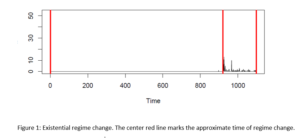
              The most drastic forms of regime change are existential. Figure 1 shows an example of an existential change: There was no demand at all for a long time, then suddenly there was demand. If you had no demand for an item because it didn’t exist but you retain zero demand values in your database, and then the item goes live and you do have sales, the transition from nothing to something is an extreme regime change. Including all those zero demand values from before “Day One” is sure to bias statistical forecasts down below where they should be. The same thing happens if you kill off a product but keep recording zero demand: Including all those recent zeros degrades your demand forecasts.

              In principle, careful record keeping should eliminate these problems. You should record only meaningful zero values. If you have a new item, start recording when it goes live. If you no longer have any demand for an item and expect none, purge it from your database, or at least forecast zero demand.

              Unfortunately, there is a difference between principle and practice. We see many instances in which the data records for both new and dormant items are not properly kept, with “fake zeros” confounded with “real zeros”. This problem is not necessarily the result of incompetence: Usually, it is a byproduct of the scale of the problem, with too few people trying to keep track of too many items.

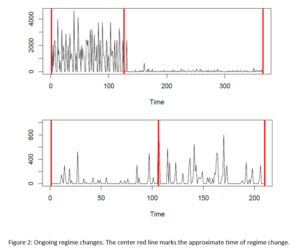
              These existential regime changes are relatively easy to deal with compared to more subtle forms, which appear to afflict more items. Figure 2 shows two examples of regime changes in a pattern of ongoing sales. There are any number of factors that can change the demand for an item: salesforce performance, marketing and advertising efforts, competitor and supplier actions, new customers arising or old customers disappearing, etc. If demand for an item has been chugging along at a steady 1 unit per day but suddenly doubles (or vice versa), that’s a regime change. In the new world order, demand is 2 units/day and forecasts should reflect that. Instead, statistical forecasting algorithms will forecast too little demand if fed all the data, including that from before the regime change.

              How do you protect yourself from regime change? The answer is the same for the cruelest dictator or the most innocent demand planner: Intelligence. And because threats are many, the intelligence is best automated. Modern software systems have the capability to screen tens of thousands of items for signs of regime change. Then the software can call your attention to the problematic items and prompt you to designate which recent data to use in calculations. Or the software can automatically detect and correct for regime change, working quickly at a scale that would easily defeat any busy person working “by hand”.


              Leave a Comment

              Related Posts

              Innovating the OEM Aftermarket with AI-Driven Inventory Optimization

              Innovating the OEM Aftermarket with AI-Driven Inventory Optimization

              The aftermarket sector provides OEMs with a decisive advantage by offering a steady revenue stream and fostering customer loyalty through the reliable and timely delivery of service parts. However, managing inventory and forecasting demand in the aftermarket is fraught with challenges, including unpredictable demand patterns, vast product ranges, and the necessity for quick turnarounds. Traditional methods often fall short due to the complexity and variability of demand in the aftermarket. The latest technologies can analyze large datasets to predict future demand more accurately and optimize inventory levels, leading to better service and lower costs.

              Forecast-Based Inventory Management for Better Planning

              Forecast-Based Inventory Management for Better Planning

              Forecast-based inventory management, or MRP (Material Requirements Planning) logic, is a forward-planning method that helps businesses meet demand without overstocking or understocking. By anticipating demand and adjusting inventory levels, it maintains a balance between meeting customer needs and minimizing excess inventory costs. This approach optimizes operations, reduces waste, and enhances customer satisfaction.

              Make AI-Driven Inventory Optimization an Ally for Your Organization

              Make AI-Driven Inventory Optimization an Ally for Your Organization

              In this blog, we will explore how organizations can achieve exceptional efficiency and accuracy with AI-driven inventory optimization. Traditional inventory management methods often fall short due to their reactive nature and reliance on manual processes. Maintaining optimal inventory levels is fundamental for meeting customer demand while minimizing costs. The introduction of AI-driven inventory optimization can significantly reduce the burden of manual processes, providing relief to supply chain managers from tedious tasks.

              Recent Posts

              • Managing Spare Parts Inventory: Best PracticesManaging Spare Parts Inventory: Best Practices
                In this blog, we’ll explore several effective strategies for managing spare parts inventory, emphasizing the importance of optimizing stock levels, maintaining service levels, and using smart tools to aid in decision-making. Managing spare parts inventory is a critical component for businesses that depend on equipment uptime and service reliability. Unlike regular inventory items, spare parts often have unpredictable demand patterns, making them more challenging to manage effectively. An efficient spare parts inventory management system helps prevent stockouts that can lead to operational downtime and costly delays while also avoiding overstocking that unnecessarily ties up capital and increases holding costs. […]
              • 5 Ways to Improve Supply Chain Decision Speed5 Ways to Improve Supply Chain Decision Speed
                The promise of a digital supply chain has transformed how businesses operate. At its core, it can make rapid, data-driven decisions while ensuring quality and efficiency throughout operations. However, it's not just about having access to more data. Organizations need the right tools and platforms to turn that data into actionable insights. This is where decision-making becomes critical, especially in a landscape where new digital supply chain solutions and AI-driven platforms can support you in streamlining many processes within the decision matrix. […]
              • Two employees checking inventory in temporary storage in a distribution warehouse.12 Causes of Overstocking and Practical Solutions
                Managing inventory effectively is critical for maintaining a healthy balance sheet and ensuring that resources are optimally allocated. Here is an in-depth exploration of the main causes of overstocking, their implications, and possible solutions. […]
              • FAQ Mastering Smart IP&O for Better Inventory ManagementFAQ: Mastering Smart IP&O for Better Inventory Management.
                Effective supply chain and inventory management are essential for achieving operational efficiency and customer satisfaction. This blog provides clear and concise answers to some basic and other common questions from our Smart IP&O customers, offering practical insights to overcome typical challenges and enhance your inventory management practices. Focusing on these key areas, we help you transform complex inventory issues into strategic, manageable actions that reduce costs and improve overall performance with Smart IP&O. […]
              • 7 Key Demand Planning Trends Shaping the Future7 Key Demand Planning Trends Shaping the Future
                Demand planning goes beyond simply forecasting product needs; it's about ensuring your business meets customer demands with precision, efficiency, and cost-effectiveness. Latest demand planning technology addresses key challenges like forecast accuracy, inventory management, and market responsiveness. In this blog, we will introduce critical demand planning trends, including data-driven insights, probabilistic forecasting, consensus planning, predictive analytics, scenario modeling, real-time visibility, and multilevel forecasting. These trends will help you stay ahead of the curve, optimize your supply chain, reduce costs, and enhance customer satisfaction, positioning your business for long-term success. […]

                Inventory Optimization for Manufacturers, Distributors, and MRO

                • Managing Spare Parts Inventory: Best PracticesManaging Spare Parts Inventory: Best Practices
                  In this blog, we’ll explore several effective strategies for managing spare parts inventory, emphasizing the importance of optimizing stock levels, maintaining service levels, and using smart tools to aid in decision-making. Managing spare parts inventory is a critical component for businesses that depend on equipment uptime and service reliability. Unlike regular inventory items, spare parts often have unpredictable demand patterns, making them more challenging to manage effectively. An efficient spare parts inventory management system helps prevent stockouts that can lead to operational downtime and costly delays while also avoiding overstocking that unnecessarily ties up capital and increases holding costs. […]
                • Innovating the OEM Aftermarket with AI-Driven Inventory Optimization XLInnovating the OEM Aftermarket with AI-Driven Inventory Optimization
                  The aftermarket sector provides OEMs with a decisive advantage by offering a steady revenue stream and fostering customer loyalty through the reliable and timely delivery of service parts. However, managing inventory and forecasting demand in the aftermarket is fraught with challenges, including unpredictable demand patterns, vast product ranges, and the necessity for quick turnarounds. Traditional methods often fall short due to the complexity and variability of demand in the aftermarket. The latest technologies can analyze large datasets to predict future demand more accurately and optimize inventory levels, leading to better service and lower costs. […]
                • Future-Proofing Utilities. Advanced Analytics for Supply Chain OptimizationFuture-Proofing Utilities: Advanced Analytics for Supply Chain Optimization
                  Utilities in the electrical, natural gas, urban water, and telecommunications fields are all asset-intensive and reliant on physical infrastructure that must be properly maintained, updated, and upgraded over time. Maximizing asset uptime and the reliability of physical infrastructure demands effective inventory management, spare parts forecasting, and supplier management. A utility that executes these processes effectively will outperform its peers, provide better returns for its investors and higher service levels for its customers, while reducing its environmental impact. […]
                • Centering Act Spare Parts Timing Pricing and ReliabilityCentering Act: Spare Parts Timing, Pricing, and Reliability
                  In this article, we'll walk you through the process of crafting a spare parts inventory plan that prioritizes availability metrics such as service levels and fill rates while ensuring cost efficiency. We'll focus on an approach to inventory planning called Service Level-Driven Inventory Optimization. Next, we'll discuss how to determine what parts you should include in your inventory and those that might not be necessary. Lastly, we'll explore ways to enhance your service-level-driven inventory plan consistently. […]

                  Don’t Become a Victim of Your Forecast Models

                  The Smart Forecaster

                   Pursuing best practices in demand planning,

                  forecasting and inventory optimization

                  Quants and Financial Meltdowns

                  I spend much of my time developing new quantitative methods for statistical forecasting, demand forecasting and inventory optimization. For me, this is an engaging way to contribute to society. But I know that the most prudent way to do algorithm development is to stand a little to the side and cast a skeptical eye on my own work.

                  The need for this skepticism was highlighted for me recently as I read Scott Patterson’s book The Quants: How a New Breed of Math Whizzes Conquered Wall Street and Nearly Destroyed It (Crown Publishing, 2010). This book reviewed the “quants” whose complex financial models were largely responsible for the financial meltdown in 2007. As I read along and thought “What was wrong with these guys?” I began to wonder if we supply chain quants were guilty of some of the same sins.

                  Models versus Instincts

                  Generally, the supply chain field has lagged behind finance in terms of the use of statistical models. My university colleagues and I are chipping away at that, but we have a long way to go. Some supply chains are quite technically sophisticated, but many, perhaps more, are essentially managed as much by gut instinct as by the numbers. Is this avoidance of analytics safer than relying on models?

                  What makes gut instinct dangerous is that it is so amorphous. Everyone who works long in a job develops instincts, but longevity is not the same as wisdom. It is possible to learn all the wrong lessons over a long career. It is also possible to miss the chance to learn the right lessons because certain informative scenarios may never arise in one person’s career. It is also possible to have good days and bad days; even gurus can mess up. Gut instinct is also anti-productive, since all decisions have to pass through that one gut, which becomes an enterprise chokepoint. And Golden Guts eventually reach their Golden Years and take their Golden Watch and go off into a Golden Sunset; at that point, whatever expertise had been present has walked out the door.

                  In contrast, models have certain advantages. Relative to gut instinct, models are:

                  • Explicit: The theory of the supply chain operation is exposed for all to see.
                  • Adaptive: Because the theory is visible, it can be reviewed, critiqued, tested against data, and evolved.
                  • Consistent: Models may be more or less true, but they are not subject to day-to-day variability.
                  • Comprehensive: At least potentially, models can accumulate a wide range of empirical experience, including scenarios never encountered during any one person’s career.
                  • Instructive: Models are collections of relationships among variables. If the model’s “guts” are made visible, users can learn about those relationships.

                  Model Error

                  Nevertheless, despite all their virtues, models can also be wrong. In fact, that is a given. A constructive way to live with this is encoded in the famous aphorism by Dr. George Box, one of the best modelers of the last half century: “All models are wrong. Some are useful.”

                  The finance quants’ models were wrong by being oversimplified. They started with a quasi-religious belief in the efficiency of markets and developed statistical models that made certain assumptions that were more likely to be true of the physical world than the financial world. Among these were Normal distributions of changes in asset prices and independence of events across various corners of the market. They also assumed human rationality.

                  It should be a bit alarming that the Normal distribution and independence assumptions also underlie many of the models in supply chain software. In fact, there are alternative models of supply chain dynamics that do not require these simplifying assumptions, so this is an unnecessary risk being run by many, perhaps most, of the users of supply chain software.

                  But even with more robust and realistic model assumptions, there is no denying that model error is a constant risk. So, can you be victimized by your models? Of course you can.

                  Self-Protection: Look at the Data

                  Every supply chain professional who uses models, then, is subject to model risk. But unlike with decisions based on gut feel, decisions based on model calculations can be exposed and compared to real-world outcomes. Repeated checking is the best way to protect against model error, because it not only tests whether the model is realistic but also signals when it is time to update the model.

                  As noted above, a model is a set of functional relationships between key variables. Those relationships have parameters that tune the model to the current operating context. For instance, supply chain models often rely, in part, on estimates of demand volatility. Historical demand data are used to calculate numerical values for these parameters. If demand volatility changes, the model becomes obsolete and likely to produce inapt recommendations. Therefore, good practice demands frequent updates to model parameters.

                  Even when parameter values are current, there may still be trouble due to incorrect functional relationships. For example, consider the relationship between the mean and standard deviation of demand for spare parts. Generally speaking, the greater the average demand, the greater the demand volatility as measured by the standard deviation.

                  Now consider simplified “old school” models that describe spare part demand as a Poisson process. The Poisson process is widely useful and relatively simple, so it often shows up in Statistics 101 classes. Because of their relative simplicity, Poisson models are the white rats of supply chain analytics for spare parts, i.e., people do computer experiments and theory development based on the behavior of Poisson models of demand. For Poisson models, the standard deviation of demand equals the square root of the mean. However, when we look at our customers’ actual demand data, we discover that the actual relationship between the mean and standard deviation of demand is better described by a more general power-law relationship. Thus, the simple model may use accurate estimates of mean and standard deviation but still not accurately reflect their relationship. This in turn leads to incorrect recommendations about reorder points for spare parts. Checking real data is the best antidote to cavalier assumption-making.


                  What to Do Next

                  I do not sense that today’s supply chain models are on the brink of creating the kind of meltdown we saw in the start of the Great Recession. But those of us who are supply chain quants need to show more professional maturity than our financial colleagues. We need to not fall in love with our models, and we need to alert our customers to correct model hygiene.

                  So, model users, wash your hands frequently as we begin flu season, and wash your models thoroughly through hard data to be sure that the models you rely on are both up-to-date and grounded in reality. Both those steps will protect you from being victimized by your models and let you exploit their advantages over management by gut feel.

                  Appendix: Technical Tips

                  Supply chain analytics provide various types of outputs. In the realm of forecasting and demand planning, the obvious empirical check is to compare forecasts against the actual demand values that eventually reveal themselves. This same “forecast then check” approach can also be used in the generation of forecasts.  In the realm of inventory management, the models can build on forecasts to recommend policy choices, such as reorder points and order quantities or Min and Max values. There is a smart way to confirm the accuracy of recommendations of reorder points and Min’s.  See our blog The Right Forecast Accuracy Metric for Inventory Planning


                  Leave a Comment

                  Related Posts

                  Innovating the OEM Aftermarket with AI-Driven Inventory Optimization

                  Innovating the OEM Aftermarket with AI-Driven Inventory Optimization

                  The aftermarket sector provides OEMs with a decisive advantage by offering a steady revenue stream and fostering customer loyalty through the reliable and timely delivery of service parts. However, managing inventory and forecasting demand in the aftermarket is fraught with challenges, including unpredictable demand patterns, vast product ranges, and the necessity for quick turnarounds. Traditional methods often fall short due to the complexity and variability of demand in the aftermarket. The latest technologies can analyze large datasets to predict future demand more accurately and optimize inventory levels, leading to better service and lower costs.

                  Forecast-Based Inventory Management for Better Planning

                  Forecast-Based Inventory Management for Better Planning

                  Forecast-based inventory management, or MRP (Material Requirements Planning) logic, is a forward-planning method that helps businesses meet demand without overstocking or understocking. By anticipating demand and adjusting inventory levels, it maintains a balance between meeting customer needs and minimizing excess inventory costs. This approach optimizes operations, reduces waste, and enhances customer satisfaction.

                  Make AI-Driven Inventory Optimization an Ally for Your Organization

                  Make AI-Driven Inventory Optimization an Ally for Your Organization

                  In this blog, we will explore how organizations can achieve exceptional efficiency and accuracy with AI-driven inventory optimization. Traditional inventory management methods often fall short due to their reactive nature and reliance on manual processes. Maintaining optimal inventory levels is fundamental for meeting customer demand while minimizing costs. The introduction of AI-driven inventory optimization can significantly reduce the burden of manual processes, providing relief to supply chain managers from tedious tasks.

                  Recent Posts

                  • Managing Spare Parts Inventory: Best PracticesManaging Spare Parts Inventory: Best Practices
                    In this blog, we’ll explore several effective strategies for managing spare parts inventory, emphasizing the importance of optimizing stock levels, maintaining service levels, and using smart tools to aid in decision-making. Managing spare parts inventory is a critical component for businesses that depend on equipment uptime and service reliability. Unlike regular inventory items, spare parts often have unpredictable demand patterns, making them more challenging to manage effectively. An efficient spare parts inventory management system helps prevent stockouts that can lead to operational downtime and costly delays while also avoiding overstocking that unnecessarily ties up capital and increases holding costs. […]
                  • 5 Ways to Improve Supply Chain Decision Speed5 Ways to Improve Supply Chain Decision Speed
                    The promise of a digital supply chain has transformed how businesses operate. At its core, it can make rapid, data-driven decisions while ensuring quality and efficiency throughout operations. However, it's not just about having access to more data. Organizations need the right tools and platforms to turn that data into actionable insights. This is where decision-making becomes critical, especially in a landscape where new digital supply chain solutions and AI-driven platforms can support you in streamlining many processes within the decision matrix. […]
                  • Two employees checking inventory in temporary storage in a distribution warehouse.12 Causes of Overstocking and Practical Solutions
                    Managing inventory effectively is critical for maintaining a healthy balance sheet and ensuring that resources are optimally allocated. Here is an in-depth exploration of the main causes of overstocking, their implications, and possible solutions. […]
                  • FAQ Mastering Smart IP&O for Better Inventory ManagementFAQ: Mastering Smart IP&O for Better Inventory Management.
                    Effective supply chain and inventory management are essential for achieving operational efficiency and customer satisfaction. This blog provides clear and concise answers to some basic and other common questions from our Smart IP&O customers, offering practical insights to overcome typical challenges and enhance your inventory management practices. Focusing on these key areas, we help you transform complex inventory issues into strategic, manageable actions that reduce costs and improve overall performance with Smart IP&O. […]
                  • 7 Key Demand Planning Trends Shaping the Future7 Key Demand Planning Trends Shaping the Future
                    Demand planning goes beyond simply forecasting product needs; it's about ensuring your business meets customer demands with precision, efficiency, and cost-effectiveness. Latest demand planning technology addresses key challenges like forecast accuracy, inventory management, and market responsiveness. In this blog, we will introduce critical demand planning trends, including data-driven insights, probabilistic forecasting, consensus planning, predictive analytics, scenario modeling, real-time visibility, and multilevel forecasting. These trends will help you stay ahead of the curve, optimize your supply chain, reduce costs, and enhance customer satisfaction, positioning your business for long-term success. […]

                    Inventory Optimization for Manufacturers, Distributors, and MRO

                    • Managing Spare Parts Inventory: Best PracticesManaging Spare Parts Inventory: Best Practices
                      In this blog, we’ll explore several effective strategies for managing spare parts inventory, emphasizing the importance of optimizing stock levels, maintaining service levels, and using smart tools to aid in decision-making. Managing spare parts inventory is a critical component for businesses that depend on equipment uptime and service reliability. Unlike regular inventory items, spare parts often have unpredictable demand patterns, making them more challenging to manage effectively. An efficient spare parts inventory management system helps prevent stockouts that can lead to operational downtime and costly delays while also avoiding overstocking that unnecessarily ties up capital and increases holding costs. […]
                    • Innovating the OEM Aftermarket with AI-Driven Inventory Optimization XLInnovating the OEM Aftermarket with AI-Driven Inventory Optimization
                      The aftermarket sector provides OEMs with a decisive advantage by offering a steady revenue stream and fostering customer loyalty through the reliable and timely delivery of service parts. However, managing inventory and forecasting demand in the aftermarket is fraught with challenges, including unpredictable demand patterns, vast product ranges, and the necessity for quick turnarounds. Traditional methods often fall short due to the complexity and variability of demand in the aftermarket. The latest technologies can analyze large datasets to predict future demand more accurately and optimize inventory levels, leading to better service and lower costs. […]
                    • Future-Proofing Utilities. Advanced Analytics for Supply Chain OptimizationFuture-Proofing Utilities: Advanced Analytics for Supply Chain Optimization
                      Utilities in the electrical, natural gas, urban water, and telecommunications fields are all asset-intensive and reliant on physical infrastructure that must be properly maintained, updated, and upgraded over time. Maximizing asset uptime and the reliability of physical infrastructure demands effective inventory management, spare parts forecasting, and supplier management. A utility that executes these processes effectively will outperform its peers, provide better returns for its investors and higher service levels for its customers, while reducing its environmental impact. […]
                    • Centering Act Spare Parts Timing Pricing and ReliabilityCentering Act: Spare Parts Timing, Pricing, and Reliability
                      In this article, we'll walk you through the process of crafting a spare parts inventory plan that prioritizes availability metrics such as service levels and fill rates while ensuring cost efficiency. We'll focus on an approach to inventory planning called Service Level-Driven Inventory Optimization. Next, we'll discuss how to determine what parts you should include in your inventory and those that might not be necessary. Lastly, we'll explore ways to enhance your service-level-driven inventory plan consistently. […]