Managing the Inventory of Promoted Items

The Smart Forecaster

 Pursuing best practices in demand planning,

forecasting and inventory optimization

In a previous post, I discussed one of the thornier problems demand planners sometimes face: working with product demand data characterized by what statisticians call skewness — a situation that can necessitate costly inventory investments. This sort of problematic data is found in several different scenarios. In at least one, the combination of intermittent demand and very effective sales promotions, the problem lends itself to an effective solution.

Reviewing terms, recall that “service level” is the probability of not stocking out while waiting for a replenishment order to arrive, while “fill rate” is the percentage of demand that is satisfied immediately from stock. In my previous post, “The Scourge of Skewness”, I pointed out that a certain type of demand distribution, having a “long right tail”, will lead to fill rates that can be much lower than service levels. I also pointed out that sometimes the only way to improve the fill rate is to increase the target service level to an unusually high level, which can be expensive.

In this post, I’ll look at solving the problem in one special case: skewness resulting from effective sales promotions mixed with “intermittent demand”. Intermittent demand has a large proportion of zero values, with nonzero values mixed in at random. Successful sales promotions, obviously positive, have a downside: they can confuse the “demand signal” with spikes in your demand history, and can undermine forecasts and bias safety stock calculations. When intermittent demand and effective sales promotions are the source of your data’s skewness, methods exist to work around the problem to achieve both higher fill rates and more accurate demand forecasts.

How Promotions Increase Skewness

Successful promotions abruptly increase item demand. This creates anomalies, or “outliers”, which contribute to forming a skewed distribution. Knowing when promotions occurred in the past, we can adjust an item’s record of past demand. We produce an alternate demand history as if there had been no promotions, by replacing the outliers with values more representative of the “natural” level of demand. These adjustments reduce demand skewness. Reduced skewness can lead to significant reductions in both expected forecasts and safety stocks, which add together to form reorder points.

Successful promotions are likely to be repeated. When that happens, the promotion effects can be added in to demand forecasts to increase their accuracy. The effect of future promotions on inventory management will be to increase the risk of stockouts, so a sensible response is to work at the operational level to build up temporary supply, in a quantity keyed to the estimated impact of prior promotions on the effected items.
 

Using Event Modeling to Improve Demand Forecasting

It’s possible to model the impact of like events, and apply this to planned events in the future. Doing so can improve your forecast in two big ways: by projecting the demand jolt you expect from a planned event; and rationalizing the spikes in the past that were caused by events, making your baseline activity more visible and more accurately forecastable. We do a lot of this in SmartForecasts, so allow me to use our experience there to show you what I mean.

Event Modeling entails the following steps:
• Automatically estimating the impact of previous promotions (which is a useful result in itself).
• Adjusting historical demand to statistically remove the effect of promotions.
• Creating promotion-free forecasts.
• Revising the forecasts for any future time periods in which promotions are planned.

We call this this type of analysis “Promo forecasting”. We use the word “promotions” to describe what you do yourself to improve your results. We use “events” to describe what the world does to you, usually to your detriment; examples include strikes, power outages, warehouse fires and other unlucky happenings.

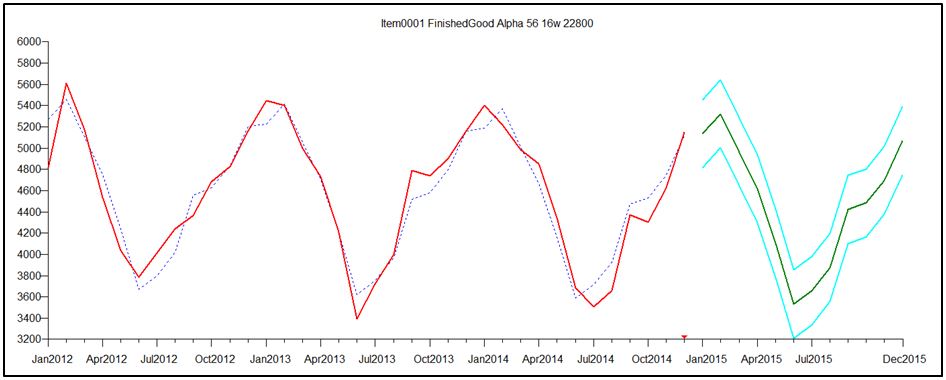
To understand how Event Modeling can help you cope with skewness when doing demand forecasting for high-volume items, consider Figures 1-3.
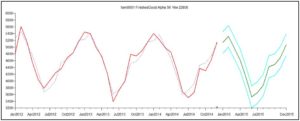
Figure 1 shows that this item’s demand pattern is clearly seasonal, and the forecast is both seasonal and “tight”, meaning that the forecast uncertainty interval (“margin of error”, shown in cyan lines) is very narrow.
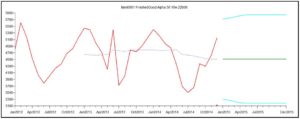
Figure 2 shows an alternative history in which a promotion in June 2014 reversed the usual seasonal low associated with June sales. This demand pattern was forecasted using the Automatic forecasting tournament in SmartForecasts, as in Figure 1. This time, the promotion scrambled the seasonal pattern enough to create an inappropriate non-seasonal forecast, and one that has a much larger margin of error.
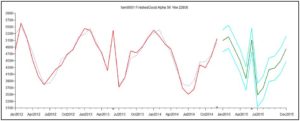
Finally, Figure 3 shows how Promo forecasting handles the same promoted scenario, retaining a seasonal forecast and building into the forecast an estimate of the effect of a planned repeat promotion in 2015.

The Case of Intermittent Demand

In Figure 1, the item was a high-volume finished good and the task was demand forecasting. Promo modeling is also useful when dealing with the task of setting safety stocks and reorder points for items with intermittent demand, whether the items are finished goods, components or spare parts. Intermittent demand very often has a skewed distribution that makes it difficult to achieve high item availability with a small investment in inventory.
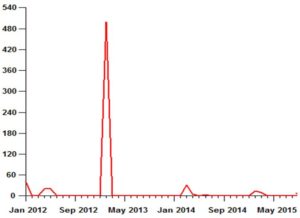
Figure 4 illustrates the problem that a successful promotion can accidentally create for inventory management. If such a spike arises from the natural, un-promoted demand, then the only way to maintain high fill rates is to provide safety stocks large enough to cope with these random surges. In this case, the big spike in demand of 500 units in February 2013 was the result of a one-time promotion.

Taking Account of Promotions to Improve Inventory Management

Unwittingly treating the spike in the example above as part of the natural demand variability results in a poor fill rate. To achieve a target service level of, say, 95% with a lead time of one month would require a reorder point of 38 units, computed as the sum of an expected forecast over the one month replenishment lead time of 21 units supplemented by a safety stock of 17 units. This investment would result in a disappointing fill rate of only 36%.

However, recognizing that the spike is a one-time promotion and replacing the 500 units with 0 obviously would make a big difference. The reorder point would drop from 38 units to 31 (the sum of an expected demand of 7 units and a safety stock of 24 units) and the fill rate would increase to 94%.

Of course, it is not ok to just throw out inconvenient demand spikes whenever they make life uncomfortable; there has to be a valid “business story” behind the adjustment of historical demand. If the spike is the result of a data processing error, then by all means, fix it. If the spike coincides with a promotion, then replacing the spike with, say, the median demand (often zero, as in this example) will result in a much more sustainable inventory investment that still meets aggressive performance targets. Future promotions of the same type on the same item will require some extra effort to prepare for the temporary surge in demand, but the recommended reorder point will be correct in the long run.

Thomas Willemain, PhD, co-founded Smart Software and currently serves as Senior Vice President for Research. Dr. Willemain also serves as Professor Emeritus of Industrial and Systems Engineering at Rensselear Polytechnic Institute and as a member of the research staff at the Center for Computing Sciences, Institute for Defense Analyses.

Leave a Comment

Related Posts

Reveal Your Real Inventory Planning and Forecasting Policy by Answering These 10 Questions

Reveal Your Real Inventory Planning and Forecasting Policy by Answering These 10 Questions

In this blog, we review 10 specific questions you can ask to uncover what’s really happening with the inventory planning and demand forecasting policy at your company. We detail the typical answers provided when a forecasting/inventory planning policy doesn’t really exist, explain how to interpret these answers, and offer some clear advice on what to do about it.

Riding the Tradeoff Curve

Riding the Tradeoff Curve

In the supply chain planning world, the most fundamental decision is how to balance item availability against the cost of maintaining that availability (service levels and fill rates). At one extreme, you can grossly overstock and never run out until you go broke and have to close up shop from sinking all your cash into inventory that doesn’t sell.

Quantum Inventory Theory?

Quantum Inventory Theory?

Physics at the quantum level is quite weird – not at all like what we experience in our usual macroscopic life. Among the oddities are “superposition”, “entanglement”, and “quantum foam.”  Weird as these phenomena are, I cannot help seeing analogs in the supposedly different world of supply chain management.

Recent Posts

  • Managing Spare Parts Inventory: Best PracticesManaging Spare Parts Inventory: Best Practices
    In this blog, we’ll explore several effective strategies for managing spare parts inventory, emphasizing the importance of optimizing stock levels, maintaining service levels, and using smart tools to aid in decision-making. Managing spare parts inventory is a critical component for businesses that depend on equipment uptime and service reliability. Unlike regular inventory items, spare parts often have unpredictable demand patterns, making them more challenging to manage effectively. An efficient spare parts inventory management system helps prevent stockouts that can lead to operational downtime and costly delays while also avoiding overstocking that unnecessarily ties up capital and increases holding costs. […]

  • 5 Ways to Improve Supply Chain Decision Speed5 Ways to Improve Supply Chain Decision Speed
    The promise of a digital supply chain has transformed how businesses operate. At its core, it can make rapid, data-driven decisions while ensuring quality and efficiency throughout operations. However, it's not just about having access to more data. Organizations need the right tools and platforms to turn that data into actionable insights. This is where decision-making becomes critical, especially in a landscape where new digital supply chain solutions and AI-driven platforms can support you in streamlining many processes within the decision matrix. […]

  • Two employees checking inventory in temporary storage in a distribution warehouse.12 Causes of Overstocking and Practical Solutions
    Managing inventory effectively is critical for maintaining a healthy balance sheet and ensuring that resources are optimally allocated. Here is an in-depth exploration of the main causes of overstocking, their implications, and possible solutions. […]

  • FAQ Mastering Smart IP&O for Better Inventory ManagementFAQ: Mastering Smart IP&O for Better Inventory Management.
    Effective supply chain and inventory management are essential for achieving operational efficiency and customer satisfaction. This blog provides clear and concise answers to some basic and other common questions from our Smart IP&O customers, offering practical insights to overcome typical challenges and enhance your inventory management practices. Focusing on these key areas, we help you transform complex inventory issues into strategic, manageable actions that reduce costs and improve overall performance with Smart IP&O. […]

  • 7 Key Demand Planning Trends Shaping the Future7 Key Demand Planning Trends Shaping the Future
    Demand planning goes beyond simply forecasting product needs; it's about ensuring your business meets customer demands with precision, efficiency, and cost-effectiveness. Latest demand planning technology addresses key challenges like forecast accuracy, inventory management, and market responsiveness. In this blog, we will introduce critical demand planning trends, including data-driven insights, probabilistic forecasting, consensus planning, predictive analytics, scenario modeling, real-time visibility, and multilevel forecasting. These trends will help you stay ahead of the curve, optimize your supply chain, reduce costs, and enhance customer satisfaction, positioning your business for long-term success. […]

    Inventory Optimization for Manufacturers, Distributors, and MRO

    • Managing Spare Parts Inventory: Best PracticesManaging Spare Parts Inventory: Best Practices
      In this blog, we’ll explore several effective strategies for managing spare parts inventory, emphasizing the importance of optimizing stock levels, maintaining service levels, and using smart tools to aid in decision-making. Managing spare parts inventory is a critical component for businesses that depend on equipment uptime and service reliability. Unlike regular inventory items, spare parts often have unpredictable demand patterns, making them more challenging to manage effectively. An efficient spare parts inventory management system helps prevent stockouts that can lead to operational downtime and costly delays while also avoiding overstocking that unnecessarily ties up capital and increases holding costs. […]

    • Innovating the OEM Aftermarket with AI-Driven Inventory Optimization XLInnovating the OEM Aftermarket with AI-Driven Inventory Optimization
      The aftermarket sector provides OEMs with a decisive advantage by offering a steady revenue stream and fostering customer loyalty through the reliable and timely delivery of service parts. However, managing inventory and forecasting demand in the aftermarket is fraught with challenges, including unpredictable demand patterns, vast product ranges, and the necessity for quick turnarounds. Traditional methods often fall short due to the complexity and variability of demand in the aftermarket. The latest technologies can analyze large datasets to predict future demand more accurately and optimize inventory levels, leading to better service and lower costs. […]

    • Future-Proofing Utilities. Advanced Analytics for Supply Chain OptimizationFuture-Proofing Utilities: Advanced Analytics for Supply Chain Optimization
      Utilities in the electrical, natural gas, urban water, and telecommunications fields are all asset-intensive and reliant on physical infrastructure that must be properly maintained, updated, and upgraded over time. Maximizing asset uptime and the reliability of physical infrastructure demands effective inventory management, spare parts forecasting, and supplier management. A utility that executes these processes effectively will outperform its peers, provide better returns for its investors and higher service levels for its customers, while reducing its environmental impact. […]
    • Centering Act Spare Parts Timing Pricing and ReliabilityCentering Act: Spare Parts Timing, Pricing, and Reliability
      In this article, we'll walk you through the process of crafting a spare parts inventory plan that prioritizes availability metrics such as service levels and fill rates while ensuring cost efficiency. We'll focus on an approach to inventory planning called Service Level-Driven Inventory Optimization. Next, we'll discuss how to determine what parts you should include in your inventory and those that might not be necessary. Lastly, we'll explore ways to enhance your service-level-driven inventory plan consistently. […]
      Riding the Tradeoff Curve

      The Smart Forecaster

       Pursuing best practices in demand planning,

      forecasting and inventory optimization

      What We’re Up Against

      As a third-generation Boston Red Sox fan, I’m disinclined to take advice from any New York Yankee ballplayer, even a great one but have to agree that sometimes, you just need to make a decision.   However, wouldn’t it be better if we knew the tradeoffs associated with each decision. Perhaps one road is more scenic but takes longer while the other is more direct but boring. Then you wouldn’t have to simply “take it” but could make an informed decision based on the advantages/disadvantages of each approach.

      In the supply chain planning world, the most fundamental decision is how to balance item availability against the cost of maintaining that availability (service levels and fill rates). At one extreme, you can grossly overstock and never run out until you go broke and have to close up shop from sinking all your cash into inventory that doesn’t sell.  At the other extreme, you can grossly understock and save a bundle on inventory holding costs but go broke and have to close up shop because all your customers took their business elsewhere.

      There is no escaping this fundamental tension. They way to survive and thrive is to find a productive and sustainable balance. To do that requires fact-based tradeoffs based on the numbers. To get the numbers requires software.

      The general drift of things is obvious. If you decide to keep more inventory, you will have more Holding Costs, lower Shortage Costs, and possibly lower Ordering Costs. Whether this costs or saves money is impossible to know without some sophisticated analysis, but usually the result is that the Total Cost goes up. But if you do invest in more inventory, something will be gained, because you will offer your customers higher Service Levels and Fill Rates. How much higher requires, as you might guess, some sophisticated analysis.

      Show Me the Numbers

      This blog lays out what such an analysis looks like. There is no universal solution pointing you to the “right” decision. You might think that the right decision is the one that does best by your bottom line. But to get those numbers, you would need something rarely seen: an accurate model of customer behavior with regard to service level (check out our article “How to choose a target service level”) For example, at what point will a customer walk away and take their business elsewhere?  Will it be after you stock out 1% of the time, 5% of time, 10% of the time? Will you still keep their business as long as you fill back orders quickly?  Will it be after a back order of 1 day, 2 days? 3 weeks? Will it be after this happens one time on one an important part or many times across many parts?  While modeling the precise service level that will allow you to keep your customer while minimizing costs seems like an unapproachable ideal, another type of sophisticated analysis is more pragmatic. 

      Inventory optimization and forecasting software can factor all associated costs such as the cost of stocking out, cost of holding inventory, and cost of ordering inventory in order to prescribe an optimal service level target that yields the lowest total cost. However, even that “optimal” service level is sensitive to changes in the costs making the results potentially questionable.  For example, if you don’t accurately estimate the precise costs (shortage costs are the most difficult) it will be tough to definitely state something like “If I increase my on-hand inventory by an average of one unit for all items in an important product family, my company will see a net gain of $170,500.  That gain increases until I get to 4 units.  At 4 units and higher, the return declines due to excessive holding costs. So, the best decision factoring projected holding, ordering, and stockout is to increase inventory by 3 units to see a net gain of over $500,000.  

      Short of that ideal, you can do something that is simpler yet still extremely valuable: Quantify the tradeoff curve between inventory cost and item availability. While you won’t necessarily know the service level you should target, you will know the costs of varying service levels.  Then you can earn your big bucks by finding a good place to be on that tradeoff curve and communicating where you at risk, where you aren’t, and setting expectations with customers and internal stakeholders.  Without the tradeoff curve to guide you, you are flying blind with no way to rationally modify stocking policy.

      A Scenario to Learn From

      Let’s sketch out a realistic tradeoff curve. We start with a scenario requiring a management decision. The scenario we will use and associated assumptions about demand, lead times, and costs are detailed below:

      Inventory Policy

      • Periodic review – Reorder decisions made every 30 days
      • Order-Up-To-Level (“S”) – Varied from 30 to 60 units
      • Shortage Policy – Allow backorders, no lost orders

      Demand

      • Demand is intermittent
      • Average = 0.8 units per day
      • Standard deviation = 1.2 units per day
      • Largest demand in a year ≈ 9
      • % of days with no demand = 53%

      Lead Time

      • Random at either 7, 14 or 21 days with probabilities 70%, 20% and 10%, respectively

      Cost Parameters

      • Holding cost = $1 per day
      • Ordering Cost = $10 per order without regard to size of order
      • Shortage Cost = $100 per unit not immediately shipped from stock

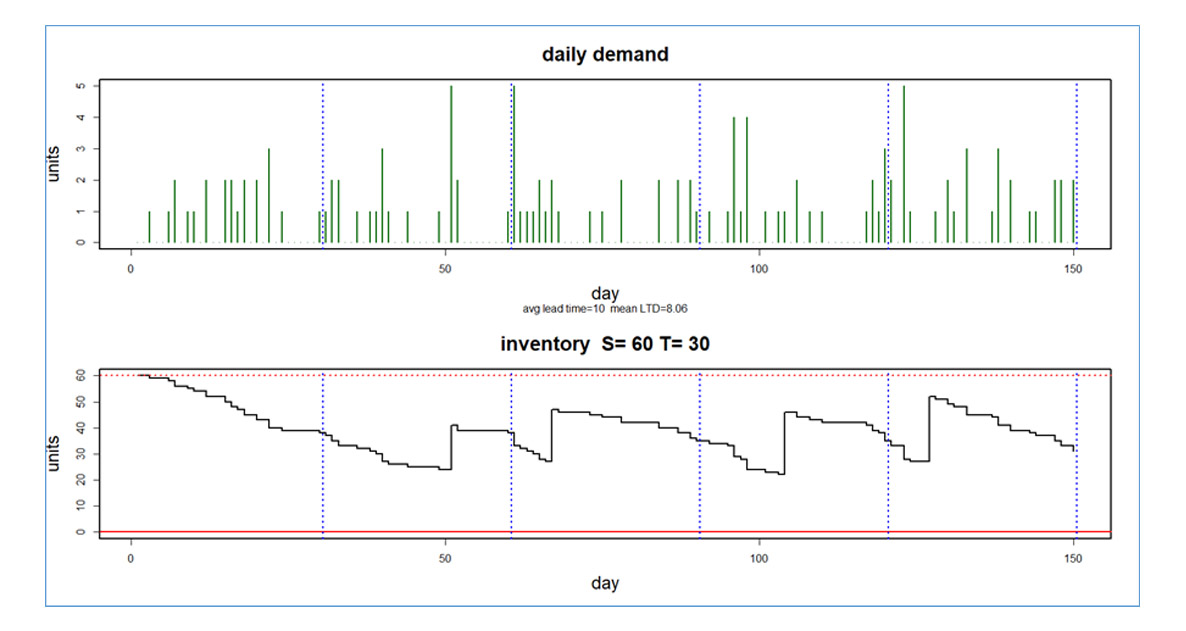
      We imagine an inventory control policy that is known in the trade as a “periodic review” or (T,S) policy. In this instance, the Review Period (“T”) is 30 days, meaning that every 30 days the inventory position is checked and an ordering decision is made. The order quantity is the difference between the observed number of units on hand and the Order-Up-To Quantity (“S”). So, if the end-of-month inventory is 12 units and S = 20, the order quantity would be S – 12 = 20 -1 2 = 8. The next month, the order quantity is likely to be different. If the inventory ever goes negative (backorders) during a review period, the next order tries to restore equilibrium by ordering more in order to fill those backorders. For example, if the inventory is -5 (meaning 5 units ordered by not available for shipping, the next order would be S – (-5) = S + 5. Details of the hypothetical demand stream, supplier lead times, and cost elements are shown in Figure 1 below. Figure 2 show a sample of daily demand and daily inventory over five review periods. Demand is intermittent, as is often true for spare parts, and therefore difficult to plan for.

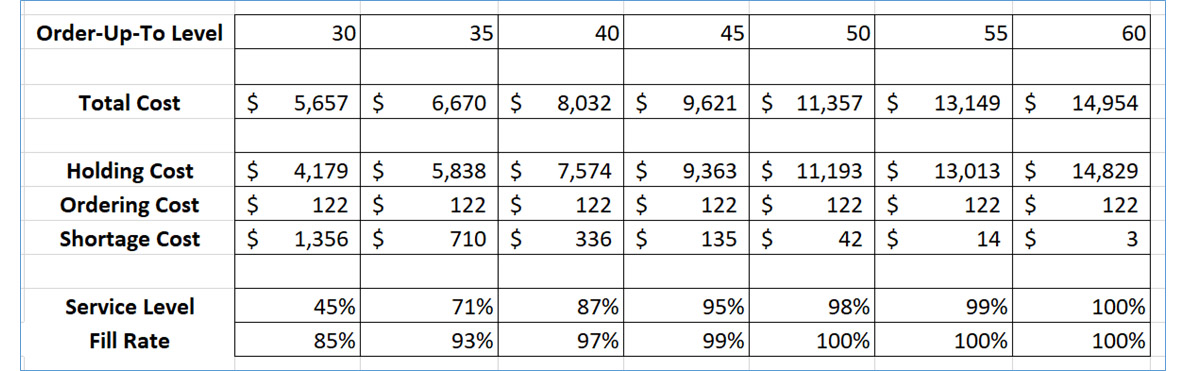
      Figure 1: Different choices of inventory policy (order up to), associated costs, and service levels

      Figure 2: Details of five months of system operation given one of the polices


      Inventory Planning Software Is Our Friend

      Software encodes the logic of the operation of the (T,S) system, generates many hypothetical but realistic demand scenarios, calculates how each of those scenarios plays out, then looks back on the simulated operation (here, 10 years or 3,650 consecutive days) to calculate cost and performance metrics.

      To reveal the tradeoff curve, we ran several computational experiments in which we varied the Order-Up-To Level, S. The plots Figure 2 show the behavior of the on-hand inventory in “richest” alternative with S = 60. In the snippet shown in Figure 2, the on-hand inventory never comes close to stocking out. You can read that too ways. One, a bit naïve, is to say “Good, we’re well protected.” The other, more aggressive, is to say, “Oh no, we’re bloated. I wonder what would happen if we reduced S.”

      The Tradeoff Curve Revealed

      Figure 3 shows the results of reducing S from 60 down to 30 in steps of 5 units. The table shows that Total Cost is the sum of Holding Cost, Ordering Cost, and Shortage Cost. For the (T,S) policy, the ordering cost is always the same, since an order is placed like clockwork every 30 days. But the other components of cost respond to the changes in S.

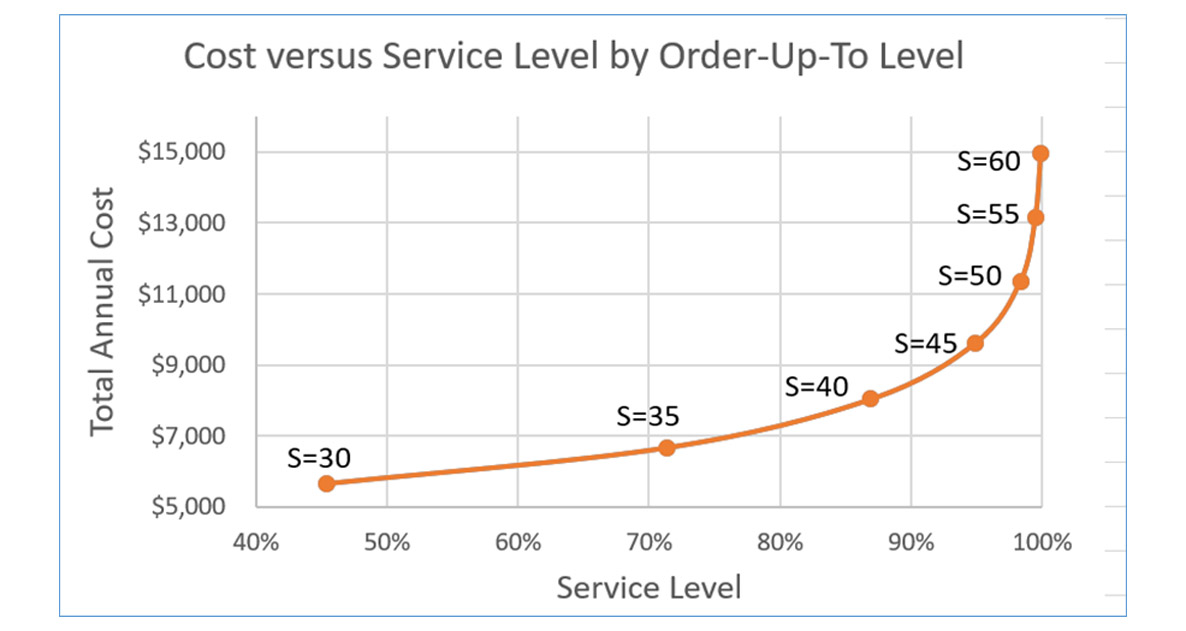
      Figure 3: The experimental results and corresponding tradeoff curve showing how changing the Order-Up-To Level (“S”) impacts both Service Level and Total Annual Cost

      Note that the Service Level is always lower than the Fill Rate in these scenarios. As a professor, I always think of this difference in terms of exam grading. Each replenishment cycle is like a test. Service Level is about the probability of a stockout, so it’s a like the grade on pass/fail exam with one question that must be answered perfectly. If there is no stockout in a cycle, that’s an A. If there is a stockout, that’s an F. It doesn’t matter if it’s one unit that’s not supplied or 50 – it’s still an F. But Fill Rate is like a question that is graded with partial credit. So being short one of ten units gets you 90% Fill Rate for that cycle, not 0%. It’s important to understand the difference between these two important metrics for inventory planning – check out this vlog describing service level vs. fill rate via an interactive exercise in Excel.

      The plot in Figure 3 is the real news. It pairs Total Cost and Service Level for various levels of S. If you read the graph right to left, it tells us that there are dramatic cost savings to be had by reducing S with very little penalty in terms of reduced item availability. For instance, reducing S from 60 to 55 saves close to $800 per year on this one item while reducing service level just a bit from (essentially) 100% to a still-impressive 99%. Cutting S some more does the same, though not as dramatically. If you read the graph left to right, you see that moving up from S = 30 to S = 35 costs about $1,000 per year but improves Service Level from an F grade (45%) to at least a C grade (71%). After that, pushing S higher costs progressively more while gaining progressive less.

      The tradeoff curve doesn’t give you an answer to how to set the Order-Up-To Level, but it does let you evaluate the costs and benefits of each possible answer. Take a minute and pretend that this is your problem: Where would you want to be along the tradeoff curve?

      You may object and say you hate your choices and want to change the game. Is there escape from the curve? Not from the general curve, but you might be able to shape a less painful curve. How?

      You may have other cards to play. One avenue is to try to “shape” the demand so that it is less variable. The demand plot in Figure 2 shows a lot of variability. If you could smooth out the demand, the whole tradeoff curve would shift down, making every choice less expensive. A second avenue is to try to reduce the mean and variability of supplier lead times. Achieving either would also shift the curve down to make the choice less painful. Check out our article on how suppliers influence your inventory costs

      Summary

      The tradeoff curve is always with us. Sometimes we may be able to make it more friendly, but we always to pick our spot along it. It is better to know what you’re getting for any choice of inventory policy than to try to guess, and the curve gives you that.  When you have an accurate estimate of that curve, you are no longer flying blind when it comes to inventory planning. 


      Leave a Comment

      Related Posts

      Demand Forecasting in a “Build to Order” Company

      Demand Forecasting in a “Build to Order” Company

      We often come into contact with potential customers who claim that they cannot use a forecasting system since they are a “build-to-order” manufacturing operation. I find this a puzzling perspective, because whatever these organizations build requires lower level raw materials or intermediate goods. If those lower level inputs are not available when an order for the finished good is received, the order cannot be built. Consequently, the order could be canceled and the associated revenue lost.

      3 Types of Supply Chain Analytics

      3 Types of Supply Chain Analytics

      The three types of supply chain analytics are “descriptive”, “predictive”, and “prescriptive.” Each plays a different role in helping you manage your inventory. Modern supply chain software lets you exploit all three helping you to reduce inventory costs, improve on time delivery and service levels, while running a more efficient supply chain.

      A Check on Forecast Automation with the Attention Index

      A Check on Forecast Automation with the Attention Index

      A new metric we call the “Attention Index” will help forecasters identify situations where “data behaving badly” can distort automatic statistical forecasts (see adjacent poem). It quickly identifies those items most likely to require forecast overrides—providing a more efficient way to put business experience and other human intelligence to work maximizing the accuracy of forecasts. How does it work?

      Recent Posts

      • Managing Spare Parts Inventory: Best PracticesManaging Spare Parts Inventory: Best Practices
        In this blog, we’ll explore several effective strategies for managing spare parts inventory, emphasizing the importance of optimizing stock levels, maintaining service levels, and using smart tools to aid in decision-making. Managing spare parts inventory is a critical component for businesses that depend on equipment uptime and service reliability. Unlike regular inventory items, spare parts often have unpredictable demand patterns, making them more challenging to manage effectively. An efficient spare parts inventory management system helps prevent stockouts that can lead to operational downtime and costly delays while also avoiding overstocking that unnecessarily ties up capital and increases holding costs. […]
      • 5 Ways to Improve Supply Chain Decision Speed5 Ways to Improve Supply Chain Decision Speed
        The promise of a digital supply chain has transformed how businesses operate. At its core, it can make rapid, data-driven decisions while ensuring quality and efficiency throughout operations. However, it's not just about having access to more data. Organizations need the right tools and platforms to turn that data into actionable insights. This is where decision-making becomes critical, especially in a landscape where new digital supply chain solutions and AI-driven platforms can support you in streamlining many processes within the decision matrix. […]
      • Two employees checking inventory in temporary storage in a distribution warehouse.12 Causes of Overstocking and Practical Solutions
        Managing inventory effectively is critical for maintaining a healthy balance sheet and ensuring that resources are optimally allocated. Here is an in-depth exploration of the main causes of overstocking, their implications, and possible solutions. […]
      • FAQ Mastering Smart IP&O for Better Inventory ManagementFAQ: Mastering Smart IP&O for Better Inventory Management.
        Effective supply chain and inventory management are essential for achieving operational efficiency and customer satisfaction. This blog provides clear and concise answers to some basic and other common questions from our Smart IP&O customers, offering practical insights to overcome typical challenges and enhance your inventory management practices. Focusing on these key areas, we help you transform complex inventory issues into strategic, manageable actions that reduce costs and improve overall performance with Smart IP&O. […]
      • 7 Key Demand Planning Trends Shaping the Future7 Key Demand Planning Trends Shaping the Future
        Demand planning goes beyond simply forecasting product needs; it's about ensuring your business meets customer demands with precision, efficiency, and cost-effectiveness. Latest demand planning technology addresses key challenges like forecast accuracy, inventory management, and market responsiveness. In this blog, we will introduce critical demand planning trends, including data-driven insights, probabilistic forecasting, consensus planning, predictive analytics, scenario modeling, real-time visibility, and multilevel forecasting. These trends will help you stay ahead of the curve, optimize your supply chain, reduce costs, and enhance customer satisfaction, positioning your business for long-term success. […]

        Inventory Optimization for Manufacturers, Distributors, and MRO

        • Managing Spare Parts Inventory: Best PracticesManaging Spare Parts Inventory: Best Practices
          In this blog, we’ll explore several effective strategies for managing spare parts inventory, emphasizing the importance of optimizing stock levels, maintaining service levels, and using smart tools to aid in decision-making. Managing spare parts inventory is a critical component for businesses that depend on equipment uptime and service reliability. Unlike regular inventory items, spare parts often have unpredictable demand patterns, making them more challenging to manage effectively. An efficient spare parts inventory management system helps prevent stockouts that can lead to operational downtime and costly delays while also avoiding overstocking that unnecessarily ties up capital and increases holding costs. […]
        • Innovating the OEM Aftermarket with AI-Driven Inventory Optimization XLInnovating the OEM Aftermarket with AI-Driven Inventory Optimization
          The aftermarket sector provides OEMs with a decisive advantage by offering a steady revenue stream and fostering customer loyalty through the reliable and timely delivery of service parts. However, managing inventory and forecasting demand in the aftermarket is fraught with challenges, including unpredictable demand patterns, vast product ranges, and the necessity for quick turnarounds. Traditional methods often fall short due to the complexity and variability of demand in the aftermarket. The latest technologies can analyze large datasets to predict future demand more accurately and optimize inventory levels, leading to better service and lower costs. […]
        • Future-Proofing Utilities. Advanced Analytics for Supply Chain OptimizationFuture-Proofing Utilities: Advanced Analytics for Supply Chain Optimization
          Utilities in the electrical, natural gas, urban water, and telecommunications fields are all asset-intensive and reliant on physical infrastructure that must be properly maintained, updated, and upgraded over time. Maximizing asset uptime and the reliability of physical infrastructure demands effective inventory management, spare parts forecasting, and supplier management. A utility that executes these processes effectively will outperform its peers, provide better returns for its investors and higher service levels for its customers, while reducing its environmental impact. […]
        • Centering Act Spare Parts Timing Pricing and ReliabilityCentering Act: Spare Parts Timing, Pricing, and Reliability
          In this article, we'll walk you through the process of crafting a spare parts inventory plan that prioritizes availability metrics such as service levels and fill rates while ensuring cost efficiency. We'll focus on an approach to inventory planning called Service Level-Driven Inventory Optimization. Next, we'll discuss how to determine what parts you should include in your inventory and those that might not be necessary. Lastly, we'll explore ways to enhance your service-level-driven inventory plan consistently. […]
          How to Tell You Don’t Really Have an Inventory Planning and Forecasting Policy

          The Smart Forecaster

           Pursuing best practices in demand planning,

          forecasting and inventory optimization

          You can’t properly manage your inventory levels, let alone optimize them, if you don’t have a handle on exactly how demand forecasts and stocking parameters (such as Min/Max, safety stocks, and reorder points, and order quantities) are determined.

          Many organizations cannot specify how policy inputs are calculated or identify situations calling for management overrides to the policy.   For example, many people can say they rely on a particular planning method such as Min/Max, reorder point, or forecast with safety stock, but they can’t say exactly how these planning inputs are calculated.  More fundamentally, they may not understand what would happen to their KPI’s if they were to change Min,Max, or Safety Stock. They may know that the forecast relies on “averages” or “history” or “sales input”, but specific details about how the final forecast is arrived at are unclear.

          Often enough, a company’s inventory planning and forecasting logic was developed by a former employee or vanished consultant and entombed in a spreadsheet.  It otherwise may rely on outdated ERP functionality or ERP customization by an IT organization that incorrectly assumed that ERP software can and should do everything. (Read this great and, as they say, “funny because it’s true,” blog by Shaun Snapp about ERP Centric Strategies.)  The policy may not have been properly documented, and no one currently on the job can improve it or use it to best advantage.

          This unhappy situation leads to another, in which buyers and inventory planners flat out ignore the output from the ERP system, forcing reliance on Microsoft Excel to determine order schedules.  Ad hoc methods are developed that impede cohesive responses to operational issues and aren’t visible to the rest of the organization (unless you want your CFO to learn the complex and finicky spreadsheet).  These methods often rely on rules of thumb, averaging techniques, or textbook statistics without a full understanding of their shortcomings or applicability.  And even when documented, most companies often discover that actual ordering strays from the documented policy.  One company we consulted for had on hand inventory levels that were routinely 2 x’s the Max quantity!  In other words, there isn’t really a policy at all.

          In summary, many current inventory and demand forecast “systems” were developed out of distrust for the previous system’s suggestions but don’t actually improve KPI’s.  They also force the organization to rely on a few employees to manage demand forecasting, daily ordering, and inventory replenishment.

          And when there is a problem, it is impossible for the executive team to unwind how you got there, because there are too many moving parts.  For example, was the excess stock the fault of an inaccurate demand forecast that relied on an averaging method that didn’t account for a declining demand?  Or was it due to an outdated lead time setting that was higher than it should’ve been?  Or was it due to a forecast override a planner made to account for an order that just never happened?  And who gave the feedback to make that override?  A customer? Salesperson?

          Do you have any of these problems?  If so, you are wasting hundreds of thousands to millions of dollars each year in unnecessary shortage costs, holding costs, and ordering costs.  What would you be able to do with that extra cash?  Imagine the impact that this would have on your business.

          This blog details the top 10 questions that you can ask in order to uncover what’s really happening at your company.  We detail the typical answers provided when a forecasting/inventory planning policy doesn’t really exist, explain how to interpret these answers, and offer some clear advice on what to do about it.


          Leave a Comment

          Related Posts

          Demand Forecasting in a “Build to Order” Company

          Demand Forecasting in a “Build to Order” Company

          We often come into contact with potential customers who claim that they cannot use a forecasting system since they are a “build-to-order” manufacturing operation. I find this a puzzling perspective, because whatever these organizations build requires lower level raw materials or intermediate goods. If those lower level inputs are not available when an order for the finished good is received, the order cannot be built. Consequently, the order could be canceled and the associated revenue lost.

          3 Types of Supply Chain Analytics

          3 Types of Supply Chain Analytics

          The three types of supply chain analytics are “descriptive”, “predictive”, and “prescriptive.” Each plays a different role in helping you manage your inventory. Modern supply chain software lets you exploit all three helping you to reduce inventory costs, improve on time delivery and service levels, while running a more efficient supply chain.

          A Check on Forecast Automation with the Attention Index

          A Check on Forecast Automation with the Attention Index

          A new metric we call the “Attention Index” will help forecasters identify situations where “data behaving badly” can distort automatic statistical forecasts (see adjacent poem). It quickly identifies those items most likely to require forecast overrides—providing a more efficient way to put business experience and other human intelligence to work maximizing the accuracy of forecasts. How does it work?

          Recent Posts

          • Managing Spare Parts Inventory: Best PracticesManaging Spare Parts Inventory: Best Practices
            In this blog, we’ll explore several effective strategies for managing spare parts inventory, emphasizing the importance of optimizing stock levels, maintaining service levels, and using smart tools to aid in decision-making. Managing spare parts inventory is a critical component for businesses that depend on equipment uptime and service reliability. Unlike regular inventory items, spare parts often have unpredictable demand patterns, making them more challenging to manage effectively. An efficient spare parts inventory management system helps prevent stockouts that can lead to operational downtime and costly delays while also avoiding overstocking that unnecessarily ties up capital and increases holding costs. […]
          • 5 Ways to Improve Supply Chain Decision Speed5 Ways to Improve Supply Chain Decision Speed
            The promise of a digital supply chain has transformed how businesses operate. At its core, it can make rapid, data-driven decisions while ensuring quality and efficiency throughout operations. However, it's not just about having access to more data. Organizations need the right tools and platforms to turn that data into actionable insights. This is where decision-making becomes critical, especially in a landscape where new digital supply chain solutions and AI-driven platforms can support you in streamlining many processes within the decision matrix. […]
          • Two employees checking inventory in temporary storage in a distribution warehouse.12 Causes of Overstocking and Practical Solutions
            Managing inventory effectively is critical for maintaining a healthy balance sheet and ensuring that resources are optimally allocated. Here is an in-depth exploration of the main causes of overstocking, their implications, and possible solutions. […]
          • FAQ Mastering Smart IP&O for Better Inventory ManagementFAQ: Mastering Smart IP&O for Better Inventory Management.
            Effective supply chain and inventory management are essential for achieving operational efficiency and customer satisfaction. This blog provides clear and concise answers to some basic and other common questions from our Smart IP&O customers, offering practical insights to overcome typical challenges and enhance your inventory management practices. Focusing on these key areas, we help you transform complex inventory issues into strategic, manageable actions that reduce costs and improve overall performance with Smart IP&O. […]
          • 7 Key Demand Planning Trends Shaping the Future7 Key Demand Planning Trends Shaping the Future
            Demand planning goes beyond simply forecasting product needs; it's about ensuring your business meets customer demands with precision, efficiency, and cost-effectiveness. Latest demand planning technology addresses key challenges like forecast accuracy, inventory management, and market responsiveness. In this blog, we will introduce critical demand planning trends, including data-driven insights, probabilistic forecasting, consensus planning, predictive analytics, scenario modeling, real-time visibility, and multilevel forecasting. These trends will help you stay ahead of the curve, optimize your supply chain, reduce costs, and enhance customer satisfaction, positioning your business for long-term success. […]

            Inventory Optimization for Manufacturers, Distributors, and MRO

            • Managing Spare Parts Inventory: Best PracticesManaging Spare Parts Inventory: Best Practices
              In this blog, we’ll explore several effective strategies for managing spare parts inventory, emphasizing the importance of optimizing stock levels, maintaining service levels, and using smart tools to aid in decision-making. Managing spare parts inventory is a critical component for businesses that depend on equipment uptime and service reliability. Unlike regular inventory items, spare parts often have unpredictable demand patterns, making them more challenging to manage effectively. An efficient spare parts inventory management system helps prevent stockouts that can lead to operational downtime and costly delays while also avoiding overstocking that unnecessarily ties up capital and increases holding costs. […]
            • Innovating the OEM Aftermarket with AI-Driven Inventory Optimization XLInnovating the OEM Aftermarket with AI-Driven Inventory Optimization
              The aftermarket sector provides OEMs with a decisive advantage by offering a steady revenue stream and fostering customer loyalty through the reliable and timely delivery of service parts. However, managing inventory and forecasting demand in the aftermarket is fraught with challenges, including unpredictable demand patterns, vast product ranges, and the necessity for quick turnarounds. Traditional methods often fall short due to the complexity and variability of demand in the aftermarket. The latest technologies can analyze large datasets to predict future demand more accurately and optimize inventory levels, leading to better service and lower costs. […]
            • Future-Proofing Utilities. Advanced Analytics for Supply Chain OptimizationFuture-Proofing Utilities: Advanced Analytics for Supply Chain Optimization
              Utilities in the electrical, natural gas, urban water, and telecommunications fields are all asset-intensive and reliant on physical infrastructure that must be properly maintained, updated, and upgraded over time. Maximizing asset uptime and the reliability of physical infrastructure demands effective inventory management, spare parts forecasting, and supplier management. A utility that executes these processes effectively will outperform its peers, provide better returns for its investors and higher service levels for its customers, while reducing its environmental impact. […]
            • Centering Act Spare Parts Timing Pricing and ReliabilityCentering Act: Spare Parts Timing, Pricing, and Reliability
              In this article, we'll walk you through the process of crafting a spare parts inventory plan that prioritizes availability metrics such as service levels and fill rates while ensuring cost efficiency. We'll focus on an approach to inventory planning called Service Level-Driven Inventory Optimization. Next, we'll discuss how to determine what parts you should include in your inventory and those that might not be necessary. Lastly, we'll explore ways to enhance your service-level-driven inventory plan consistently. […]
              Smart Software VP of Research to Present at ISF 2018
              Dr. Tom Willemain to lead ISF session on Time Series Dissaggregation Belmont, Mass., May 14, 2018 – Smart Software, Inc., provider of industry-leading demand forecasting, planning, and inventory optimization solutions, today announced that Tom Willemain, vice president for research, will present at the International Symposium of Forecasting from June 17 – 20 in Boulder, CO. Dr. Willemain, will present a tutorial on Time Series Dissaggregation and how the approaches he’ll outline can improve the quality of demand forecasts.  Imagine that you must provide daily forecast results but can only obtain historical demand at monthly or weekly levels.   Often times, granular demand data is not available.  How do you proceed?  Converting aggregate quarterly, monthly, or weekly data to daily data is example of the time series dissaggregation problem. Dr. Willemain will discuss current solutions to this problem and press an improved solution. As the premier, international forecasting conference, the ISF provides the opportunity to interact with the world’s leading forecasting researchers and practitioners. The attendance is large enough so that the best in the field are attracted, yet small enough that you are able to meet and discuss one-on-one. The ISF offers a variety of networking opportunities, through keynote speaker presentations, academic sessions, workshops, meals, and social programs. In addition, representatives of leading publishing, software, and other related companies are on hand to discuss their most recent offerings. About Dr. Thomas Willemain Dr. Thomas Reed Willemain served as an Expert Statistical Consultant to the National Security Agency (NSA) at Ft. Meade, MD and as a member of the Adjunct Research Staff at an affiliated think-tank, the Institute for Defense Analyses Center for Computing Sciences (IDA/CCS). He is Professor Emeritus of Industrial and Systems Engineering at Rensselaer Polytechnic Institute, having previously held faculty positions at Harvard’s Kennedy School of Government and Massachusetts Institute of Technology. He is also co-founder and Senior Vice President/Research at Smart Software, Inc. He is a member of the Association of Former Intelligence Officers, the Military Operations Research Society, the American Statistical Association, and several other professional organizations. Willemain received the BSE degree (summa cum laude, Phi Beta Kappa) from Princeton University and the MS and PhD degrees from Massachusetts Institute of Technology. His other books include: Statistical Methods for Planners, Emergency Medical Systems Analysis (with R. C. Larson), and 80 articles in peer-reviewed journals on topics in statistics, operations research, health care and other topics. For more information, email: TomW@SmartCorp.com or visit www.TomWillemain.com. About Smart Software, Inc. Founded in 1981, Smart Software, Inc. is a leader in providing businesses with enterprise-wide demand forecasting, planning and inventory optimization solutions.  Smart Software’s demand forecasting and inventory optimization solutions have helped thousands of users worldwide, including customers at mid-market enterprises and Fortune 500 companies, such as Mitsubishi, Siemens, Disney, FedEx, MARS, and The Home Depot.  Smart Inventory Planning & Optimization gives demand planners the tools to handle sales seasonality, promotions, new and aging products, multi-dimensional hierarchies, and intermittently demanded service parts and capital goods items.  It also provides inventory managers with accurate estimates of the optimal inventory and safety stock required to meet future orders and achieve desired service levels.  Smart Software is headquartered in Belmont, Massachusetts and can be found at www.smartcorp.com SmartForecasts is a registered trademark of Smart Software, Inc.  All other trademarks are the property of their respective owners.
              For more information, please contact Smart Software, Inc., Four Hill Road, Belmont, MA 02478. Phone: 1-800-SMART-99 (800-762-7899); FAX: 1-617-489-2748; E-mail: info@smartcorp.com
              Forecasting and the Rising Tide of Big Data

              The Smart Forecaster

               Pursuing best practices in demand planning,

              forecasting and inventory optimization

              “Trillions of records of millions of people…Finding the useful and right information, understanding its quality and producing reliable analyzed data in a timely and cost-effective manner are all critical issues.”

              Smart Software Senior Vice President for Research Tom Willemain recently had the opportunity to talk with Dr. Mohsen Hamoudia, President of the International Institute of Forecasters (IIF), to discuss current issues with, and opportunities for, big data analytics. The IIF informs practitioners on trends and research developments in forecasting via print and online publications and the hosting of professional conferences.

              Dr. Hamoudia begins, by way of introduction:

              In all industries, data availability is exploding in volume, variety and velocity. Big data analytics is playing an important role in identifying the data that is most important to the business.

              Let me take the example of the Information and Communication Technology (ICT) sector. We are seeing literally exponential growth in the amount of data available to telecoms, Over-the-top (OTT) independent content distributors, government, regulators and other organizations.

              Around the world, we are witnessing petabytes of data: trillions of records of millions of people—all coming from multiple sources. Among these sources: internet connections, sales, customer contact centers, social media, mobile and land lines data. Finding the useful and right information, understanding its quality and producing reliable analyzed data in a timely and cost-effective manner are all critical issues. ICT companies are increasingly looking to find actionable insights in their data. How they can increase their customer base and loyalty programs? How can they improve the quality of service (QoS) and reduce customer turnover? With the right big data analytics platforms in place, they can be more competitive and efficient, improving operations, customer service and risk management. Forecasting and predicting customer trends and directions are key for telecoms.

              Forecasting skills, including mathematics, statistics and econometrics, form one of the most important “blocks” of required skills in managing Big Data. Some forecasting activities naturally form part of the big data debate.

              In retail industries, forecasting addresses daily demand across thousands of products. Financial forecasting, whether considering customer behavior or financial data series, generates massive on-line data sets. As pointed out by Robert Fildes, Distinguished Professor at Lancaster University, as yet the academic forecasting community is not thoroughly engaged—with only a few exceptions. Hal Varian of Google has looked at some of the work that David Hendry and Jennifer Castle, at Oxford University, have undertaken on searching large data sets for data congruent meaningful models. Stock and Watson have also developed their own approaches to large macro data sets. But despite the attempt, at last year’s symposium on forecasting in Seoul, to explore the theme of big data and its forecasting applications, there remain few convincing applications of using on-line data on real forecasting problems.

              Q. One hears a great deal about “predictive analytics” these days, yet the phrase rarely is linked with forecasting. Do you agree that forecasting lies at the heart of predictive analytics? Have you an explanation for why the link has been broken? Have you ideas about how to re-inject forecasting into the conversation?

              The results of forecasting (the “what”) are perhaps now perceived as less important than the “how”. Consequently, the trust that users give to traditional forecasting has declined. Who indeed is challenging the accuracy or relevance of forecasting by comparing, a posteriori, the reality vs. forecast—making a case for metholodiges’ effectiveness and therefor building credibility?

              With the current perception of “predictive analytics”, there is probably more space in the public imagination allocated to the “how” side of things, and therefor a more credible story to tell to partners, investors or customers.

              Q. It appears that there is almost no link between traditional forecasting and mobile technology (smart phones, tablet computers). Is this true, or are some companies migrating forecasting to mobile devices? Do you see a path forward in which traditional forecasting algorithms would routinely reside on mobile devices?

              First of all, I am really delighted to invite your readers to have a look at our latest issue of Foresight. An excellent paper on the subject, “Forecasting In the Pocket: Mobile Devices Can Improve Collaboration”, explains that “the increasing popularity of PDAs, smartphones, tablet computers and other mobile devices opens up new opportunities for communication and collaboration on business forecasts.” The authors tell us “mobile forecasting (m-forecasting) applications may streamline approaches to collaboration between retailers and suppliers, thus contributing to the provision and exchange of product information, especially since forecasts are strongly tied to local context knowledge.”

              For example, on the ICT & OTT side, a large number of predictive projects, such as those of Google+ and Facebook, are happening thanks to the inclusion of the “user location” data in the OTT IT systems. In my opinion, and what I see in some sectors like retail and logistics, is that traditional forecasting and mobile forecasting (m-forecasting) are complementary. This latter could be seen as a bottom-up forecasting approach that will or will not confirm the top-down forecasting results.

              Q. Some people argue that big data will facilitate the replacement of forecasting with “sense and react” systems. Practically speaking, how would you explain “sense and react”, and are there application areas where you think it is or is not likely to take hold?

              It seems to me that “sense and react” is fully oriented to the short-term perspective. Forecasting extends this by addressing needs for a variable horizon: short-term and medium-term.

              As a side effect of ATAWAD (Anytime, Anywhere, Any Device), the decision-making criteria are, more than ever, “short term”. Big data is a “weak signals” sensing system, which enable the near-real-time detection of business opportunities that would go unnoticed with traditional IT systems. There are not really preferred or non-priority applications for this, the question is more on the “when” side.

              Big data is relevant when looking below the surface in difficult economic times, but I am less sure whether it is worth the effort in “normal” economic period. To conclude on this point: I will be happy to see an example on how accurate are forecasts which are based on “sense and react” versus forecast based on traditional models.

              Q. I’m asking some big questions. To what extent do you see the IIF community shaping these discussions and outcomes? How can readers join in the dialogue?

              We are expecting an increasing availability, and increasing usage, of huge amount of data in many industries—such as energy, transportation, health care, finance, telecommunications and tourism.

              Many of the IIF’s members are engaged in different aspects of the big data “movement.” The IIF is doing some work in the forecasting activities that naturally form part of the big data debate. More generally, the IIF is actively participating in, and providing a forum for, the discussion of forecasting in the wider world.

              The theme of our last International Symposium on Forecasting (ISF) held in Seoul was “Forecasting with Big Data” and a few presentations were related to health care and telecommunications. A relevant workshop has just been run by the European Central Bank (ECB). If these models are capitalized on, they have the potential to impact the economic policy of Europe quite quickly.

              Readers can join in the dialogue by contributing papers to the IIF’s publications (The International Journal of Forecasting, Foresight and The Oracle). Foresight, for one, is an invaluable voice in bringing academics and practitioners together in an ongoing discussion.

              Readers also can present papers at the annual conference (the aforementioned ISF). They also can suggest and organize specific workshops for specific applications of big data, like the one that was just organized by the ECB in Frankfurt. Another opportunity is to invite IIF’s members to attend any meeting related to forecasting with big data. All these opportunities form good platforms for networking and working together.

              Mohsen Hamoudia, PhD, is the President of the International Institute of Forecasters. He also serves as Head of Strategy for Large Projects (Paris) for Orange Business Services (the former France Telecom).

              Thomas Willemain, PhD, co-founded Smart Software and currently serves as Senior Vice President for Research. Dr. Willemain also serves as Professor Emeritus of Industrial and Systems Engineering at Rensselear Polytechnic Institute, and as a member of the research staff at the Center for Computing Sciences, Institute for Defense Analyses.

              Leave a Comment

              Related Posts

              A Check on Forecast Automation with the Attention Index

              A Check on Forecast Automation with the Attention Index

              A new metric we call the “Attention Index” will help forecasters identify situations where “data behaving badly” can distort automatic statistical forecasts (see adjacent poem). It quickly identifies those items most likely to require forecast overrides—providing a more efficient way to put business experience and other human intelligence to work maximizing the accuracy of forecasts. How does it work?

              Handling Extreme Supply Chain Variability at Rev-A-Shelf

              Handling Extreme Supply Chain Variability at Rev-A-Shelf

              Does your extended supply chain suffer from extreme seasonal variability? Does this situation challenge your ability to meet service level commitments to your customers? I have grappled with this at Rev-A-Shelf, addressing unusual conditions created by Chinese New Year and other global events, and would like to share the experience and a few things I learned along the way.

              Recommended Resource: ‘Practical Time Series Forecasting: A Hands-On Guide’, by Galit Schmueli

              Recommended Resource: ‘Practical Time Series Forecasting: A Hands-On Guide’, by Galit Schmueli

              A readable, well-organized textbook could be invaluable to “help corporate forecasters-in-training understand the basics of time series forecasting,” as Tom Willemain notes in the conclusion to this review, originally published in Foresight: The International Journal of Applied Forecasting. Principally written for an academic audience, the review also serves inexperienced demand planning professionals by pointing them to an in-depth resource.

              Recent Posts

              • Managing Spare Parts Inventory: Best PracticesManaging Spare Parts Inventory: Best Practices
                In this blog, we’ll explore several effective strategies for managing spare parts inventory, emphasizing the importance of optimizing stock levels, maintaining service levels, and using smart tools to aid in decision-making. Managing spare parts inventory is a critical component for businesses that depend on equipment uptime and service reliability. Unlike regular inventory items, spare parts often have unpredictable demand patterns, making them more challenging to manage effectively. An efficient spare parts inventory management system helps prevent stockouts that can lead to operational downtime and costly delays while also avoiding overstocking that unnecessarily ties up capital and increases holding costs. […]
              • 5 Ways to Improve Supply Chain Decision Speed5 Ways to Improve Supply Chain Decision Speed
                The promise of a digital supply chain has transformed how businesses operate. At its core, it can make rapid, data-driven decisions while ensuring quality and efficiency throughout operations. However, it's not just about having access to more data. Organizations need the right tools and platforms to turn that data into actionable insights. This is where decision-making becomes critical, especially in a landscape where new digital supply chain solutions and AI-driven platforms can support you in streamlining many processes within the decision matrix. […]
              • Two employees checking inventory in temporary storage in a distribution warehouse.12 Causes of Overstocking and Practical Solutions
                Managing inventory effectively is critical for maintaining a healthy balance sheet and ensuring that resources are optimally allocated. Here is an in-depth exploration of the main causes of overstocking, their implications, and possible solutions. […]
              • FAQ Mastering Smart IP&O for Better Inventory ManagementFAQ: Mastering Smart IP&O for Better Inventory Management.
                Effective supply chain and inventory management are essential for achieving operational efficiency and customer satisfaction. This blog provides clear and concise answers to some basic and other common questions from our Smart IP&O customers, offering practical insights to overcome typical challenges and enhance your inventory management practices. Focusing on these key areas, we help you transform complex inventory issues into strategic, manageable actions that reduce costs and improve overall performance with Smart IP&O. […]
              • 7 Key Demand Planning Trends Shaping the Future7 Key Demand Planning Trends Shaping the Future
                Demand planning goes beyond simply forecasting product needs; it's about ensuring your business meets customer demands with precision, efficiency, and cost-effectiveness. Latest demand planning technology addresses key challenges like forecast accuracy, inventory management, and market responsiveness. In this blog, we will introduce critical demand planning trends, including data-driven insights, probabilistic forecasting, consensus planning, predictive analytics, scenario modeling, real-time visibility, and multilevel forecasting. These trends will help you stay ahead of the curve, optimize your supply chain, reduce costs, and enhance customer satisfaction, positioning your business for long-term success. […]

                Inventory Optimization for Manufacturers, Distributors, and MRO

                • Managing Spare Parts Inventory: Best PracticesManaging Spare Parts Inventory: Best Practices
                  In this blog, we’ll explore several effective strategies for managing spare parts inventory, emphasizing the importance of optimizing stock levels, maintaining service levels, and using smart tools to aid in decision-making. Managing spare parts inventory is a critical component for businesses that depend on equipment uptime and service reliability. Unlike regular inventory items, spare parts often have unpredictable demand patterns, making them more challenging to manage effectively. An efficient spare parts inventory management system helps prevent stockouts that can lead to operational downtime and costly delays while also avoiding overstocking that unnecessarily ties up capital and increases holding costs. […]
                • Innovating the OEM Aftermarket with AI-Driven Inventory Optimization XLInnovating the OEM Aftermarket with AI-Driven Inventory Optimization
                  The aftermarket sector provides OEMs with a decisive advantage by offering a steady revenue stream and fostering customer loyalty through the reliable and timely delivery of service parts. However, managing inventory and forecasting demand in the aftermarket is fraught with challenges, including unpredictable demand patterns, vast product ranges, and the necessity for quick turnarounds. Traditional methods often fall short due to the complexity and variability of demand in the aftermarket. The latest technologies can analyze large datasets to predict future demand more accurately and optimize inventory levels, leading to better service and lower costs. […]
                • Future-Proofing Utilities. Advanced Analytics for Supply Chain OptimizationFuture-Proofing Utilities: Advanced Analytics for Supply Chain Optimization
                  Utilities in the electrical, natural gas, urban water, and telecommunications fields are all asset-intensive and reliant on physical infrastructure that must be properly maintained, updated, and upgraded over time. Maximizing asset uptime and the reliability of physical infrastructure demands effective inventory management, spare parts forecasting, and supplier management. A utility that executes these processes effectively will outperform its peers, provide better returns for its investors and higher service levels for its customers, while reducing its environmental impact. […]
                • Centering Act Spare Parts Timing Pricing and ReliabilityCentering Act: Spare Parts Timing, Pricing, and Reliability
                  In this article, we'll walk you through the process of crafting a spare parts inventory plan that prioritizes availability metrics such as service levels and fill rates while ensuring cost efficiency. We'll focus on an approach to inventory planning called Service Level-Driven Inventory Optimization. Next, we'll discuss how to determine what parts you should include in your inventory and those that might not be necessary. Lastly, we'll explore ways to enhance your service-level-driven inventory plan consistently. […]