When implementing inventory optimization, don’t swing for the fences when a single will do!

The Smart Forecaster

 Pursuing best practices in demand planning,

forecasting and inventory optimization

When implementing inventory optimization, the pressure is on to get results.  As the Major League Baseball season starts it’s final stretch towards the playoffs, we thought this analogy might help enforce an important point about the pace of deploying a new inventory optimization process.


The Situation

It’s the bottom of the ninth and your team is down by a run.  You step up to the plate batting lead-off. With the roar of the crowd and excitement in the air, you are tempted to swing hard for that elusive home run.  As you dig into the batter’s box, you weigh the options and decide on a better approach: stay patient and do whatever you can to get one base.  You don’t try to hit a home run and focus on making good contact with the ball. You know that in this situation, a single will do.  By getting on base you help build team confidence.  Most importantly, you put the team in a better position to win the game than taking an aggressive but risky swing of the bat.

3 Reasons for a Progressive Approach to Inventory Optimization

When the pressure is on to optimize inventory, you might want to move fast much like the hitter who wants to hit that home run.  And in some cases, swinging for the fences might be the recommended approach.  More often than not, a progressive approach to inventory optimization is more effective.  Here are three reasons why:

  1. It builds user confidence and creates momentum
  2. Early success buys necessary time to get full management buy-in
  3. Corporate roll out of a new process requires progressive evidence of success


Industry Example

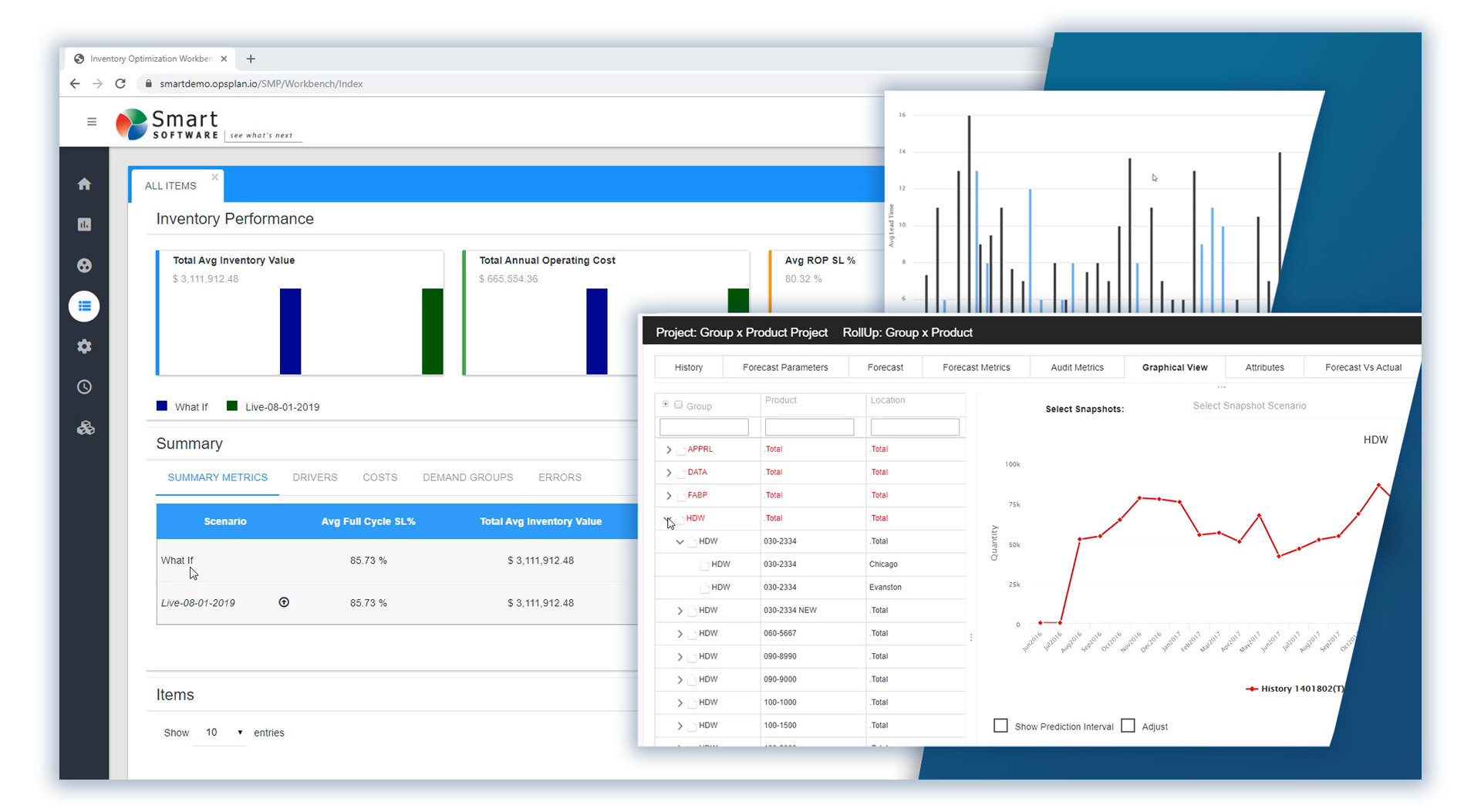
A case in point is a multinational company offering next day PC and electronic device repair services.  They never know what will come in for repair, but need to set inventory policy to meet their next day service commitment for thousands of parts, while keeping inventory to a minimum.  They’ve chosen our inventory optimization software to help and are in the process of implementing.  The planning team has taken this progressive approach, working brand by brand to set optimal reorder points and order quantities using Smart’s probability forecasting engine.  They selected one brand to illustrate the process and show results: starting with 26 items, they filtered out 14 parts with little or no demand history.  Assessing the remaining 12, they showed how to reduce inventory by $51,000 while increasing service levels.  While the $51,000 reduction was just a small proportion of the overall benefit, it was easily understood, and presenting it has helped gain support to build out their inventory optimization implementation, brand by brand across the company.

Confidence is Key

User confidence is key and this comes with mastering the use of the inventory optimization software and being able to present results.  So, too, is management confidence.  We have encountered situations where optimization scenarios have clearly shown opportunities for large inventory savings, but staff were reluctant to seize them.  Why?  Because they would be reducing inventory, and that felt risky.  Again, selecting a subset of items, working through the optimization process, and gaining the top-down management support to make the change made all the difference.  And they will substantially reduce their inventory as a result.

Inventory Optimization success comes with a motivated team, the right technology, and solid execution of a good plan.  A progressive approach to implementation reduces risk, validates the plan, and provides the foundation for an effective inventory planning and optimization program.

Download Smart Inventory Optimization product sheet here: https://smartcorp.com/inventory-optimization/
Leave a Comment

Related Posts

No Results Found

The page you requested could not be found. Try refining your search, or use the navigation above to locate the post.

Recent Posts

  • Managing Spare Parts Inventory: Best PracticesManaging Spare Parts Inventory: Best Practices
    In this blog, we’ll explore several effective strategies for managing spare parts inventory, emphasizing the importance of optimizing stock levels, maintaining service levels, and using smart tools to aid in decision-making. Managing spare parts inventory is a critical component for businesses that depend on equipment uptime and service reliability. Unlike regular inventory items, spare parts often have unpredictable demand patterns, making them more challenging to manage effectively. An efficient spare parts inventory management system helps prevent stockouts that can lead to operational downtime and costly delays while also avoiding overstocking that unnecessarily ties up capital and increases holding costs. […]

  • 5 Ways to Improve Supply Chain Decision Speed5 Ways to Improve Supply Chain Decision Speed
    The promise of a digital supply chain has transformed how businesses operate. At its core, it can make rapid, data-driven decisions while ensuring quality and efficiency throughout operations. However, it's not just about having access to more data. Organizations need the right tools and platforms to turn that data into actionable insights. This is where decision-making becomes critical, especially in a landscape where new digital supply chain solutions and AI-driven platforms can support you in streamlining many processes within the decision matrix. […]

  • Two employees checking inventory in temporary storage in a distribution warehouse.12 Causes of Overstocking and Practical Solutions
    Managing inventory effectively is critical for maintaining a healthy balance sheet and ensuring that resources are optimally allocated. Here is an in-depth exploration of the main causes of overstocking, their implications, and possible solutions. […]

  • FAQ Mastering Smart IP&O for Better Inventory ManagementFAQ: Mastering Smart IP&O for Better Inventory Management.
    Effective supply chain and inventory management are essential for achieving operational efficiency and customer satisfaction. This blog provides clear and concise answers to some basic and other common questions from our Smart IP&O customers, offering practical insights to overcome typical challenges and enhance your inventory management practices. Focusing on these key areas, we help you transform complex inventory issues into strategic, manageable actions that reduce costs and improve overall performance with Smart IP&O. […]

  • 7 Key Demand Planning Trends Shaping the Future7 Key Demand Planning Trends Shaping the Future
    Demand planning goes beyond simply forecasting product needs; it's about ensuring your business meets customer demands with precision, efficiency, and cost-effectiveness. Latest demand planning technology addresses key challenges like forecast accuracy, inventory management, and market responsiveness. In this blog, we will introduce critical demand planning trends, including data-driven insights, probabilistic forecasting, consensus planning, predictive analytics, scenario modeling, real-time visibility, and multilevel forecasting. These trends will help you stay ahead of the curve, optimize your supply chain, reduce costs, and enhance customer satisfaction, positioning your business for long-term success. […]

    Inventory Optimization for Manufacturers, Distributors, and MRO

    • Managing Spare Parts Inventory: Best PracticesManaging Spare Parts Inventory: Best Practices
      In this blog, we’ll explore several effective strategies for managing spare parts inventory, emphasizing the importance of optimizing stock levels, maintaining service levels, and using smart tools to aid in decision-making. Managing spare parts inventory is a critical component for businesses that depend on equipment uptime and service reliability. Unlike regular inventory items, spare parts often have unpredictable demand patterns, making them more challenging to manage effectively. An efficient spare parts inventory management system helps prevent stockouts that can lead to operational downtime and costly delays while also avoiding overstocking that unnecessarily ties up capital and increases holding costs. […]

    • Innovating the OEM Aftermarket with AI-Driven Inventory Optimization XLInnovating the OEM Aftermarket with AI-Driven Inventory Optimization
      The aftermarket sector provides OEMs with a decisive advantage by offering a steady revenue stream and fostering customer loyalty through the reliable and timely delivery of service parts. However, managing inventory and forecasting demand in the aftermarket is fraught with challenges, including unpredictable demand patterns, vast product ranges, and the necessity for quick turnarounds. Traditional methods often fall short due to the complexity and variability of demand in the aftermarket. The latest technologies can analyze large datasets to predict future demand more accurately and optimize inventory levels, leading to better service and lower costs. […]

    • Future-Proofing Utilities. Advanced Analytics for Supply Chain OptimizationFuture-Proofing Utilities: Advanced Analytics for Supply Chain Optimization
      Utilities in the electrical, natural gas, urban water, and telecommunications fields are all asset-intensive and reliant on physical infrastructure that must be properly maintained, updated, and upgraded over time. Maximizing asset uptime and the reliability of physical infrastructure demands effective inventory management, spare parts forecasting, and supplier management. A utility that executes these processes effectively will outperform its peers, provide better returns for its investors and higher service levels for its customers, while reducing its environmental impact. […]
    • Centering Act Spare Parts Timing Pricing and ReliabilityCentering Act: Spare Parts Timing, Pricing, and Reliability
      In this article, we'll walk you through the process of crafting a spare parts inventory plan that prioritizes availability metrics such as service levels and fill rates while ensuring cost efficiency. We'll focus on an approach to inventory planning called Service Level-Driven Inventory Optimization. Next, we'll discuss how to determine what parts you should include in your inventory and those that might not be necessary. Lastly, we'll explore ways to enhance your service-level-driven inventory plan consistently. […]


      Reveal Your Real Inventory Planning and Forecasting Policy by Answering These 10 Questions

      The Smart Forecaster

       Pursuing best practices in demand planning,

      forecasting and inventory optimization

      In our last blog we posed the question:  How can you be sure that you really have a policy for inventory planning and demand forecasting? We explained how an organization’s lack of understanding on the basics (how a forecast is created, how safety stock buffers are determined, and how/why these values are adjusted) contributes to poor forecast accuracy, misallocated inventory, and lack of trust in the whole process.

      In this blog, we review 10 specific questions you can ask to uncover what’s really happening at your company. We detail the typical answers provided when a forecasting/inventory planning policy doesn’t really exist, explain how to interpret these answers, and offer some clear advice on what to do about it.

      Always start with a simple hypothetical example. Focusing on a specific problem you just experienced is bound to provoke defensive answers that hide the full story. The goal is to uncover the actual approach used to plan inventory and forecasts that has been baked into the mental math or spreadsheets.   Here is an example:

      Suppose you have 100 units on hand, the lead time to replenish is 3 months, and the average monthly demand is 20 units?   When should you order more?  How much would you order? How will your answer change if expected receipts of 10 per month were scheduled to arrive?  How will your answer change if the item is the item is an A, B, or C item, the cost of the item is high or low, lead time of the item is long or short?  Simply put, when you schedule a production job or place a new order with a supplier, why did you do it? What triggered the decision to get more?  What planning inputs were considered?

      When getting answers to the above question, focus on uncovering answers to the following questions:

      1. What is the underlying replenishment approach? This will typically be one of Min/Max, forecast/safety stock, Reorder Point/Order Quantity, Periodic Review/Order Up To or even some odd combination

      2. How are the planning parameters, such as demand forecasts, reorder points, or Min/Max, actually calculated? It’s not enough to know that you use Min/Max.  You have to know exactly how these values are calculated. Answers such as “We use history” or “We use an average” are not specific enough.   You’ll need answers that clearly outline how history is used.  For example, “We take an average of the last 6 months, divide that by 30 to get a daily average, and then multiply that by the lead time in days.  For ‘A’ items we then multiply the lead time average by 2 and for ‘B’ items we use a multiplier of 1.5.” (While that is not an especially good technical approach, at least it has a clear logic.)

      Once you have a policy well-defined, you can identify its weaknesses in order to improve it.  But if the answer provided doesn’t get much further past “We use history”, then you don’t have a policy to start with.   Answers will often reveal that different planners use history in different ways.  Some may only consider the most recent demand, others might stock according to the average of the highest demand periods, etc.  In other words, you may find that you actually have multiple ill-conceived “policies”.

      3. Are forecasts used to drive replenishment planning and if so, how? Many companies will say they forecast, but their forecasts are calculated and used differently. Is the forecast used to predict what on hand inventory will be in the future, resulting in an order being triggered?  Or is it used to derive a reorder point but not to predict when to order (i.e. I predict we’ll sell 10 a week so to help protect against stock out, I’ll order more when on hand gets to 15)? Is it used as a guide for the planner to help subjectively determine when they should order more?  Is it used to set up blanket orders with suppliers?  Some use it to drive MRP. You’ll need to know these specifics.  A thorough answer to this question might look like this: “My forecast is 10 per week and my lead time is 3 weeks so I make my reorder point a multiple of that forecast, typically 2 x lead time demand or 60 unit for important items and I use a smaller multiple for less important items.  (Again, not a great technical approach, but clear.)

      4.  What technique is actually used to generate the forecast? Is it an average, a trending model such as double exponential smoothing, a seasonal model? Does the choice of technique change depend on the type of demand data or when new demand data is available? (Spare parts and high-volume items have very different demand patterns.) How do you go about selecting the forecast model? Is this process automated?  How often is the choice of model reconsidered?  How often are the model parameters recomputed? What is the process used to reconsider your approach?  The answer here documents how the baseline forecasts are produced.  Once determined, you can conduct an analysis to identify whether other forecasting methods would improve forecast accuracy.  If you aren’t documenting forecast accuracy and conducting “forecast value add” analysis then you aren’t in a position to properly assess whether the forecasts being produced are the best that they can be.  You’ll miss out on opportunities to improve the process, increase forecast accuracy, and educate the business on what type of forecast error is normal and should be expected.

      5. How do you use safety stock? Notice the question was not “Do you use safety stock?” In this context, and to keep it simple, the term “safety stock” means stock used to buffer inventory against supply and demand variability.  All companies use buffering approaches in some way.  There are some exceptions though.  Maybe you are a job shop manufacturer that procures all parts to order and your customers are completely fine waiting weeks or months for you to source material, manufacture, QA, and ship.  Or maybe you are high-volume manufacturer with tons of buying power so your suppliers set up local warehouses that are stocked full and ready to provide inventory to you almost immediately.  If these descriptions don’t describe your company, you will definitely have some sort of buffer to protect against demand and supply variability.  You may not use the “safety stock” field in your ERP but you are definitely buffering.

      Answers might be provided such as “We don’t use safety stock because we forecast.”  Unfortunately, a good forecast will have a 50/50 chance of being over/under the actual demand.  This means you’ll incur a stock out 50% of the time without a safety stock buffer added to the forecast.  Forecasts are only perfect when there is no randomness. Since there is always randomness, you’ll need to buffer if you don’t want to have abysmal service levels.

      If the answer isn’t revealed, you can probe a bit more into how the varying replenishment levers are used to add possible buffers which leads to questions 6 & 7.

      6. Do you ever increase the lead time or order earlier than you truly need to?
      In our hypothetical example, your supplier typically takes 4 weeks to deliver and is pretty consistent. But to protect against stockouts your buyer routinely orders 6 weeks out instead of 4 weeks.  The safety stock field in your ERP system might be set to zero because “we don’t use safety stock”, but in reality, the buyer’s ordering approach just added 2 weeks of buffer stock.

      7. Do you pad the demand forecast?
      In our example, the planner expects to consume 10 units per month but “just in case” enters a forecast of 20 per month.  The safety stock field in the MRP system is left blank but the now disguised buffer stock has been smuggled into the demand forecast.  This is a mistake that introduces “forecast bias.”  Not only will your forecasts be less accurate but if the bias isn’t accounted for and safety stock is added by other departments, you will overstock.

      The ad-hoc nature of the above approaches compounds the problems by not considering the actual demand or supply variability of the item. For example, the planner might simply make a rule of thumb that doubles the lead time forecast for important items.  One-size doesn’t fit all when it comes to inventory management.  This approach will substantially overstock the predictable items while substantially understocking the intermittently demanded items. You can read “Beware of Simple Rules of Thumb for Managing Inventory” to learn more about why this type of approach is so costly.

      The ad-hoc nature of the approaches also ignores what happens the company is faced with a huge overstock or stock out. When trying to understand what happened, the stated policies will be examined. In the case of an overstock, the system will show zero safety stock.  The business leaders will assume they aren’t carrying any safety stock, scratch their heads, and eventually just blame the forecast, declare “Our business can’t be forecasted” and stumble on. They may even blame the supplier for shipping too early and making them hold more than needed. In the case of a stock out, they will think they aren’t carrying enough and arbitrarily add more stock across many items not realizing there is in fact lots of extra safety stock baked into process.  This makes it more likely inventory will need to be written off in the future.

      8. What is the exact inventory terminology used? Define what you mean by safety stock, Min, reorder point, EOQ, etc.  While there are standard technical definitions it’s possible that something differs, and miscommunication here will be problematic.  For example, some companies refer to Min as the amount of inventory needed to satisfy lead time demand while some may define Min as inclusive of both lead time demand and safety stock to buffer against demand variability. Others may mean the minimum order quantity.

      9. Is on hand inventory consistent with the policy? When your detective work is done and everything is documented, open your spreadsheet or ERP system and look at the on-hand quantity. It should be more or less in line with your planning parameters (i.e. if Min/Max is 20/40 and typical lead time demand is 10, then you should have roughly 10 to 40 units on hand at any given point in time.  Surprisingly, for many companies there is often a huge inconsistency. We have observed situations where the Min/Max setting is 20/40 but the on-hand inventory is 300+.  This indicates that whatever policy has been prescribed just isn’t being followed.   That’s a bigger problem.

      10. What are you going to do next?

      Demand forecasting and inventory stocking policy need to be well-defined processes that are understood and accepted by everybody involved.  There should be zero mystery.

      To do this right, the demand and supply variability must be analyzed and used to compute the proper levels of safety stock.   Adding buffers without an implicit understanding of what each additional unit of buffer stock is buying you in terms of service is like arbitrarily throwing a handful of ingredients into a cake recipe.  A small change in ingredients can have a huge impact on what comes out of the oven – one bite too sweet but the next too sour.  It is the same with inventory management.  A little extra here, a little less there, and pretty soon you find yourself with costly excess inventory in some areas, painful shortages in others, no idea how you got there, and with little guidance on how to make things better.

      Modern inventory optimization and demand planning software with its advanced analytics and strong basis in forecast analysis can help a good deal with this problem. But even the best software won’t help if it is used inconsistently.

      Leave a Comment

      Related Posts

      Do your statistical forecasts suffer from the wiggle effect?

      Do your statistical forecasts suffer from the wiggle effect?

      What is the wiggle effect? It’s when your statistical forecast incorrectly predicts the ups and downs observed in your demand history when there really isn’t a pattern. It’s important to make sure your forecasts don’t wiggle unless there is a real pattern. Here is a transcript from a recent customer where this issue was discussed:

      How to Handle Statistical Forecasts of Zero

      How to Handle Statistical Forecasts of Zero

      A statistical forecast of zero can cause lots of confusion for forecasters, especially when the historical demand is non-zero. Sure, it’s obvious that demand is trending downward, but should it trend to zero?

      Recent Posts

      • Managing Spare Parts Inventory: Best PracticesManaging Spare Parts Inventory: Best Practices
        In this blog, we’ll explore several effective strategies for managing spare parts inventory, emphasizing the importance of optimizing stock levels, maintaining service levels, and using smart tools to aid in decision-making. Managing spare parts inventory is a critical component for businesses that depend on equipment uptime and service reliability. Unlike regular inventory items, spare parts often have unpredictable demand patterns, making them more challenging to manage effectively. An efficient spare parts inventory management system helps prevent stockouts that can lead to operational downtime and costly delays while also avoiding overstocking that unnecessarily ties up capital and increases holding costs. […]
      • 5 Ways to Improve Supply Chain Decision Speed5 Ways to Improve Supply Chain Decision Speed
        The promise of a digital supply chain has transformed how businesses operate. At its core, it can make rapid, data-driven decisions while ensuring quality and efficiency throughout operations. However, it's not just about having access to more data. Organizations need the right tools and platforms to turn that data into actionable insights. This is where decision-making becomes critical, especially in a landscape where new digital supply chain solutions and AI-driven platforms can support you in streamlining many processes within the decision matrix. […]
      • Two employees checking inventory in temporary storage in a distribution warehouse.12 Causes of Overstocking and Practical Solutions
        Managing inventory effectively is critical for maintaining a healthy balance sheet and ensuring that resources are optimally allocated. Here is an in-depth exploration of the main causes of overstocking, their implications, and possible solutions. […]
      • FAQ Mastering Smart IP&O for Better Inventory ManagementFAQ: Mastering Smart IP&O for Better Inventory Management.
        Effective supply chain and inventory management are essential for achieving operational efficiency and customer satisfaction. This blog provides clear and concise answers to some basic and other common questions from our Smart IP&O customers, offering practical insights to overcome typical challenges and enhance your inventory management practices. Focusing on these key areas, we help you transform complex inventory issues into strategic, manageable actions that reduce costs and improve overall performance with Smart IP&O. […]
      • 7 Key Demand Planning Trends Shaping the Future7 Key Demand Planning Trends Shaping the Future
        Demand planning goes beyond simply forecasting product needs; it's about ensuring your business meets customer demands with precision, efficiency, and cost-effectiveness. Latest demand planning technology addresses key challenges like forecast accuracy, inventory management, and market responsiveness. In this blog, we will introduce critical demand planning trends, including data-driven insights, probabilistic forecasting, consensus planning, predictive analytics, scenario modeling, real-time visibility, and multilevel forecasting. These trends will help you stay ahead of the curve, optimize your supply chain, reduce costs, and enhance customer satisfaction, positioning your business for long-term success. […]

        Inventory Optimization for Manufacturers, Distributors, and MRO

        • Managing Spare Parts Inventory: Best PracticesManaging Spare Parts Inventory: Best Practices
          In this blog, we’ll explore several effective strategies for managing spare parts inventory, emphasizing the importance of optimizing stock levels, maintaining service levels, and using smart tools to aid in decision-making. Managing spare parts inventory is a critical component for businesses that depend on equipment uptime and service reliability. Unlike regular inventory items, spare parts often have unpredictable demand patterns, making them more challenging to manage effectively. An efficient spare parts inventory management system helps prevent stockouts that can lead to operational downtime and costly delays while also avoiding overstocking that unnecessarily ties up capital and increases holding costs. […]
        • Innovating the OEM Aftermarket with AI-Driven Inventory Optimization XLInnovating the OEM Aftermarket with AI-Driven Inventory Optimization
          The aftermarket sector provides OEMs with a decisive advantage by offering a steady revenue stream and fostering customer loyalty through the reliable and timely delivery of service parts. However, managing inventory and forecasting demand in the aftermarket is fraught with challenges, including unpredictable demand patterns, vast product ranges, and the necessity for quick turnarounds. Traditional methods often fall short due to the complexity and variability of demand in the aftermarket. The latest technologies can analyze large datasets to predict future demand more accurately and optimize inventory levels, leading to better service and lower costs. […]
        • Future-Proofing Utilities. Advanced Analytics for Supply Chain OptimizationFuture-Proofing Utilities: Advanced Analytics for Supply Chain Optimization
          Utilities in the electrical, natural gas, urban water, and telecommunications fields are all asset-intensive and reliant on physical infrastructure that must be properly maintained, updated, and upgraded over time. Maximizing asset uptime and the reliability of physical infrastructure demands effective inventory management, spare parts forecasting, and supplier management. A utility that executes these processes effectively will outperform its peers, provide better returns for its investors and higher service levels for its customers, while reducing its environmental impact. […]
        • Centering Act Spare Parts Timing Pricing and ReliabilityCentering Act: Spare Parts Timing, Pricing, and Reliability
          In this article, we'll walk you through the process of crafting a spare parts inventory plan that prioritizes availability metrics such as service levels and fill rates while ensuring cost efficiency. We'll focus on an approach to inventory planning called Service Level-Driven Inventory Optimization. Next, we'll discuss how to determine what parts you should include in your inventory and those that might not be necessary. Lastly, we'll explore ways to enhance your service-level-driven inventory plan consistently. […]

          Caught in a Perfect Storm, SmartForecasts Helps Rev-A-Shelf Weather the Crisis

          The Smart Forecaster

          Pursuing best practices in demand planning, forecasting and inventory optimization

          Does your extended supply chain suffer from extreme seasonal variability? Does this situation challenge your ability to meet service level commitments to your customers? I have grappled with this at Rev-A-Shelf, addressing unusual conditions created by Chinese New Year and other global events, and would like to share the experience and a few things I learned along the way.

          First, let me explain our situation. We import 60% of the parts we use to build our kitchen and bath accessories from China and Europe. Most of the year we were able to plan our inventory needs using a spreadsheet-based min/max approach. But not during Chinese New Year, which drives the planet’s greatest annual population migration. Chinese New Year shuts down production for up to two months, creating significant supply risk as we strive to meet our three day order fulfillment commitment.

          We solved our problem, introducing statistical demand forecasting with the flexibility to extend lead times when necessary, the ability to reliably establish safety stocks that achieve our required service levels and a continuous reporting system that lets everyone know exactly where we stand. However, success required much more than a new piece of software. We needed to change the way we view future demand, supply risk and safety stock. Here are a few key things we did that made all the difference.

          Stakeholder education and buy-in

          Regardless of the project, it’s always best to enlist the buy-in of all stakeholders. We knew we had to do something to solve our problem, but there was bound to be resistance. Senior managers, for example, had developed a healthy distrust of software and wondered whether demand forecasting software could help. Our buyers had developed their own perspectives and procurement methods, and felt personally at risk as we considered new approaches.

          People came around as they developed a common understanding of the problem and how we would address it. Education was a big part of the solution. We explained how forecasting works and key factors we should all understand: how to analyze trends, how to use “what if” scenarios, impact of shifting lead times, how to relate service levels to supply risk and safety stock and key performance indicators like inventory turns. Going through this process together, we all became stakeholders in the solution.

          Use the Right software

          When you have lots of part numbers and any sort of supply or demand variability, you just cannot forecast effectively with a spreadsheet. With our min/max forecasting system, we were planning to an average, and it wasn’t working. Average usage has inherent flaws for planning purposes—it’s always looking backward!

          You need software that looks ahead, recognizes seasonal patterns and enables you to determine how much stock you’ll need to meet required service levels over varying lead times.

          Fine-tune processes

          When the old ways don’t work, you need to be open to adjusting your assumptions. Think less about where you’ve been, and more about where you want to be. Take a look at your lead times and plan to your desired service level. Last year’s history may not be the best predictor of this year’s demand. The same forecast horizon may not be appropriate for all products or certain time of the year.

          Make the Forecast Actionable

          It’s not enough to produce an accurate forecast and estimated inventory stocking levels. You’ve got to develop a way to make the information actionable for those tasked with using it. We developed a set of reports that enabled buyers to leverage better forecast and safety stock information. Now, at the end of every month, we produce a forecast report that provides a clear picture of current inventory, safety stock, past usage, forecasted usage, incoming deliveries (PO’s) and recommended order quantities.

          Validate Results

          You can, and we did, test our new methods against our own demand history. Still, an authoritative outsider can make acceptance easier. We commissioned a study by a professor at Louisville University’s College of Business who set one of her graduate students to the task. Through them we were able to reinforce what we saw happening from our results, and feel comfortable that we were on a good path.

          All of these factors helped Rev-A-Shelf transform its demand planning process, to great effect. Today we are exceeding our service level targets, and our fill rate, based on a three day ship cycle, is showing steady improvement, and trending up. Overall, units-in-stock have stayed flat while supporting a 13% increase in sales

          John Engelhardt is currently Director of Purchasing and Asian Operations for Rev-a-Shelf, LLC in Louisville, KY. He has held a variety of management positions both in private business and public organizations. At Rev-A-Shelf he held the position of International Sales Manager and Director of Sales Support before assuming his current position. He can be reached at johne at rev-a-shelf dot com.


          Leave a Comment

          Related Posts

          Do your statistical forecasts suffer from the wiggle effect?

          Do your statistical forecasts suffer from the wiggle effect?

          What is the wiggle effect? It’s when your statistical forecast incorrectly predicts the ups and downs observed in your demand history when there really isn’t a pattern. It’s important to make sure your forecasts don’t wiggle unless there is a real pattern. Here is a transcript from a recent customer where this issue was discussed:

          How to Handle Statistical Forecasts of Zero

          How to Handle Statistical Forecasts of Zero

          A statistical forecast of zero can cause lots of confusion for forecasters, especially when the historical demand is non-zero. Sure, it’s obvious that demand is trending downward, but should it trend to zero?

          Recent Posts

          • Managing Spare Parts Inventory: Best PracticesManaging Spare Parts Inventory: Best Practices
            In this blog, we’ll explore several effective strategies for managing spare parts inventory, emphasizing the importance of optimizing stock levels, maintaining service levels, and using smart tools to aid in decision-making. Managing spare parts inventory is a critical component for businesses that depend on equipment uptime and service reliability. Unlike regular inventory items, spare parts often have unpredictable demand patterns, making them more challenging to manage effectively. An efficient spare parts inventory management system helps prevent stockouts that can lead to operational downtime and costly delays while also avoiding overstocking that unnecessarily ties up capital and increases holding costs. […]
          • 5 Ways to Improve Supply Chain Decision Speed5 Ways to Improve Supply Chain Decision Speed
            The promise of a digital supply chain has transformed how businesses operate. At its core, it can make rapid, data-driven decisions while ensuring quality and efficiency throughout operations. However, it's not just about having access to more data. Organizations need the right tools and platforms to turn that data into actionable insights. This is where decision-making becomes critical, especially in a landscape where new digital supply chain solutions and AI-driven platforms can support you in streamlining many processes within the decision matrix. […]
          • Two employees checking inventory in temporary storage in a distribution warehouse.12 Causes of Overstocking and Practical Solutions
            Managing inventory effectively is critical for maintaining a healthy balance sheet and ensuring that resources are optimally allocated. Here is an in-depth exploration of the main causes of overstocking, their implications, and possible solutions. […]
          • FAQ Mastering Smart IP&O for Better Inventory ManagementFAQ: Mastering Smart IP&O for Better Inventory Management.
            Effective supply chain and inventory management are essential for achieving operational efficiency and customer satisfaction. This blog provides clear and concise answers to some basic and other common questions from our Smart IP&O customers, offering practical insights to overcome typical challenges and enhance your inventory management practices. Focusing on these key areas, we help you transform complex inventory issues into strategic, manageable actions that reduce costs and improve overall performance with Smart IP&O. […]
          • 7 Key Demand Planning Trends Shaping the Future7 Key Demand Planning Trends Shaping the Future
            Demand planning goes beyond simply forecasting product needs; it's about ensuring your business meets customer demands with precision, efficiency, and cost-effectiveness. Latest demand planning technology addresses key challenges like forecast accuracy, inventory management, and market responsiveness. In this blog, we will introduce critical demand planning trends, including data-driven insights, probabilistic forecasting, consensus planning, predictive analytics, scenario modeling, real-time visibility, and multilevel forecasting. These trends will help you stay ahead of the curve, optimize your supply chain, reduce costs, and enhance customer satisfaction, positioning your business for long-term success. […]

            Inventory Optimization for Manufacturers, Distributors, and MRO

            • Managing Spare Parts Inventory: Best PracticesManaging Spare Parts Inventory: Best Practices
              In this blog, we’ll explore several effective strategies for managing spare parts inventory, emphasizing the importance of optimizing stock levels, maintaining service levels, and using smart tools to aid in decision-making. Managing spare parts inventory is a critical component for businesses that depend on equipment uptime and service reliability. Unlike regular inventory items, spare parts often have unpredictable demand patterns, making them more challenging to manage effectively. An efficient spare parts inventory management system helps prevent stockouts that can lead to operational downtime and costly delays while also avoiding overstocking that unnecessarily ties up capital and increases holding costs. […]
            • Innovating the OEM Aftermarket with AI-Driven Inventory Optimization XLInnovating the OEM Aftermarket with AI-Driven Inventory Optimization
              The aftermarket sector provides OEMs with a decisive advantage by offering a steady revenue stream and fostering customer loyalty through the reliable and timely delivery of service parts. However, managing inventory and forecasting demand in the aftermarket is fraught with challenges, including unpredictable demand patterns, vast product ranges, and the necessity for quick turnarounds. Traditional methods often fall short due to the complexity and variability of demand in the aftermarket. The latest technologies can analyze large datasets to predict future demand more accurately and optimize inventory levels, leading to better service and lower costs. […]
            • Future-Proofing Utilities. Advanced Analytics for Supply Chain OptimizationFuture-Proofing Utilities: Advanced Analytics for Supply Chain Optimization
              Utilities in the electrical, natural gas, urban water, and telecommunications fields are all asset-intensive and reliant on physical infrastructure that must be properly maintained, updated, and upgraded over time. Maximizing asset uptime and the reliability of physical infrastructure demands effective inventory management, spare parts forecasting, and supplier management. A utility that executes these processes effectively will outperform its peers, provide better returns for its investors and higher service levels for its customers, while reducing its environmental impact. […]
            • Centering Act Spare Parts Timing Pricing and ReliabilityCentering Act: Spare Parts Timing, Pricing, and Reliability
              In this article, we'll walk you through the process of crafting a spare parts inventory plan that prioritizes availability metrics such as service levels and fill rates while ensuring cost efficiency. We'll focus on an approach to inventory planning called Service Level-Driven Inventory Optimization. Next, we'll discuss how to determine what parts you should include in your inventory and those that might not be necessary. Lastly, we'll explore ways to enhance your service-level-driven inventory plan consistently. […]

              3 Types of Supply Chain Analytics

              The Smart Forecaster

              Pursuing best practices in demand planning,

              forecasting and inventory optimization

              There’s a stale old joke: “There are two types of people – those who believe there are two types of people, and those who don’t.” We can modify that joke: “There are two types of people – those who know there are three types of supply chain analytics, and those who haven’t yet read this blog.”

              The three types of supply chain analytics are “descriptive”, “predictive”, and “prescriptive.” Each plays a different role in helping you manage your inventory. Modern supply chain software lets you exploit all three.

              Descriptive Analytics

              Descriptive Analytics are the stuff of dashboards. They tell you “what’s happenin’ now.” Included in this category are such summary numbers as dollars currently invested in inventory, current customer service level and fill rate, and average supplier lead times. These statistics are useful for keeping track of your operations, especially when you track changes in them from month to month. You will rely on them every day. They require accurate corporate databases, processed statistically.

              Predictive Analytics

              Predictive Analytics most commonly manifest as forecasts of demand, often broken down by product and location and sometimes also by customer. These statistics provide early warning so you can gear up production, staffing and raw material procurement to satisfy demand. They also provide predictions of the effect of changes in operating policies, e.g., what happens if we increase our order quantity for Product X from 20 to 25 units? You might rely on Predictive Analytics periodically, perhaps weekly or monthly, when you look up from what’s happening now to see what will happen next. Predictive Analytics uses Descriptive Analytics as a foundation but adds more capability. Predictive Analytics for demand forecasting requires advanced statistical processing to detect and estimate such features of product demand as trend, seasonality and regime change.  Predictive Analytics for inventory management uses forecasts of demand as inputs into models of the operation of inventory policies, which in turn provide estimates of key performance metrics such as service levels, fill rates, and operating costs.

              Prescriptive Analytics

              Prescriptive Analytics are not about what is happening now, or what will happen next, but about what you should do next, i.e., they recommend decisions aimed at maximizing inventory system performance. You might rely on Prescriptive Analytics to best posture your entire inventory policy. Prescriptive Analytics uses Predictive Analytics as a foundation then adds optimization capability. For instance, Prescriptive Analytics software can automatically work out the best choices for future values of Min’s and Max’s for thousands of inventory items. Here, “best” might mean the values of Min and Max for each item that minimize operating cost (the sum of holding, ordering, and shortage costs) while maintaining a 90% floor on item fill rate.

              Example

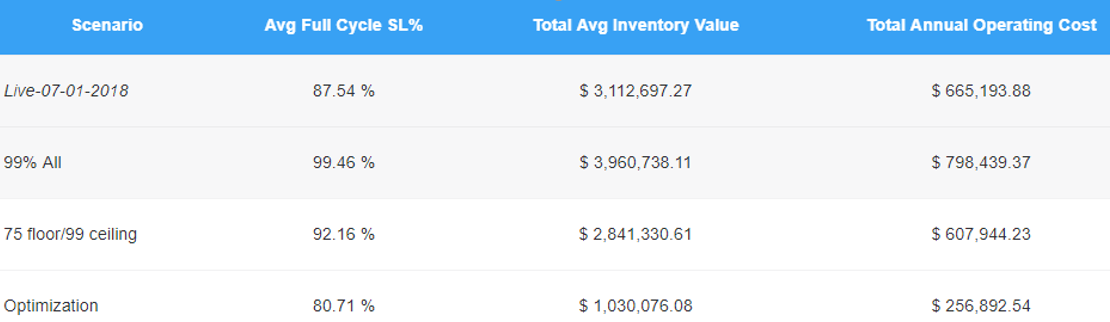
              The figure below shows how supply chain analytics can help the inventory manager. The columns show three predicted Key Performance Indicators (KPI’s): service level, inventory investment, and operating costs (holding costs + ordering costs + shortage costs).

               Figure 1: The three types of analytics used to evaluate planning scenarios

              The rows show four alternative inventory policies, expressed as scenarios. The “Live” scenario reports on the values of the KPI’s on July 1, 2018. The “99% All” scenario changes the current policy by raising the service level of all items to 99%. The “75 floor/99 ceiling” scenario raises service levels that are too low up to 75% and lowers very high (i.e., expensive) service levels down to 95%. The “Optimization” scenario prescribes item specific service levels that minimizes total operating costs.

              The “Live 07-01-2018” scenario is an example of Descriptive Analytics. It shows the current baseline performance. The software then allows the user to try out changes in inventory policy by creating new “What If” scenarios that might then be converted to named scenarios for further consideration. The next two scenarios are examples of Predictive Analytics. They both assess the consequences of their recommended inventory control policies, i.e., recommended values of Min and Max for all items. The “Optimization” scenario is an example of Prescriptive Analytics because it recommends a best compromise policy.

              Consider how the three alternative scenarios compare to the baseline “Live” scenario. The “99% All” scenario raises the item availability metrics, increasing service level from 88% to 99%. However, doing so increases the total inventory investment from $3 million to about $4 million. In contrast, the “75 floor/99 ceiling” scenario increases both service level and reduces the cash tied up in inventory by about $300,000. Finally, the “Optimization” scenario achieves an 80% service level, a reduction from the current 88%, but it cuts more than $2 million from the inventory value and reduces operating costs by more than $400,000 annually. From here, managers could try further options, such as giving back some of the $2 million savings to achieve a higher average service level.

              Summary

              Modern software packages for inventory planning and inventory optimization should offer three kinds of supply chain analytics: Descriptive, Predictive, and Prescriptive. Their combination lets inventory managers track their operations (Descriptive), forecast where their operations will be in the future (Predictive), and optimize their inventory policies in response in anticipation of future conditions (Prescriptive).


              Leave a Comment

              Related Posts

              Do your statistical forecasts suffer from the wiggle effect?

              Do your statistical forecasts suffer from the wiggle effect?

              What is the wiggle effect? It’s when your statistical forecast incorrectly predicts the ups and downs observed in your demand history when there really isn’t a pattern. It’s important to make sure your forecasts don’t wiggle unless there is a real pattern. Here is a transcript from a recent customer where this issue was discussed:

              How to Handle Statistical Forecasts of Zero

              How to Handle Statistical Forecasts of Zero

              A statistical forecast of zero can cause lots of confusion for forecasters, especially when the historical demand is non-zero. Sure, it’s obvious that demand is trending downward, but should it trend to zero?

              Recent Posts

              • Managing Spare Parts Inventory: Best PracticesManaging Spare Parts Inventory: Best Practices
                In this blog, we’ll explore several effective strategies for managing spare parts inventory, emphasizing the importance of optimizing stock levels, maintaining service levels, and using smart tools to aid in decision-making. Managing spare parts inventory is a critical component for businesses that depend on equipment uptime and service reliability. Unlike regular inventory items, spare parts often have unpredictable demand patterns, making them more challenging to manage effectively. An efficient spare parts inventory management system helps prevent stockouts that can lead to operational downtime and costly delays while also avoiding overstocking that unnecessarily ties up capital and increases holding costs. […]
              • 5 Ways to Improve Supply Chain Decision Speed5 Ways to Improve Supply Chain Decision Speed
                The promise of a digital supply chain has transformed how businesses operate. At its core, it can make rapid, data-driven decisions while ensuring quality and efficiency throughout operations. However, it's not just about having access to more data. Organizations need the right tools and platforms to turn that data into actionable insights. This is where decision-making becomes critical, especially in a landscape where new digital supply chain solutions and AI-driven platforms can support you in streamlining many processes within the decision matrix. […]
              • Two employees checking inventory in temporary storage in a distribution warehouse.12 Causes of Overstocking and Practical Solutions
                Managing inventory effectively is critical for maintaining a healthy balance sheet and ensuring that resources are optimally allocated. Here is an in-depth exploration of the main causes of overstocking, their implications, and possible solutions. […]
              • FAQ Mastering Smart IP&O for Better Inventory ManagementFAQ: Mastering Smart IP&O for Better Inventory Management.
                Effective supply chain and inventory management are essential for achieving operational efficiency and customer satisfaction. This blog provides clear and concise answers to some basic and other common questions from our Smart IP&O customers, offering practical insights to overcome typical challenges and enhance your inventory management practices. Focusing on these key areas, we help you transform complex inventory issues into strategic, manageable actions that reduce costs and improve overall performance with Smart IP&O. […]
              • 7 Key Demand Planning Trends Shaping the Future7 Key Demand Planning Trends Shaping the Future
                Demand planning goes beyond simply forecasting product needs; it's about ensuring your business meets customer demands with precision, efficiency, and cost-effectiveness. Latest demand planning technology addresses key challenges like forecast accuracy, inventory management, and market responsiveness. In this blog, we will introduce critical demand planning trends, including data-driven insights, probabilistic forecasting, consensus planning, predictive analytics, scenario modeling, real-time visibility, and multilevel forecasting. These trends will help you stay ahead of the curve, optimize your supply chain, reduce costs, and enhance customer satisfaction, positioning your business for long-term success. […]

                Inventory Optimization for Manufacturers, Distributors, and MRO

                • Managing Spare Parts Inventory: Best PracticesManaging Spare Parts Inventory: Best Practices
                  In this blog, we’ll explore several effective strategies for managing spare parts inventory, emphasizing the importance of optimizing stock levels, maintaining service levels, and using smart tools to aid in decision-making. Managing spare parts inventory is a critical component for businesses that depend on equipment uptime and service reliability. Unlike regular inventory items, spare parts often have unpredictable demand patterns, making them more challenging to manage effectively. An efficient spare parts inventory management system helps prevent stockouts that can lead to operational downtime and costly delays while also avoiding overstocking that unnecessarily ties up capital and increases holding costs. […]
                • Innovating the OEM Aftermarket with AI-Driven Inventory Optimization XLInnovating the OEM Aftermarket with AI-Driven Inventory Optimization
                  The aftermarket sector provides OEMs with a decisive advantage by offering a steady revenue stream and fostering customer loyalty through the reliable and timely delivery of service parts. However, managing inventory and forecasting demand in the aftermarket is fraught with challenges, including unpredictable demand patterns, vast product ranges, and the necessity for quick turnarounds. Traditional methods often fall short due to the complexity and variability of demand in the aftermarket. The latest technologies can analyze large datasets to predict future demand more accurately and optimize inventory levels, leading to better service and lower costs. […]
                • Future-Proofing Utilities. Advanced Analytics for Supply Chain OptimizationFuture-Proofing Utilities: Advanced Analytics for Supply Chain Optimization
                  Utilities in the electrical, natural gas, urban water, and telecommunications fields are all asset-intensive and reliant on physical infrastructure that must be properly maintained, updated, and upgraded over time. Maximizing asset uptime and the reliability of physical infrastructure demands effective inventory management, spare parts forecasting, and supplier management. A utility that executes these processes effectively will outperform its peers, provide better returns for its investors and higher service levels for its customers, while reducing its environmental impact. […]
                • Centering Act Spare Parts Timing Pricing and ReliabilityCentering Act: Spare Parts Timing, Pricing, and Reliability
                  In this article, we'll walk you through the process of crafting a spare parts inventory plan that prioritizes availability metrics such as service levels and fill rates while ensuring cost efficiency. We'll focus on an approach to inventory planning called Service Level-Driven Inventory Optimization. Next, we'll discuss how to determine what parts you should include in your inventory and those that might not be necessary. Lastly, we'll explore ways to enhance your service-level-driven inventory plan consistently. […]

                  Smart Software Wins Three Supply Chain Awards for 2013

                  Supply & Demand Chain Executive and Inbound Logistics Again Select Smart Software for Top 100 Lists and Executive Recognition

                  Belmont, Mass., July 16, 2013 – Smart Software, Inc., provider of industry-leading demand forecasting, planning and inventory optimization solutions, today announced that three supply chain industry publications have again recognized the company and its president as supply chain leaders. Smart was selected by Supply & Demand Chain Executive and Inbound Logistics for the eighth and ninth years, respectively, to be on their “Top 100” lists. In addition, Supply & Demand Chain Executive also chose Smart’s president and CEO, Nelson Hartunian, as a “Provider Pro to Know.”  The competitive awards recognize Smart Software as a leader in the supply chain planning software niche, and highlight the company’s strengths in technical innovation and the ability to meet customers’ needs for forecasting and demand planning solutions.

                  Supply & Demand Chain Executive 100
                  Supply & Demand Chain Executive magazine chose Smart Software, from more than 300 entries, for its annual “Supply & Demand Chain Executive 100” announced on May 13, and published in its June 2013 issue. The 2013 Supply & Demand Chain Executive 100 are supply chain solution and service providers that are helping their customers and clients achieve supply chain excellence. They have produced measurable gains in ROI through cost-cutting and increased efficiency in forecasting and demand planning chain.

                  “Smart Software’s inclusion in this year’s “100” list recognizes its leadership as a solution and service provider in assisting the Supply Chain function and supply chain executives as your customers move toward supply chain excellence,” said Barry Hochfelder, editor, Supply & Demand Chain Executive.

                  Top 100 Logistics IT Providers
                  In its April 2013 issue, Inbound Logistics’ editors recognized 100 logistics IT companies that support and enable logistics excellence.  Chosen from more than 300 companies, the “Top 100 Logistics IT Providers” selected demonstrate leadership by answering Inbound Logistics readers’ needs for scalability, simplicity, fast ROI and ease of implementation.

                  “Inbound Logistics editors have selected 100 logistics technology companies that enable logistics and supply chain excellence. Smart Software was recognized by Inbound Logistics for leading the way in 2013 and positioning enterprises for the years ahead.” said Felicia Stratton, editor of Inbound Logistics. “Smart Software excels at providing solutions that drive supply chain excellence and answer IL readers’ need for simplicity, ROI, and efficient implementation. Inbound Logistics is proud to honor Smart Software for continuing to offer our readers solutions that optimize logistics and supply chain excellence.”

                  Provider Pros to Know
                  President and CEO, Dr. Nelson Hartunian, has been chosen a “2013 Provider Pro to Know” by Supply & Demand Chain Executive magazine in its February/March 2013 issue.  This well-respected publication’s annual listing of Provider Pros to Know recognizes a select group of individuals, and Dr. Hartunian, a pioneer in developing inventory optimization techniques for intermittent demand, was chosen from more than 400 entries submitted.

                  “Those working to overcome supply chain challenges and grow the global supply chain at the same time should get the recognition they deserve for their achievements,” said Barry Hochfelder, editor, Supply & Demand Chain Executive.  “Now in its 13th year, the Supply & Demand Chain Executive “Pros to Know” awards recognize both ends of the supply chain. This includes honoring individuals from software firms, service providers, consultancies or academia who helped their supply chain clients or the supply chain community prepare to meet industry challenges.”

                  “We work diligently with our customers to achieve their demand planning goals,” said Dr. Hartunian. “Our customers have found that better demand planning, using SmartForecasts, has become a critical strategic element for improving their operations and the productivity of their supply chain. While initially many purchase SmartForecasts® to achieve tactical goals, they quickly discover strategic benefits. More specifically, the ability to accurately forecast and estimate their inventory stocking levels improves their relationships with both customers and suppliers, especially where their inventories experience a lot of intermittent demand.”

                  About Smart Software, Inc.
                  Founded in 1981, Smart Software, Inc. is a leading provider of enterprise-wide demand forecasting, planning and inventory optimization solutions.  Smart Software’s flagship product, SmartForecasts, has thousands of users worldwide, including customers at mid-market enterprises and Fortune 500 companies, such as Abbott Laboratories, Metro-North Railroad, Siemens, Disney, Nestle, Nikon, GE and The Coca-Cola Company.  Smart Software is headquartered in Belmont, Massachusetts and can be found online at www.smartsoftware.wpengine.com .

                  SmartForecasts is a registered trademark of Smart Software, Inc.  All other trademarks are the property of their respective owners.


                  For more information, please contact Smart Software, Inc., Four Hill Road, Belmont, MA 02478.
                  Phone: 1-800-SMART-99 (800-762-7899); FAX: 1-617-489-2748; E-mail: info@smartsoftware.wpengine.com