Worst Practices in Forecasting

The Smart Forecaster

 Pursuing best practices in demand planning,

forecasting and inventory optimization

Companies launch initiatives to upgrade or improve their sales & operations planning and demand planning processes all the time. Many of these initiatives fail to deliver the results they should. Has your forecasting function fallen short of expectations? Do you struggle with “best practices” that seem incapable of producing accurate results?

For ten years, the editorial team at Foresight: The International Journal of Applied Forecasting has been telling readers about the struggles and successes of forecasting professionals and doing all we can to educate them about methods and practices that really work. We do that with articles contributed by forecasting professionals as well as respected academics and authors of highly-regarded books.

As Founding Editor of Foresight, I’d like to invite you to join us for the upcoming Foresight Practitioner Conference entitled “Worst Practices in Forecasting: Today’s Mistakes to Tomorrow’s Breakthroughs.”

This 1.5-day event will take place in Raleigh, North Carolina, October 5-6. There we will take a hard look at common practices that may be inhibiting efforts to build better forecasts. Our invited speakers will share how they and others have uncovered and eliminated bad habits and worst practices in their organizations for dramatic improvements in forecasting performance.

Some of the topics to be addressed include:

• Use and Abuse of Judgmental Overrides

• Avoiding Dangers in Sales Force Input to Forecasts

• Improper Practices in Inventory Optimization

• Pitfalls in Forecast Accuracy Measurement

• Worst Practices in S&OP and Demand Planning

• Worst Practices in Forecasting Software Implementation

Foresight is published by the non-profit International Institute of Forecasters (IIF), an unbiased, non-commercial organization, dedicated to the generation, distribution and use of knowledge on forecasting in a wide range of fields. (Smart Software’s own Tom Willemain serves on Foresight’s Advisory Board.) Foresight is just one of the resources made available by the IIF. Additional publications, a host of online resources, an annual symposium and periodic workshops and conferences are available to all IIF members. The Smart Forecaster previously interviewed IIF past-president Dr. Mohsen Hamoudia. Visit the IIF site for information about joining.

(Len Tashman is the editor of Foresight: The International Journal of Applied Forecasting. The unusual practice-related conference he describes, upcoming in October 2016, will appeal to many of readers of The Smart Forecaster. For instance, those who have received Smart Software’s training have been alerted to the possibility that overriding statistical forecasts can backfire if done cavalierly. Two sessions at the conference focus on the use of judgement in the forecasting process. — Tom Willemain)

Leave a Comment

Related Posts

Truth in Forecasting—Practical Advice at Year’s End

Truth in Forecasting—Practical Advice at Year’s End

At year’s end, we are often caught up in thinking and planning for the coming year. Did 2013 turn out the way you expected? Will 2014 be dramatically different? Are there other factors—things we are planning to do; things we think our competitors might do; outside forces like changing taste, demographics or economics—that might change the course of business in the coming year?

A CFO’s Perspective on Demand Planning – “More Strategic Than You Think”

A CFO’s Perspective on Demand Planning – “More Strategic Than You Think”

NKK Switches, based in Scottsdale, Arizona, is a leading manufacturer and supplier of electromechanical switches. The business involves many different switch types—toggles, push-button, rotary, even some programmable switch types. We are known for our high quality, and for our ability to meet an exceptionally broad range of customer requirements on a turnkey (custom configuration) basis. NKK Switches produces customized solutions from component parts sourced exclusively from manufacturing facilities in Japan and China.

Estimating Safety Stock

Estimating Safety Stock

In my previous post in this series on essential concepts, “What is ‘A Good Forecast’”, I discussed the basic effort to discover the most likely future in a demand planning scenario. I defined a good forecast as one that is unbiased and as accurate as possible. But I also cautioned that, depending on the stability or volatility of the data we have to work with, there may still be some inaccuracy in even a good forecast. The key is to have an understanding of how much.

Recent Posts

  • Managing Spare Parts Inventory: Best PracticesManaging Spare Parts Inventory: Best Practices
    In this blog, we’ll explore several effective strategies for managing spare parts inventory, emphasizing the importance of optimizing stock levels, maintaining service levels, and using smart tools to aid in decision-making. Managing spare parts inventory is a critical component for businesses that depend on equipment uptime and service reliability. Unlike regular inventory items, spare parts often have unpredictable demand patterns, making them more challenging to manage effectively. An efficient spare parts inventory management system helps prevent stockouts that can lead to operational downtime and costly delays while also avoiding overstocking that unnecessarily ties up capital and increases holding costs. […]

  • 5 Ways to Improve Supply Chain Decision Speed5 Ways to Improve Supply Chain Decision Speed
    The promise of a digital supply chain has transformed how businesses operate. At its core, it can make rapid, data-driven decisions while ensuring quality and efficiency throughout operations. However, it's not just about having access to more data. Organizations need the right tools and platforms to turn that data into actionable insights. This is where decision-making becomes critical, especially in a landscape where new digital supply chain solutions and AI-driven platforms can support you in streamlining many processes within the decision matrix. […]

  • Two employees checking inventory in temporary storage in a distribution warehouse.12 Causes of Overstocking and Practical Solutions
    Managing inventory effectively is critical for maintaining a healthy balance sheet and ensuring that resources are optimally allocated. Here is an in-depth exploration of the main causes of overstocking, their implications, and possible solutions. […]

  • FAQ Mastering Smart IP&O for Better Inventory ManagementFAQ: Mastering Smart IP&O for Better Inventory Management.
    Effective supply chain and inventory management are essential for achieving operational efficiency and customer satisfaction. This blog provides clear and concise answers to some basic and other common questions from our Smart IP&O customers, offering practical insights to overcome typical challenges and enhance your inventory management practices. Focusing on these key areas, we help you transform complex inventory issues into strategic, manageable actions that reduce costs and improve overall performance with Smart IP&O. […]

  • 7 Key Demand Planning Trends Shaping the Future7 Key Demand Planning Trends Shaping the Future
    Demand planning goes beyond simply forecasting product needs; it's about ensuring your business meets customer demands with precision, efficiency, and cost-effectiveness. Latest demand planning technology addresses key challenges like forecast accuracy, inventory management, and market responsiveness. In this blog, we will introduce critical demand planning trends, including data-driven insights, probabilistic forecasting, consensus planning, predictive analytics, scenario modeling, real-time visibility, and multilevel forecasting. These trends will help you stay ahead of the curve, optimize your supply chain, reduce costs, and enhance customer satisfaction, positioning your business for long-term success. […]

    Inventory Optimization for Manufacturers, Distributors, and MRO

    • Managing Spare Parts Inventory: Best PracticesManaging Spare Parts Inventory: Best Practices
      In this blog, we’ll explore several effective strategies for managing spare parts inventory, emphasizing the importance of optimizing stock levels, maintaining service levels, and using smart tools to aid in decision-making. Managing spare parts inventory is a critical component for businesses that depend on equipment uptime and service reliability. Unlike regular inventory items, spare parts often have unpredictable demand patterns, making them more challenging to manage effectively. An efficient spare parts inventory management system helps prevent stockouts that can lead to operational downtime and costly delays while also avoiding overstocking that unnecessarily ties up capital and increases holding costs. […]

    • Innovating the OEM Aftermarket with AI-Driven Inventory Optimization XLInnovating the OEM Aftermarket with AI-Driven Inventory Optimization
      The aftermarket sector provides OEMs with a decisive advantage by offering a steady revenue stream and fostering customer loyalty through the reliable and timely delivery of service parts. However, managing inventory and forecasting demand in the aftermarket is fraught with challenges, including unpredictable demand patterns, vast product ranges, and the necessity for quick turnarounds. Traditional methods often fall short due to the complexity and variability of demand in the aftermarket. The latest technologies can analyze large datasets to predict future demand more accurately and optimize inventory levels, leading to better service and lower costs. […]

    • Future-Proofing Utilities. Advanced Analytics for Supply Chain OptimizationFuture-Proofing Utilities: Advanced Analytics for Supply Chain Optimization
      Utilities in the electrical, natural gas, urban water, and telecommunications fields are all asset-intensive and reliant on physical infrastructure that must be properly maintained, updated, and upgraded over time. Maximizing asset uptime and the reliability of physical infrastructure demands effective inventory management, spare parts forecasting, and supplier management. A utility that executes these processes effectively will outperform its peers, provide better returns for its investors and higher service levels for its customers, while reducing its environmental impact. […]
    • Centering Act Spare Parts Timing Pricing and ReliabilityCentering Act: Spare Parts Timing, Pricing, and Reliability
      In this article, we'll walk you through the process of crafting a spare parts inventory plan that prioritizes availability metrics such as service levels and fill rates while ensuring cost efficiency. We'll focus on an approach to inventory planning called Service Level-Driven Inventory Optimization. Next, we'll discuss how to determine what parts you should include in your inventory and those that might not be necessary. Lastly, we'll explore ways to enhance your service-level-driven inventory plan consistently. […]

      Caught in a Perfect Storm, SmartForecasts Helps Rev-A-Shelf Weather the Crisis

      The Smart Forecaster

      Pursuing best practices in demand planning, forecasting and inventory optimization

      Does your extended supply chain suffer from extreme seasonal variability? Does this situation challenge your ability to meet service level commitments to your customers? I have grappled with this at Rev-A-Shelf, addressing unusual conditions created by Chinese New Year and other global events, and would like to share the experience and a few things I learned along the way.

      First, let me explain our situation. We import 60% of the parts we use to build our kitchen and bath accessories from China and Europe. Most of the year we were able to plan our inventory needs using a spreadsheet-based min/max approach. But not during Chinese New Year, which drives the planet’s greatest annual population migration. Chinese New Year shuts down production for up to two months, creating significant supply risk as we strive to meet our three day order fulfillment commitment.

      We solved our problem, introducing statistical demand forecasting with the flexibility to extend lead times when necessary, the ability to reliably establish safety stocks that achieve our required service levels and a continuous reporting system that lets everyone know exactly where we stand. However, success required much more than a new piece of software. We needed to change the way we view future demand, supply risk and safety stock. Here are a few key things we did that made all the difference.

      Stakeholder education and buy-in

      Regardless of the project, it’s always best to enlist the buy-in of all stakeholders. We knew we had to do something to solve our problem, but there was bound to be resistance. Senior managers, for example, had developed a healthy distrust of software and wondered whether demand forecasting software could help. Our buyers had developed their own perspectives and procurement methods, and felt personally at risk as we considered new approaches.

      People came around as they developed a common understanding of the problem and how we would address it. Education was a big part of the solution. We explained how forecasting works and key factors we should all understand: how to analyze trends, how to use “what if” scenarios, impact of shifting lead times, how to relate service levels to supply risk and safety stock and key performance indicators like inventory turns. Going through this process together, we all became stakeholders in the solution.

      Use the Right software

      When you have lots of part numbers and any sort of supply or demand variability, you just cannot forecast effectively with a spreadsheet. With our min/max forecasting system, we were planning to an average, and it wasn’t working. Average usage has inherent flaws for planning purposes—it’s always looking backward!

      You need software that looks ahead, recognizes seasonal patterns and enables you to determine how much stock you’ll need to meet required service levels over varying lead times.

      Fine-tune processes

      When the old ways don’t work, you need to be open to adjusting your assumptions. Think less about where you’ve been, and more about where you want to be. Take a look at your lead times and plan to your desired service level. Last year’s history may not be the best predictor of this year’s demand. The same forecast horizon may not be appropriate for all products or certain time of the year.

      Make the Forecast Actionable

      It’s not enough to produce an accurate forecast and estimated inventory stocking levels. You’ve got to develop a way to make the information actionable for those tasked with using it. We developed a set of reports that enabled buyers to leverage better forecast and safety stock information. Now, at the end of every month, we produce a forecast report that provides a clear picture of current inventory, safety stock, past usage, forecasted usage, incoming deliveries (PO’s) and recommended order quantities.

      Validate Results

      You can, and we did, test our new methods against our own demand history. Still, an authoritative outsider can make acceptance easier. We commissioned a study by a professor at Louisville University’s College of Business who set one of her graduate students to the task. Through them we were able to reinforce what we saw happening from our results, and feel comfortable that we were on a good path.

      All of these factors helped Rev-A-Shelf transform its demand planning process, to great effect. Today we are exceeding our service level targets, and our fill rate, based on a three day ship cycle, is showing steady improvement, and trending up. Overall, units-in-stock have stayed flat while supporting a 13% increase in sales

      John Engelhardt is currently Director of Purchasing and Asian Operations for Rev-a-Shelf, LLC in Louisville, KY. He has held a variety of management positions both in private business and public organizations. At Rev-A-Shelf he held the position of International Sales Manager and Director of Sales Support before assuming his current position. He can be reached at johne at rev-a-shelf dot com.


      Leave a Comment

      Related Posts

      Too Much or Too Little Inventory?

      Too Much or Too Little Inventory?

      Do you know which items have too much or too little inventory? What if you knew? How would you go about cutting overstocks while still ensuring a competitive service level? Would you be able to reduce stockouts without incurring a prohibitively expensive inventory increase? How would these changes impact service levels, costs and turns—for individual items, groups of items and overall?

      Handling Extreme Supply Chain Variability at Rev-A-Shelf

      Handling Extreme Supply Chain Variability at Rev-A-Shelf

      Does your extended supply chain suffer from extreme seasonal variability? Does this situation challenge your ability to meet service level commitments to your customers? I have grappled with this at Rev-A-Shelf, addressing unusual conditions created by Chinese New Year and other global events, and would like to share the experience and a few things I learned along the way.

      Recommended Reading: Cloud Software Helps Overcome Budget Constraints

      Recommended Reading: Cloud Software Helps Overcome Budget Constraints

      Smart Software recently announced a Software as a Service (SaaS) option for SmartForecasts—SFCloud™. Premises-based perpetual licenses will continue to be the preferred software implementation method for many organizations, but there are many reasons why demand for cloud-based solutions is taking off. A vintage post by Bill Richardson at ApplicantStack Team Blog summarizes key benefits of the SaaS model.

      Recent Posts

      • Managing Spare Parts Inventory: Best PracticesManaging Spare Parts Inventory: Best Practices
        In this blog, we’ll explore several effective strategies for managing spare parts inventory, emphasizing the importance of optimizing stock levels, maintaining service levels, and using smart tools to aid in decision-making. Managing spare parts inventory is a critical component for businesses that depend on equipment uptime and service reliability. Unlike regular inventory items, spare parts often have unpredictable demand patterns, making them more challenging to manage effectively. An efficient spare parts inventory management system helps prevent stockouts that can lead to operational downtime and costly delays while also avoiding overstocking that unnecessarily ties up capital and increases holding costs. […]
      • 5 Ways to Improve Supply Chain Decision Speed5 Ways to Improve Supply Chain Decision Speed
        The promise of a digital supply chain has transformed how businesses operate. At its core, it can make rapid, data-driven decisions while ensuring quality and efficiency throughout operations. However, it's not just about having access to more data. Organizations need the right tools and platforms to turn that data into actionable insights. This is where decision-making becomes critical, especially in a landscape where new digital supply chain solutions and AI-driven platforms can support you in streamlining many processes within the decision matrix. […]
      • Two employees checking inventory in temporary storage in a distribution warehouse.12 Causes of Overstocking and Practical Solutions
        Managing inventory effectively is critical for maintaining a healthy balance sheet and ensuring that resources are optimally allocated. Here is an in-depth exploration of the main causes of overstocking, their implications, and possible solutions. […]
      • FAQ Mastering Smart IP&O for Better Inventory ManagementFAQ: Mastering Smart IP&O for Better Inventory Management.
        Effective supply chain and inventory management are essential for achieving operational efficiency and customer satisfaction. This blog provides clear and concise answers to some basic and other common questions from our Smart IP&O customers, offering practical insights to overcome typical challenges and enhance your inventory management practices. Focusing on these key areas, we help you transform complex inventory issues into strategic, manageable actions that reduce costs and improve overall performance with Smart IP&O. […]
      • 7 Key Demand Planning Trends Shaping the Future7 Key Demand Planning Trends Shaping the Future
        Demand planning goes beyond simply forecasting product needs; it's about ensuring your business meets customer demands with precision, efficiency, and cost-effectiveness. Latest demand planning technology addresses key challenges like forecast accuracy, inventory management, and market responsiveness. In this blog, we will introduce critical demand planning trends, including data-driven insights, probabilistic forecasting, consensus planning, predictive analytics, scenario modeling, real-time visibility, and multilevel forecasting. These trends will help you stay ahead of the curve, optimize your supply chain, reduce costs, and enhance customer satisfaction, positioning your business for long-term success. […]

        Inventory Optimization for Manufacturers, Distributors, and MRO

        • Managing Spare Parts Inventory: Best PracticesManaging Spare Parts Inventory: Best Practices
          In this blog, we’ll explore several effective strategies for managing spare parts inventory, emphasizing the importance of optimizing stock levels, maintaining service levels, and using smart tools to aid in decision-making. Managing spare parts inventory is a critical component for businesses that depend on equipment uptime and service reliability. Unlike regular inventory items, spare parts often have unpredictable demand patterns, making them more challenging to manage effectively. An efficient spare parts inventory management system helps prevent stockouts that can lead to operational downtime and costly delays while also avoiding overstocking that unnecessarily ties up capital and increases holding costs. […]
        • Innovating the OEM Aftermarket with AI-Driven Inventory Optimization XLInnovating the OEM Aftermarket with AI-Driven Inventory Optimization
          The aftermarket sector provides OEMs with a decisive advantage by offering a steady revenue stream and fostering customer loyalty through the reliable and timely delivery of service parts. However, managing inventory and forecasting demand in the aftermarket is fraught with challenges, including unpredictable demand patterns, vast product ranges, and the necessity for quick turnarounds. Traditional methods often fall short due to the complexity and variability of demand in the aftermarket. The latest technologies can analyze large datasets to predict future demand more accurately and optimize inventory levels, leading to better service and lower costs. […]
        • Future-Proofing Utilities. Advanced Analytics for Supply Chain OptimizationFuture-Proofing Utilities: Advanced Analytics for Supply Chain Optimization
          Utilities in the electrical, natural gas, urban water, and telecommunications fields are all asset-intensive and reliant on physical infrastructure that must be properly maintained, updated, and upgraded over time. Maximizing asset uptime and the reliability of physical infrastructure demands effective inventory management, spare parts forecasting, and supplier management. A utility that executes these processes effectively will outperform its peers, provide better returns for its investors and higher service levels for its customers, while reducing its environmental impact. […]
        • Centering Act Spare Parts Timing Pricing and ReliabilityCentering Act: Spare Parts Timing, Pricing, and Reliability
          In this article, we'll walk you through the process of crafting a spare parts inventory plan that prioritizes availability metrics such as service levels and fill rates while ensuring cost efficiency. We'll focus on an approach to inventory planning called Service Level-Driven Inventory Optimization. Next, we'll discuss how to determine what parts you should include in your inventory and those that might not be necessary. Lastly, we'll explore ways to enhance your service-level-driven inventory plan consistently. […]
          The Scourge of Skewness

          The Smart Forecaster

           Pursuing best practices in demand planning,

          forecasting and inventory optimization

          Demand planners have to cope with multiple problems to get their job done. One is the Irritation of Intermittency. The “now you see it, now you don’t” character of intermittent demand, with its heavy mix of zero values, forces the use of advanced statistical methods, such as Smart Software’s patented Markov Bootstrap algorithm. But even within the dark realm of intermittent demand, there are degrees of difficulty: planners must further cope with the potentially costly Scourge of Skewness.

          Skewness is a statistical term describing the degree to which a demand distribution is not symmetrical. The classic (and largely mythic) “bell-shaped” curve is symmetric, with equal chances of demand in any time period falling below or above the average. In contrast, a skewed distribution is lopsided, with most values falling either above or below the average. In most cases, demand data are positively skewed, with a long tail of values extending toward the higher end of the demand scale.

          Bar graphs of two time series
          Figure 1: Two intermittent demand series with different levels of skewness
          Figure 1 shows two time series of 60 months of intermittent demand. Both are positively skewed, but the data in the bottom panel are more skewed. Both series have nearly the same average demand, but the one on top is a mix of 0’s, 1’s and 2’s, while the one on the bottom is a mix of 0’s, 1’s and 4’s.

          What makes positive skewness a problem is that it reduces an item’s fill rate. Fill rate is an important inventory management performance metric. It measures the percentage of demand that is satisfied immediately from on-hand inventory. Any backorders or lost sales reduce the fill rate (besides squandering customer good will).

          Fill rate is a companion to the other key performance metric: Service level. Service level measures the chance that an item will stock out during the replenishment lead time. Lead time is measured from the moment when inventory drops to or below an item’s reorder point, triggering a replenishment order, until the arrival of the replacement inventory.

          Inventory management software, such as Smart Software’s SmartForecasts, can analyze demand patterns to calculate the reorder point required to achieve a specified service level target. To hit a 95% service level for the item in the top panel of Figure 1, assuming a lead time of 1 month, the required reorder point is 3; for the bottom item, the reorder point is 1. (The first reorder point is 3 to allow for the distinct possibility that future demand values will exceed the largest values, 2, observed so far. In fact, values as large as 8 are possible.) See Figure 2.

          Histograms of two time series
          Figure 2: Distributions of total demand during a replenishment lead time of 1 month
          (Figure 2 plots the predicted distribution of demand over the lead time. The green bars represent the probability that any particular level of demand will materialize.)

          Using the required reorder point of 3 units, the fill rate for the less skewed item is a healthy 93%. However, the fill rate for the more skewed item is a troubling 44%, even though this item too achieves a service level of 95%. This is the scourge of skewness.

          The explanation for the difference in fill rates is the degree of skewness. The reorder point for the more skewed item is 1 unit. Having 1 unit on hand at the start of the lead time will be sufficient to handle 95% of the demands arriving during a 1 month lead time. However, the monthly demand could reach above 15 units, so when the more skewed unit stocks out, it will “stock out big time”, losing a much larger number of units.

          Most demand planners would be proud to achieve a 95% service level and a 93% fill rate. Most would be troubled, and puzzled, by achieving the 95% service level but only a 44% fill rate. This partial failure would not be their fault: it can be traced directly to the nasty skewness in the distribution of monthly demand values.

          There is no painless fix to this problem. The only way to boost the fill rate in this situation is to raise the service level target, which will in turn boost the reorder point, which finally will reduce both the frequency of stockouts and their size whenever they occur. In this example, raising the reorder point from 1 unit to 3 units will achieve a 99% service level and boost fill rate to a respectable, but not outstanding, 84%. This improvement would come at the cost of essentially tripling the dollars tied up in managing this more skewed item.

          Thomas Willemain, PhD, co-founded Smart Software and currently serves as Senior Vice President for Research. Dr. Willemain also serves as Professor Emeritus of Industrial and Systems Engineering at Rensselear Polytechnic Institute and as a member of the research staff at the Center for Computing Sciences, Institute for Defense Analyses.

          Leave a Comment

          Related Posts

          Key Considerations When Evaluating your ERP system’s Forecasting Capabilities

          Key Considerations When Evaluating your ERP system’s Forecasting Capabilities

          Consider what is meant by “demand management”, “demand planning”, and “forecasting”. These terms imply certain standard functionality for collaboration, statistical analysis, and reporting to support a professional demand planning process.  However, in most ERP systems, “demand management” running MRP and reconciling demand and supply for the purpose of placing orders

          The Top 5 Myths about Demand Planning Implementations

          The Top 5 Myths about Demand Planning Implementations

          We just need to feed our demand histories into our new statistical methods, and we can start planning more effectively. Not quite: it’s about the technology and the process. You are investing in a new business process to develop forecasts for driving business strategy and inventory planning decisions.

          The Right Forecast Accuracy Metric for Inventory Planning

          The Right Forecast Accuracy Metric for Inventory Planning

          Testing software solutions via a series of empirical competition can be an attractive option. In the case of forecasting and demand planning, a traditional “hold out” test is a good way to assess monthly or weekly forecast accuracy, but it is minimally useful if you have a different objective: Optimizing inventory.

          Recent Posts

          • Managing Spare Parts Inventory: Best PracticesManaging Spare Parts Inventory: Best Practices
            In this blog, we’ll explore several effective strategies for managing spare parts inventory, emphasizing the importance of optimizing stock levels, maintaining service levels, and using smart tools to aid in decision-making. Managing spare parts inventory is a critical component for businesses that depend on equipment uptime and service reliability. Unlike regular inventory items, spare parts often have unpredictable demand patterns, making them more challenging to manage effectively. An efficient spare parts inventory management system helps prevent stockouts that can lead to operational downtime and costly delays while also avoiding overstocking that unnecessarily ties up capital and increases holding costs. […]
          • 5 Ways to Improve Supply Chain Decision Speed5 Ways to Improve Supply Chain Decision Speed
            The promise of a digital supply chain has transformed how businesses operate. At its core, it can make rapid, data-driven decisions while ensuring quality and efficiency throughout operations. However, it's not just about having access to more data. Organizations need the right tools and platforms to turn that data into actionable insights. This is where decision-making becomes critical, especially in a landscape where new digital supply chain solutions and AI-driven platforms can support you in streamlining many processes within the decision matrix. […]
          • Two employees checking inventory in temporary storage in a distribution warehouse.12 Causes of Overstocking and Practical Solutions
            Managing inventory effectively is critical for maintaining a healthy balance sheet and ensuring that resources are optimally allocated. Here is an in-depth exploration of the main causes of overstocking, their implications, and possible solutions. […]
          • FAQ Mastering Smart IP&O for Better Inventory ManagementFAQ: Mastering Smart IP&O for Better Inventory Management.
            Effective supply chain and inventory management are essential for achieving operational efficiency and customer satisfaction. This blog provides clear and concise answers to some basic and other common questions from our Smart IP&O customers, offering practical insights to overcome typical challenges and enhance your inventory management practices. Focusing on these key areas, we help you transform complex inventory issues into strategic, manageable actions that reduce costs and improve overall performance with Smart IP&O. […]
          • 7 Key Demand Planning Trends Shaping the Future7 Key Demand Planning Trends Shaping the Future
            Demand planning goes beyond simply forecasting product needs; it's about ensuring your business meets customer demands with precision, efficiency, and cost-effectiveness. Latest demand planning technology addresses key challenges like forecast accuracy, inventory management, and market responsiveness. In this blog, we will introduce critical demand planning trends, including data-driven insights, probabilistic forecasting, consensus planning, predictive analytics, scenario modeling, real-time visibility, and multilevel forecasting. These trends will help you stay ahead of the curve, optimize your supply chain, reduce costs, and enhance customer satisfaction, positioning your business for long-term success. […]

            Inventory Optimization for Manufacturers, Distributors, and MRO

            • Managing Spare Parts Inventory: Best PracticesManaging Spare Parts Inventory: Best Practices
              In this blog, we’ll explore several effective strategies for managing spare parts inventory, emphasizing the importance of optimizing stock levels, maintaining service levels, and using smart tools to aid in decision-making. Managing spare parts inventory is a critical component for businesses that depend on equipment uptime and service reliability. Unlike regular inventory items, spare parts often have unpredictable demand patterns, making them more challenging to manage effectively. An efficient spare parts inventory management system helps prevent stockouts that can lead to operational downtime and costly delays while also avoiding overstocking that unnecessarily ties up capital and increases holding costs. […]
            • Innovating the OEM Aftermarket with AI-Driven Inventory Optimization XLInnovating the OEM Aftermarket with AI-Driven Inventory Optimization
              The aftermarket sector provides OEMs with a decisive advantage by offering a steady revenue stream and fostering customer loyalty through the reliable and timely delivery of service parts. However, managing inventory and forecasting demand in the aftermarket is fraught with challenges, including unpredictable demand patterns, vast product ranges, and the necessity for quick turnarounds. Traditional methods often fall short due to the complexity and variability of demand in the aftermarket. The latest technologies can analyze large datasets to predict future demand more accurately and optimize inventory levels, leading to better service and lower costs. […]
            • Future-Proofing Utilities. Advanced Analytics for Supply Chain OptimizationFuture-Proofing Utilities: Advanced Analytics for Supply Chain Optimization
              Utilities in the electrical, natural gas, urban water, and telecommunications fields are all asset-intensive and reliant on physical infrastructure that must be properly maintained, updated, and upgraded over time. Maximizing asset uptime and the reliability of physical infrastructure demands effective inventory management, spare parts forecasting, and supplier management. A utility that executes these processes effectively will outperform its peers, provide better returns for its investors and higher service levels for its customers, while reducing its environmental impact. […]
            • Centering Act Spare Parts Timing Pricing and ReliabilityCentering Act: Spare Parts Timing, Pricing, and Reliability
              In this article, we'll walk you through the process of crafting a spare parts inventory plan that prioritizes availability metrics such as service levels and fill rates while ensuring cost efficiency. We'll focus on an approach to inventory planning called Service Level-Driven Inventory Optimization. Next, we'll discuss how to determine what parts you should include in your inventory and those that might not be necessary. Lastly, we'll explore ways to enhance your service-level-driven inventory plan consistently. […]

              A Check on Forecast Automation with the Attention Index

              The Smart Forecaster

              Pursuing best practices in demand planning,

              forecasting and inventory optimization

              A new metric we call the “Attention Index” will help forecasters identify situations where “data behaving badly” can distort automatic statistical forecasts (see adjacent poem). It quickly identifies those items most likely to require forecast overrides—providing a more efficient way to put business experience and other human intelligence to work maximizing the accuracy of forecasts. How does it work?

              Classical forecasting methods, such as the various flavors of exponential smoothing and moving averages, insist on a leap of faith. They require that we trust present conditions to persist into the future. If present conditions do persist, then it is sensible to use these extrapolative methods—methods which quantify the current level, trend, seasonality and “noise” of a time series and project them into the future.

              But if they do not persist, extrapolative methods can get us into trouble. What had been going up might suddenly be going down. What used to be centered around one level might suddenly jump to another. Or something really odd might happen that is entirely out of pattern. In these surprising circumstances, forecast accuracy deteriorates, inventory calculations go wrong and general unhappiness ensues.

              One way to cope with this problem is to rely on more complex forecasting models that account for external factors that drive the variable being forecasted. For instance, sales promotions attempt to disrupt buying patterns and move them in a positive direction, so including promotion activity in the forecasting process can improve sales forecasting. Sometimes macroeconomic indicators, such as housing starts or inflation rates, can be used to improve forecast accuracy. But more complex models require more data and more expertise, and they may not be useful for some problems—such as managing parts or subsystems, rather than finished goods.

              If one is stuck using simple extrapolative methods, it is useful to have a way to flag items that will be difficult to forecast. This is the Attention Index. As the name suggests, items to be forecast with a high Attention Index require special handling—at least a review, and usually some sort of forecast adjustment.


              The Attention Index detects three types of problems:

              An outlier in the demand history of an item.
              An abrupt change in the level of an item.
              An abrupt change in the trend of an item.
              Using software like SmartForecasts™, the forecaster can deal with an outlier by replacing it with a more typical value.

              An abrupt change in level or trend can be dealt with by omitting, from the forecasting calculations, all data from before the “rupture” in the demand pattern—assuming that the item has switched into a new regime that renders the older data irrelevant.

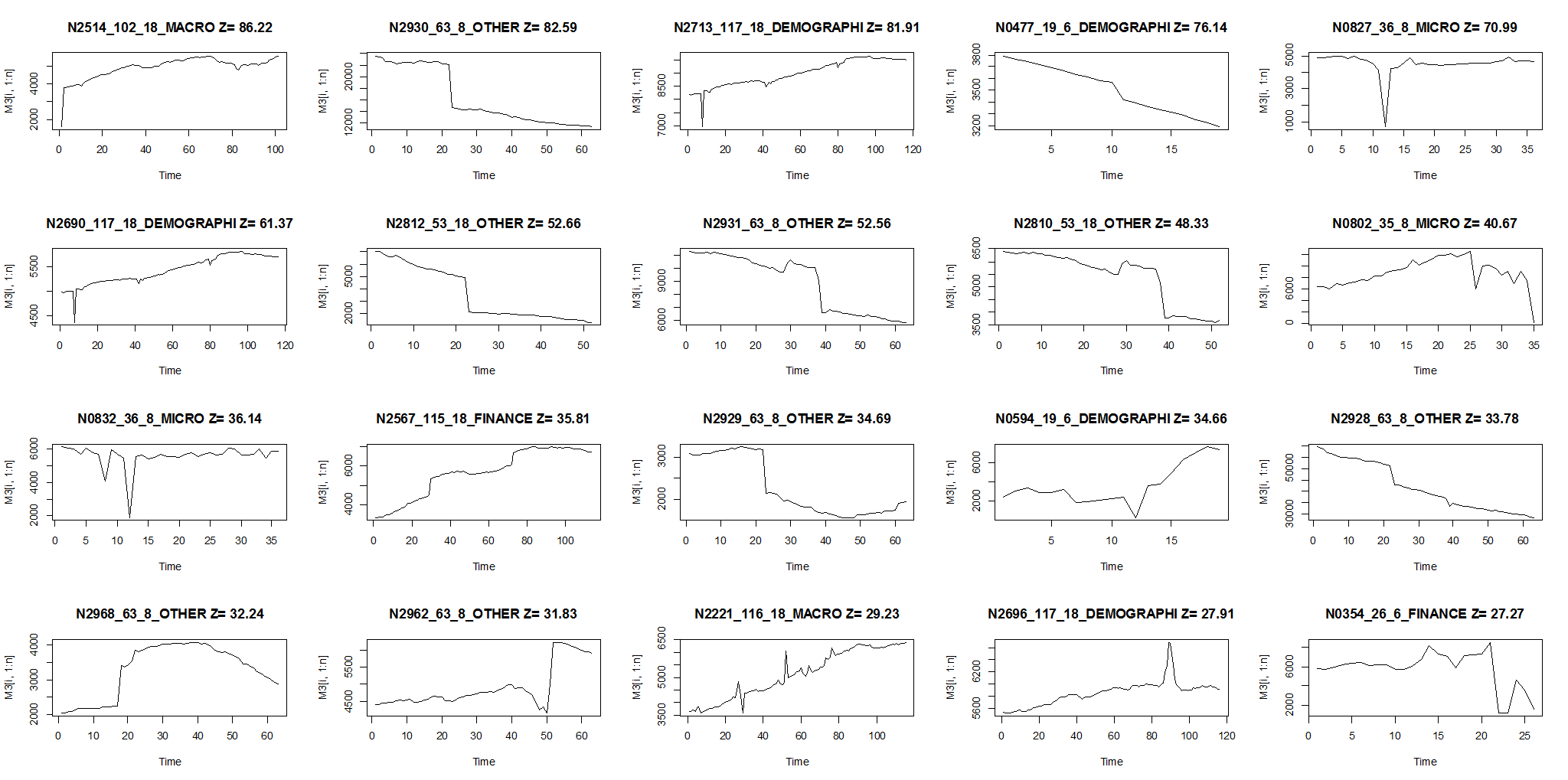
              While no index is perfect, the Attention Index does a good job of focusing attention on the most problematic demand histories. This is demonstrated in the two figures below, which were produced with data from the M3 Competition, well known in the forecasting world. Figure 1 shows the 20 items (out of the contest’s 3,003) with the highest Attention Index scores; all of these have grotesque outliers and ruptures. Figure 2 shows the 20 items with the lowest Attention Index scores; most (but not all) of the items with low scores have relatively benign patterns.

              If you have thousands of items to forecast, the new Attention Index will be very useful for focusing your attention on those items most likely to be problematic.

              Thomas Willemain, PhD, co-founded Smart Software and currently serves as Senior Vice President for Research. Dr. Willemain also serves as Professor Emeritus of Industrial and Systems Engineering at Rensselaer Polytechnic Institute and as a member of the research staff at the Center for Computing Sciences, Institute for Defense Analyses.

              Leave a Comment

              Related Posts

              No Results Found

              The page you requested could not be found. Try refining your search, or use the navigation above to locate the post.

              Recent Posts

              • Managing Spare Parts Inventory: Best PracticesManaging Spare Parts Inventory: Best Practices
                In this blog, we’ll explore several effective strategies for managing spare parts inventory, emphasizing the importance of optimizing stock levels, maintaining service levels, and using smart tools to aid in decision-making. Managing spare parts inventory is a critical component for businesses that depend on equipment uptime and service reliability. Unlike regular inventory items, spare parts often have unpredictable demand patterns, making them more challenging to manage effectively. An efficient spare parts inventory management system helps prevent stockouts that can lead to operational downtime and costly delays while also avoiding overstocking that unnecessarily ties up capital and increases holding costs. […]
              • 5 Ways to Improve Supply Chain Decision Speed5 Ways to Improve Supply Chain Decision Speed
                The promise of a digital supply chain has transformed how businesses operate. At its core, it can make rapid, data-driven decisions while ensuring quality and efficiency throughout operations. However, it's not just about having access to more data. Organizations need the right tools and platforms to turn that data into actionable insights. This is where decision-making becomes critical, especially in a landscape where new digital supply chain solutions and AI-driven platforms can support you in streamlining many processes within the decision matrix. […]
              • Two employees checking inventory in temporary storage in a distribution warehouse.12 Causes of Overstocking and Practical Solutions
                Managing inventory effectively is critical for maintaining a healthy balance sheet and ensuring that resources are optimally allocated. Here is an in-depth exploration of the main causes of overstocking, their implications, and possible solutions. […]
              • FAQ Mastering Smart IP&O for Better Inventory ManagementFAQ: Mastering Smart IP&O for Better Inventory Management.
                Effective supply chain and inventory management are essential for achieving operational efficiency and customer satisfaction. This blog provides clear and concise answers to some basic and other common questions from our Smart IP&O customers, offering practical insights to overcome typical challenges and enhance your inventory management practices. Focusing on these key areas, we help you transform complex inventory issues into strategic, manageable actions that reduce costs and improve overall performance with Smart IP&O. […]
              • 7 Key Demand Planning Trends Shaping the Future7 Key Demand Planning Trends Shaping the Future
                Demand planning goes beyond simply forecasting product needs; it's about ensuring your business meets customer demands with precision, efficiency, and cost-effectiveness. Latest demand planning technology addresses key challenges like forecast accuracy, inventory management, and market responsiveness. In this blog, we will introduce critical demand planning trends, including data-driven insights, probabilistic forecasting, consensus planning, predictive analytics, scenario modeling, real-time visibility, and multilevel forecasting. These trends will help you stay ahead of the curve, optimize your supply chain, reduce costs, and enhance customer satisfaction, positioning your business for long-term success. […]

                Inventory Optimization for Manufacturers, Distributors, and MRO

                • Managing Spare Parts Inventory: Best PracticesManaging Spare Parts Inventory: Best Practices
                  In this blog, we’ll explore several effective strategies for managing spare parts inventory, emphasizing the importance of optimizing stock levels, maintaining service levels, and using smart tools to aid in decision-making. Managing spare parts inventory is a critical component for businesses that depend on equipment uptime and service reliability. Unlike regular inventory items, spare parts often have unpredictable demand patterns, making them more challenging to manage effectively. An efficient spare parts inventory management system helps prevent stockouts that can lead to operational downtime and costly delays while also avoiding overstocking that unnecessarily ties up capital and increases holding costs. […]
                • Innovating the OEM Aftermarket with AI-Driven Inventory Optimization XLInnovating the OEM Aftermarket with AI-Driven Inventory Optimization
                  The aftermarket sector provides OEMs with a decisive advantage by offering a steady revenue stream and fostering customer loyalty through the reliable and timely delivery of service parts. However, managing inventory and forecasting demand in the aftermarket is fraught with challenges, including unpredictable demand patterns, vast product ranges, and the necessity for quick turnarounds. Traditional methods often fall short due to the complexity and variability of demand in the aftermarket. The latest technologies can analyze large datasets to predict future demand more accurately and optimize inventory levels, leading to better service and lower costs. […]
                • Future-Proofing Utilities. Advanced Analytics for Supply Chain OptimizationFuture-Proofing Utilities: Advanced Analytics for Supply Chain Optimization
                  Utilities in the electrical, natural gas, urban water, and telecommunications fields are all asset-intensive and reliant on physical infrastructure that must be properly maintained, updated, and upgraded over time. Maximizing asset uptime and the reliability of physical infrastructure demands effective inventory management, spare parts forecasting, and supplier management. A utility that executes these processes effectively will outperform its peers, provide better returns for its investors and higher service levels for its customers, while reducing its environmental impact. […]
                • Centering Act Spare Parts Timing Pricing and ReliabilityCentering Act: Spare Parts Timing, Pricing, and Reliability
                  In this article, we'll walk you through the process of crafting a spare parts inventory plan that prioritizes availability metrics such as service levels and fill rates while ensuring cost efficiency. We'll focus on an approach to inventory planning called Service Level-Driven Inventory Optimization. Next, we'll discuss how to determine what parts you should include in your inventory and those that might not be necessary. Lastly, we'll explore ways to enhance your service-level-driven inventory plan consistently. […]

                  Handling Extreme Supply Chain Variability at Rev-A-Shelf

                  The Smart Forecaster

                  Pursuing best practices in demand planning,

                  forecasting and inventory optimization

                  Does your extended supply chain suffer from extreme seasonal variability? Does this situation challenge your ability to meet service level commitments to your customers? I have grappled with this at Rev-A-Shelf, addressing unusual conditions created by Chinese New Year and other global events, and would like to share the experience and a few things I learned along the way.

                  First, let me explain our situation. We import 60% of the parts we use to build our kitchen and bath accessories from China and Europe. Most of the year we were able to plan our inventory needs using a spreadsheet-based min/max approach. But not during Chinese New Year, which drives the planet’s greatest annual population migration. Chinese New Year shuts down production for up to two months, creating significant supply risk as we strive to meet our three day order fulfillment commitment.

                  We solved our problem, introducing statistical demand forecasting with the flexibility to extend lead times when necessary, the ability to reliably establish safety stocks that achieve our required service levels and a continuous reporting system that lets everyone know exactly where we stand. However, success required much more than a new piece of software. We needed to change the way we view future demand, supply risk and safety stock. Here are a few key things we did that made all the difference.

                  Stakeholder education and buy-in

                  Regardless of the project, it’s always best to enlist the buy-in of all stakeholders. We knew we had to do something to solve our problem, but there was bound to be resistance. Senior managers, for example, had developed a healthy distrust of software and wondered whether demand forecasting software could help. Our buyers had developed their own perspectives and procurement methods, and felt personally at risk as we considered new approaches.

                  People came around as they developed a common understanding of the problem and how we would address it. Education was a big part of the solution. We explained how forecasting works and key factors we should all understand: how to analyze trends, how to use “what if” scenarios, impact of shifting lead times, how to relate service levels to supply risk and safety stock and key performance indicators like inventory turns. Going through this process together, we all became stakeholders in the solution.

                  Use the Right software

                  When you have lots of part numbers and any sort of supply or demand variability, you just cannot forecast effectively with a spreadsheet. With our min/max forecasting system, we were planning to an average, and it wasn’t working. Average usage has inherent flaws for planning purposes—it’s always looking backward!

                  You need software that looks ahead, recognizes seasonal patterns and enables you to determine how much stock you’ll need to meet required service levels over varying lead times.

                  Fine-tune processes

                  When the old ways don’t work, you need to be open to adjusting your assumptions. Think less about where you’ve been, and more about where you want to be. Take a look at your lead times and plan to your desired service level. Last year’s history may not be the best predictor of this year’s demand. The same forecast horizon may not be appropriate for all products or certain time of the year.

                  Make the Forecast Actionable

                  It’s not enough to produce an accurate forecast and estimated inventory stocking levels. You’ve got to develop a way to make the information actionable for those tasked with using it. We developed a set of reports that enabled buyers to leverage better forecast and safety stock information. Now, at the end of every month, we produce a forecast report that provides a clear picture of current inventory, safety stock, past usage, forecasted usage, incoming deliveries (PO’s) and recommended order quantities.

                  Validate Results

                  You can, and we did, test our new methods against our own demand history. Still, an authoritative outsider can make acceptance easier. We commissioned a study by a professor at Louisville University’s College of Business who set one of her graduate students to the task. Through them we were able to reinforce what we saw happening from our results, and feel comfortable that we were on a good path.

                  All of these factors helped Rev-A-Shelf transform its demand planning process, to great effect. Today we are exceeding our service level targets, and our fill rate, based on a three day ship cycle, is showing steady improvement, and trending up. Overall, units-in-stock have stayed flat while supporting a 13% increase in sales.

                  John Engelhardt is currently Director of Purchasing and Asian Operations for Rev-a-Shelf, LLC in Louisville, KY. He has held a variety of management positions both in private business and public organizations. At Rev-A-Shelf he held the position of International Sales Manager and Director of Sales Support before assuming his current position. He can be reached at johne at rev-a-shelf dot com.

                  Leave a Comment

                  Related Posts

                  No Results Found

                  The page you requested could not be found. Try refining your search, or use the navigation above to locate the post.

                  Recent Posts

                  • Managing Spare Parts Inventory: Best PracticesManaging Spare Parts Inventory: Best Practices
                    In this blog, we’ll explore several effective strategies for managing spare parts inventory, emphasizing the importance of optimizing stock levels, maintaining service levels, and using smart tools to aid in decision-making. Managing spare parts inventory is a critical component for businesses that depend on equipment uptime and service reliability. Unlike regular inventory items, spare parts often have unpredictable demand patterns, making them more challenging to manage effectively. An efficient spare parts inventory management system helps prevent stockouts that can lead to operational downtime and costly delays while also avoiding overstocking that unnecessarily ties up capital and increases holding costs. […]
                  • 5 Ways to Improve Supply Chain Decision Speed5 Ways to Improve Supply Chain Decision Speed
                    The promise of a digital supply chain has transformed how businesses operate. At its core, it can make rapid, data-driven decisions while ensuring quality and efficiency throughout operations. However, it's not just about having access to more data. Organizations need the right tools and platforms to turn that data into actionable insights. This is where decision-making becomes critical, especially in a landscape where new digital supply chain solutions and AI-driven platforms can support you in streamlining many processes within the decision matrix. […]
                  • Two employees checking inventory in temporary storage in a distribution warehouse.12 Causes of Overstocking and Practical Solutions
                    Managing inventory effectively is critical for maintaining a healthy balance sheet and ensuring that resources are optimally allocated. Here is an in-depth exploration of the main causes of overstocking, their implications, and possible solutions. […]
                  • FAQ Mastering Smart IP&O for Better Inventory ManagementFAQ: Mastering Smart IP&O for Better Inventory Management.
                    Effective supply chain and inventory management are essential for achieving operational efficiency and customer satisfaction. This blog provides clear and concise answers to some basic and other common questions from our Smart IP&O customers, offering practical insights to overcome typical challenges and enhance your inventory management practices. Focusing on these key areas, we help you transform complex inventory issues into strategic, manageable actions that reduce costs and improve overall performance with Smart IP&O. […]
                  • 7 Key Demand Planning Trends Shaping the Future7 Key Demand Planning Trends Shaping the Future
                    Demand planning goes beyond simply forecasting product needs; it's about ensuring your business meets customer demands with precision, efficiency, and cost-effectiveness. Latest demand planning technology addresses key challenges like forecast accuracy, inventory management, and market responsiveness. In this blog, we will introduce critical demand planning trends, including data-driven insights, probabilistic forecasting, consensus planning, predictive analytics, scenario modeling, real-time visibility, and multilevel forecasting. These trends will help you stay ahead of the curve, optimize your supply chain, reduce costs, and enhance customer satisfaction, positioning your business for long-term success. […]

                    Inventory Optimization for Manufacturers, Distributors, and MRO

                    • Managing Spare Parts Inventory: Best PracticesManaging Spare Parts Inventory: Best Practices
                      In this blog, we’ll explore several effective strategies for managing spare parts inventory, emphasizing the importance of optimizing stock levels, maintaining service levels, and using smart tools to aid in decision-making. Managing spare parts inventory is a critical component for businesses that depend on equipment uptime and service reliability. Unlike regular inventory items, spare parts often have unpredictable demand patterns, making them more challenging to manage effectively. An efficient spare parts inventory management system helps prevent stockouts that can lead to operational downtime and costly delays while also avoiding overstocking that unnecessarily ties up capital and increases holding costs. […]
                    • Innovating the OEM Aftermarket with AI-Driven Inventory Optimization XLInnovating the OEM Aftermarket with AI-Driven Inventory Optimization
                      The aftermarket sector provides OEMs with a decisive advantage by offering a steady revenue stream and fostering customer loyalty through the reliable and timely delivery of service parts. However, managing inventory and forecasting demand in the aftermarket is fraught with challenges, including unpredictable demand patterns, vast product ranges, and the necessity for quick turnarounds. Traditional methods often fall short due to the complexity and variability of demand in the aftermarket. The latest technologies can analyze large datasets to predict future demand more accurately and optimize inventory levels, leading to better service and lower costs. […]
                    • Future-Proofing Utilities. Advanced Analytics for Supply Chain OptimizationFuture-Proofing Utilities: Advanced Analytics for Supply Chain Optimization
                      Utilities in the electrical, natural gas, urban water, and telecommunications fields are all asset-intensive and reliant on physical infrastructure that must be properly maintained, updated, and upgraded over time. Maximizing asset uptime and the reliability of physical infrastructure demands effective inventory management, spare parts forecasting, and supplier management. A utility that executes these processes effectively will outperform its peers, provide better returns for its investors and higher service levels for its customers, while reducing its environmental impact. […]
                    • Centering Act Spare Parts Timing Pricing and ReliabilityCentering Act: Spare Parts Timing, Pricing, and Reliability
                      In this article, we'll walk you through the process of crafting a spare parts inventory plan that prioritizes availability metrics such as service levels and fill rates while ensuring cost efficiency. We'll focus on an approach to inventory planning called Service Level-Driven Inventory Optimization. Next, we'll discuss how to determine what parts you should include in your inventory and those that might not be necessary. Lastly, we'll explore ways to enhance your service-level-driven inventory plan consistently. […]