
The Top 5 Myths about Demand Planning Implementations

The Smart Forecaster

 Pursuing best practices in demand planning,

forecasting and inventory optimization

1. The setup will be straightforward.

We just need to feed our demand histories into our new statistical methods, and we can start planning more effectively.  Not quite: it’s about the technology and the process. You are investing in a new business process to develop forecasts for driving business strategy and inventory planning decisions. It will take time to get all stakeholders involved: sales, marketing, procurement, operations, and maintenance/technicians (for spare parts inventory).  Who owns the forecast? What will your items’ forecast hierarchy look like?  Where will the most business knowledge come from?  Is there a consensus process that will use the business knowledge to customize the forecasts to your particular situation? Does everyone understand the statistical methods?   Is there agreement on the underlying values that balance holding, ordering and (especially) shortage costs? Are you prepared to make choices along the crucial tradeoff curve relating inventory costs to customer service levels?  How do you plan on measuring forecasting accuracy/error? Does management understand the concept of “forecast value add” whereby you track the error with each version of the forecast (statistical error vs. sales forecast error vs. consensus error).  Without this context and agreed upon participation from key stake holders, the system will still be implemented but used in silo

2. All I need is historical demand data, and then I can start forecasting.

Almost.  Getting good data isn’t easy.  Are your demand history data complete and correct? Are your supplier data (e.g., lead times) also complete and correct? Have you recognized the special needs of new and end-of-life items? Sure, IT could export a file of aggregated demand data (weekly or monthly), but how do you know it is correct?  When orders and shipments are booked, they fall under a variety of different transactions codes.  You have to be able to know how to compose your demand signal.  Orders or shipments? Include or exclude returns? What about warehouse transfers?  What about returns that occur many periods after initial shipment?  How will my ERP interpret the forecast?  But wait…we are using a solution with an ERP connector that promises data will flow back and forth seamlessly.  An ERP connector will certainly cover the transfer of historical data and forecast results between systems but it won’t improve bad data quality.  You also have to make sure the ERP connector has the flexibility of determining how to compose your demand history.  For example, if it is hard coded to pull certain transactions types that you may not want or require different transactions it doesn’t include, you’ll need customizations.  There is also the problem of product supersession and/or location changes – i.e., Product A gets phased out and becomes Product B, or now Product A ships from a different warehouse.   Sounds simple, but if this happens often across thousands of items then it must be accounted for as part of an automatic forecasting process.  Otherwise, your users are required to manually manage this constant updating. Then you lose economies of scale. More “data wrangling” means more hassle, more errors, and missed decision deadlines. Less frequent updates can mean less accurate forecasts, which leads to excess inventory for some items and insufficient inventory for others

3. If we get a better forecast, we’ll have the right inventory, reduce stockouts, and increase service.

The demand forecast is one component of a larger process.  If you have another department that applies incorrect buffers (too much or too little safety stock), then a lot of the benefit of a more accurate forecast goes out the window.  You have to look holistically at forecasting within the context of inventory management. You can’t get maximum benefit (and in some cases, any benefit) unless you account for all components including buffer levels such as safety stock and reorder points, ordering rules, and managing supplier/internal lead times. It is not uncommon for buyers to implement rules of thumb inventory policies such as ordering early or inflating the forecast to reduce the risk of running out.  The opposite behavior where an order signal triggered by the forecast is deferred to a later date to prevent an order from being placed “too early” is equally prevalent.  This type of behavior is based on a pain avoidance response that occurs within companies that have an ad-hoc inventory planning process that doesn’t holistically connect the forecast to inventory strategy.  

4. The more forecasting models the better.

 This is true in some cases. In an ironic twist, the more models to choose from sometimes means you’ll have a greater chance of picking the wrong one.  This occurs even when there is an automated system selecting the right method.  This is because most automated forecasting systems still make the mistake of selecting methods based on best fit to past demand. This backward-looking approach usually results in poor performance when looking forward in time; this can be tested by waiting a bit and then comparing forecasted versus actual demand (or, if you don’t want to wait, by hiding some of the recent data and forecasting it, in which case the actuals are already in hand). In principle, having more models might be useful, but what is important is understanding the approach for model selection.  Furthermore, most forecasting models produce a single-number forecast (“Demand for Product A will be 17 units next month”) without any indication of the forecast uncertainty or margin of error. Without knowing the margin of error, you cannot appreciate and rationally manage forecast risk.

In our software, we offer automated time series selection that chooses from dozens of proven techniques on the basis of estimated future performance, not fit to past data.  We also go beyond single-number forecasting using probabilistic methods to generate thousands of forecast scenarios to assess forecast uncertainty.  We’ve found that this approach is considerably more accurate for certain types of data than the traditional tournament selection.  So, in these situations the number of models we’d recommend using is “One!”  Does that it make inferior?  Of course not.  Take the time to fine-tune your models in order to see what works best for your business.

5. With the right software, anybody can do the job well.

Would that it were so. However, after our involvement in decades of implementations, it is clear that not everybody should be at the demand planning keyboard. The job doesn’t need a super-hero, but certain traits make for success:

  • Having a company-wide perspective. So many problems in demand planning stem from stove-piped thinking. A proper planning process surfaces the need for all stakeholders’ involvement, so a user unable to think beyond his or her previous fiefdom can be a liability.
  • Being innumerate. A user who is not comfortable with numbers will struggle.
  • Appreciating randomness. This is similar to innumeracy but goes beyond. Most of the friction in demand planning and inventory optimization derives from randomness: in product demand, in supplier lead time, etc. Without a good feel for how randomness causes trouble, a user will often be puzzled at how poorly his or her decisions turn out
  • Being incurious. Top-flight software encourages users to game out “what if?” scenarios to see how to tweak automatically computed solutions to get even better results. If the user never gets into a “what if?” mentality, they will under perform. Furthermore, playing with alternative scenarios is one of the best ways to build an instinctive feel for the randomness in the system.

Conclusion

The five reasons outlined here show why implementing a forecasting, demand planning, or inventory optimization system isn’t as simple as turning on the software, importing your historical data, and getting some user training on how to operate the software.  You are implementing a new process for planning your business and determining stocking policy that will drive spending on inventory and impact your ability to capture sales.  However, the effort is well worth it.  Per an Institute of Business Forecasting (IBF) blog, a 1% reduction in under-forecast error at a $50 Million company yields a savings as much as $1.52M.  Conversely, the benefits of a 1% reduction in over-forecast error were $1.28M yielding an average benefit of $1.4M.  This means you stand to save your business $260,000 annually for every $10 Million in revenue! 


Leave a Comment

Related Posts

Why Inventory Planning Shouldn’t Rely Exclusively on Simple Rules of Thumb

Why Inventory Planning Shouldn’t Rely Exclusively on Simple Rules of Thumb

For too many companies, a critical piece of data fact-finding ― the measurement of demand uncertainty ― is handled by simple but inaccurate rules of thumb. For example, demand planners will often compute safety stock by a user-defined multiple of the forecast or historical average. Or they may configure their ERP to order more when on hand inventory gets to 2 x the average demand over the lead time for important items and 1.5 x for less important ones. This is a huge mistake with costly consequences.

Why MRO Businesses Should Care About Excess Inventory

Why MRO Businesses Should Care About Excess Inventory

Do MRO companies genuinely prioritize reducing excess spare parts inventory? From an organizational standpoint, our experience suggests not necessarily. Boardroom discussions typically revolve around expanding fleets, acquiring new customers, meeting service level agreements (SLAs), modernizing infrastructure, and maximizing uptime. In industries where assets supported by spare parts cost hundreds of millions or generate significant revenue (e.g., mining or oil & gas), the value of the inventory just doesn’t raise any eyebrows, and organizations tend to overlook massive amounts of excessive inventory.

Constructive Play with Digital Twins

Constructive Play with Digital Twins

Those of you who track hot topics will be familiar with the term “digital twin.” Those who have been too busy with work may want to read on and catch up. While there are several definitions of digital twin, here’s one that works well: A digital twin is a dynamic virtual copy of a physical asset, process, system, or environment that looks like and behaves identically to its real-world counterpart. A digital twin ingests data and replicates processes so you can predict possible performance outcomes and issues that the real-world product might undergo.

Recent Posts

  • Managing Spare Parts Inventory: Best PracticesManaging Spare Parts Inventory: Best Practices
    In this blog, we’ll explore several effective strategies for managing spare parts inventory, emphasizing the importance of optimizing stock levels, maintaining service levels, and using smart tools to aid in decision-making. Managing spare parts inventory is a critical component for businesses that depend on equipment uptime and service reliability. Unlike regular inventory items, spare parts often have unpredictable demand patterns, making them more challenging to manage effectively. An efficient spare parts inventory management system helps prevent stockouts that can lead to operational downtime and costly delays while also avoiding overstocking that unnecessarily ties up capital and increases holding costs. […]

  • 5 Ways to Improve Supply Chain Decision Speed5 Ways to Improve Supply Chain Decision Speed
    The promise of a digital supply chain has transformed how businesses operate. At its core, it can make rapid, data-driven decisions while ensuring quality and efficiency throughout operations. However, it's not just about having access to more data. Organizations need the right tools and platforms to turn that data into actionable insights. This is where decision-making becomes critical, especially in a landscape where new digital supply chain solutions and AI-driven platforms can support you in streamlining many processes within the decision matrix. […]

  • Two employees checking inventory in temporary storage in a distribution warehouse.12 Causes of Overstocking and Practical Solutions
    Managing inventory effectively is critical for maintaining a healthy balance sheet and ensuring that resources are optimally allocated. Here is an in-depth exploration of the main causes of overstocking, their implications, and possible solutions. […]

  • FAQ Mastering Smart IP&O for Better Inventory ManagementFAQ: Mastering Smart IP&O for Better Inventory Management.
    Effective supply chain and inventory management are essential for achieving operational efficiency and customer satisfaction. This blog provides clear and concise answers to some basic and other common questions from our Smart IP&O customers, offering practical insights to overcome typical challenges and enhance your inventory management practices. Focusing on these key areas, we help you transform complex inventory issues into strategic, manageable actions that reduce costs and improve overall performance with Smart IP&O. […]

  • 7 Key Demand Planning Trends Shaping the Future7 Key Demand Planning Trends Shaping the Future
    Demand planning goes beyond simply forecasting product needs; it's about ensuring your business meets customer demands with precision, efficiency, and cost-effectiveness. Latest demand planning technology addresses key challenges like forecast accuracy, inventory management, and market responsiveness. In this blog, we will introduce critical demand planning trends, including data-driven insights, probabilistic forecasting, consensus planning, predictive analytics, scenario modeling, real-time visibility, and multilevel forecasting. These trends will help you stay ahead of the curve, optimize your supply chain, reduce costs, and enhance customer satisfaction, positioning your business for long-term success. […]

    Inventory Optimization for Manufacturers, Distributors, and MRO

    • Managing Spare Parts Inventory: Best PracticesManaging Spare Parts Inventory: Best Practices
      In this blog, we’ll explore several effective strategies for managing spare parts inventory, emphasizing the importance of optimizing stock levels, maintaining service levels, and using smart tools to aid in decision-making. Managing spare parts inventory is a critical component for businesses that depend on equipment uptime and service reliability. Unlike regular inventory items, spare parts often have unpredictable demand patterns, making them more challenging to manage effectively. An efficient spare parts inventory management system helps prevent stockouts that can lead to operational downtime and costly delays while also avoiding overstocking that unnecessarily ties up capital and increases holding costs. […]

    • Innovating the OEM Aftermarket with AI-Driven Inventory Optimization XLInnovating the OEM Aftermarket with AI-Driven Inventory Optimization
      The aftermarket sector provides OEMs with a decisive advantage by offering a steady revenue stream and fostering customer loyalty through the reliable and timely delivery of service parts. However, managing inventory and forecasting demand in the aftermarket is fraught with challenges, including unpredictable demand patterns, vast product ranges, and the necessity for quick turnarounds. Traditional methods often fall short due to the complexity and variability of demand in the aftermarket. The latest technologies can analyze large datasets to predict future demand more accurately and optimize inventory levels, leading to better service and lower costs. […]

    • Future-Proofing Utilities. Advanced Analytics for Supply Chain OptimizationFuture-Proofing Utilities: Advanced Analytics for Supply Chain Optimization
      Utilities in the electrical, natural gas, urban water, and telecommunications fields are all asset-intensive and reliant on physical infrastructure that must be properly maintained, updated, and upgraded over time. Maximizing asset uptime and the reliability of physical infrastructure demands effective inventory management, spare parts forecasting, and supplier management. A utility that executes these processes effectively will outperform its peers, provide better returns for its investors and higher service levels for its customers, while reducing its environmental impact. […]
    • Centering Act Spare Parts Timing Pricing and ReliabilityCentering Act: Spare Parts Timing, Pricing, and Reliability
      In this article, we'll walk you through the process of crafting a spare parts inventory plan that prioritizes availability metrics such as service levels and fill rates while ensuring cost efficiency. We'll focus on an approach to inventory planning called Service Level-Driven Inventory Optimization. Next, we'll discuss how to determine what parts you should include in your inventory and those that might not be necessary. Lastly, we'll explore ways to enhance your service-level-driven inventory plan consistently. […]

      Smart Software VP of Research to Present at ISF 2018
      Dr. Tom Willemain to lead ISF session on Time Series Dissaggregation Belmont, Mass., May 14, 2018 – Smart Software, Inc., provider of industry-leading demand forecasting, planning, and inventory optimization solutions, today announced that Tom Willemain, vice president for research, will present at the International Symposium of Forecasting from June 17 – 20 in Boulder, CO. Dr. Willemain, will present a tutorial on Time Series Dissaggregation and how the approaches he’ll outline can improve the quality of demand forecasts.  Imagine that you must provide daily forecast results but can only obtain historical demand at monthly or weekly levels.   Often times, granular demand data is not available.  How do you proceed?  Converting aggregate quarterly, monthly, or weekly data to daily data is example of the time series dissaggregation problem. Dr. Willemain will discuss current solutions to this problem and press an improved solution. As the premier, international forecasting conference, the ISF provides the opportunity to interact with the world’s leading forecasting researchers and practitioners. The attendance is large enough so that the best in the field are attracted, yet small enough that you are able to meet and discuss one-on-one. The ISF offers a variety of networking opportunities, through keynote speaker presentations, academic sessions, workshops, meals, and social programs. In addition, representatives of leading publishing, software, and other related companies are on hand to discuss their most recent offerings. About Dr. Thomas Willemain Dr. Thomas Reed Willemain served as an Expert Statistical Consultant to the National Security Agency (NSA) at Ft. Meade, MD and as a member of the Adjunct Research Staff at an affiliated think-tank, the Institute for Defense Analyses Center for Computing Sciences (IDA/CCS). He is Professor Emeritus of Industrial and Systems Engineering at Rensselaer Polytechnic Institute, having previously held faculty positions at Harvard’s Kennedy School of Government and Massachusetts Institute of Technology. He is also co-founder and Senior Vice President/Research at Smart Software, Inc. He is a member of the Association of Former Intelligence Officers, the Military Operations Research Society, the American Statistical Association, and several other professional organizations. Willemain received the BSE degree (summa cum laude, Phi Beta Kappa) from Princeton University and the MS and PhD degrees from Massachusetts Institute of Technology. His other books include: Statistical Methods for Planners, Emergency Medical Systems Analysis (with R. C. Larson), and 80 articles in peer-reviewed journals on topics in statistics, operations research, health care and other topics. For more information, email: TomW@SmartCorp.com or visit www.TomWillemain.com. About Smart Software, Inc. Founded in 1981, Smart Software, Inc. is a leader in providing businesses with enterprise-wide demand forecasting, planning and inventory optimization solutions.  Smart Software’s demand forecasting and inventory optimization solutions have helped thousands of users worldwide, including customers at mid-market enterprises and Fortune 500 companies, such as Mitsubishi, Siemens, Disney, FedEx, MARS, and The Home Depot.  Smart Inventory Planning & Optimization gives demand planners the tools to handle sales seasonality, promotions, new and aging products, multi-dimensional hierarchies, and intermittently demanded service parts and capital goods items.  It also provides inventory managers with accurate estimates of the optimal inventory and safety stock required to meet future orders and achieve desired service levels.  Smart Software is headquartered in Belmont, Massachusetts and can be found at www.smartcorp.com SmartForecasts is a registered trademark of Smart Software, Inc.  All other trademarks are the property of their respective owners.
      For more information, please contact Smart Software, Inc., Four Hill Road, Belmont, MA 02478. Phone: 1-800-SMART-99 (800-762-7899); FAX: 1-617-489-2748; E-mail: info@smartcorp.com
      Caught in a Perfect Storm, SmartForecasts Helps Rev-A-Shelf Weather the Crisis

      The Smart Forecaster

      Pursuing best practices in demand planning, forecasting and inventory optimization

      Does your extended supply chain suffer from extreme seasonal variability? Does this situation challenge your ability to meet service level commitments to your customers? I have grappled with this at Rev-A-Shelf, addressing unusual conditions created by Chinese New Year and other global events, and would like to share the experience and a few things I learned along the way.

      First, let me explain our situation. We import 60% of the parts we use to build our kitchen and bath accessories from China and Europe. Most of the year we were able to plan our inventory needs using a spreadsheet-based min/max approach. But not during Chinese New Year, which drives the planet’s greatest annual population migration. Chinese New Year shuts down production for up to two months, creating significant supply risk as we strive to meet our three day order fulfillment commitment.

      We solved our problem, introducing statistical demand forecasting with the flexibility to extend lead times when necessary, the ability to reliably establish safety stocks that achieve our required service levels and a continuous reporting system that lets everyone know exactly where we stand. However, success required much more than a new piece of software. We needed to change the way we view future demand, supply risk and safety stock. Here are a few key things we did that made all the difference.

      Stakeholder education and buy-in

      Regardless of the project, it’s always best to enlist the buy-in of all stakeholders. We knew we had to do something to solve our problem, but there was bound to be resistance. Senior managers, for example, had developed a healthy distrust of software and wondered whether demand forecasting software could help. Our buyers had developed their own perspectives and procurement methods, and felt personally at risk as we considered new approaches.

      People came around as they developed a common understanding of the problem and how we would address it. Education was a big part of the solution. We explained how forecasting works and key factors we should all understand: how to analyze trends, how to use “what if” scenarios, impact of shifting lead times, how to relate service levels to supply risk and safety stock and key performance indicators like inventory turns. Going through this process together, we all became stakeholders in the solution.

      Use the Right software

      When you have lots of part numbers and any sort of supply or demand variability, you just cannot forecast effectively with a spreadsheet. With our min/max forecasting system, we were planning to an average, and it wasn’t working. Average usage has inherent flaws for planning purposes—it’s always looking backward!

      You need software that looks ahead, recognizes seasonal patterns and enables you to determine how much stock you’ll need to meet required service levels over varying lead times.

      Fine-tune processes

      When the old ways don’t work, you need to be open to adjusting your assumptions. Think less about where you’ve been, and more about where you want to be. Take a look at your lead times and plan to your desired service level. Last year’s history may not be the best predictor of this year’s demand. The same forecast horizon may not be appropriate for all products or certain time of the year.

      Make the Forecast Actionable

      It’s not enough to produce an accurate forecast and estimated inventory stocking levels. You’ve got to develop a way to make the information actionable for those tasked with using it. We developed a set of reports that enabled buyers to leverage better forecast and safety stock information. Now, at the end of every month, we produce a forecast report that provides a clear picture of current inventory, safety stock, past usage, forecasted usage, incoming deliveries (PO’s) and recommended order quantities.

      Validate Results

      You can, and we did, test our new methods against our own demand history. Still, an authoritative outsider can make acceptance easier. We commissioned a study by a professor at Louisville University’s College of Business who set one of her graduate students to the task. Through them we were able to reinforce what we saw happening from our results, and feel comfortable that we were on a good path.

      All of these factors helped Rev-A-Shelf transform its demand planning process, to great effect. Today we are exceeding our service level targets, and our fill rate, based on a three day ship cycle, is showing steady improvement, and trending up. Overall, units-in-stock have stayed flat while supporting a 13% increase in sales

      John Engelhardt is currently Director of Purchasing and Asian Operations for Rev-a-Shelf, LLC in Louisville, KY. He has held a variety of management positions both in private business and public organizations. At Rev-A-Shelf he held the position of International Sales Manager and Director of Sales Support before assuming his current position. He can be reached at johne at rev-a-shelf dot com.


      Leave a Comment

      Related Posts

      Why Inventory Planning Shouldn’t Rely Exclusively on Simple Rules of Thumb

      Why Inventory Planning Shouldn’t Rely Exclusively on Simple Rules of Thumb

      For too many companies, a critical piece of data fact-finding ― the measurement of demand uncertainty ― is handled by simple but inaccurate rules of thumb. For example, demand planners will often compute safety stock by a user-defined multiple of the forecast or historical average. Or they may configure their ERP to order more when on hand inventory gets to 2 x the average demand over the lead time for important items and 1.5 x for less important ones. This is a huge mistake with costly consequences.

      Why MRO Businesses Should Care About Excess Inventory

      Why MRO Businesses Should Care About Excess Inventory

      Do MRO companies genuinely prioritize reducing excess spare parts inventory? From an organizational standpoint, our experience suggests not necessarily. Boardroom discussions typically revolve around expanding fleets, acquiring new customers, meeting service level agreements (SLAs), modernizing infrastructure, and maximizing uptime. In industries where assets supported by spare parts cost hundreds of millions or generate significant revenue (e.g., mining or oil & gas), the value of the inventory just doesn’t raise any eyebrows, and organizations tend to overlook massive amounts of excessive inventory.

      Constructive Play with Digital Twins

      Constructive Play with Digital Twins

      Those of you who track hot topics will be familiar with the term “digital twin.” Those who have been too busy with work may want to read on and catch up. While there are several definitions of digital twin, here’s one that works well: A digital twin is a dynamic virtual copy of a physical asset, process, system, or environment that looks like and behaves identically to its real-world counterpart. A digital twin ingests data and replicates processes so you can predict possible performance outcomes and issues that the real-world product might undergo.

      Recent Posts

      • Managing Spare Parts Inventory: Best PracticesManaging Spare Parts Inventory: Best Practices
        In this blog, we’ll explore several effective strategies for managing spare parts inventory, emphasizing the importance of optimizing stock levels, maintaining service levels, and using smart tools to aid in decision-making. Managing spare parts inventory is a critical component for businesses that depend on equipment uptime and service reliability. Unlike regular inventory items, spare parts often have unpredictable demand patterns, making them more challenging to manage effectively. An efficient spare parts inventory management system helps prevent stockouts that can lead to operational downtime and costly delays while also avoiding overstocking that unnecessarily ties up capital and increases holding costs. […]
      • 5 Ways to Improve Supply Chain Decision Speed5 Ways to Improve Supply Chain Decision Speed
        The promise of a digital supply chain has transformed how businesses operate. At its core, it can make rapid, data-driven decisions while ensuring quality and efficiency throughout operations. However, it's not just about having access to more data. Organizations need the right tools and platforms to turn that data into actionable insights. This is where decision-making becomes critical, especially in a landscape where new digital supply chain solutions and AI-driven platforms can support you in streamlining many processes within the decision matrix. […]
      • Two employees checking inventory in temporary storage in a distribution warehouse.12 Causes of Overstocking and Practical Solutions
        Managing inventory effectively is critical for maintaining a healthy balance sheet and ensuring that resources are optimally allocated. Here is an in-depth exploration of the main causes of overstocking, their implications, and possible solutions. […]
      • FAQ Mastering Smart IP&O for Better Inventory ManagementFAQ: Mastering Smart IP&O for Better Inventory Management.
        Effective supply chain and inventory management are essential for achieving operational efficiency and customer satisfaction. This blog provides clear and concise answers to some basic and other common questions from our Smart IP&O customers, offering practical insights to overcome typical challenges and enhance your inventory management practices. Focusing on these key areas, we help you transform complex inventory issues into strategic, manageable actions that reduce costs and improve overall performance with Smart IP&O. […]
      • 7 Key Demand Planning Trends Shaping the Future7 Key Demand Planning Trends Shaping the Future
        Demand planning goes beyond simply forecasting product needs; it's about ensuring your business meets customer demands with precision, efficiency, and cost-effectiveness. Latest demand planning technology addresses key challenges like forecast accuracy, inventory management, and market responsiveness. In this blog, we will introduce critical demand planning trends, including data-driven insights, probabilistic forecasting, consensus planning, predictive analytics, scenario modeling, real-time visibility, and multilevel forecasting. These trends will help you stay ahead of the curve, optimize your supply chain, reduce costs, and enhance customer satisfaction, positioning your business for long-term success. […]

        Inventory Optimization for Manufacturers, Distributors, and MRO

        • Managing Spare Parts Inventory: Best PracticesManaging Spare Parts Inventory: Best Practices
          In this blog, we’ll explore several effective strategies for managing spare parts inventory, emphasizing the importance of optimizing stock levels, maintaining service levels, and using smart tools to aid in decision-making. Managing spare parts inventory is a critical component for businesses that depend on equipment uptime and service reliability. Unlike regular inventory items, spare parts often have unpredictable demand patterns, making them more challenging to manage effectively. An efficient spare parts inventory management system helps prevent stockouts that can lead to operational downtime and costly delays while also avoiding overstocking that unnecessarily ties up capital and increases holding costs. […]
        • Innovating the OEM Aftermarket with AI-Driven Inventory Optimization XLInnovating the OEM Aftermarket with AI-Driven Inventory Optimization
          The aftermarket sector provides OEMs with a decisive advantage by offering a steady revenue stream and fostering customer loyalty through the reliable and timely delivery of service parts. However, managing inventory and forecasting demand in the aftermarket is fraught with challenges, including unpredictable demand patterns, vast product ranges, and the necessity for quick turnarounds. Traditional methods often fall short due to the complexity and variability of demand in the aftermarket. The latest technologies can analyze large datasets to predict future demand more accurately and optimize inventory levels, leading to better service and lower costs. […]
        • Future-Proofing Utilities. Advanced Analytics for Supply Chain OptimizationFuture-Proofing Utilities: Advanced Analytics for Supply Chain Optimization
          Utilities in the electrical, natural gas, urban water, and telecommunications fields are all asset-intensive and reliant on physical infrastructure that must be properly maintained, updated, and upgraded over time. Maximizing asset uptime and the reliability of physical infrastructure demands effective inventory management, spare parts forecasting, and supplier management. A utility that executes these processes effectively will outperform its peers, provide better returns for its investors and higher service levels for its customers, while reducing its environmental impact. […]
        • Centering Act Spare Parts Timing Pricing and ReliabilityCentering Act: Spare Parts Timing, Pricing, and Reliability
          In this article, we'll walk you through the process of crafting a spare parts inventory plan that prioritizes availability metrics such as service levels and fill rates while ensuring cost efficiency. We'll focus on an approach to inventory planning called Service Level-Driven Inventory Optimization. Next, we'll discuss how to determine what parts you should include in your inventory and those that might not be necessary. Lastly, we'll explore ways to enhance your service-level-driven inventory plan consistently. […]

          3 Types of Supply Chain Analytics

          The Smart Forecaster

          Pursuing best practices in demand planning,

          forecasting and inventory optimization

          There’s a stale old joke: “There are two types of people – those who believe there are two types of people, and those who don’t.” We can modify that joke: “There are two types of people – those who know there are three types of supply chain analytics, and those who haven’t yet read this blog.”

          The three types of supply chain analytics are “descriptive”, “predictive”, and “prescriptive.” Each plays a different role in helping you manage your inventory. Modern supply chain software lets you exploit all three.

          Descriptive Analytics

          Descriptive Analytics are the stuff of dashboards. They tell you “what’s happenin’ now.” Included in this category are such summary numbers as dollars currently invested in inventory, current customer service level and fill rate, and average supplier lead times. These statistics are useful for keeping track of your operations, especially when you track changes in them from month to month. You will rely on them every day. They require accurate corporate databases, processed statistically.

          Predictive Analytics

          Predictive Analytics most commonly manifest as forecasts of demand, often broken down by product and location and sometimes also by customer. These statistics provide early warning so you can gear up production, staffing and raw material procurement to satisfy demand. They also provide predictions of the effect of changes in operating policies, e.g., what happens if we increase our order quantity for Product X from 20 to 25 units? You might rely on Predictive Analytics periodically, perhaps weekly or monthly, when you look up from what’s happening now to see what will happen next. Predictive Analytics uses Descriptive Analytics as a foundation but adds more capability. Predictive Analytics for demand forecasting requires advanced statistical processing to detect and estimate such features of product demand as trend, seasonality and regime change.  Predictive Analytics for inventory management uses forecasts of demand as inputs into models of the operation of inventory policies, which in turn provide estimates of key performance metrics such as service levels, fill rates, and operating costs.

          Prescriptive Analytics

          Prescriptive Analytics are not about what is happening now, or what will happen next, but about what you should do next, i.e., they recommend decisions aimed at maximizing inventory system performance. You might rely on Prescriptive Analytics to best posture your entire inventory policy. Prescriptive Analytics uses Predictive Analytics as a foundation then adds optimization capability. For instance, Prescriptive Analytics software can automatically work out the best choices for future values of Min’s and Max’s for thousands of inventory items. Here, “best” might mean the values of Min and Max for each item that minimize operating cost (the sum of holding, ordering, and shortage costs) while maintaining a 90% floor on item fill rate.

          Example

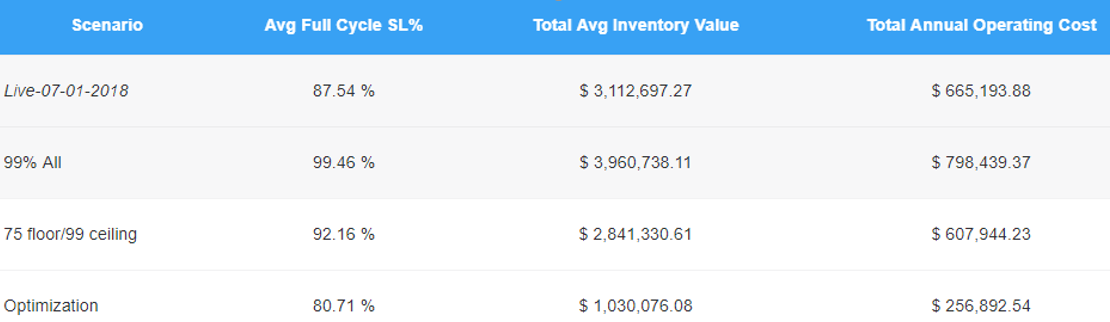
          The figure below shows how supply chain analytics can help the inventory manager. The columns show three predicted Key Performance Indicators (KPI’s): service level, inventory investment, and operating costs (holding costs + ordering costs + shortage costs).

           Figure 1: The three types of analytics used to evaluate planning scenarios

          The rows show four alternative inventory policies, expressed as scenarios. The “Live” scenario reports on the values of the KPI’s on July 1, 2018. The “99% All” scenario changes the current policy by raising the service level of all items to 99%. The “75 floor/99 ceiling” scenario raises service levels that are too low up to 75% and lowers very high (i.e., expensive) service levels down to 95%. The “Optimization” scenario prescribes item specific service levels that minimizes total operating costs.

          The “Live 07-01-2018” scenario is an example of Descriptive Analytics. It shows the current baseline performance. The software then allows the user to try out changes in inventory policy by creating new “What If” scenarios that might then be converted to named scenarios for further consideration. The next two scenarios are examples of Predictive Analytics. They both assess the consequences of their recommended inventory control policies, i.e., recommended values of Min and Max for all items. The “Optimization” scenario is an example of Prescriptive Analytics because it recommends a best compromise policy.

          Consider how the three alternative scenarios compare to the baseline “Live” scenario. The “99% All” scenario raises the item availability metrics, increasing service level from 88% to 99%. However, doing so increases the total inventory investment from $3 million to about $4 million. In contrast, the “75 floor/99 ceiling” scenario increases both service level and reduces the cash tied up in inventory by about $300,000. Finally, the “Optimization” scenario achieves an 80% service level, a reduction from the current 88%, but it cuts more than $2 million from the inventory value and reduces operating costs by more than $400,000 annually. From here, managers could try further options, such as giving back some of the $2 million savings to achieve a higher average service level.

          Summary

          Modern software packages for inventory planning and inventory optimization should offer three kinds of supply chain analytics: Descriptive, Predictive, and Prescriptive. Their combination lets inventory managers track their operations (Descriptive), forecast where their operations will be in the future (Predictive), and optimize their inventory policies in response in anticipation of future conditions (Prescriptive).


          Leave a Comment

          Related Posts

          Why Inventory Planning Shouldn’t Rely Exclusively on Simple Rules of Thumb

          Why Inventory Planning Shouldn’t Rely Exclusively on Simple Rules of Thumb

          For too many companies, a critical piece of data fact-finding ― the measurement of demand uncertainty ― is handled by simple but inaccurate rules of thumb. For example, demand planners will often compute safety stock by a user-defined multiple of the forecast or historical average. Or they may configure their ERP to order more when on hand inventory gets to 2 x the average demand over the lead time for important items and 1.5 x for less important ones. This is a huge mistake with costly consequences.

          Why MRO Businesses Should Care About Excess Inventory

          Why MRO Businesses Should Care About Excess Inventory

          Do MRO companies genuinely prioritize reducing excess spare parts inventory? From an organizational standpoint, our experience suggests not necessarily. Boardroom discussions typically revolve around expanding fleets, acquiring new customers, meeting service level agreements (SLAs), modernizing infrastructure, and maximizing uptime. In industries where assets supported by spare parts cost hundreds of millions or generate significant revenue (e.g., mining or oil & gas), the value of the inventory just doesn’t raise any eyebrows, and organizations tend to overlook massive amounts of excessive inventory.

          Constructive Play with Digital Twins

          Constructive Play with Digital Twins

          Those of you who track hot topics will be familiar with the term “digital twin.” Those who have been too busy with work may want to read on and catch up. While there are several definitions of digital twin, here’s one that works well: A digital twin is a dynamic virtual copy of a physical asset, process, system, or environment that looks like and behaves identically to its real-world counterpart. A digital twin ingests data and replicates processes so you can predict possible performance outcomes and issues that the real-world product might undergo.

          Recent Posts

          • Managing Spare Parts Inventory: Best PracticesManaging Spare Parts Inventory: Best Practices
            In this blog, we’ll explore several effective strategies for managing spare parts inventory, emphasizing the importance of optimizing stock levels, maintaining service levels, and using smart tools to aid in decision-making. Managing spare parts inventory is a critical component for businesses that depend on equipment uptime and service reliability. Unlike regular inventory items, spare parts often have unpredictable demand patterns, making them more challenging to manage effectively. An efficient spare parts inventory management system helps prevent stockouts that can lead to operational downtime and costly delays while also avoiding overstocking that unnecessarily ties up capital and increases holding costs. […]
          • 5 Ways to Improve Supply Chain Decision Speed5 Ways to Improve Supply Chain Decision Speed
            The promise of a digital supply chain has transformed how businesses operate. At its core, it can make rapid, data-driven decisions while ensuring quality and efficiency throughout operations. However, it's not just about having access to more data. Organizations need the right tools and platforms to turn that data into actionable insights. This is where decision-making becomes critical, especially in a landscape where new digital supply chain solutions and AI-driven platforms can support you in streamlining many processes within the decision matrix. […]
          • Two employees checking inventory in temporary storage in a distribution warehouse.12 Causes of Overstocking and Practical Solutions
            Managing inventory effectively is critical for maintaining a healthy balance sheet and ensuring that resources are optimally allocated. Here is an in-depth exploration of the main causes of overstocking, their implications, and possible solutions. […]
          • FAQ Mastering Smart IP&O for Better Inventory ManagementFAQ: Mastering Smart IP&O for Better Inventory Management.
            Effective supply chain and inventory management are essential for achieving operational efficiency and customer satisfaction. This blog provides clear and concise answers to some basic and other common questions from our Smart IP&O customers, offering practical insights to overcome typical challenges and enhance your inventory management practices. Focusing on these key areas, we help you transform complex inventory issues into strategic, manageable actions that reduce costs and improve overall performance with Smart IP&O. […]
          • 7 Key Demand Planning Trends Shaping the Future7 Key Demand Planning Trends Shaping the Future
            Demand planning goes beyond simply forecasting product needs; it's about ensuring your business meets customer demands with precision, efficiency, and cost-effectiveness. Latest demand planning technology addresses key challenges like forecast accuracy, inventory management, and market responsiveness. In this blog, we will introduce critical demand planning trends, including data-driven insights, probabilistic forecasting, consensus planning, predictive analytics, scenario modeling, real-time visibility, and multilevel forecasting. These trends will help you stay ahead of the curve, optimize your supply chain, reduce costs, and enhance customer satisfaction, positioning your business for long-term success. […]

            Inventory Optimization for Manufacturers, Distributors, and MRO

            • Managing Spare Parts Inventory: Best PracticesManaging Spare Parts Inventory: Best Practices
              In this blog, we’ll explore several effective strategies for managing spare parts inventory, emphasizing the importance of optimizing stock levels, maintaining service levels, and using smart tools to aid in decision-making. Managing spare parts inventory is a critical component for businesses that depend on equipment uptime and service reliability. Unlike regular inventory items, spare parts often have unpredictable demand patterns, making them more challenging to manage effectively. An efficient spare parts inventory management system helps prevent stockouts that can lead to operational downtime and costly delays while also avoiding overstocking that unnecessarily ties up capital and increases holding costs. […]
            • Innovating the OEM Aftermarket with AI-Driven Inventory Optimization XLInnovating the OEM Aftermarket with AI-Driven Inventory Optimization
              The aftermarket sector provides OEMs with a decisive advantage by offering a steady revenue stream and fostering customer loyalty through the reliable and timely delivery of service parts. However, managing inventory and forecasting demand in the aftermarket is fraught with challenges, including unpredictable demand patterns, vast product ranges, and the necessity for quick turnarounds. Traditional methods often fall short due to the complexity and variability of demand in the aftermarket. The latest technologies can analyze large datasets to predict future demand more accurately and optimize inventory levels, leading to better service and lower costs. […]
            • Future-Proofing Utilities. Advanced Analytics for Supply Chain OptimizationFuture-Proofing Utilities: Advanced Analytics for Supply Chain Optimization
              Utilities in the electrical, natural gas, urban water, and telecommunications fields are all asset-intensive and reliant on physical infrastructure that must be properly maintained, updated, and upgraded over time. Maximizing asset uptime and the reliability of physical infrastructure demands effective inventory management, spare parts forecasting, and supplier management. A utility that executes these processes effectively will outperform its peers, provide better returns for its investors and higher service levels for its customers, while reducing its environmental impact. […]
            • Centering Act Spare Parts Timing Pricing and ReliabilityCentering Act: Spare Parts Timing, Pricing, and Reliability
              In this article, we'll walk you through the process of crafting a spare parts inventory plan that prioritizes availability metrics such as service levels and fill rates while ensuring cost efficiency. We'll focus on an approach to inventory planning called Service Level-Driven Inventory Optimization. Next, we'll discuss how to determine what parts you should include in your inventory and those that might not be necessary. Lastly, we'll explore ways to enhance your service-level-driven inventory plan consistently. […]
              Smart Software to Help New Jersey Transit Improve Inventory Planning and Service Parts Availability

              Belmont, Mass., June 13, 2013 – Smart Software, Inc., provider of industry-leading demand forecasting, planning, and inventory optimization solutions, today announced that New Jersey Transit (NJT) has purchased Smart’s flagship product, SmartForecasts®, for its rail and bus operations as part of a company-wide service improvement and inventory reduction program. NJT is the nation’s third largest provider of bus, rail and light rail transit, and links major points in New Jersey, New York and Philadelphia.

              NJT will use SmartForecasts to forecast parts consumption and inventory stocking requirements for its 40,000 active spare and service parts, valued at more than $100 million. Much of NJT’s inventory experiences erratic, intermittent demand which is especially difficult to forecast and can lead to significant over- and under-stocking of critical parts.  Early results with SmartForecasts indicate the potential for substantial savings and service level improvements, once full-scale implementation is complete.

              Smart Software will implement the NJT project in two stages. The first stage will focus on using SmartForecasts to identify immediate short term benefits for key groups of parts, as well as measure the likely long term benefits for NJT. In the second stage, SmartForecasts will be integrated into the day-to-day planning environment at New Jersey Transit.

              SmartForecasts offers unique, patented statistical solutions to forecast intermittent demand, a particularly challenging aspect of service parts management, as well as a complete suite of automated forecasting and planning methodologies.  By automatically identifying the right method for each part, SmartForecasts can significantly reduce the amount of inventory required to meet a defined level of service.

              “We have had several very strong successes helping transit systems improve their parts inventory planning and provide better service to their customers with better parts availability,” said Nelson Hartunian, CEO of Smart Software. “Organizations like New Jersey Transit are looking for ways to help them reduce their costs without negatively impacting customer service. With ridership trending up, this is ever more important. We look forward to helping NJT achieve its goals.”

              About New Jersey Transit
              NJ TRANSIT is New Jersey’s public transportation corporation. Its mission is to provide safe, reliable, convenient and cost-effective transit service with a skilled team of employees, dedicated to our customers’ needs and committed to excellence. Covering a service area of 5,325 square miles, NJ Transit is the nation’s third largest provider of bus, rail and light rail transit, linking major points in New Jersey, New York and Philadelphia. The agency operates a fleet of 2,027 buses, 711 trains and 45 light rail vehicles. On 236 bus routes and 11 rail lines statewide, NJ Transit provides nearly 223 million passenger trips each year. In addition, the agency provides support and equipment to privately-owned contract bus carriers. For additional information about NJ Transit, click here.

              About Smart Software, Inc.
              Founded in 1981, Smart Software, Inc. is a leading provider of enterprise-wide demand forecasting, planning and inventory optimization solutions.  Smart Software’s flagship product, SmartForecasts, has thousands of users worldwide, including customers at mid-market enterprises and Fortune 500 companies, such as Abbott Laboratories, Metro-North Railroad, Siemens, Disney, Nestle, Nikon, GE and The Coca-Cola Company.  Smart Software is headquartered in Belmont, Massachusetts and can be found online at www.smartsoftware.wpengine.com .

              SmartForecasts is a registered trademark of Smart Software, Inc.  All other trademarks are the property of their respective owners.


              For more information, please contact Smart Software, Inc., Four Hill Road, Belmont, MA 02478.
              Phone: 1-800-SMART-99 (800-762-7899); FAX: 1-617-489-2748; E-mail: info@smartsoftware.wpengine.com