Spare Parts Planning Webinar for Public Transit Agencies

Spare Parts Planning in the Age of Covid: Problems and Solutions for Public Transit Agencies

Covid has wreaked havoc on public transit. Plummeting ridership, reduced capacity, unprecedented losses in fare and tax revenue, along with added costs to keep buses and trains safe have resulted in massive transit system budget shortfalls. APTA reports that even with two rounds of emergency funding, public transit agencies will face a projected shortfall of $39.3 Billion through 2023.

This webinar will address the need for transit agencies to reconsider traditional practices, find innovative ways to capture cost savings, and do so without jeopardizing service levels. Greg Hartunian, CEO of Smart Software, will discuss the particular challenge of spare parts planning, why traditional practices used today fail, and how inventory forecasting technology is being harnessed to optimize performance and drive significant financial return.

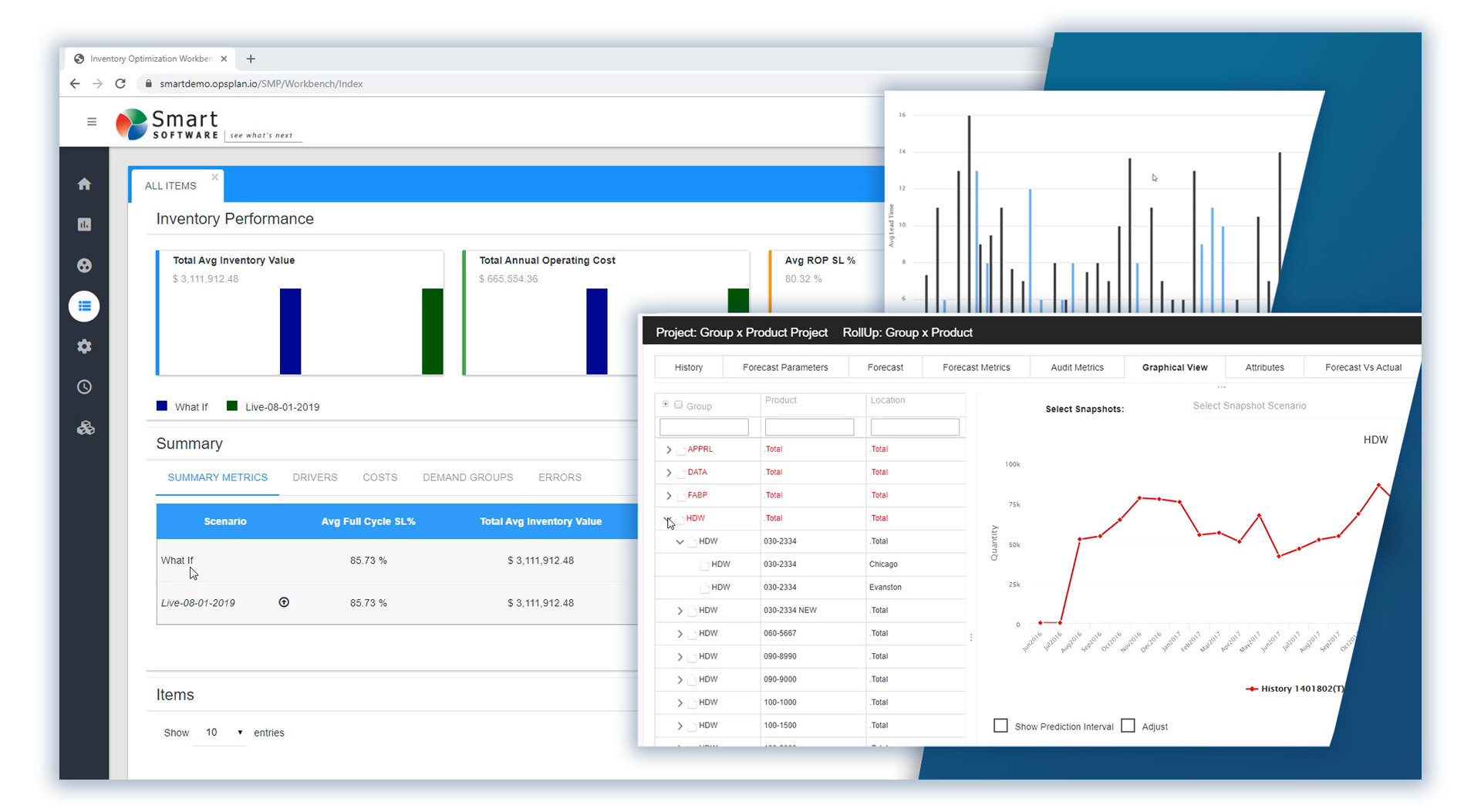
Greg will highlight the experience of Smart Software’s transit customers, how they’ve generated bottom-line savings, what they are doing to prepare for the rebound, and share a technology demonstration using transit industry data. Please feel free to review the content below. We have provided case studies profiling the use of our technology within public transit and a software review from APICS Magazine.

Transit Specific Content


About Smart Software, Inc.

Founded in 1981, Smart Software, Inc. is a leader in providing businesses with enterprise-wide demand forecasting, planning, and inventory optimization solutions.  Smart Software’s demand forecasting and inventory optimization solutions have helped thousands of users worldwide, including customers at mid-market enterprises and Fortune 500 companies, such as Disney, Siemens, Metro Transit, APS, and The American Red Cross.  Smart Inventory Planning & Optimization gives demand planners the tools to handle sales seasonality, promotions, new and aging products, multi-dimensional hierarchies, and intermittently demanded service parts and capital goods items.  It also provides inventory managers with accurate estimates of the optimal inventory and safety stock required to meet future orders and achieve desired service levels.  Smart Software is headquartered in Belmont, Massachusetts, and can be found on the World Wide Web at www.smartcorp.com.


SmartForecasts and Smart IP&O have registered trademarks of Smart Software, Inc.  All other trademarks are their respective owners’ property.

For more information, please contact Smart Software, Inc., Four Hill Road, Belmont, MA 02478.
Phone: 1-800-SMART-99 (800-762-7899); FAX: 1-617-489-2748; E-mail: info@smartcorp.com


Gaming Out Your Logistical Response to the Corona Virus

The Smart Forecaster

 Pursuing best practices in demand planning,

forecasting and inventory optimization

​As the world holds its breathe to see how the new corona virus (2019-nCOV) will play out, we cross our fingers for all those currently in quarantine or under treatment and pray that health authorities around the world will soon get the upper hand.

This short note is about one way your business can develop a plan to adjust to one of the likely fallouts from the virus: sudden increases in the time it takes to get inventory replenishment from suppliers. Supply chains around the world are being disrupted. If this happens to you, how can you react in a systematic way?

Reacting to Longer Lead Times

This is a problem that can be solved using advanced supply chain analytics. Presumably, you may have already used this technology to make good choices for the control parameters used in managing all your inventory items, e.g., values for Min and Max or Reorder Point and Order Quantity. The specific technical question addressed here is how to convert an increase in replenishment lead time to changes in those control parameters.

In general, longer lead times require fatter inventories if you want to maintain a high level of customer service. This general rule translates into larger values of Min and/or Max. How much larger depends critically on what new, longer lead time values will appear and their probabilities of occurring.

While many planning software systems assume a fixed lead time, the reality is that almost all lead times have some degree of randomness. Typically, ignoring that randomness increases stockout risk, so having a good estimate of the probability distribution of lead times is important. In normal times, your transactional data can be used to estimate that relationship. But sudden disruptions like 2019-nCOV create unprecedented situations in which you have to make educated guesses about what new delays you will see and how likely they are. We will assume here that you can imagine some such scenarios and want to figure out how to best respond to them.

An Example using Advanced Software

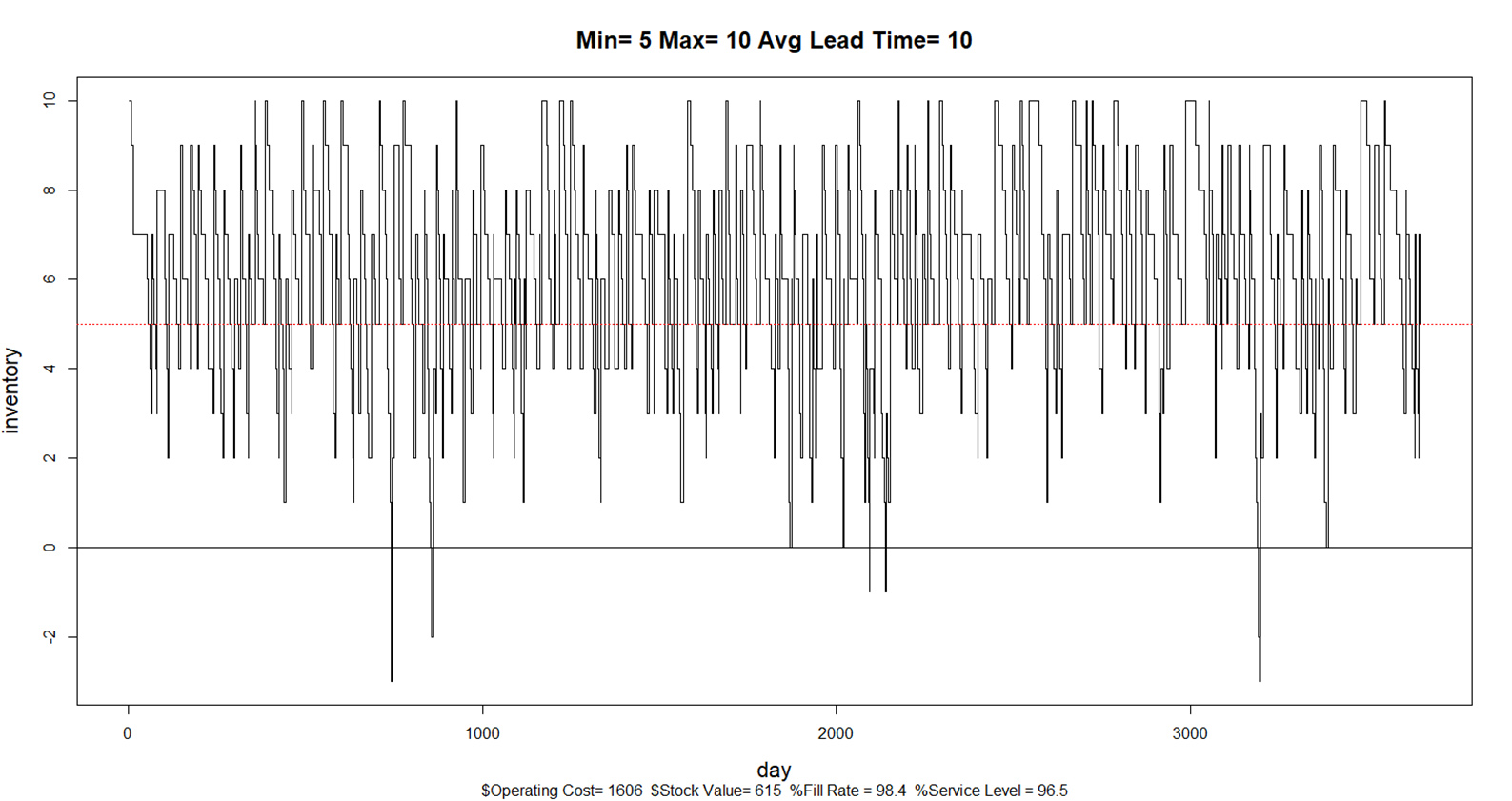
To illustrate this type of prospective planning, consider a hypothetical example. One item, a spare part, has an established pattern of replenishment lead times, with delays of 5, 10 and 15 days occurring with 15%, 70% and 15% probabilities, respectively. Given this distribution and a random demand averaging one unit every 5 days, values of Min = 5 and Max = 10 do a good job. Figure 1 shows a simulation of 10 years of daily operation under this scenario. Fill rate and service level are high, and stockouts are infrequent.

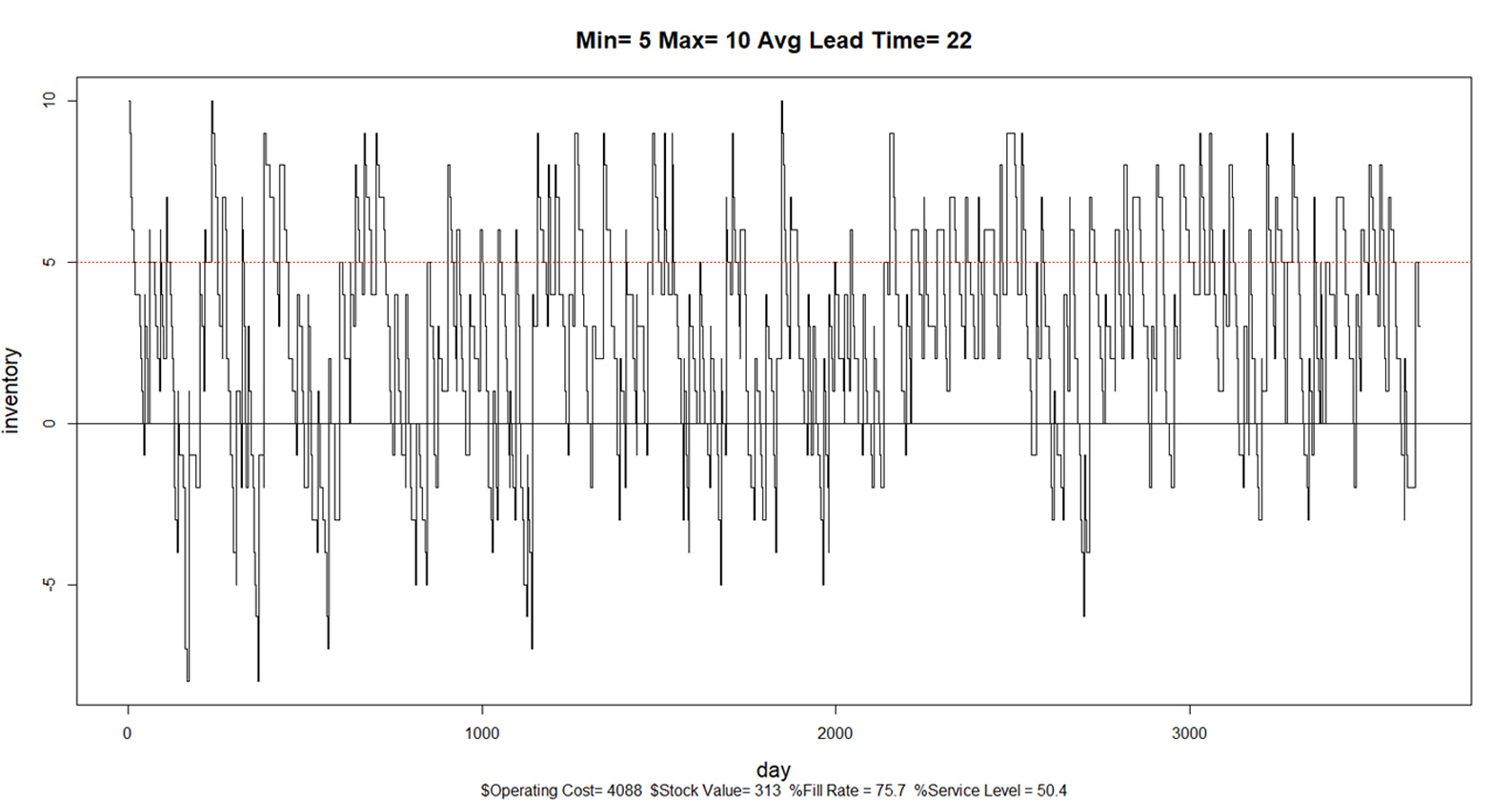
Now suppose that disruptions in the supply chain create a less favorable distribution of lead time, with a 50:50 mix of 15 and 30 days. Figure 2 shows how badly the current values of Min and Max perform in this new scenario. Fill rate and service level plummet due to frequent stockouts. Operating costs more than triple due to penalties for backorders. Only inventory investment (the average dollar value of stock on the shelf) seems to get better, but this happens only because so often there are backorders with nothing left on the shelf. The shift to longer lead times clearly requires new higher values of Min and Max.

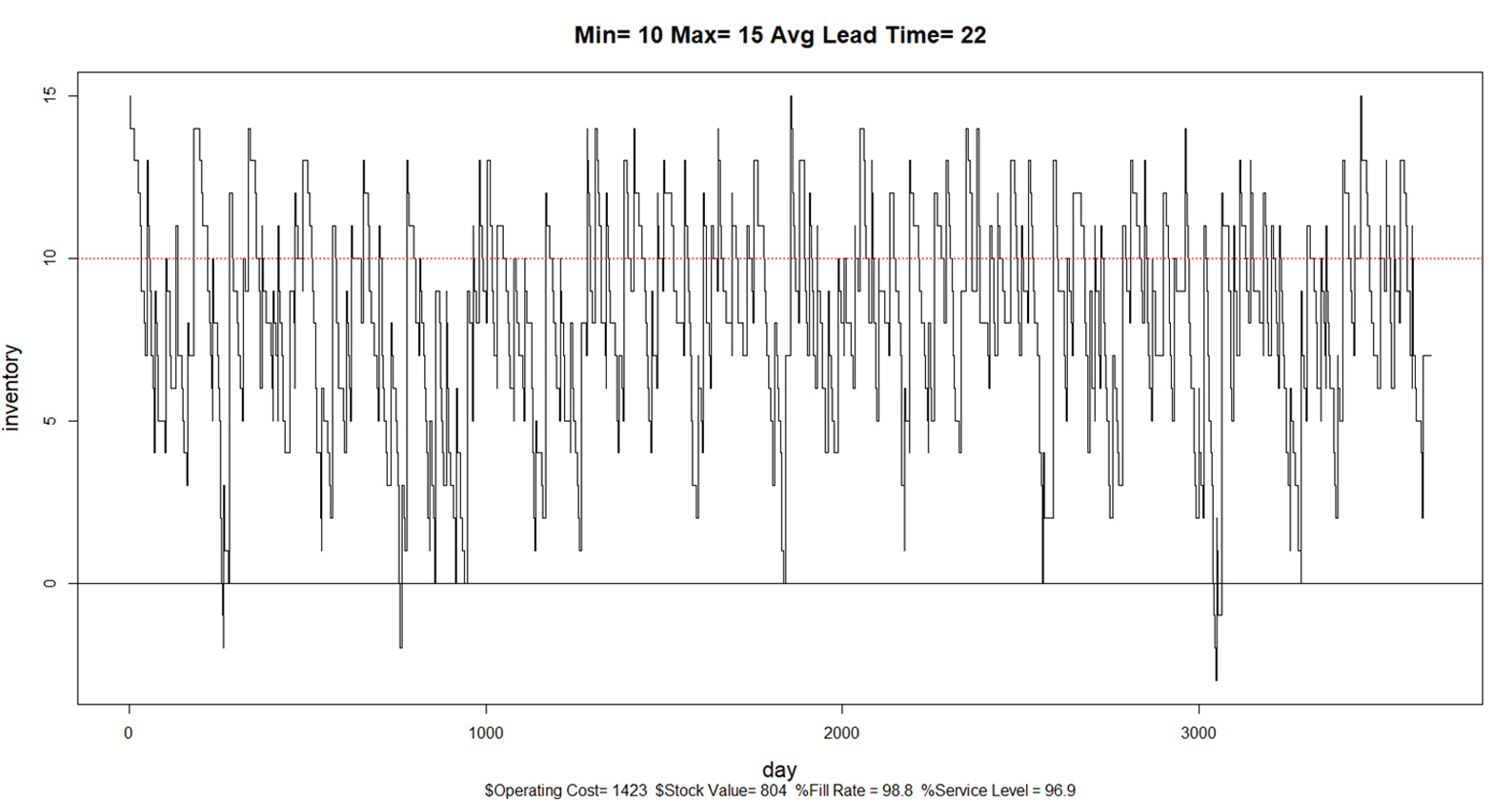
Figure 3 shows how the system performs when the Min is increased from 5 to 10 and the Max from 10 to 15. This change compensates for the longer lead times, restoring the previous high levels of fill rate and service level. Inventory investment is necessarily greater, but operating costs are actually lower than before.

Summary

Changes in normal operating conditions require adjustments in the way inventory items are managed. One such change looming large on this date is the potential impact of the 2019-nCOV Corona virus on supply chains, with anticipated increases in replenishment lead times.

Changes in lead times require changes in inventory control parameters such as Min’s and Max’s. These changes are difficult to make with any confidence using pure guesswork. But with some estimate of the increase in lead times, you can use advanced software to learn how to make these adjustments with some confidence.

This note illustrates this point using simulations of the daily operation of an inventory control system.

Figure 1 Simulation of normal operations using current replenishment lead times, Min and Max

Figure 2 Simulation of abnormal operations using longer lead times and current Min and Max

Figure 3 Simulation of abnormal operations using longer lead times and revised Min and Max

Leave a Comment

Related Posts

Key Considerations When Evaluating your ERP system’s Forecasting Capabilities

Key Considerations When Evaluating your ERP system’s Forecasting Capabilities

Consider what is meant by “demand management”, “demand planning”, and “forecasting”. These terms imply certain standard functionality for collaboration, statistical analysis, and reporting to support a professional demand planning process.  However, in most ERP systems, “demand management” running MRP and reconciling demand and supply for the purpose of placing orders

The 3 Types of Supply Chain Analytics

The 3 Types of Supply Chain Analytics

The three types of supply chain analytics are “descriptive”, “predictive”, and “prescriptive.” Each plays a different role in helping you manage your inventory. Modern supply chain software lets you exploit all three helping you to reduce inventory costs, improve on time delivery and service levels, while running a more efficient supply chain.

The Right Forecast Accuracy Metric for Inventory Planning

The Right Forecast Accuracy Metric for Inventory Planning

Testing software solutions via a series of empirical competition can be an attractive option. In the case of forecasting and demand planning, a traditional “hold out” test is a good way to assess monthly or weekly forecast accuracy, but it is minimally useful if you have a different objective: Optimizing inventory.

Recent Posts

  • Managing Spare Parts Inventory: Best PracticesManaging Spare Parts Inventory: Best Practices
    In this blog, we’ll explore several effective strategies for managing spare parts inventory, emphasizing the importance of optimizing stock levels, maintaining service levels, and using smart tools to aid in decision-making. Managing spare parts inventory is a critical component for businesses that depend on equipment uptime and service reliability. Unlike regular inventory items, spare parts often have unpredictable demand patterns, making them more challenging to manage effectively. An efficient spare parts inventory management system helps prevent stockouts that can lead to operational downtime and costly delays while also avoiding overstocking that unnecessarily ties up capital and increases holding costs. […]
  • 5 Ways to Improve Supply Chain Decision Speed5 Ways to Improve Supply Chain Decision Speed
    The promise of a digital supply chain has transformed how businesses operate. At its core, it can make rapid, data-driven decisions while ensuring quality and efficiency throughout operations. However, it's not just about having access to more data. Organizations need the right tools and platforms to turn that data into actionable insights. This is where decision-making becomes critical, especially in a landscape where new digital supply chain solutions and AI-driven platforms can support you in streamlining many processes within the decision matrix. […]
  • Two employees checking inventory in temporary storage in a distribution warehouse.12 Causes of Overstocking and Practical Solutions
    Managing inventory effectively is critical for maintaining a healthy balance sheet and ensuring that resources are optimally allocated. Here is an in-depth exploration of the main causes of overstocking, their implications, and possible solutions. […]
  • FAQ Mastering Smart IP&O for Better Inventory ManagementFAQ: Mastering Smart IP&O for Better Inventory Management.
    Effective supply chain and inventory management are essential for achieving operational efficiency and customer satisfaction. This blog provides clear and concise answers to some basic and other common questions from our Smart IP&O customers, offering practical insights to overcome typical challenges and enhance your inventory management practices. Focusing on these key areas, we help you transform complex inventory issues into strategic, manageable actions that reduce costs and improve overall performance with Smart IP&O. […]
  • 7 Key Demand Planning Trends Shaping the Future7 Key Demand Planning Trends Shaping the Future
    Demand planning goes beyond simply forecasting product needs; it's about ensuring your business meets customer demands with precision, efficiency, and cost-effectiveness. Latest demand planning technology addresses key challenges like forecast accuracy, inventory management, and market responsiveness. In this blog, we will introduce critical demand planning trends, including data-driven insights, probabilistic forecasting, consensus planning, predictive analytics, scenario modeling, real-time visibility, and multilevel forecasting. These trends will help you stay ahead of the curve, optimize your supply chain, reduce costs, and enhance customer satisfaction, positioning your business for long-term success. […]

    Inventory Optimization for Manufacturers, Distributors, and MRO

    • Managing Spare Parts Inventory: Best PracticesManaging Spare Parts Inventory: Best Practices
      In this blog, we’ll explore several effective strategies for managing spare parts inventory, emphasizing the importance of optimizing stock levels, maintaining service levels, and using smart tools to aid in decision-making. Managing spare parts inventory is a critical component for businesses that depend on equipment uptime and service reliability. Unlike regular inventory items, spare parts often have unpredictable demand patterns, making them more challenging to manage effectively. An efficient spare parts inventory management system helps prevent stockouts that can lead to operational downtime and costly delays while also avoiding overstocking that unnecessarily ties up capital and increases holding costs. […]
    • Innovating the OEM Aftermarket with AI-Driven Inventory Optimization XLInnovating the OEM Aftermarket with AI-Driven Inventory Optimization
      The aftermarket sector provides OEMs with a decisive advantage by offering a steady revenue stream and fostering customer loyalty through the reliable and timely delivery of service parts. However, managing inventory and forecasting demand in the aftermarket is fraught with challenges, including unpredictable demand patterns, vast product ranges, and the necessity for quick turnarounds. Traditional methods often fall short due to the complexity and variability of demand in the aftermarket. The latest technologies can analyze large datasets to predict future demand more accurately and optimize inventory levels, leading to better service and lower costs. […]
    • Future-Proofing Utilities. Advanced Analytics for Supply Chain OptimizationFuture-Proofing Utilities: Advanced Analytics for Supply Chain Optimization
      Utilities in the electrical, natural gas, urban water, and telecommunications fields are all asset-intensive and reliant on physical infrastructure that must be properly maintained, updated, and upgraded over time. Maximizing asset uptime and the reliability of physical infrastructure demands effective inventory management, spare parts forecasting, and supplier management. A utility that executes these processes effectively will outperform its peers, provide better returns for its investors and higher service levels for its customers, while reducing its environmental impact. […]
    • Centering Act Spare Parts Timing Pricing and ReliabilityCentering Act: Spare Parts Timing, Pricing, and Reliability
      In this article, we'll walk you through the process of crafting a spare parts inventory plan that prioritizes availability metrics such as service levels and fill rates while ensuring cost efficiency. We'll focus on an approach to inventory planning called Service Level-Driven Inventory Optimization. Next, we'll discuss how to determine what parts you should include in your inventory and those that might not be necessary. Lastly, we'll explore ways to enhance your service-level-driven inventory plan consistently. […]

      There is a way your business can develop a plan to adjust increasing Demand. Cloud computing companies with unique server and hardware parts, e-commerce, online retailers, home and office supply companies, onsite furniture, power utilities, intensive assets maintenance or warehousing for water supply companies have increased their activity during the pandemic.Delivery service companies, cleaning services, liquor stores and canned or jarred goods warehouses, home improvement stores, gardening suppliers, yard care companies, hardware, kitchen and baking supplies stores, home furniture suppliers with high demand are facing stockouts, long lead times, inventory shortage costs, higher operating costs and ordering costs. Garages selling car parts and truck parts, pharmaceuticals, healthcare or medical supply manufacturers and safety product suppliers are dealing with increasing demand.

      Smart Software Senior VP/Research to present at Military Operations Research Society (MORS) Emerging Techniques Forum
      Smart Software announced today that its co-founder and Senior VP of Research, Dr. Thomas Willemain, has been selected to present at the prestigious MORS Emerging Techniques Forum December 4 – 5, 2019 in Alexandria, VA. MORS is the Military Operations Research Society, funded by the Navy, Army, Air Force, Marine Corps, Office of the Secretary of the Defense and the Department of Homeland Security. Its mission is to enhance the quality of analysis that informs national and homeland security decisions. The Emerging Techniques Forum provides the defense analytic community with extensive content on emerging analytic topics and techniques. Willemain will be one of a small number of experts speaking in the Computational Advances in Analytics track. This track addresses new tools and techniques that leverage increased computing power and data availability. Willemain’s topic will be “Validating Demand Scenario Generators for Inventory Optimization.” This research is part of Smart Software’s continuing work to push the state of the art in managing fleets of spare parts and hard to forecast items.  These advancements will be incorporated into Smart IP&O, the company’s multi-tenant web based platform for forecasting, inventory planning and optimization.  The research began with Dr. Willemain’s doctoral students at Rensselaer Polytechnic Institute, where he remains active as Professor Emeritus of Industrial and Systems Engineering.   About Smart Software, Inc. Founded in 1981, Smart Software, Inc. is a leader in providing businesses with enterprise-wide demand forecasting, planning and inventory optimization solutions.  Smart Software’s demand forecasting and inventory optimization solutions have helped thousands of users worldwide, including customers at mid-market enterprises and Fortune 500 companies, such as Mitsubishi, Siemens, Disney, FedEx, MARS, and The Home Depot.  Smart Inventory Planning & Optimization gives demand planners the tools to handle sales seasonality, promotions, new and aging products, multi-dimensional hierarchies, and intermittently demanded service parts and capital goods items.  It also provides inventory managers with accurate estimates of the optimal inventory and safety stock required to meet future orders and achieve desired service levels.  Smart Software is headquartered in Belmont, Massachusetts and can be found on the World Wide Web at www.smartcorp.com. SmartForecasts and Smart IP&O are registered trademarks of Smart Software, Inc.  All other trademarks are the property of their respective owners.
      For more information, please contact Smart Software, Inc., Four Hill Road, Belmont, MA 02478. Phone: 1-800-SMART-99 (800-762-7899); FAX: 1-617-489-2748; E-mail: info@smartcorp.com  
      Caught in a Perfect Storm, SmartForecasts Helps Rev-A-Shelf Weather the Crisis

      The Smart Forecaster

      Pursuing best practices in demand planning, forecasting and inventory optimization

      Does your extended supply chain suffer from extreme seasonal variability? Does this situation challenge your ability to meet service level commitments to your customers? I have grappled with this at Rev-A-Shelf, addressing unusual conditions created by Chinese New Year and other global events, and would like to share the experience and a few things I learned along the way.

      First, let me explain our situation. We import 60% of the parts we use to build our kitchen and bath accessories from China and Europe. Most of the year we were able to plan our inventory needs using a spreadsheet-based min/max approach. But not during Chinese New Year, which drives the planet’s greatest annual population migration. Chinese New Year shuts down production for up to two months, creating significant supply risk as we strive to meet our three day order fulfillment commitment.

      We solved our problem, introducing statistical demand forecasting with the flexibility to extend lead times when necessary, the ability to reliably establish safety stocks that achieve our required service levels and a continuous reporting system that lets everyone know exactly where we stand. However, success required much more than a new piece of software. We needed to change the way we view future demand, supply risk and safety stock. Here are a few key things we did that made all the difference.

      Stakeholder education and buy-in

      Regardless of the project, it’s always best to enlist the buy-in of all stakeholders. We knew we had to do something to solve our problem, but there was bound to be resistance. Senior managers, for example, had developed a healthy distrust of software and wondered whether demand forecasting software could help. Our buyers had developed their own perspectives and procurement methods, and felt personally at risk as we considered new approaches.

      People came around as they developed a common understanding of the problem and how we would address it. Education was a big part of the solution. We explained how forecasting works and key factors we should all understand: how to analyze trends, how to use “what if” scenarios, impact of shifting lead times, how to relate service levels to supply risk and safety stock and key performance indicators like inventory turns. Going through this process together, we all became stakeholders in the solution.

      Use the Right software

      When you have lots of part numbers and any sort of supply or demand variability, you just cannot forecast effectively with a spreadsheet. With our min/max forecasting system, we were planning to an average, and it wasn’t working. Average usage has inherent flaws for planning purposes—it’s always looking backward!

      You need software that looks ahead, recognizes seasonal patterns and enables you to determine how much stock you’ll need to meet required service levels over varying lead times.

      Fine-tune processes

      When the old ways don’t work, you need to be open to adjusting your assumptions. Think less about where you’ve been, and more about where you want to be. Take a look at your lead times and plan to your desired service level. Last year’s history may not be the best predictor of this year’s demand. The same forecast horizon may not be appropriate for all products or certain time of the year.

      Make the Forecast Actionable

      It’s not enough to produce an accurate forecast and estimated inventory stocking levels. You’ve got to develop a way to make the information actionable for those tasked with using it. We developed a set of reports that enabled buyers to leverage better forecast and safety stock information. Now, at the end of every month, we produce a forecast report that provides a clear picture of current inventory, safety stock, past usage, forecasted usage, incoming deliveries (PO’s) and recommended order quantities.

      Validate Results

      You can, and we did, test our new methods against our own demand history. Still, an authoritative outsider can make acceptance easier. We commissioned a study by a professor at Louisville University’s College of Business who set one of her graduate students to the task. Through them we were able to reinforce what we saw happening from our results, and feel comfortable that we were on a good path.

      All of these factors helped Rev-A-Shelf transform its demand planning process, to great effect. Today we are exceeding our service level targets, and our fill rate, based on a three day ship cycle, is showing steady improvement, and trending up. Overall, units-in-stock have stayed flat while supporting a 13% increase in sales

      John Engelhardt is currently Director of Purchasing and Asian Operations for Rev-a-Shelf, LLC in Louisville, KY. He has held a variety of management positions both in private business and public organizations. At Rev-A-Shelf he held the position of International Sales Manager and Director of Sales Support before assuming his current position. He can be reached at johne at rev-a-shelf dot com.


      Leave a Comment

      Related Posts

      Key Considerations When Evaluating your ERP system’s Forecasting Capabilities

      Key Considerations When Evaluating your ERP system’s Forecasting Capabilities

      Consider what is meant by “demand management”, “demand planning”, and “forecasting”. These terms imply certain standard functionality for collaboration, statistical analysis, and reporting to support a professional demand planning process.  However, in most ERP systems, “demand management” running MRP and reconciling demand and supply for the purpose of placing orders

      The 3 Types of Supply Chain Analytics

      The 3 Types of Supply Chain Analytics

      The three types of supply chain analytics are “descriptive”, “predictive”, and “prescriptive.” Each plays a different role in helping you manage your inventory. Modern supply chain software lets you exploit all three helping you to reduce inventory costs, improve on time delivery and service levels, while running a more efficient supply chain.

      The Right Forecast Accuracy Metric for Inventory Planning

      The Right Forecast Accuracy Metric for Inventory Planning

      Testing software solutions via a series of empirical competition can be an attractive option. In the case of forecasting and demand planning, a traditional “hold out” test is a good way to assess monthly or weekly forecast accuracy, but it is minimally useful if you have a different objective: Optimizing inventory.

      Recent Posts

      • Managing Spare Parts Inventory: Best PracticesManaging Spare Parts Inventory: Best Practices
        In this blog, we’ll explore several effective strategies for managing spare parts inventory, emphasizing the importance of optimizing stock levels, maintaining service levels, and using smart tools to aid in decision-making. Managing spare parts inventory is a critical component for businesses that depend on equipment uptime and service reliability. Unlike regular inventory items, spare parts often have unpredictable demand patterns, making them more challenging to manage effectively. An efficient spare parts inventory management system helps prevent stockouts that can lead to operational downtime and costly delays while also avoiding overstocking that unnecessarily ties up capital and increases holding costs. […]
      • 5 Ways to Improve Supply Chain Decision Speed5 Ways to Improve Supply Chain Decision Speed
        The promise of a digital supply chain has transformed how businesses operate. At its core, it can make rapid, data-driven decisions while ensuring quality and efficiency throughout operations. However, it's not just about having access to more data. Organizations need the right tools and platforms to turn that data into actionable insights. This is where decision-making becomes critical, especially in a landscape where new digital supply chain solutions and AI-driven platforms can support you in streamlining many processes within the decision matrix. […]
      • Two employees checking inventory in temporary storage in a distribution warehouse.12 Causes of Overstocking and Practical Solutions
        Managing inventory effectively is critical for maintaining a healthy balance sheet and ensuring that resources are optimally allocated. Here is an in-depth exploration of the main causes of overstocking, their implications, and possible solutions. […]
      • FAQ Mastering Smart IP&O for Better Inventory ManagementFAQ: Mastering Smart IP&O for Better Inventory Management.
        Effective supply chain and inventory management are essential for achieving operational efficiency and customer satisfaction. This blog provides clear and concise answers to some basic and other common questions from our Smart IP&O customers, offering practical insights to overcome typical challenges and enhance your inventory management practices. Focusing on these key areas, we help you transform complex inventory issues into strategic, manageable actions that reduce costs and improve overall performance with Smart IP&O. […]
      • 7 Key Demand Planning Trends Shaping the Future7 Key Demand Planning Trends Shaping the Future
        Demand planning goes beyond simply forecasting product needs; it's about ensuring your business meets customer demands with precision, efficiency, and cost-effectiveness. Latest demand planning technology addresses key challenges like forecast accuracy, inventory management, and market responsiveness. In this blog, we will introduce critical demand planning trends, including data-driven insights, probabilistic forecasting, consensus planning, predictive analytics, scenario modeling, real-time visibility, and multilevel forecasting. These trends will help you stay ahead of the curve, optimize your supply chain, reduce costs, and enhance customer satisfaction, positioning your business for long-term success. […]

        Inventory Optimization for Manufacturers, Distributors, and MRO

        • Managing Spare Parts Inventory: Best PracticesManaging Spare Parts Inventory: Best Practices
          In this blog, we’ll explore several effective strategies for managing spare parts inventory, emphasizing the importance of optimizing stock levels, maintaining service levels, and using smart tools to aid in decision-making. Managing spare parts inventory is a critical component for businesses that depend on equipment uptime and service reliability. Unlike regular inventory items, spare parts often have unpredictable demand patterns, making them more challenging to manage effectively. An efficient spare parts inventory management system helps prevent stockouts that can lead to operational downtime and costly delays while also avoiding overstocking that unnecessarily ties up capital and increases holding costs. […]
        • Innovating the OEM Aftermarket with AI-Driven Inventory Optimization XLInnovating the OEM Aftermarket with AI-Driven Inventory Optimization
          The aftermarket sector provides OEMs with a decisive advantage by offering a steady revenue stream and fostering customer loyalty through the reliable and timely delivery of service parts. However, managing inventory and forecasting demand in the aftermarket is fraught with challenges, including unpredictable demand patterns, vast product ranges, and the necessity for quick turnarounds. Traditional methods often fall short due to the complexity and variability of demand in the aftermarket. The latest technologies can analyze large datasets to predict future demand more accurately and optimize inventory levels, leading to better service and lower costs. […]
        • Future-Proofing Utilities. Advanced Analytics for Supply Chain OptimizationFuture-Proofing Utilities: Advanced Analytics for Supply Chain Optimization
          Utilities in the electrical, natural gas, urban water, and telecommunications fields are all asset-intensive and reliant on physical infrastructure that must be properly maintained, updated, and upgraded over time. Maximizing asset uptime and the reliability of physical infrastructure demands effective inventory management, spare parts forecasting, and supplier management. A utility that executes these processes effectively will outperform its peers, provide better returns for its investors and higher service levels for its customers, while reducing its environmental impact. […]
        • Centering Act Spare Parts Timing Pricing and ReliabilityCentering Act: Spare Parts Timing, Pricing, and Reliability
          In this article, we'll walk you through the process of crafting a spare parts inventory plan that prioritizes availability metrics such as service levels and fill rates while ensuring cost efficiency. We'll focus on an approach to inventory planning called Service Level-Driven Inventory Optimization. Next, we'll discuss how to determine what parts you should include in your inventory and those that might not be necessary. Lastly, we'll explore ways to enhance your service-level-driven inventory plan consistently. […]

          Saving Billions? How Far the ‘Center for Innovation in Logistics Systems’ Might Take the US Army

          The Smart Forecaster

          Pursuing best practices in demand planning,

          forecasting and inventory optimization

          Contributed to The Smart Forecaster by Dr. Greg Parlier (Colonel, U.S. Army, retired). Details on Dr. Parlier’s background conclude the post.

          For over two decades, the General Accounting Office (GAO) has indicated that the Defense Department’s logistics management has been ineffective and wasteful, and that the Services lack strategic plans to improve overall inventory management and supply chain performance.

          For the US Army, this problem is directly related to a persistent inability to link inventory investment levels and policies with supply chain effectiveness to achieve combat equipment readiness objectives required for globally deployed forces. This shortcoming has been attributed to numerous complexities associated with managing geographically dispersed, independently operating organizations, further compounded by a lack of visibility, authority and accountability across this vast global enterprise.

          Unlike the corporate world, where powerful forces encourage innovation to drive competitiveness and efficiency, the Army is not a revenue generating organization focused on “quarterly earnings” and profitability. Certainly, the Army wants to be an efficient consumer of resources—but unlike the private sector’s focus on profit as a bottom line, the surrogate motivator for the Army is ‘force readiness’. This includes equipment availability and weapon system readiness for current operations in Afghanistan, as well as future capability requirements directed by the National Command Authority.

          To sustain that equipment availability, the Army must synchronize disparate organizational components using myriad processes with disconnected legacy management information systems across numerous supply support activities which frequently relocate to support deploying forces.

          Today, while still engaged in Afghanistan, the Army is also committed to a comprehensive and ongoing transformation. Central to this effort is recognition that dramatic improvements must be achieved in logistics operations and supply chain management. Owning one of the world’s largest and most complex supply chains, the Army is now investing in historically unprecedented efforts to fully capitalize on the promises offered by new information-based technologies. For example, the “Single Army Logistics Enterprise” is believed to be the most ambitious and expensive Enterprise Resource Planning (ERP) implementation project ever undertaken.

          These ERP implementation projects have met with very mixed results. While the evidence suggests that dramatic performance improvements for competitive advantage can be achieved in the commercial sector, this has occurred only where so called “IT solutions” are applied to an underlying foundation of mature, efficient and appropriate business processes.

          The reality of most cases in recent years, however, has not been this success. Rather, attempts have been made to “bolt on” a solution (like an ERP system, for example) to existing business processes, in misguided efforts to replicate legacy management practices. Such efforts to automate existing processes have, all too often, simply created chaos. In fact, these attempts have not only failed to achieve anticipated improvements, but have actually resulted in reduced performance.

          The general pattern has been: the greater the IT investment and organizational scope, the more likely “failure” occurs, in the form of cost overruns, missed schedules, and even project failure—where the effort has finally been abandoned.

          We believe the way to enable a coordinated, comprehensive approach for logistics transformation is by creating an “engine for innovation” to accelerate and sustain continuous performance improvement for Army logistics and supply chain management. We are developing a ‘Center for Innovation in Logistics Systems’ to systematically evaluate major organizational components, conduct root cause analyses, diagnose structural disorders and prescribe integrated solutions. We have now identified several ‘catalysts for innovation’ to reduce supply side variability and demand uncertainty—the proximate causes of the notorious ‘bull whip effect’. These include what we refer to as the ‘readiness equation’, ‘mission-based forecasting’, ‘readiness-based sparing’ and ‘readiness responsive retrograde’.

          Our goal is to develop a comprehensive modeling capacity to generate and test these innovation catalysts along with several other initiatives in order to estimate cost effective approaches before they are adopted as policy and implemented in practice. We are looking at performance analysis, organizational design, management information and decision support concepts, enterprise systems engineering and workforce considerations including human capital investment needs.

          Examining the ‘catalysts’ in isolation, we have seen significant potential for improvement which could yield hundreds of millions of dollars in savings. When combined into new, integrated management practices, however, the potential magnitude for improvement is truly dramatic—billions of dollars in further savings are likely. More importantly, it becomes possible to relate investment levels to current readiness and future capabilities.

          The center is capable of developing ‘management innovation as a strategic technology’ by integrating advanced analytics with transformational strategic planning. By harnessing, focusing and applying the power of analysis, we are promoting both qualitative and quantitative common sense—the compelling analytical arguments for necessary change to pursue a common vision. With this power, we are beginning to educate the Army’s leadership, motivate logistics managers to action and provide a source for innovation the culture can embrace. During our journey, we have certainly adapted and applied much from both academic domains and the corporate sector. They, in turn, might now benefit from what we have been able to learn and achieve as well.

          Prior to his retirement, Colonel Parlier was the Army’s senior, most experienced operations research analyst and served as Army Aviation and Missile Command’s (AMCOM) Deputy Commander for Transformation. He is the author of Transforming U.S. Army Supply Chains: Strategies for Management Innovation, describing the analytical framework of a multi-year Army Materiel Command (AMC) research and development project providing operations research insights for use by the Army and Department of Defense.

          Leave a Comment

          Related Posts

          No Results Found

          The page you requested could not be found. Try refining your search, or use the navigation above to locate the post.

          Recent Posts

          • Managing Spare Parts Inventory: Best PracticesManaging Spare Parts Inventory: Best Practices
            In this blog, we’ll explore several effective strategies for managing spare parts inventory, emphasizing the importance of optimizing stock levels, maintaining service levels, and using smart tools to aid in decision-making. Managing spare parts inventory is a critical component for businesses that depend on equipment uptime and service reliability. Unlike regular inventory items, spare parts often have unpredictable demand patterns, making them more challenging to manage effectively. An efficient spare parts inventory management system helps prevent stockouts that can lead to operational downtime and costly delays while also avoiding overstocking that unnecessarily ties up capital and increases holding costs. […]
          • 5 Ways to Improve Supply Chain Decision Speed5 Ways to Improve Supply Chain Decision Speed
            The promise of a digital supply chain has transformed how businesses operate. At its core, it can make rapid, data-driven decisions while ensuring quality and efficiency throughout operations. However, it's not just about having access to more data. Organizations need the right tools and platforms to turn that data into actionable insights. This is where decision-making becomes critical, especially in a landscape where new digital supply chain solutions and AI-driven platforms can support you in streamlining many processes within the decision matrix. […]
          • Two employees checking inventory in temporary storage in a distribution warehouse.12 Causes of Overstocking and Practical Solutions
            Managing inventory effectively is critical for maintaining a healthy balance sheet and ensuring that resources are optimally allocated. Here is an in-depth exploration of the main causes of overstocking, their implications, and possible solutions. […]
          • FAQ Mastering Smart IP&O for Better Inventory ManagementFAQ: Mastering Smart IP&O for Better Inventory Management.
            Effective supply chain and inventory management are essential for achieving operational efficiency and customer satisfaction. This blog provides clear and concise answers to some basic and other common questions from our Smart IP&O customers, offering practical insights to overcome typical challenges and enhance your inventory management practices. Focusing on these key areas, we help you transform complex inventory issues into strategic, manageable actions that reduce costs and improve overall performance with Smart IP&O. […]
          • 7 Key Demand Planning Trends Shaping the Future7 Key Demand Planning Trends Shaping the Future
            Demand planning goes beyond simply forecasting product needs; it's about ensuring your business meets customer demands with precision, efficiency, and cost-effectiveness. Latest demand planning technology addresses key challenges like forecast accuracy, inventory management, and market responsiveness. In this blog, we will introduce critical demand planning trends, including data-driven insights, probabilistic forecasting, consensus planning, predictive analytics, scenario modeling, real-time visibility, and multilevel forecasting. These trends will help you stay ahead of the curve, optimize your supply chain, reduce costs, and enhance customer satisfaction, positioning your business for long-term success. […]

            Inventory Optimization for Manufacturers, Distributors, and MRO

            • Managing Spare Parts Inventory: Best PracticesManaging Spare Parts Inventory: Best Practices
              In this blog, we’ll explore several effective strategies for managing spare parts inventory, emphasizing the importance of optimizing stock levels, maintaining service levels, and using smart tools to aid in decision-making. Managing spare parts inventory is a critical component for businesses that depend on equipment uptime and service reliability. Unlike regular inventory items, spare parts often have unpredictable demand patterns, making them more challenging to manage effectively. An efficient spare parts inventory management system helps prevent stockouts that can lead to operational downtime and costly delays while also avoiding overstocking that unnecessarily ties up capital and increases holding costs. […]
            • Innovating the OEM Aftermarket with AI-Driven Inventory Optimization XLInnovating the OEM Aftermarket with AI-Driven Inventory Optimization
              The aftermarket sector provides OEMs with a decisive advantage by offering a steady revenue stream and fostering customer loyalty through the reliable and timely delivery of service parts. However, managing inventory and forecasting demand in the aftermarket is fraught with challenges, including unpredictable demand patterns, vast product ranges, and the necessity for quick turnarounds. Traditional methods often fall short due to the complexity and variability of demand in the aftermarket. The latest technologies can analyze large datasets to predict future demand more accurately and optimize inventory levels, leading to better service and lower costs. […]
            • Future-Proofing Utilities. Advanced Analytics for Supply Chain OptimizationFuture-Proofing Utilities: Advanced Analytics for Supply Chain Optimization
              Utilities in the electrical, natural gas, urban water, and telecommunications fields are all asset-intensive and reliant on physical infrastructure that must be properly maintained, updated, and upgraded over time. Maximizing asset uptime and the reliability of physical infrastructure demands effective inventory management, spare parts forecasting, and supplier management. A utility that executes these processes effectively will outperform its peers, provide better returns for its investors and higher service levels for its customers, while reducing its environmental impact. […]
            • Centering Act Spare Parts Timing Pricing and ReliabilityCentering Act: Spare Parts Timing, Pricing, and Reliability
              In this article, we'll walk you through the process of crafting a spare parts inventory plan that prioritizes availability metrics such as service levels and fill rates while ensuring cost efficiency. We'll focus on an approach to inventory planning called Service Level-Driven Inventory Optimization. Next, we'll discuss how to determine what parts you should include in your inventory and those that might not be necessary. Lastly, we'll explore ways to enhance your service-level-driven inventory plan consistently. […]