Smart Software and ArcherPoint Team Up to Launch Smart IP&O for NAV

Collaboration Provides Smart Inventory Planning, Forecasting, & Optimization for Microsoft NAV

Boston MA., June 5, 2018 – Smart Software, Inc. is excited to announce the successful integration of its cloud-based Inventory Planning and Optimization software with Microsoft Dynamics NAV to create Smart IP&O for NAV.  Smart Software partnered with ArcherPoint Inc., a Microsoft Dynamics ERP Gold Partner and full-service provider for Dynamics NAV and Dynamics 365 to build the connector.

Smart Software is a global provider of next generation 100% web-based demand planning, forecasting, and inventory optimization solutions. ArcherPoint created the connector to integrate Smart Software’s tools with Microsoft Dynamics NAV. The new integration brings the cloud-based Smart IP&O (Inventory Planning and Optimization) into the latest version of Microsoft’s ERP solution. By seamlessly integrating strategic planning in Smart IP&O with operational execution in Dynamics NAV, business users can continuously predict, respond, and plan more effectively in today’s uncertain business environment.

Jim Benson, sales executive from ArcherPoint says, Smart Software helps our customers by delivering insightful business analytics for inventory modeling and forecasting that drive ordering and replenishment in the latest version of Microsoft NAV. With Smart IP&O, our customers gain a means to shape inventory strategy to align with the business objectives, while empowering their planning teams to reduce inventory and improve service. In today’s supply chain, it is no longer enough to simply manage inventory. It must be optimized.”

The Smart/NAV integration makes all transactional data in NAV, such as shipments, sales orders, receipts, inventory on hand, and more, available in Smart IP&O’s data model. Smart IP&O brings this data to life leveraging field-proven analytics and forecasting methods. This enables executives and their planning team to identify operational inefficiencies, accurately forecast demand, model the financial and customer impact of current and proposed inventory policies, and return optimal planning parameters and forecasts to drive replenishment.

Greg Hartunian, CEO of Smart Software stated, “Businesses that leverage inventory optimization and forecasting technology are able to better understand their operations, lower costs, improve customer service, and outperform the competition. We look forward to working closely with ArcherPoint to help our joint customers achieve these key benefits.”

To learn more about the Smart IP&O for NAV and how it can help your business, please join us for a free webinar, Wednesday, June 27 at 2pm ET. We will provide a demo on the software, uses, and benefits of the product.  To register for the webinar please visit: https://www.archerpoint.com/events/lunch-and-learn-archerpoint-smart-inventory-planning-and-optimization

About Smart Software
Smart Software, a leading innovator in demand planning and inventory optimization software, offers Smart IP&O, an integrated suite of web-based demand planning, inventory optimization and supply chain analytics applications.  Smart Software has collaborated with ArcherPoint to develop an automated integration with Microsoft Dynamics NAV, enabling the transparent flow of data and results to drive Sales, Inventory and Operations Planning.  Founded in 1981, Smart serves a wide range of manufacturing, distribution, and transportation organizations including The Home Depot, FedEx, SCIEX, DisneyLand Resorts, MARS, BC Transit, Metro-North Railroad and many more.  Learn more at www.smartcorp.com.

About ArcherPoint
ArcherPoint has built a business around adaptive innovation. Regardless of industry, companies look to ArcherPoint as a business solution provider and partner they can depend on to deliver results. Our history with Microsoft Dynamics NAV dates back to the product’s beginnings. Today, our team includes experts all over the world, not only in Dynamics NAV solution designdevelopment, 24/7 support, and upgrades, but also in accounting, manufacturingretaildistribution, and other key areas of business. With a commitment to quality service, ArcherPoint is dedicated to helping companies realize true business value by giving them access to world-class ERP solutions that will grow with them to meet their needs now and in their future.


For more information, please contact Smart Software, Inc., Four Hill Road, Belmont, MA 02478.
Phone: 1-800-SMART-99 (800-762-7899); FAX: 1-617-489-2748; E-mail: info@smartcorp.com


The Real Culprits of Stockouts and Excess

The Smart Forecaster

 Pursuing best practices in demand planning,

forecasting and inventory optimization

What is to blame for having too much of the stuff you don’t need and not enough of the stuff you do need?  Demand and supply variability are often blamed.  These problems are significant and seems impossible to overcome leaving many organizations to simply accept misallocated stock as a cost of doing business.  However, the real problem it isn’t simply late supplier deliveries and unpredictable demand.  These are supply chain planning “facts of life” and it’s how your company addresses them that counts.  Watch Greg Hartunian’s vlog to hear his thoughts and what you can do about it.


Smart Inventory Planning and Optimization automatically calculates the stocking policy that yields the best return for your business considering holding costs, ordering costs, and stock outs.  To see it in action, register below to watch a 12 minute demonstration.

    Your Name *

    Company Name *

    Work Email *

    Work Phone


    Leave a Comment

    Related Posts

    Excess Inventory Hurts Customer Service!

    Excess Inventory Hurts Customer Service!

    Many companies adopt a “customer first, better to have the inventory and not need it” approach to inventory planning. While well intentioned, this approach often ignores the role that diminishing returns and opportunity costs play in inventory management impacting the organizations ability to quickly respond to demand.

    How to Choose a Target Service Level

    How to Choose a Target Service Level

    When setting a target service level, make sure to take into account factors like current service levels, replenishment lead times, cost constraints, the pain inflicted by shortages on you and your customers, and your competitive position.

    Beware of Simple Rules of Thumb for Managing Inventory

    Beware of Simple Rules of Thumb for Managing Inventory

    Managing inventory requires executives to balance competing goals: high product availability versus low investment in inventory. Executives strike this balance by stating availability targets and budget constraints. Then supply chain professionals translate these “commander’s intentions” into detailed specifications about reorder points and order quantities.

    Recent Posts

    • Managing Spare Parts Inventory: Best PracticesManaging Spare Parts Inventory: Best Practices
      In this blog, we’ll explore several effective strategies for managing spare parts inventory, emphasizing the importance of optimizing stock levels, maintaining service levels, and using smart tools to aid in decision-making. Managing spare parts inventory is a critical component for businesses that depend on equipment uptime and service reliability. Unlike regular inventory items, spare parts often have unpredictable demand patterns, making them more challenging to manage effectively. An efficient spare parts inventory management system helps prevent stockouts that can lead to operational downtime and costly delays while also avoiding overstocking that unnecessarily ties up capital and increases holding costs. […]
    • 5 Ways to Improve Supply Chain Decision Speed5 Ways to Improve Supply Chain Decision Speed
      The promise of a digital supply chain has transformed how businesses operate. At its core, it can make rapid, data-driven decisions while ensuring quality and efficiency throughout operations. However, it's not just about having access to more data. Organizations need the right tools and platforms to turn that data into actionable insights. This is where decision-making becomes critical, especially in a landscape where new digital supply chain solutions and AI-driven platforms can support you in streamlining many processes within the decision matrix. […]
    • Two employees checking inventory in temporary storage in a distribution warehouse.12 Causes of Overstocking and Practical Solutions
      Managing inventory effectively is critical for maintaining a healthy balance sheet and ensuring that resources are optimally allocated. Here is an in-depth exploration of the main causes of overstocking, their implications, and possible solutions. […]
    • FAQ Mastering Smart IP&O for Better Inventory ManagementFAQ: Mastering Smart IP&O for Better Inventory Management.
      Effective supply chain and inventory management are essential for achieving operational efficiency and customer satisfaction. This blog provides clear and concise answers to some basic and other common questions from our Smart IP&O customers, offering practical insights to overcome typical challenges and enhance your inventory management practices. Focusing on these key areas, we help you transform complex inventory issues into strategic, manageable actions that reduce costs and improve overall performance with Smart IP&O. […]
    • 7 Key Demand Planning Trends Shaping the Future7 Key Demand Planning Trends Shaping the Future
      Demand planning goes beyond simply forecasting product needs; it's about ensuring your business meets customer demands with precision, efficiency, and cost-effectiveness. Latest demand planning technology addresses key challenges like forecast accuracy, inventory management, and market responsiveness. In this blog, we will introduce critical demand planning trends, including data-driven insights, probabilistic forecasting, consensus planning, predictive analytics, scenario modeling, real-time visibility, and multilevel forecasting. These trends will help you stay ahead of the curve, optimize your supply chain, reduce costs, and enhance customer satisfaction, positioning your business for long-term success. […]

      Inventory Optimization for Manufacturers, Distributors, and MRO

      • Managing Spare Parts Inventory: Best PracticesManaging Spare Parts Inventory: Best Practices
        In this blog, we’ll explore several effective strategies for managing spare parts inventory, emphasizing the importance of optimizing stock levels, maintaining service levels, and using smart tools to aid in decision-making. Managing spare parts inventory is a critical component for businesses that depend on equipment uptime and service reliability. Unlike regular inventory items, spare parts often have unpredictable demand patterns, making them more challenging to manage effectively. An efficient spare parts inventory management system helps prevent stockouts that can lead to operational downtime and costly delays while also avoiding overstocking that unnecessarily ties up capital and increases holding costs. […]
      • Innovating the OEM Aftermarket with AI-Driven Inventory Optimization XLInnovating the OEM Aftermarket with AI-Driven Inventory Optimization
        The aftermarket sector provides OEMs with a decisive advantage by offering a steady revenue stream and fostering customer loyalty through the reliable and timely delivery of service parts. However, managing inventory and forecasting demand in the aftermarket is fraught with challenges, including unpredictable demand patterns, vast product ranges, and the necessity for quick turnarounds. Traditional methods often fall short due to the complexity and variability of demand in the aftermarket. The latest technologies can analyze large datasets to predict future demand more accurately and optimize inventory levels, leading to better service and lower costs. […]
      • Future-Proofing Utilities. Advanced Analytics for Supply Chain OptimizationFuture-Proofing Utilities: Advanced Analytics for Supply Chain Optimization
        Utilities in the electrical, natural gas, urban water, and telecommunications fields are all asset-intensive and reliant on physical infrastructure that must be properly maintained, updated, and upgraded over time. Maximizing asset uptime and the reliability of physical infrastructure demands effective inventory management, spare parts forecasting, and supplier management. A utility that executes these processes effectively will outperform its peers, provide better returns for its investors and higher service levels for its customers, while reducing its environmental impact. […]
      • Centering Act Spare Parts Timing Pricing and ReliabilityCentering Act: Spare Parts Timing, Pricing, and Reliability
        In this article, we'll walk you through the process of crafting a spare parts inventory plan that prioritizes availability metrics such as service levels and fill rates while ensuring cost efficiency. We'll focus on an approach to inventory planning called Service Level-Driven Inventory Optimization. Next, we'll discuss how to determine what parts you should include in your inventory and those that might not be necessary. Lastly, we'll explore ways to enhance your service-level-driven inventory plan consistently. […]

        The Force Need Not Be With You

        The Smart Forecaster

         Pursuing best practices in demand planning,

        forecasting and inventory optimization

        With the world once again in the grip of Jedi-mania, we can take a moment to think about what special powers are needed to turn an ordinary inventory professional into an Inventory Optimizer.

        There’s a lot to know

        Proficiency in the inventory arts requires mastery of a great deal of knowledge: Product knowledge, knowledge of suppliers and customers, teamwork skills, and a visceral understanding of the stochastic dynamics of inventory demand. One of the most fundamental types of knowledge is corporate self-knowledge, especially knowing where you want your organization to go.

        How to know it

        So much of that knowledge rests on an understanding of operational information: How to gather it, interpret it, and discern its implications. Most of that information is in the form of hard numbers, usually too many to absorb without computer help. Some of it comes from conversations with customers and suppliers, which let you know where they want their organizations to go and how you figure into their plans. Blending large quantities of numbers with knowledge of everybody’s goals and intentions provides situational awareness.

        How to use the knowledge

        Situational awareness must be translated into detailed operational decisions for every inventory item. For each item, you must decide on an inventory policy: As inventory decreases, at what point should we order more? How much more? How do we respond to stockouts?

        In the good old days, these decisions were usually made based on gut instinct. You might say, or hope, that these decisions were guided by The Force. Unfortunately, what the good old days often bequeathed the present day was nothing more than a mish-mash of incoherent and dysfunctional policies. If there is “no try, only do or not do”, then the history of inventory management has seen a lot of not do.

        Rather than hoping for mystical inspiration, the way forward is to systematically organize all that information into accurate, comprehensive probability models of inventory dynamics. Such models can relate all the key levers of performance to key performance indicators (KPI’s).

        How software analytics can help

        Software analytics can relate key drivers of performance to performance metrics. Key drivers include reorder points or min’s, order quantities or max’s, replenishment lead times, and the level and variability of demand. Also important are the costs of holding, ordering and running out of inventory. Using numerical values for these key inputs, inventory software can estimate the corresponding values of service level, fill rate, inventory operating costs and total inventory capital investment. In other words, the software can convert design decisions into consequences.

        Now, some decisions might be a bit misguided, with consequences that are not appealing. Then the software becomes not just an analysis tool but a design tool. That is, it lets you play around a bit, exploring different decisions and hunting for system designs that yield better results.

        This is where reliance on The Force reappears in practice, because you are left using the software to help you intuit your way to good system designs. We call this “hunt and peck optimization”. It amounts to a guessing game in which you try changing one or more of the drivers to see whether the KPI’s get better or worse.

        The most advanced inventory software can take you to the next level. It is inventory optimization software. It eliminates the guesswork by automating the search through the very large “design space” to find desirable system designs for all your items.

        For instance, you might ask the software to find that combination of reorder point and order quantity that minimizes the total cost of managing an item (i.e., the sum of holding, ordering and shortage costs) while insuring that the chance of a stockout is tolerably low. Even if your Jedi powers would eventually lead you to the same design, do you really want to whack your way through all 20,000 items you are managing? Let R2D2 figure it all out: That’s what droids are for.

        Why we still need our light sabers

        Despite all the productivity gains by inventory optimization software, you may still feel the need to take light saber in hand and finish off the design of inventory policy for selected items. You may want to do this for several reasons.

        One is to see how sensitive the optimal design is to slight changes. For example, the most efficient designs might require more orders than your purchasing department can comfortably handle in one year. So you might want to see how much performance deteriorates if you make a practical concession and specify a larger order quantity.

        There are key differences between this kind of “post-optimality” analysis and the old-fashioned hand-crafting of individual inventory policies. For one, the starting point is a very smart design, not a guess. For another, you can pick and choose the items that get your personal attention, assured that all the rest are well provided for.

        ondemandwebinar

        Leave a Comment

        Related Posts

        Excess Inventory Hurts Customer Service!

        Excess Inventory Hurts Customer Service!

        Many companies adopt a “customer first, better to have the inventory and not need it” approach to inventory planning. While well intentioned, this approach often ignores the role that diminishing returns and opportunity costs play in inventory management impacting the organizations ability to quickly respond to demand.

        How to Choose a Target Service Level

        How to Choose a Target Service Level

        When setting a target service level, make sure to take into account factors like current service levels, replenishment lead times, cost constraints, the pain inflicted by shortages on you and your customers, and your competitive position.

        Beware of Simple Rules of Thumb for Managing Inventory

        Beware of Simple Rules of Thumb for Managing Inventory

        Managing inventory requires executives to balance competing goals: high product availability versus low investment in inventory. Executives strike this balance by stating availability targets and budget constraints. Then supply chain professionals translate these “commander’s intentions” into detailed specifications about reorder points and order quantities.

        Recent Posts

        • Managing Spare Parts Inventory: Best PracticesManaging Spare Parts Inventory: Best Practices
          In this blog, we’ll explore several effective strategies for managing spare parts inventory, emphasizing the importance of optimizing stock levels, maintaining service levels, and using smart tools to aid in decision-making. Managing spare parts inventory is a critical component for businesses that depend on equipment uptime and service reliability. Unlike regular inventory items, spare parts often have unpredictable demand patterns, making them more challenging to manage effectively. An efficient spare parts inventory management system helps prevent stockouts that can lead to operational downtime and costly delays while also avoiding overstocking that unnecessarily ties up capital and increases holding costs. […]
        • 5 Ways to Improve Supply Chain Decision Speed5 Ways to Improve Supply Chain Decision Speed
          The promise of a digital supply chain has transformed how businesses operate. At its core, it can make rapid, data-driven decisions while ensuring quality and efficiency throughout operations. However, it's not just about having access to more data. Organizations need the right tools and platforms to turn that data into actionable insights. This is where decision-making becomes critical, especially in a landscape where new digital supply chain solutions and AI-driven platforms can support you in streamlining many processes within the decision matrix. […]
        • Two employees checking inventory in temporary storage in a distribution warehouse.12 Causes of Overstocking and Practical Solutions
          Managing inventory effectively is critical for maintaining a healthy balance sheet and ensuring that resources are optimally allocated. Here is an in-depth exploration of the main causes of overstocking, their implications, and possible solutions. […]
        • FAQ Mastering Smart IP&O for Better Inventory ManagementFAQ: Mastering Smart IP&O for Better Inventory Management.
          Effective supply chain and inventory management are essential for achieving operational efficiency and customer satisfaction. This blog provides clear and concise answers to some basic and other common questions from our Smart IP&O customers, offering practical insights to overcome typical challenges and enhance your inventory management practices. Focusing on these key areas, we help you transform complex inventory issues into strategic, manageable actions that reduce costs and improve overall performance with Smart IP&O. […]
        • 7 Key Demand Planning Trends Shaping the Future7 Key Demand Planning Trends Shaping the Future
          Demand planning goes beyond simply forecasting product needs; it's about ensuring your business meets customer demands with precision, efficiency, and cost-effectiveness. Latest demand planning technology addresses key challenges like forecast accuracy, inventory management, and market responsiveness. In this blog, we will introduce critical demand planning trends, including data-driven insights, probabilistic forecasting, consensus planning, predictive analytics, scenario modeling, real-time visibility, and multilevel forecasting. These trends will help you stay ahead of the curve, optimize your supply chain, reduce costs, and enhance customer satisfaction, positioning your business for long-term success. […]

          Inventory Optimization for Manufacturers, Distributors, and MRO

          • Managing Spare Parts Inventory: Best PracticesManaging Spare Parts Inventory: Best Practices
            In this blog, we’ll explore several effective strategies for managing spare parts inventory, emphasizing the importance of optimizing stock levels, maintaining service levels, and using smart tools to aid in decision-making. Managing spare parts inventory is a critical component for businesses that depend on equipment uptime and service reliability. Unlike regular inventory items, spare parts often have unpredictable demand patterns, making them more challenging to manage effectively. An efficient spare parts inventory management system helps prevent stockouts that can lead to operational downtime and costly delays while also avoiding overstocking that unnecessarily ties up capital and increases holding costs. […]
          • Innovating the OEM Aftermarket with AI-Driven Inventory Optimization XLInnovating the OEM Aftermarket with AI-Driven Inventory Optimization
            The aftermarket sector provides OEMs with a decisive advantage by offering a steady revenue stream and fostering customer loyalty through the reliable and timely delivery of service parts. However, managing inventory and forecasting demand in the aftermarket is fraught with challenges, including unpredictable demand patterns, vast product ranges, and the necessity for quick turnarounds. Traditional methods often fall short due to the complexity and variability of demand in the aftermarket. The latest technologies can analyze large datasets to predict future demand more accurately and optimize inventory levels, leading to better service and lower costs. […]
          • Future-Proofing Utilities. Advanced Analytics for Supply Chain OptimizationFuture-Proofing Utilities: Advanced Analytics for Supply Chain Optimization
            Utilities in the electrical, natural gas, urban water, and telecommunications fields are all asset-intensive and reliant on physical infrastructure that must be properly maintained, updated, and upgraded over time. Maximizing asset uptime and the reliability of physical infrastructure demands effective inventory management, spare parts forecasting, and supplier management. A utility that executes these processes effectively will outperform its peers, provide better returns for its investors and higher service levels for its customers, while reducing its environmental impact. […]
          • Centering Act Spare Parts Timing Pricing and ReliabilityCentering Act: Spare Parts Timing, Pricing, and Reliability
            In this article, we'll walk you through the process of crafting a spare parts inventory plan that prioritizes availability metrics such as service levels and fill rates while ensuring cost efficiency. We'll focus on an approach to inventory planning called Service Level-Driven Inventory Optimization. Next, we'll discuss how to determine what parts you should include in your inventory and those that might not be necessary. Lastly, we'll explore ways to enhance your service-level-driven inventory plan consistently. […]

            Service Level vs Fill Rate

            The Smart Forecaster

             Pursuing best practices in demand planning,

            forecasting and inventory optimization

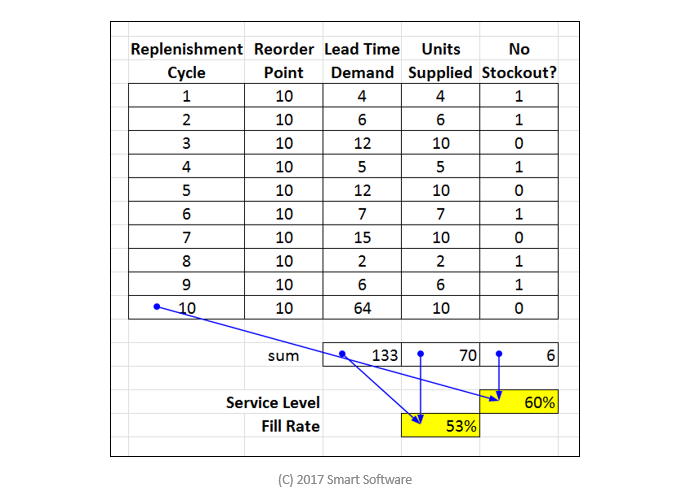
            We are often asked what the difference is between these two important performance metrics for inventory planning. While they are both important for measuring how successful a business is in meeting demand, their meaning is very different.  If not understood and incorporated into the strategic inventory planning process, inventory will be inefficiently allocated resulting in lower customer service and higher carrying costs.  We’ve illustrated the difference in this 4 minute recording using Microsoft Excel.


            Graphic to approach is advocated nearly universally for assessing forecast accuracySmart Operational Analytics automatically calculates historical service levels & fill rates across any item.  To see how you calculate these and other operational metrics including inventory turns, supplier performance, and more register below to watch a five minute demonstration.  The demo will show how our cloud platform continuously calculates and reports these metrics across thousands of items helping you identify opportunities for service level improvement and inventory reduction.
             

              Your Name *

              Company Name *

              Work Email *

              Work Phone


              Leave a Comment

              Related Posts

              Excess Inventory Hurts Customer Service!

              Excess Inventory Hurts Customer Service!

              Many companies adopt a “customer first, better to have the inventory and not need it” approach to inventory planning. While well intentioned, this approach often ignores the role that diminishing returns and opportunity costs play in inventory management impacting the organizations ability to quickly respond to demand.

              How to Choose a Target Service Level

              How to Choose a Target Service Level

              When setting a target service level, make sure to take into account factors like current service levels, replenishment lead times, cost constraints, the pain inflicted by shortages on you and your customers, and your competitive position.

              Beware of Simple Rules of Thumb for Managing Inventory

              Beware of Simple Rules of Thumb for Managing Inventory

              Managing inventory requires executives to balance competing goals: high product availability versus low investment in inventory. Executives strike this balance by stating availability targets and budget constraints. Then supply chain professionals translate these “commander’s intentions” into detailed specifications about reorder points and order quantities.

              Recent Posts

              • Managing Spare Parts Inventory: Best PracticesManaging Spare Parts Inventory: Best Practices
                In this blog, we’ll explore several effective strategies for managing spare parts inventory, emphasizing the importance of optimizing stock levels, maintaining service levels, and using smart tools to aid in decision-making. Managing spare parts inventory is a critical component for businesses that depend on equipment uptime and service reliability. Unlike regular inventory items, spare parts often have unpredictable demand patterns, making them more challenging to manage effectively. An efficient spare parts inventory management system helps prevent stockouts that can lead to operational downtime and costly delays while also avoiding overstocking that unnecessarily ties up capital and increases holding costs. […]
              • 5 Ways to Improve Supply Chain Decision Speed5 Ways to Improve Supply Chain Decision Speed
                The promise of a digital supply chain has transformed how businesses operate. At its core, it can make rapid, data-driven decisions while ensuring quality and efficiency throughout operations. However, it's not just about having access to more data. Organizations need the right tools and platforms to turn that data into actionable insights. This is where decision-making becomes critical, especially in a landscape where new digital supply chain solutions and AI-driven platforms can support you in streamlining many processes within the decision matrix. […]
              • Two employees checking inventory in temporary storage in a distribution warehouse.12 Causes of Overstocking and Practical Solutions
                Managing inventory effectively is critical for maintaining a healthy balance sheet and ensuring that resources are optimally allocated. Here is an in-depth exploration of the main causes of overstocking, their implications, and possible solutions. […]
              • FAQ Mastering Smart IP&O for Better Inventory ManagementFAQ: Mastering Smart IP&O for Better Inventory Management.
                Effective supply chain and inventory management are essential for achieving operational efficiency and customer satisfaction. This blog provides clear and concise answers to some basic and other common questions from our Smart IP&O customers, offering practical insights to overcome typical challenges and enhance your inventory management practices. Focusing on these key areas, we help you transform complex inventory issues into strategic, manageable actions that reduce costs and improve overall performance with Smart IP&O. […]
              • 7 Key Demand Planning Trends Shaping the Future7 Key Demand Planning Trends Shaping the Future
                Demand planning goes beyond simply forecasting product needs; it's about ensuring your business meets customer demands with precision, efficiency, and cost-effectiveness. Latest demand planning technology addresses key challenges like forecast accuracy, inventory management, and market responsiveness. In this blog, we will introduce critical demand planning trends, including data-driven insights, probabilistic forecasting, consensus planning, predictive analytics, scenario modeling, real-time visibility, and multilevel forecasting. These trends will help you stay ahead of the curve, optimize your supply chain, reduce costs, and enhance customer satisfaction, positioning your business for long-term success. […]

                Inventory Optimization for Manufacturers, Distributors, and MRO

                • Managing Spare Parts Inventory: Best PracticesManaging Spare Parts Inventory: Best Practices
                  In this blog, we’ll explore several effective strategies for managing spare parts inventory, emphasizing the importance of optimizing stock levels, maintaining service levels, and using smart tools to aid in decision-making. Managing spare parts inventory is a critical component for businesses that depend on equipment uptime and service reliability. Unlike regular inventory items, spare parts often have unpredictable demand patterns, making them more challenging to manage effectively. An efficient spare parts inventory management system helps prevent stockouts that can lead to operational downtime and costly delays while also avoiding overstocking that unnecessarily ties up capital and increases holding costs. […]
                • Innovating the OEM Aftermarket with AI-Driven Inventory Optimization XLInnovating the OEM Aftermarket with AI-Driven Inventory Optimization
                  The aftermarket sector provides OEMs with a decisive advantage by offering a steady revenue stream and fostering customer loyalty through the reliable and timely delivery of service parts. However, managing inventory and forecasting demand in the aftermarket is fraught with challenges, including unpredictable demand patterns, vast product ranges, and the necessity for quick turnarounds. Traditional methods often fall short due to the complexity and variability of demand in the aftermarket. The latest technologies can analyze large datasets to predict future demand more accurately and optimize inventory levels, leading to better service and lower costs. […]
                • Future-Proofing Utilities. Advanced Analytics for Supply Chain OptimizationFuture-Proofing Utilities: Advanced Analytics for Supply Chain Optimization
                  Utilities in the electrical, natural gas, urban water, and telecommunications fields are all asset-intensive and reliant on physical infrastructure that must be properly maintained, updated, and upgraded over time. Maximizing asset uptime and the reliability of physical infrastructure demands effective inventory management, spare parts forecasting, and supplier management. A utility that executes these processes effectively will outperform its peers, provide better returns for its investors and higher service levels for its customers, while reducing its environmental impact. […]
                • Centering Act Spare Parts Timing Pricing and ReliabilityCentering Act: Spare Parts Timing, Pricing, and Reliability
                  In this article, we'll walk you through the process of crafting a spare parts inventory plan that prioritizes availability metrics such as service levels and fill rates while ensuring cost efficiency. We'll focus on an approach to inventory planning called Service Level-Driven Inventory Optimization. Next, we'll discuss how to determine what parts you should include in your inventory and those that might not be necessary. Lastly, we'll explore ways to enhance your service-level-driven inventory plan consistently. […]

                  Getting “Halfway There” with Demand Planning

                  The Smart Forecaster

                   Pursuing best practices in demand planning,

                  forecasting and inventory optimization

                  Demand planning takes time and effort. It’s worth the effort to the extent that it actually helps you make what you need when you need it.

                  But the job can be done well or poorly. We see many manufacturers stopping at the first level when they could easily go to the second level. And with a little more effort, they could go all the way to the third level, utilizing probabilistic modeling to convert demand planning results into an inventory optimization process.

                  The First Level


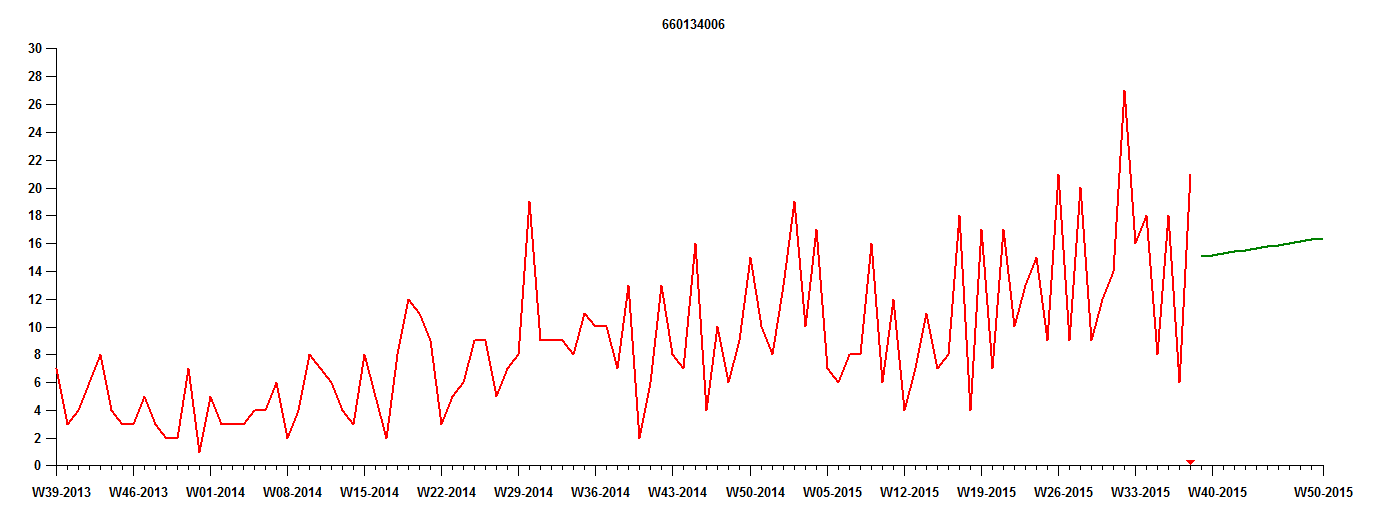
                  The first level is making a demand forecast using statistical methods. Figure 1 shows a first level effort: an item’s demand history (red line) and its expected 12-month forecast (green line).


                   The first level: A forecast of expected demand over the next 12 months


                  The forecast is bare bones. It only projects expected demand ignoring that demand is volatile and will inevitably create forecast error. (This is another example of an important maxim: “The Average is Not the Answer”). The forecast is as likely to be too high as it is to be too low, and there is no indication of forecast uncertainty accompanying the forecast. This means the planner has no estimate of the risk associated with committing to the forecast. Still, this forecast does provide a rational basis for production planning, personal scheduling, and raw materials purchase. So, it’s much better than guessing.

                  The Second Level


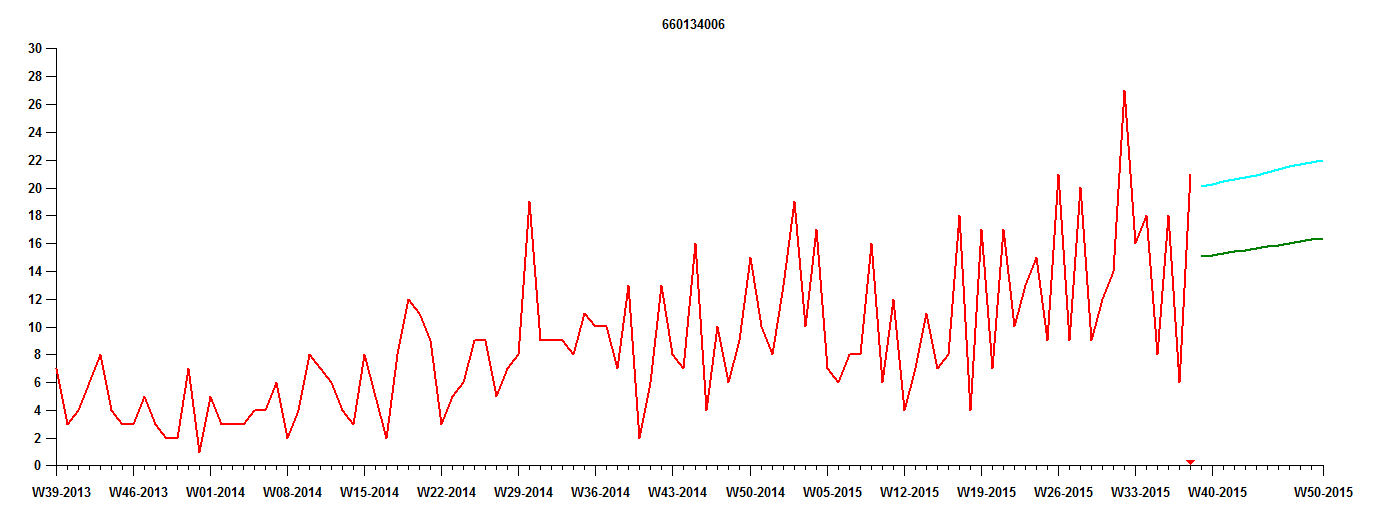
                  The second level takes explicit account of forecast uncertainty. Figure 2 shows a second level effort, known as a “percentile forecast”.

                  Now we see an explicit indication of forecast uncertainty. The cyan line above the green forecast line represents the projected 90th percentile of monthly demand. That is, the demand in each future month has a 90% chance of falling at or below the cyan line. Put another way, there is a 10% chance of demand exceeding the cyan line in each month.

                  This analysis is much more useful because it supports risk management. If it is important to assure sufficient supply of this item, then it makes sense to produce to the 90th percentile instead of to the expected forecast. After all, it’s a coin flip as to whether the expected forecast will result in enough production to meet monthly demand. This second level forecast is, in effect, a rough substitute for a careful inventory management process.


                  A percentile forecast, where the cyan line estimates the 90th percentiles of monthly demand.


                  Figure 2. A percentile forecast, where the cyan line estimates the 90th percentiles of monthly demand.

                  Going All the Way to the Third Level


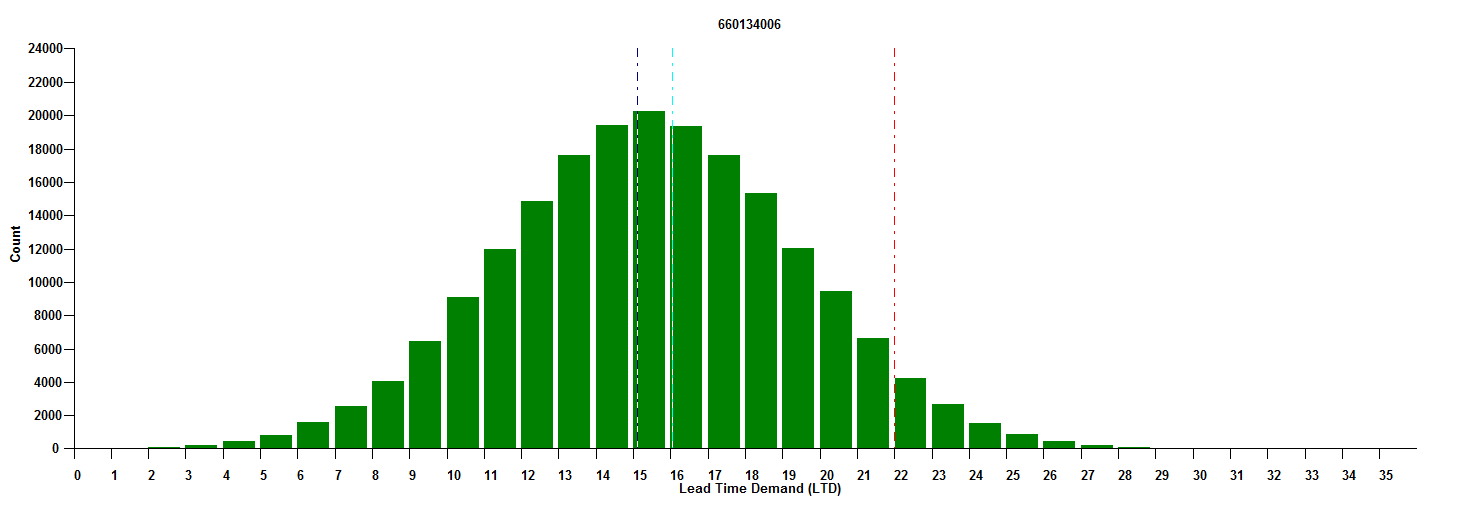
                  Best practice is the Third Level, which uses demand planning as a foundation for completing a second task: explicit inventory optimization. Figure 3 shows the fundamental plot for the efficient management of our finished good, assuming it has a 1 month production lead time.


                  Distribution of demand for finished good over its 1-month lead time


                  Figure 3 shows the utilization of probabilistic forecasting and how much draw-down in finished good inventory might take place over a one month production lead time. The uncertainty in demand is apparent in the spread of the possible demand, from a low of 0 to a high of 35, with 15 units being the most likely value. The vertical red line at 22 indicates the “reorder point“ (or “min” or “trigger value”) corresponding to keeping the chance of stocking out while waiting for replenishment to a low 5%. When inventory drops to 22 or below, it is time to order more. The Third Level uses probabilistic demand forecasting with full exposure of forecast uncertainty to efficiently manage the stock of the finished product.

                  To Sum Up


                  Forecasting the most likely demand for an item is a useful first step. It gets you halfway to where you want to be. But it provides an incomplete guide to planning because it ignores demand volatility and the forecast uncertainty that it creates. Adding a cushion to the demand forecast gets you further along, because it lessen the risk that a jump in demand will leave you short of product. This cushion can be calculated by probabilistic forecasting approaches that forecasts a high percentile of the distribution of future demand. And if you want to take one step further, you can feed forecasts of the demand distribution over a lead time to calculate reorder points (mins) to ensure that you have an acceptably low level of stock-out risk.

                  Given what modern forecasting technology can do for you, why would you want to stop halfway to your goal?

                  Leave a Comment

                  Related Posts

                  No Results Found

                  The page you requested could not be found. Try refining your search, or use the navigation above to locate the post.

                  Recent Posts

                  • Managing Spare Parts Inventory: Best PracticesManaging Spare Parts Inventory: Best Practices
                    In this blog, we’ll explore several effective strategies for managing spare parts inventory, emphasizing the importance of optimizing stock levels, maintaining service levels, and using smart tools to aid in decision-making. Managing spare parts inventory is a critical component for businesses that depend on equipment uptime and service reliability. Unlike regular inventory items, spare parts often have unpredictable demand patterns, making them more challenging to manage effectively. An efficient spare parts inventory management system helps prevent stockouts that can lead to operational downtime and costly delays while also avoiding overstocking that unnecessarily ties up capital and increases holding costs. […]
                  • 5 Ways to Improve Supply Chain Decision Speed5 Ways to Improve Supply Chain Decision Speed
                    The promise of a digital supply chain has transformed how businesses operate. At its core, it can make rapid, data-driven decisions while ensuring quality and efficiency throughout operations. However, it's not just about having access to more data. Organizations need the right tools and platforms to turn that data into actionable insights. This is where decision-making becomes critical, especially in a landscape where new digital supply chain solutions and AI-driven platforms can support you in streamlining many processes within the decision matrix. […]
                  • Two employees checking inventory in temporary storage in a distribution warehouse.12 Causes of Overstocking and Practical Solutions
                    Managing inventory effectively is critical for maintaining a healthy balance sheet and ensuring that resources are optimally allocated. Here is an in-depth exploration of the main causes of overstocking, their implications, and possible solutions. […]
                  • FAQ Mastering Smart IP&O for Better Inventory ManagementFAQ: Mastering Smart IP&O for Better Inventory Management.
                    Effective supply chain and inventory management are essential for achieving operational efficiency and customer satisfaction. This blog provides clear and concise answers to some basic and other common questions from our Smart IP&O customers, offering practical insights to overcome typical challenges and enhance your inventory management practices. Focusing on these key areas, we help you transform complex inventory issues into strategic, manageable actions that reduce costs and improve overall performance with Smart IP&O. […]
                  • 7 Key Demand Planning Trends Shaping the Future7 Key Demand Planning Trends Shaping the Future
                    Demand planning goes beyond simply forecasting product needs; it's about ensuring your business meets customer demands with precision, efficiency, and cost-effectiveness. Latest demand planning technology addresses key challenges like forecast accuracy, inventory management, and market responsiveness. In this blog, we will introduce critical demand planning trends, including data-driven insights, probabilistic forecasting, consensus planning, predictive analytics, scenario modeling, real-time visibility, and multilevel forecasting. These trends will help you stay ahead of the curve, optimize your supply chain, reduce costs, and enhance customer satisfaction, positioning your business for long-term success. […]

                    Inventory Optimization for Manufacturers, Distributors, and MRO

                    • Managing Spare Parts Inventory: Best PracticesManaging Spare Parts Inventory: Best Practices
                      In this blog, we’ll explore several effective strategies for managing spare parts inventory, emphasizing the importance of optimizing stock levels, maintaining service levels, and using smart tools to aid in decision-making. Managing spare parts inventory is a critical component for businesses that depend on equipment uptime and service reliability. Unlike regular inventory items, spare parts often have unpredictable demand patterns, making them more challenging to manage effectively. An efficient spare parts inventory management system helps prevent stockouts that can lead to operational downtime and costly delays while also avoiding overstocking that unnecessarily ties up capital and increases holding costs. […]
                    • Innovating the OEM Aftermarket with AI-Driven Inventory Optimization XLInnovating the OEM Aftermarket with AI-Driven Inventory Optimization
                      The aftermarket sector provides OEMs with a decisive advantage by offering a steady revenue stream and fostering customer loyalty through the reliable and timely delivery of service parts. However, managing inventory and forecasting demand in the aftermarket is fraught with challenges, including unpredictable demand patterns, vast product ranges, and the necessity for quick turnarounds. Traditional methods often fall short due to the complexity and variability of demand in the aftermarket. The latest technologies can analyze large datasets to predict future demand more accurately and optimize inventory levels, leading to better service and lower costs. […]
                    • Future-Proofing Utilities. Advanced Analytics for Supply Chain OptimizationFuture-Proofing Utilities: Advanced Analytics for Supply Chain Optimization
                      Utilities in the electrical, natural gas, urban water, and telecommunications fields are all asset-intensive and reliant on physical infrastructure that must be properly maintained, updated, and upgraded over time. Maximizing asset uptime and the reliability of physical infrastructure demands effective inventory management, spare parts forecasting, and supplier management. A utility that executes these processes effectively will outperform its peers, provide better returns for its investors and higher service levels for its customers, while reducing its environmental impact. […]
                    • Centering Act Spare Parts Timing Pricing and ReliabilityCentering Act: Spare Parts Timing, Pricing, and Reliability
                      In this article, we'll walk you through the process of crafting a spare parts inventory plan that prioritizes availability metrics such as service levels and fill rates while ensuring cost efficiency. We'll focus on an approach to inventory planning called Service Level-Driven Inventory Optimization. Next, we'll discuss how to determine what parts you should include in your inventory and those that might not be necessary. Lastly, we'll explore ways to enhance your service-level-driven inventory plan consistently. […]