
Probabilistic vs. Deterministic Order Planning

The Smart Forecaster

Man with a computer in a warehouse best practices in demand planning, forecasting and inventory optimization

Consider the problem of replenishing inventory. To be specific, suppose the inventory item in question is a spare part. Both you and your supplier will want some sense of how much you will be ordering and when. And your ERP system may be insisting that you let it in on the secret too.

Deterministic Model of Replenishment

The simplest way to get a decent answer to this question is to assume the world is, well, simple. In this case, simple means “not random” or, in geek speak, “deterministic.” In particular, you pretend that the random size and timing of demand is really a continuous drip-drip-drip of a fixed size coming at a fixed interval, e.g., 2, 2, 2, 2, 2, 2… If this seems unrealistic, it is. Real demand might look more like this: 0, 1, 10, 0, 1, 0, 0, 0 with lots of zeros, occasional but random spikes.

But simplicity has its virtues. If you pretend that the average demand occurs every day like clockwork, it is easy to work out when you will need to place your next order, and how many units you will need.  For instance, suppose your inventory policy is of the (Q,R) type, where Q is a fixed order quantity and R is a fixed reorder point. When stock drops to or below the reorder point R, you order Q units more. To round out the fantasy, assume that the replenishment lead time is also fixed: after L days, those Q new units will be on the shelf ready to satisfy demand.

All you need now to answer your questions is the average demand per day D for the item. The logic goes like this:

  1. You start each replenishment cycle with Q units on hand.
  2. You deplete that stock by D units per day.
  3. So, you hit the reorder point R after (Q-R)/D days.
  4. So, you order every (Q-R)/D days.
  5. Each replenishment cycle lasts (Q-R)/D + L days, so you make a total of 365D/(Q-R+LD) orders per year.
  6. As long as lead time L < R/D, you will never stock out and your inventory will be as small as possible.

Figure 1 shows the plot of on-hand inventory vs time for the deterministic model. Around Smart Software, we refer to this plot as the “Deterministic Sawtooth.” The stock starts at the level of the last order quantity Q. After steadily decreasing over the drop time (Q-R)/D, the level hits the reorder point R and triggers an order for another Q units. Over the lead time L, the stock drops to exactly zero, then the reorder magically arrives and the next cycle begins.
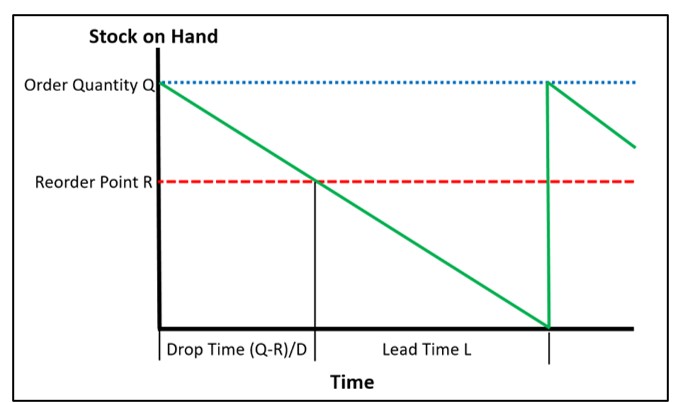
Figure 1 Deterministic model of on-hand inventory

Figure 1: Deterministic model of on-hand inventory


This model has two things going for it. It requires no more than high school algebra, and it combines (almost) all the relevant factors to answer the two related questions: When will we have to place the next order? How many orders will we place in a year?

Probabilistic Model of Replenishment

Not surprisingly, if we strip away some of the fantasy from the deterministic model, we get more useful information. The probabilistic model incorporates all the messy randomness in the real-world problem: the uncertainty in both the timing and size of demand, the variation in replenishment lead time, and the consequences of those two factors: the chance of stock on hand undershooting the reorder point, the chance that there will be a stockout, the variability in the time until the next order, and the variable number of orders executed in a year.

The probabilistic model works by simulating the consequences of uncertain demand and variable lead time. By analyzing the item’s historical demand patterns (and excluding any observations that were recorded during a time when demand may have been fundamentally different), advanced statistical methods create an unlimited number of realistic demand scenarios. Similar analysis is applied to records of supplier lead times. Combining these supply and demand scenarios with the operational rules of any given inventory control policy produces scenarios of the number of parts on hand. From these scenarios, we can extract summaries of the varying intervals between orders.

Figure 2 shows an example of a probabilistic scenario; demand is random, and the item is managed using reorder point R = 10 and order quantity Q=20. Gone is the Deterministic Sawtooth; in its place is something more complex and realistic (the Probabilistic Staircase). During the 90 simulated days of operation, there were 9 orders placed, and the time between orders clearly varied.

Using the probabilistic model, the answers to the two questions (how long between orders and how many in a year) get expressed as probability distributions reflecting the relative likelihoods of various scenarios. Figure 3 shows the distribution of the number of days between orders after ten years of simulated operation. While the average is about 8 days, the actual number varies widely, from 2 to 17.

Instead of telling your supplier that you will place X orders next year, you can now project X ± Y orders, and your supplier knows better their upside and downside risks. Better yet, you could provide the entire distribution as the richest possible answer.
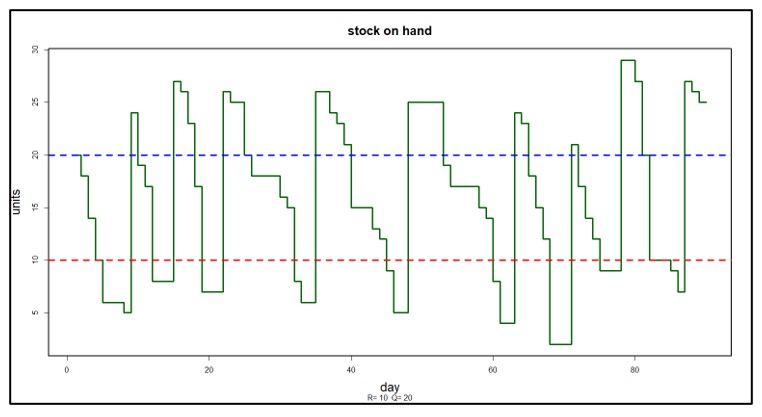
Figure 2 A probabilistic scenario of on-hand inventory
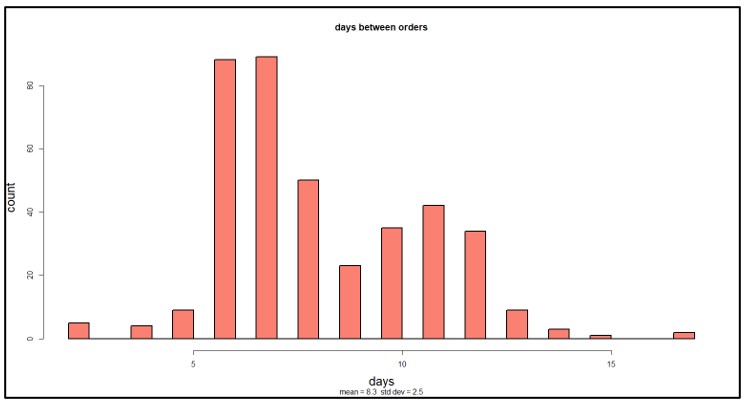
Figure 2 A probabilistic scenario of on-hand inventory


Figure 3 Distribution of days between orders

Figure 3: Distribution of days between orders


Climbing the Random Staircase to Greater Efficiency

Moving beyond the deterministic model of  inventory opens up new possibilities for optimizing operations. First, the probabilistic model allows realistic assessment of stockout risk. The simple model in Figure 1 implies there is never a stockout, whereas probabilistic scenarios allow for the possibility (though in Figure 2 there was only one close call around day 70). Once the risk is known, software can optimize by searching  the “design space” (i.e., all possible values of R and Q) to find a design that meets a target level of stockout risk at minimal cost. The value of the deterministic model in this more realistic analysis is that it provides a good starting point for the search through design space.

Summary

Modern software provides answers to operational questions with various degrees of detail. Using the example of the time between replenishment orders, we’ve shown that the answer can be calculated approximately but quickly by a simple deterministic model. But it can also be provided in much richer detail with all the variability exposed by a probabilistic model. We think of these alternatives as complementary. The deterministic model bundles all the key variables into an easy-to-understand form. The probabilistic model provides additional realism that professionals expect and supports effective search for optimal choices of reorder point and order quantity.


 

Leave a Comment
Related Posts
How Are We Doing? KPI’s and KPP’s

How Are We Doing? KPI’s and KPP’s

Dealing with the day-to-day of inventory management can keep you busy. But you know you have to get your head up now and then to see where you’re heading. For that, your inventory software should show you metrics – and not just one, but a full set of metrics or KPI’s – Key Performance Indicators.

Confused about AI and Machine Learning?

Confused about AI and Machine Learning?

Are you confused about what is AI and what is machine learning? Are you unsure why knowing more will help you with your job in inventory planning? Don’t despair. You’ll be ok, and we’ll show you how some of whatever-it-is can be useful.
Increasing Revenue by Increasing Spare Part Availability

The Smart Forecaster

 Pursuing best practices in demand planning,

forecasting and inventory optimization

Let’s start by recognizing that increased revenue is a good thing for you, and that increasing the availability of the spare parts you provide is a good thing for your customers.

But let’s also recognize that increasing item availability will not necessarily lead to increased revenue. If you plan incorrectly and end up carrying excess inventory, the net effect may be good for your customers but will definitely be bad for you. There must be some right way to make this a win-win, if only it can be recognized.

To make the right decision here, you have to think systematically about the problem. That requires that you use probabilistic models of the inventory control process.


A Scenario

Let’s consider a specific, realistic scenario. Quite a number of factors have an influence on the results:

  • The item: A specific low-volume spare part.
  • Demand mean: Averaging 0.1 units per day (so, highly “intermittent”)
  • Demand standard deviation: 0.35 units per day (so, highly variable or “overdispersed”).
  • Supplier average lead time: 5 days.
  • Unit cost: $100.
  • Holding cost per year as % of unit cost: 10%.
  • Ordering cost per PO cut: $25.
  • Stockout consequences: Lost sales (so, a competitive market, no backorders).
  • Shortage cost per lost sale: $100.
  • Service level target: 85% (so, 15% chance of a stockout in any replenishment cycle).
  • Inventory control policy: Periodic-review/Order-up-to (also called at (T,S) policy)


Inventory Control Policy

A word about the inventory control policy. The (T,S) policy is one of several that are common in practice. Though there are other more efficient policies (e.g., they don’t wait for T days to go by before making adjustment to stock), (T,S) is one of the simplest and so it is quite popular. It works this way: Every T days, you check how many units you have in stock, say X units. Then you order S-X units, which appear after the supplier lead time (in this case, 5 days). The T in (T,S) is the “order interval”, the number of days between orders; the S is the “order-up-to level”, the number of units you want to have on hand at the start of each replenishment cycle.

To get the most out of this policy, you must wisely pick values of T and S. Picking wisely means you cannot win by guessing or using simple rule-of-thumb guides like “Keep an average of 3 x average demand on hand.”  Poor choices of T and S hurt both your customers and your bottom line. And sticking too long with choices that were once good can result in poor performance should any of the factors above change significantly, so the values of T and S should be recalculated now and then.

The smart way to pick the right values of T and S is to use probabilistic models encoded in advanced software. Using software is essential when you have to scale up and pick values of T and S that are right for not one item but hundreds or thousands.


Analysis of Scenario

Let’s think about how to make money in this scenario. What’s the upside? If there were no expenses, this item could generate an average of $3,650 per year: 0.1 units/day x 365 days x $100/unit. Subtracted from that will be operating costs, comprised of holding, ordering and shortage costs. Each of those will depend on your choices of T and S.

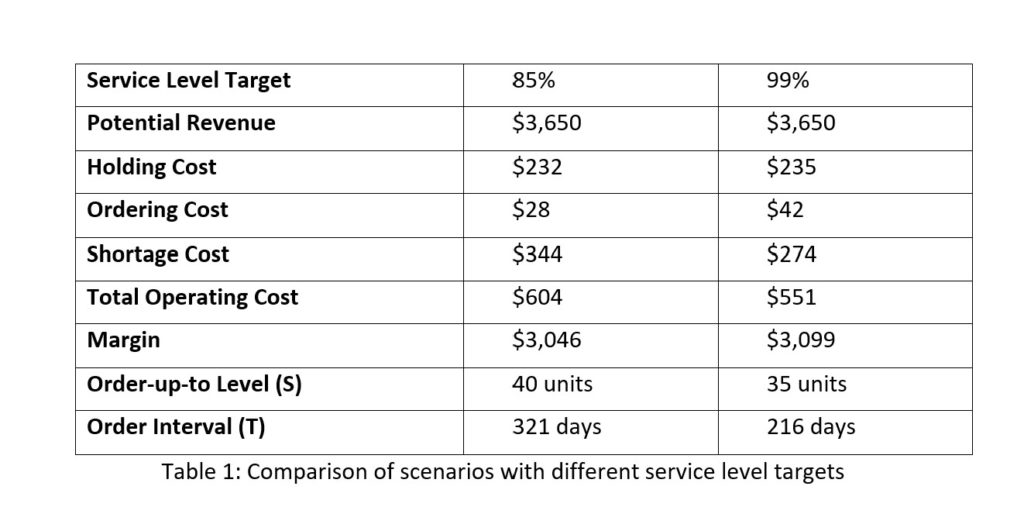
The software provides specific numbers: Setting T = 321 days and S = 40 units will result in average annual operating costs of $604, giving an expected margin of $3,650 – $604 = $3,046. See Table 1, left column. This use of software is called “predictive analytics” because it translates system design inputs into estimates of a key performance indicator, margin.

Now think about whether you can do better. The service level target in this scenario is 85%, which is a somewhat relaxed standard that is not going to turn any heads. What if you could offer your customers a 99% service level? That sounds like a distinct competitive advantage, but would it reduce your margin? Not if you properly adjust the values of T and S.

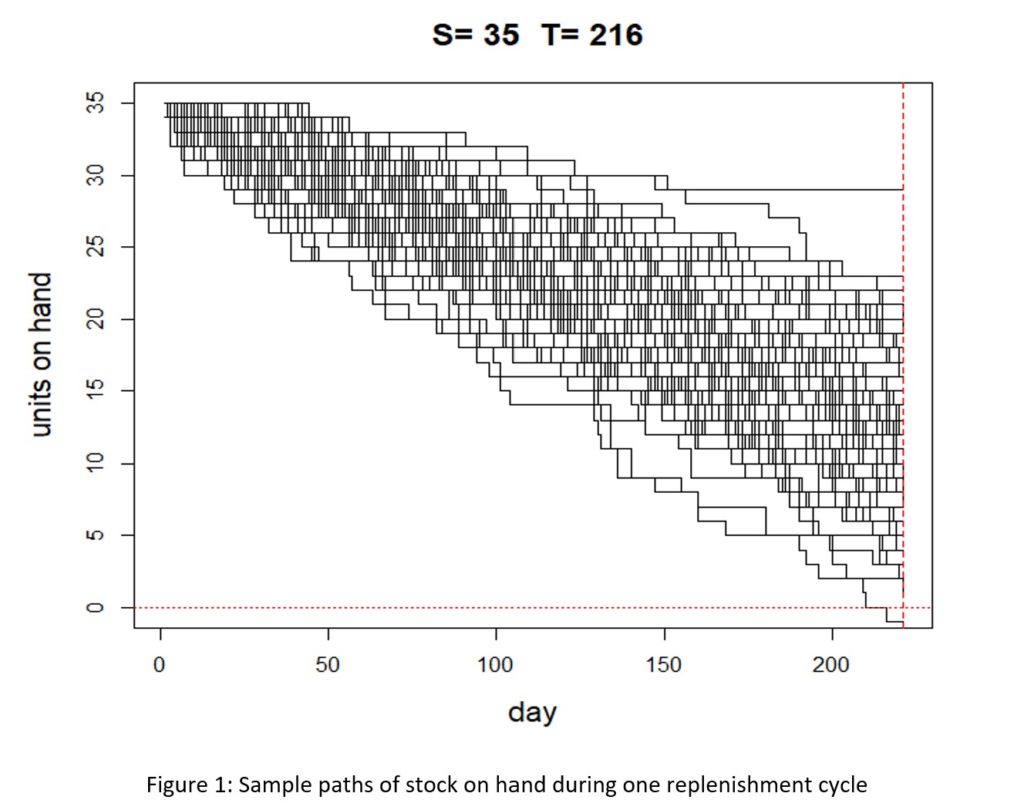
Setting T = 216 days and S = 35 units will reduce average annual operating costs to $551 and increase expected margin to $3,650 – $551 = $3,099. See Table 1, right column. Here is the win-win we wanted: higher customer satisfaction and roughly 2% more revenue. This use of the software is called “sensitivity analysis” because it shows how sensitive the margin is to the choice of service level target.

Software can also help you visualize the complex, random dynamics of inventory movements. A by-product of the analysis that populated Table 1 are graphs showing the random paths taken by stock as it decreases over a replenishment cycle. Figure 1 shows a selection of 100 random scenarios for the scenario in which the service level target is 99%. In the figure, only 1 of the 100 scenarios resulted in a stockout, confirming the accuracy of the choice of order-up-to-level.


Summary

Management of spare parts inventories is often done haphazardly using gut instinct, habit, or obsolete rule-of-thumb. Winging it this way is not a reliable and reproducible path to higher margin or higher customer satisfaction. Probability theory, distilled into probability models then encoded in advanced software, is the basis for coherent, efficient guidance about how to manage spare parts based on facts: demand characteristics, lead times, service level targets, costs and the other factors. The scenarios analyzed here illustrate that it is possible to achieve both higher service levels and higher margin. A multitude of scenarios not shown here offer ways to achieve higher service levels but lose margin. Use the software.

Scenarios with different service level targets

Stock on hand during one replenishment cycle


Leave a Comment

Related Posts

3 Types of Supply Chain Analytics

3 Types of Supply Chain Analytics

The three types of supply chain analytics are “descriptive”, “predictive”, and “prescriptive.” Each plays a different role in helping you manage your inventory. Modern supply chain software lets you exploit all three helping you to reduce inventory costs, improve on time delivery and service levels, while running a more efficient supply chain.

A Check on Forecast Automation with the Attention Index

A Check on Forecast Automation with the Attention Index

A new metric we call the “Attention Index” will help forecasters identify situations where “data behaving badly” can distort automatic statistical forecasts (see adjacent poem). It quickly identifies those items most likely to require forecast overrides—providing a more efficient way to put business experience and other human intelligence to work maximizing the accuracy of forecasts. How does it work?

Too Much or Too Little Inventory?

Too Much or Too Little Inventory?

Do you know which items have too much or too little inventory? What if you knew? How would you go about cutting overstocks while still ensuring a competitive service level? Would you be able to reduce stockouts without incurring a prohibitively expensive inventory increase? How would these changes impact service levels, costs and turns—for individual items, groups of items and overall?

Recent Posts

  • Managing Spare Parts Inventory: Best PracticesManaging Spare Parts Inventory: Best Practices
    In this blog, we’ll explore several effective strategies for managing spare parts inventory, emphasizing the importance of optimizing stock levels, maintaining service levels, and using smart tools to aid in decision-making. Managing spare parts inventory is a critical component for businesses that depend on equipment uptime and service reliability. Unlike regular inventory items, spare parts often have unpredictable demand patterns, making them more challenging to manage effectively. An efficient spare parts inventory management system helps prevent stockouts that can lead to operational downtime and costly delays while also avoiding overstocking that unnecessarily ties up capital and increases holding costs. […]
  • 5 Ways to Improve Supply Chain Decision Speed5 Ways to Improve Supply Chain Decision Speed
    The promise of a digital supply chain has transformed how businesses operate. At its core, it can make rapid, data-driven decisions while ensuring quality and efficiency throughout operations. However, it's not just about having access to more data. Organizations need the right tools and platforms to turn that data into actionable insights. This is where decision-making becomes critical, especially in a landscape where new digital supply chain solutions and AI-driven platforms can support you in streamlining many processes within the decision matrix. […]
  • Two employees checking inventory in temporary storage in a distribution warehouse.12 Causes of Overstocking and Practical Solutions
    Managing inventory effectively is critical for maintaining a healthy balance sheet and ensuring that resources are optimally allocated. Here is an in-depth exploration of the main causes of overstocking, their implications, and possible solutions. […]
  • FAQ Mastering Smart IP&O for Better Inventory ManagementFAQ: Mastering Smart IP&O for Better Inventory Management.
    Effective supply chain and inventory management are essential for achieving operational efficiency and customer satisfaction. This blog provides clear and concise answers to some basic and other common questions from our Smart IP&O customers, offering practical insights to overcome typical challenges and enhance your inventory management practices. Focusing on these key areas, we help you transform complex inventory issues into strategic, manageable actions that reduce costs and improve overall performance with Smart IP&O. […]
  • 7 Key Demand Planning Trends Shaping the Future7 Key Demand Planning Trends Shaping the Future
    Demand planning goes beyond simply forecasting product needs; it's about ensuring your business meets customer demands with precision, efficiency, and cost-effectiveness. Latest demand planning technology addresses key challenges like forecast accuracy, inventory management, and market responsiveness. In this blog, we will introduce critical demand planning trends, including data-driven insights, probabilistic forecasting, consensus planning, predictive analytics, scenario modeling, real-time visibility, and multilevel forecasting. These trends will help you stay ahead of the curve, optimize your supply chain, reduce costs, and enhance customer satisfaction, positioning your business for long-term success. […]

    Inventory Optimization for Manufacturers, Distributors, and MRO

    • Managing Spare Parts Inventory: Best PracticesManaging Spare Parts Inventory: Best Practices
      In this blog, we’ll explore several effective strategies for managing spare parts inventory, emphasizing the importance of optimizing stock levels, maintaining service levels, and using smart tools to aid in decision-making. Managing spare parts inventory is a critical component for businesses that depend on equipment uptime and service reliability. Unlike regular inventory items, spare parts often have unpredictable demand patterns, making them more challenging to manage effectively. An efficient spare parts inventory management system helps prevent stockouts that can lead to operational downtime and costly delays while also avoiding overstocking that unnecessarily ties up capital and increases holding costs. […]
    • Innovating the OEM Aftermarket with AI-Driven Inventory Optimization XLInnovating the OEM Aftermarket with AI-Driven Inventory Optimization
      The aftermarket sector provides OEMs with a decisive advantage by offering a steady revenue stream and fostering customer loyalty through the reliable and timely delivery of service parts. However, managing inventory and forecasting demand in the aftermarket is fraught with challenges, including unpredictable demand patterns, vast product ranges, and the necessity for quick turnarounds. Traditional methods often fall short due to the complexity and variability of demand in the aftermarket. The latest technologies can analyze large datasets to predict future demand more accurately and optimize inventory levels, leading to better service and lower costs. […]
    • Future-Proofing Utilities. Advanced Analytics for Supply Chain OptimizationFuture-Proofing Utilities: Advanced Analytics for Supply Chain Optimization
      Utilities in the electrical, natural gas, urban water, and telecommunications fields are all asset-intensive and reliant on physical infrastructure that must be properly maintained, updated, and upgraded over time. Maximizing asset uptime and the reliability of physical infrastructure demands effective inventory management, spare parts forecasting, and supplier management. A utility that executes these processes effectively will outperform its peers, provide better returns for its investors and higher service levels for its customers, while reducing its environmental impact. […]
    • Centering Act Spare Parts Timing Pricing and ReliabilityCentering Act: Spare Parts Timing, Pricing, and Reliability
      In this article, we'll walk you through the process of crafting a spare parts inventory plan that prioritizes availability metrics such as service levels and fill rates while ensuring cost efficiency. We'll focus on an approach to inventory planning called Service Level-Driven Inventory Optimization. Next, we'll discuss how to determine what parts you should include in your inventory and those that might not be necessary. Lastly, we'll explore ways to enhance your service-level-driven inventory plan consistently. […]

      Smart Software Celebrates 40 years

      40 years of Innovation for Demand Forecasting, Inventory Planning, and Supply Chain Analytics

        Belmont, MA, June 1, 2021 – Today marks the 40th anniversary for Smart Software, a leading innovator of demand planning, statistical forecasting, inventory management, and supply chain analytics software. Company CEO, Greg Hartunian remarked “Our success is built on continuous innovation. Our mission follows the path that our founders initiated 40 years ago; we provide cutting-edge analytical solutions that help our customers maximize sales and minimize waste.  We are enormously grateful to our customers who have given us their support, confidence, and trust.  Thank you to our partner community of resellers and consultants who have mobilized our growth and shared their expertise with us.  We are also indebted to our many employees, past and present, local and abroad, whose creativity and dedication have produced systems that are benefitting so many great companies worldwide.” Smart, Hartunian, and Willemain was incorporated in June 1981 by Charles Smart, Nelson Hartunian, and Thomas Willemain, our visionary founders. The firm later incorporated as Smart Software, Inc in 1984 reflecting their shift from boutique consultancy to software.  Over the years, their pioneering work produced the first-ever automatic statistical forecasting system for the personal computer, a patented APICS award-winning method for intermittent demand planning, and most recently a cloud-native probabilistic forecasting platform. All have produced major inventory cost reductions and service level improvements for our customers.  To learn more about Smart Software’s roots and journey, please click here:     Smart Software Company History   

      Smart Software Logo 40 years

        “Smart gives us good information to work with.  The service level planning method has led to productive conversations between sales and supply chain and given us a common ground from which we base our discussions. People are feeling comfortable with numbers, and through our S&OP process we’ve been able to create buy-in across the company.” Rod Cardenas  – Purchasing Manager, Forum Energy   “It was deployed as part of our implementation of a new centralized distribution model and highlighted significant blind spots in the original project plan. The accurate forecasts of stocking levels and SKU count provided fact-based data that allowed us to strategically phase the consolidation effort where warehouse space was at a premium.” Eric Nelson – CPA, CMA. Manager, Parts Supply and Logistics. BC Transit   “Its easy for us to give suppliers information they never had before. Our suppliers can plan their production and work with their suppliers. That visibility has been invaluable. That’s where the real payoff will come. Not just reducing inventory or saving time on people managing the inventory but being more responsive to customers’ needs. To me, that’s the overarching benefit of this software.” Bud Schultz – Vice President of Finance  NKK Switches        
        SmartForecasts and Smart IP&O have registered trademarks of Smart Software, Inc.  All other trademarks are their respective owners’ property. For more information, please contact Smart Software, Inc., Four Hill Road, Belmont, MA 02478. Phone: 1-800-SMART-99 (800-762-7899); FAX: 1-617-489-2748; E-mail: info@smartcorp.com    
      Four Useful Ways to Measure Forecast Error

      The Smart Forecaster

       Pursuing best practices in demand planning,

      forecasting and inventory optimization

      Improve Forecast Accuracy, Eliminate Excess Inventory, & Maximize Service Levels

      In this video, Dr. Thomas Willemain, co-Founder and SVP Research, talks about improving forecast accuracy by measuring forecast error. We begin by overviewing the various types of error metrics: scale-dependent error, percentage error, relative error, and scale-free error metrics. While some error is inevitable, there are ways to reduce it, and forecast metrics are necessary aids for monitoring and improving forecast accuracy. Then we will explain the special problem of intermittent demand and divide-by-zero problems. Tom concludes by explaining how to assess forecasts of multiple items and how it often makes sense to use weighted averages, weighting items differently by volume or revenue.


      Four general types of error metrics 

      1. Scale-dependent error
      2. Percentage error
      3. Relative error
      4 .Scale-free error

      Remark: Scale-dependent metrics are expressed in the units of the forecasted variable. The other three are expresses as percentages.


      1. Scale-dependent error metrics

      • Mean Absolute Error (MAE) aka Mean Absolute Deviation (MAD)
      • Median Absolute Error (MdAE)
      • Root Mean Square Error (RMSE)
      • These metrics express the error in the original units of the data.
        • Ex: units, cases, barrels, kilograms, dollars, liters, etc.
      • Since forecasts can be too high or too low, the signs of the errors will be either positive or negative, allowing for unwanted cancellations.
        • Ex: You don’t want errors of +50 and -50 to cancel and show “no error”.
      • To deal with the cancellation problem, these metrics take away negative signs by either squaring or using absolute value.


      2. Percentage error metric

      • Mean Absolute Percentage Error (MAPE)
      • This metric expresses the size of the error as a percentage of the actual value of the forecasted variable.
      • The advantage of this approach is that it immediately makes clear whether the error is a big deal or not.
      • Ex: Suppose the MAE is 100 units. Is a typical error of 100 units horrible? ok? great?
      • The answer depends on the size of the variable being forecasted. If the actual value is 100, then a MAE = 100 is as big as the thing being forecasted. But if the actual value is 10,000, then a MAE = 100 shows great accuracy, since the MAPE is only 1% of the actual.


      3. Relative error metric

      • Median Relative Absolute Error (MdRAE)
      • Relative to what? To a benchmark forecast.
      • What benchmark? Usually, the “naïve” forecast.
      • What is the naïve forecast? Next forecast value = last actual value.
      • Why use the naïve forecast? Because if you can’t beat that, you are in tough shape.


      4. Scale-Free error metric

      • Median Relative Scaled Error (MdRSE)
      • This metric expresses the absolute forecast error as a percentage of the natural level of randomness (volatility) in the data.
      • The volatility is measured by the average size of the change in the forecasted variable from one time period to the next.
        • (This is the same as the error made by the naïve forecast.)
      • How does this metric differ from the MdRAE above?
        • They do both use the naïve forecast, but this metric uses errors in forecasting the demand history, while the MdRAE uses errors in forecasting future values.
        • This matters because there are usually many more history values than there are forecasts.
        • In turn, that matters because this metric would “blow up” if all the data were zero, which is less likely when using the demand history.


      Intermittent Demand Planning and Parts Forecasting


      The special problem of intermittent demand

      • “Intermittent” demand has many zero demands mixed in with random non-zero demands.
      • MAPE gets ruined when errors are divided by zero.
      • MdRAE can also get ruined.
      • MdSAE is less likely to get ruined.


      Recap and remarks

      • Forecast metrics are necessary aids for monitoring and improving forecast accuracy.
      • There are two major classes of metrics: absolute and relative.
      • Absolute measures (MAE, MdAE, RMSE) are natural choices when assessing forecasts of one item.
      • Relative measures (MAPE, MdRAE, MdSAE) are useful when comparing accuracy across items or between alternative forecasts of the same item or assessing accuracy relative to the natural variability of an item.
      • Intermittent demand presents divide-by-zero problems which favor MdSAE over MAPE.
      • When assessing forecasts of multiple items, it often makes sense to use weighted averages, weighting items differently by volume or revenue.
      Leave a Comment

      RECENT POSTS

      How Are We Doing? KPI’s and KPP’s

      How Are We Doing? KPI’s and KPP’s

      Dealing with the day-to-day of inventory management can keep you busy. But you know you have to get your head up now and then to see where you’re heading. For that, your inventory software should show you metrics – and not just one, but a full set of metrics or KPI’s – Key Performance Indicators.

      Confused about AI and Machine Learning?

      Confused about AI and Machine Learning?

      Are you confused about what is AI and what is machine learning? Are you unsure why knowing more will help you with your job in inventory planning? Don’t despair. You’ll be ok, and we’ll show you how some of whatever-it-is can be useful.
      Recent Posts

      • Managing Spare Parts Inventory: Best PracticesManaging Spare Parts Inventory: Best Practices
        In this blog, we’ll explore several effective strategies for managing spare parts inventory, emphasizing the importance of optimizing stock levels, maintaining service levels, and using smart tools to aid in decision-making. Managing spare parts inventory is a critical component for businesses that depend on equipment uptime and service reliability. Unlike regular inventory items, spare parts often have unpredictable demand patterns, making them more challenging to manage effectively. An efficient spare parts inventory management system helps prevent stockouts that can lead to operational downtime and costly delays while also avoiding overstocking that unnecessarily ties up capital and increases holding costs. […]
      • 5 Ways to Improve Supply Chain Decision Speed5 Ways to Improve Supply Chain Decision Speed
        The promise of a digital supply chain has transformed how businesses operate. At its core, it can make rapid, data-driven decisions while ensuring quality and efficiency throughout operations. However, it's not just about having access to more data. Organizations need the right tools and platforms to turn that data into actionable insights. This is where decision-making becomes critical, especially in a landscape where new digital supply chain solutions and AI-driven platforms can support you in streamlining many processes within the decision matrix. […]
      • Two employees checking inventory in temporary storage in a distribution warehouse.12 Causes of Overstocking and Practical Solutions
        Managing inventory effectively is critical for maintaining a healthy balance sheet and ensuring that resources are optimally allocated. Here is an in-depth exploration of the main causes of overstocking, their implications, and possible solutions. […]
      • FAQ Mastering Smart IP&O for Better Inventory ManagementFAQ: Mastering Smart IP&O for Better Inventory Management.
        Effective supply chain and inventory management are essential for achieving operational efficiency and customer satisfaction. This blog provides clear and concise answers to some basic and other common questions from our Smart IP&O customers, offering practical insights to overcome typical challenges and enhance your inventory management practices. Focusing on these key areas, we help you transform complex inventory issues into strategic, manageable actions that reduce costs and improve overall performance with Smart IP&O. […]
      • 7 Key Demand Planning Trends Shaping the Future7 Key Demand Planning Trends Shaping the Future
        Demand planning goes beyond simply forecasting product needs; it's about ensuring your business meets customer demands with precision, efficiency, and cost-effectiveness. Latest demand planning technology addresses key challenges like forecast accuracy, inventory management, and market responsiveness. In this blog, we will introduce critical demand planning trends, including data-driven insights, probabilistic forecasting, consensus planning, predictive analytics, scenario modeling, real-time visibility, and multilevel forecasting. These trends will help you stay ahead of the curve, optimize your supply chain, reduce costs, and enhance customer satisfaction, positioning your business for long-term success. […]

        Inventory Optimization for Manufacturers, Distributors, and MRO

        • Managing Spare Parts Inventory: Best PracticesManaging Spare Parts Inventory: Best Practices
          In this blog, we’ll explore several effective strategies for managing spare parts inventory, emphasizing the importance of optimizing stock levels, maintaining service levels, and using smart tools to aid in decision-making. Managing spare parts inventory is a critical component for businesses that depend on equipment uptime and service reliability. Unlike regular inventory items, spare parts often have unpredictable demand patterns, making them more challenging to manage effectively. An efficient spare parts inventory management system helps prevent stockouts that can lead to operational downtime and costly delays while also avoiding overstocking that unnecessarily ties up capital and increases holding costs. […]
        • Innovating the OEM Aftermarket with AI-Driven Inventory Optimization XLInnovating the OEM Aftermarket with AI-Driven Inventory Optimization
          The aftermarket sector provides OEMs with a decisive advantage by offering a steady revenue stream and fostering customer loyalty through the reliable and timely delivery of service parts. However, managing inventory and forecasting demand in the aftermarket is fraught with challenges, including unpredictable demand patterns, vast product ranges, and the necessity for quick turnarounds. Traditional methods often fall short due to the complexity and variability of demand in the aftermarket. The latest technologies can analyze large datasets to predict future demand more accurately and optimize inventory levels, leading to better service and lower costs. […]
        • Future-Proofing Utilities. Advanced Analytics for Supply Chain OptimizationFuture-Proofing Utilities: Advanced Analytics for Supply Chain Optimization
          Utilities in the electrical, natural gas, urban water, and telecommunications fields are all asset-intensive and reliant on physical infrastructure that must be properly maintained, updated, and upgraded over time. Maximizing asset uptime and the reliability of physical infrastructure demands effective inventory management, spare parts forecasting, and supplier management. A utility that executes these processes effectively will outperform its peers, provide better returns for its investors and higher service levels for its customers, while reducing its environmental impact. […]
        • Centering Act Spare Parts Timing Pricing and ReliabilityCentering Act: Spare Parts Timing, Pricing, and Reliability
          In this article, we'll walk you through the process of crafting a spare parts inventory plan that prioritizes availability metrics such as service levels and fill rates while ensuring cost efficiency. We'll focus on an approach to inventory planning called Service Level-Driven Inventory Optimization. Next, we'll discuss how to determine what parts you should include in your inventory and those that might not be necessary. Lastly, we'll explore ways to enhance your service-level-driven inventory plan consistently. […]

          Redefine Exceptions and Fine Tune Planning to Address Uncertainty

          The Smart Forecaster

           Pursuing best practices in demand planning,

          forecasting and inventory optimization

          Inventory Planning from the Perspective of a Physicist

          In a perfect world, Just in Time (JIT) would be the appropriate solution for inventory management. If you can exactly predict what you need and where you need it and your suppliers can get what you need without delay, then you do not need to maintain much inventory locally.  But as the saying goes from famous pugilist Mike Tyson, “everyone has a plan until they get punched in the mouth.” And the latest punch in the mouth for the global supply chain was last week’s Suez Canal Blockage that held up $9.6B in trade costing an estimated $6.7M per minute[1].  Disruptions from these and similar events should be modeled and accounted for in your planning.

          The assumption that you can exactly predict the future was apparent in Isaac Newton’s laws. Since the 1920’s with the introduction of quantum physics, uncertainty became fundamental to our understanding of nature. Uncertainty is built into fundamental reality.  So too should it be built into Supply and Demand Planning processes.  Yet too often, black swan events such as the Suez Canal blockage are often thought of as anomalies and as a result, discounted when planning. It is not enough to look back in hindsight and proclaim that it should have been expected. Something needs to be done about addressing the occurrence of other such events in the future and planning stocking levels accordingly.

          We must move beyond the “thin tailed distribution” thinking where extreme outcomes are discounted and plan for “fat tails.”  So how do we execute a real-world JIT plan when it comes to planning inventory? To do this, the first step is to estimate the realistic lead time to obtain an item. However, estimation is difficult due to lead time uncertainty.  Using actual supplier lead times in your company database and external data, you can develop a distribution of possible future lead times and demands within those lead times. Probabilistic forecasting will allow you to account for disruptions and unusual events by not limiting your estimates to what has been observed solely on your own short-term demand and lead time data.  You’ll be able to generate possible outcomes with associated probabilities for each occurrence.

          Once you have an estimate of the lead time and demand distribution, you can then specify the service level you need to have for that part. Using solutions such as Smart Inventory Optimization (SIO), you will be able confidently stock based on the targeted stock-out risk with minimal inventory carrying cost. You may also consider letting the solution prescribe optimal service level targets by assessing the costs of additional inventory vs. cost of stockout.

          Finally, as I have already noted, we need to accept that we can never eliminate all uncertainty. As a physicist, I have always been intrigued by the fact that, even at the most basic levels of reality as we understand it today, there is still uncertainty. Albert Einstein believed in certainty (determinism) in physical law.  If he were an inventory manager, he might have argued for JIT because he believed physical laws should allow perfect predictability. He famously said, “God does not play with dice.”  Or could it be possible that the universe we exist in was a “black swan” event in a prior “multi-verse” that produced a particular kind of universe that allowed us to exist.

          In inventory planning, as in science, we cannot escape the reality of uncertainty and the impact of unusual events.  We must plan accordingly.


          [1] https://www.bbc.com/news/business-56559073#:~:text=Looking%20at%20the%20bigger%20picture,0.2%20to%200.4%20percentage%20points.

          Leave a Comment

          Related Posts

          3 Types of Supply Chain Analytics

          3 Types of Supply Chain Analytics

          The three types of supply chain analytics are “descriptive”, “predictive”, and “prescriptive.” Each plays a different role in helping you manage your inventory. Modern supply chain software lets you exploit all three helping you to reduce inventory costs, improve on time delivery and service levels, while running a more efficient supply chain.

          A Check on Forecast Automation with the Attention Index

          A Check on Forecast Automation with the Attention Index

          A new metric we call the “Attention Index” will help forecasters identify situations where “data behaving badly” can distort automatic statistical forecasts (see adjacent poem). It quickly identifies those items most likely to require forecast overrides—providing a more efficient way to put business experience and other human intelligence to work maximizing the accuracy of forecasts. How does it work?

          Too Much or Too Little Inventory?

          Too Much or Too Little Inventory?

          Do you know which items have too much or too little inventory? What if you knew? How would you go about cutting overstocks while still ensuring a competitive service level? Would you be able to reduce stockouts without incurring a prohibitively expensive inventory increase? How would these changes impact service levels, costs and turns—for individual items, groups of items and overall?

          Recent Posts

          • Managing Spare Parts Inventory: Best PracticesManaging Spare Parts Inventory: Best Practices
            In this blog, we’ll explore several effective strategies for managing spare parts inventory, emphasizing the importance of optimizing stock levels, maintaining service levels, and using smart tools to aid in decision-making. Managing spare parts inventory is a critical component for businesses that depend on equipment uptime and service reliability. Unlike regular inventory items, spare parts often have unpredictable demand patterns, making them more challenging to manage effectively. An efficient spare parts inventory management system helps prevent stockouts that can lead to operational downtime and costly delays while also avoiding overstocking that unnecessarily ties up capital and increases holding costs. […]
          • 5 Ways to Improve Supply Chain Decision Speed5 Ways to Improve Supply Chain Decision Speed
            The promise of a digital supply chain has transformed how businesses operate. At its core, it can make rapid, data-driven decisions while ensuring quality and efficiency throughout operations. However, it's not just about having access to more data. Organizations need the right tools and platforms to turn that data into actionable insights. This is where decision-making becomes critical, especially in a landscape where new digital supply chain solutions and AI-driven platforms can support you in streamlining many processes within the decision matrix. […]
          • Two employees checking inventory in temporary storage in a distribution warehouse.12 Causes of Overstocking and Practical Solutions
            Managing inventory effectively is critical for maintaining a healthy balance sheet and ensuring that resources are optimally allocated. Here is an in-depth exploration of the main causes of overstocking, their implications, and possible solutions. […]
          • FAQ Mastering Smart IP&O for Better Inventory ManagementFAQ: Mastering Smart IP&O for Better Inventory Management.
            Effective supply chain and inventory management are essential for achieving operational efficiency and customer satisfaction. This blog provides clear and concise answers to some basic and other common questions from our Smart IP&O customers, offering practical insights to overcome typical challenges and enhance your inventory management practices. Focusing on these key areas, we help you transform complex inventory issues into strategic, manageable actions that reduce costs and improve overall performance with Smart IP&O. […]
          • 7 Key Demand Planning Trends Shaping the Future7 Key Demand Planning Trends Shaping the Future
            Demand planning goes beyond simply forecasting product needs; it's about ensuring your business meets customer demands with precision, efficiency, and cost-effectiveness. Latest demand planning technology addresses key challenges like forecast accuracy, inventory management, and market responsiveness. In this blog, we will introduce critical demand planning trends, including data-driven insights, probabilistic forecasting, consensus planning, predictive analytics, scenario modeling, real-time visibility, and multilevel forecasting. These trends will help you stay ahead of the curve, optimize your supply chain, reduce costs, and enhance customer satisfaction, positioning your business for long-term success. […]

            Inventory Optimization for Manufacturers, Distributors, and MRO

            • Managing Spare Parts Inventory: Best PracticesManaging Spare Parts Inventory: Best Practices
              In this blog, we’ll explore several effective strategies for managing spare parts inventory, emphasizing the importance of optimizing stock levels, maintaining service levels, and using smart tools to aid in decision-making. Managing spare parts inventory is a critical component for businesses that depend on equipment uptime and service reliability. Unlike regular inventory items, spare parts often have unpredictable demand patterns, making them more challenging to manage effectively. An efficient spare parts inventory management system helps prevent stockouts that can lead to operational downtime and costly delays while also avoiding overstocking that unnecessarily ties up capital and increases holding costs. […]
            • Innovating the OEM Aftermarket with AI-Driven Inventory Optimization XLInnovating the OEM Aftermarket with AI-Driven Inventory Optimization
              The aftermarket sector provides OEMs with a decisive advantage by offering a steady revenue stream and fostering customer loyalty through the reliable and timely delivery of service parts. However, managing inventory and forecasting demand in the aftermarket is fraught with challenges, including unpredictable demand patterns, vast product ranges, and the necessity for quick turnarounds. Traditional methods often fall short due to the complexity and variability of demand in the aftermarket. The latest technologies can analyze large datasets to predict future demand more accurately and optimize inventory levels, leading to better service and lower costs. […]
            • Future-Proofing Utilities. Advanced Analytics for Supply Chain OptimizationFuture-Proofing Utilities: Advanced Analytics for Supply Chain Optimization
              Utilities in the electrical, natural gas, urban water, and telecommunications fields are all asset-intensive and reliant on physical infrastructure that must be properly maintained, updated, and upgraded over time. Maximizing asset uptime and the reliability of physical infrastructure demands effective inventory management, spare parts forecasting, and supplier management. A utility that executes these processes effectively will outperform its peers, provide better returns for its investors and higher service levels for its customers, while reducing its environmental impact. […]
            • Centering Act Spare Parts Timing Pricing and ReliabilityCentering Act: Spare Parts Timing, Pricing, and Reliability
              In this article, we'll walk you through the process of crafting a spare parts inventory plan that prioritizes availability metrics such as service levels and fill rates while ensuring cost efficiency. We'll focus on an approach to inventory planning called Service Level-Driven Inventory Optimization. Next, we'll discuss how to determine what parts you should include in your inventory and those that might not be necessary. Lastly, we'll explore ways to enhance your service-level-driven inventory plan consistently. […]