Smart Software VP of Research to Present at Business Analytics Conference, INFORMS 2022

Dr. Tom Willemain to lead INFORMS sessionDominating The Inventory Battlefield: Fighting Randomness With Randomness.”

Belmont, Mass., March 2022 – Smart Software, Inc., provider of industry-leading demand forecasting, planning, and inventory optimization solutions, today announced that Tom Willemain, Vice President for Research, will present at the INFORMS Business Analytics Conference, April 3-5, 2022, in Houston, TX.

Dr. Willemain will present a session on how next-generation analytics arms supply chain leaders in manufacturing, distribution, and MRO with tools to fight against randomness in demand and supply. During his session he will detail the following technologies:

(1) Regime change filtering to maintain data relevance against sudden shifts in the operating environment.

(2) Bootstrapping methods to generate large numbers of realistic demand and lead time scenarios to fuel models.

(3) Discrete event simulations to process the input scenarios and expose the links between management actions and key performance indicators.

(4) Stochastic optimization based on simulation experiments to tune each item for best results.

Without the analytics, inventory owners have two choices: sticking with rigid operating policies usually based on outdated and invalid rules of thumb or resorting to subjective, gut-feel guesswork that may not help and does not scale.

As the leading Business Analytics Conference, INFORMS provides the opportunity to interact with the world’s top forecasting researchers and practitioners. The attendance is large enough so that the best in the field are attracted, yet small enough that you can meet and discuss one-on-one. In addition, the conference features content from leading analytics professionals who share and showcase top analytics applications that save lives, save money, and solve problems.


About Dr. Thomas Willemain

Dr. Thomas Reed Willemain served as an Expert Statistical Consultant to the National Security Agency (NSA) at Ft. Meade, MD, and as a member of the Adjunct Research Staff at an affiliated think-tank, the Institute for Defense Analyses Center for Computing Sciences (IDA/CCS). He is Professor Emeritus of Industrial and Systems Engineering at Rensselaer Polytechnic Institute, having previously held faculty positions at Harvard’s Kennedy School of Government and Massachusetts Institute of Technology. He is also co-founder and Senior Vice President/Research at Smart Software, Inc. He is a member of the Association of Former Intelligence Officers, the Military Operations Research Society, the American Statistical Association, and several other professional organizations. Willemain received the BSE degree (summa cum laude, Phi Beta Kappa) from Princeton University and the MS and Ph.D. degrees from Massachusetts Institute of Technology. His other books include: Statistical Methods for Planners, Emergency Medical Systems Analysis (with R. C. Larson), and 80 articles in peer-reviewed journals on statistics, operations research, health care, and other topics. For more information, email: TomW@SmartCorp.com or visit www.TomWillemain.com.


About Smart Software, Inc.

Founded in 1981, Smart Software, Inc. is a leader in providing businesses with enterprise-wide demand forecasting, planning, and inventory optimization solutions.  Smart Software’s demand forecasting and inventory optimization solutions have helped thousands of users worldwide, including customers at mid-market enterprises and Fortune 500 companies, such as Disney, Arizona Public Service, and Ameren.  Smart Inventory Planning & Optimization gives demand planners the tools to handle sales seasonality, promotions, new and aging products, multi-dimensional hierarchies, and intermittently demanded service parts and capital goods items.  It also provides inventory managers with accurate estimates of the optimal inventory and safety stock required to meet future orders and achieve desired service levels.  Smart Software is headquartered in Belmont, Massachusetts, and can be found on the World Wide Web at www.smartcorp.com.


SmartForecasts and Smart IP&O have registered trademarks of Smart Software, Inc.  All other trademarks are their respective owners’ property.

For more information, please contact Smart Software, Inc., Four Hill Road, Belmont, MA 02478.
Phone: 1-800-SMART-99 (800-762-7899); FAX: 1-617-489-2748; E-mail: info@smartcorp.com



Stay the course


I’ve stood in front of thousands of students. They’ve been more or less young, more or less technical, more or less experienced – and more or less interested.  I’ve done this as a university faculty member since 1972, first at Massachusetts Institute of Technology, then at Harvard University, finally in the School of Engineering at Rensselaer Polytechnic Institute. Between Harvard and RPI I dropped out of academia temporarily to co-found Smart Software with Charlie Smart and Nelson Hartunian. So since then, I’ve also been busy training business users to exploit the power of advanced analytics for forecasting and inventory optimization.

As I write this, I’ve just returned to my office at RPI after introducing first-year Industrial Engineering students to the basic concepts of inventory management. If they stick with the program, they will go on to take required courses in supply chain, system simulation, statistical analysis, and optimization. I told them stories about how useful they will be to their companies should they decide to make a career in the world of supply chain. If I’d had more time, I would have mentioned how capable they will be when they graduate relative to many of their corporate peers. These freshmen and ready and willing to stay the course, soaking up all the techniques and theories we can throw at them, and honing their practical skills in summer jobs or coop assignments.

What I didn’t tell them is that many of them will have to work to keep their intensity when they are on the job. It’s a sad truth that, for whatever reason, many inventory practitioners settle into a kind of stasis that impedes their companies’ ability to exploit the latest technologies, such as cloud-based advanced demand forecasting and inventory optimization. Gather enough of such people in one place and agility and improved efficiency go out the window.

I think one of the factors that dulls people is that the process of implementation frequently feels painfully incremental and prolonged. It often begins with a sobering inventory of relevant data, its correctness, and its currency. Then it moves to an often-awkward discovery that there really is no systematic process in place and the subsequent need to design a good one going forward. Next is the need to learn to use a new software suite. That step involves learning new vocabulary, some level of probabilistic thought, an ability to interpret new graphs and tables, not to mention a new software interface.  All this takes time and effort.


Forecast accuracy provides a statistically sound


We’ve found that a few things help new customers stay the course. One is having a champion among management, an executive sponsor, who can vouch for the commercial importance of a successful implementation while ensuring the users are supported with continuing education.  A second is identifying and training a super-user or two having unusual combinations of technical and communication skills.  A third is breaking the training into bite-sized chunks and testing for comprehension after each chunk and repeating this process until it is clear that the new concepts, vocabulary, and process are fully absorbed. But all those maneuvers will come to naught without management being all-in and ready to stay the course.  Inventory planning practices in place for many years are not going to be replaced entirely over a three-month implementation process.  You’ve got to want it to get it.


Leave a Comment
Related Posts
You Need to Team up with the Algorithms

You Need to Team up with the Algorithms

This article is about the real power that comes from the collaboration between you and our software that happens at your fingertips. We often write about the software itself and what goes on “under the hood”. This time, the subject is how you should best team up with the software.

Using Key Performance Predictions to Plan Stocking Policies

Using Key Performance Predictions to Plan Stocking Policies

I can’t imagine being an inventory planner in spare parts, distribution, or manufacturing and having to create safety stock levels, reorder points, and order suggestions without using key performance predictions of service levels, fill rates, and inventory costs.

Top Differences Between Inventory Planning for Finished Goods and for MRO and Spare Parts

Top Differences Between Inventory Planning for Finished Goods and for MRO and Spare Parts

In today’s competitive business landscape, companies are constantly seeking ways to improve their operational efficiency and drive increased revenue. Optimizing service parts management is an often-overlooked aspect that can have a significant financial impact. Companies can improve overall efficiency and generate significant financial returns by effectively managing spare parts inventory. This article will explore the economic implications of optimized service parts management and how investing in Inventory Optimization and Demand Planning Software can provide a competitive advantage.

Goldilocks Inventory Levels

You may remember the story of Goldilocks from your long-ago youth. Sometimes the porridge was too hot, sometimes it was too cold, but just once it was just right. Now that we are adults, we can translate that fairy tale into a professional principle for inventory planning: There can be too little or too much inventory, and there is some Goldilocks level that is “just right.” This blog is about finding that sweet spot.

To illustrate our supply chain fable, consider this example. Imagine that you sell service parts to keep your customers systems up and running. You offer a particular service part that costs you $100 to make but sells for a 20% markup. You can make $20 on each unit you sell, but you don’t get to keep the whole $20 because of the inventory operating costs you bear to be able to sell the part. There are holding costs to keep the part in good repair while in stock and ordering costs to replenish units you sell. Finally, sometimes you lose revenue from lost sales due to stockouts.  

These operating costs can be directly related to the way you manage the part in inventory. For our example, assume you use a (Q,R) inventory policy, where Q is the replenishment order quantity and R is the reorder point. Assume further that the reason you are not making $30 per unit is that you have competitors, and customers will get the part from them if they can’t get it from you.

Both your revenue and your costs depend in complex ways on your choices for Q and R. These will determine how much you order, when and therefore how often you order, how often you stock out and therefore how many sales you lose, and how much cash you tie up in inventory. It is impossible to cost out these relationships by guesswork, but modern software can make the relationships visible and calculate the dollar figures you need to guide your choice of values for Q and R. It does this by running detailed, fact-based, probabilistic simulations that predict costs and performance by averaging over a large number of realistic demand scenarios.  

With these results in hand, you can work out the margin associated with (Q,R) values using the simple formula

Margin = (Demand – Lost Sales) x Profit per unit sold – Ordering Costs – Holding Costs.

In this formula, Lost Sales, Ordering Costs and Holding Costs are dependent on reorder point R and order quantity Q.

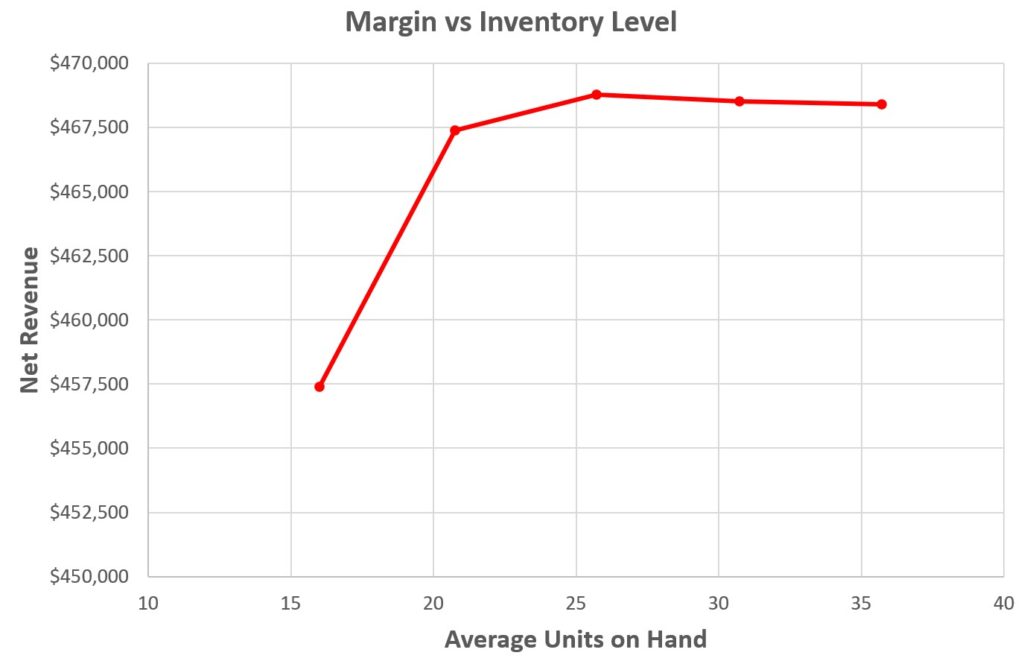
Figure 1 shows the result of simulations that fixed Q at 25 units and varied R from 10 to 30 in steps of 5. While the curve is rather flat on top, you would make the most money by keeping on-hand inventory around 25 units (which corresponds to setting R = 20). More inventory, despite a higher service level and fewer lost sales, would make a little less money (and ties up a lot more cash), and less inventory would make a lot less.


Margins vs Inventory Level Business

Figure 1: Showing that there can be too little or too much inventory on hand


Without relying on the inventory simulation software, we would not be able to discover

  • a) that it is possible to carry too little and too much inventory
  • b) what the best level of inventory is
  • c) how to get there by proper choices of reorder point R and order quantity Q.


Without an explicit understanding of the above, companies will make daily inventory decisions relying on gut feel and averaging based rule of thumb methods. The tradeoffs described here are not exposed and the resulting mix of inventory yields a far lower return forfeiting hundreds of thousands to millions per year in lost profits.  So be like Goldilocks.  With the right systems and software tools, you too can get it just right!    


Leave a Comment
Related Posts
You Need to Team up with the Algorithms

You Need to Team up with the Algorithms

This article is about the real power that comes from the collaboration between you and our software that happens at your fingertips. We often write about the software itself and what goes on “under the hood”. This time, the subject is how you should best team up with the software.

Using Key Performance Predictions to Plan Stocking Policies

Using Key Performance Predictions to Plan Stocking Policies

I can’t imagine being an inventory planner in spare parts, distribution, or manufacturing and having to create safety stock levels, reorder points, and order suggestions without using key performance predictions of service levels, fill rates, and inventory costs.

Top Differences Between Inventory Planning for Finished Goods and for MRO and Spare Parts

Top Differences Between Inventory Planning for Finished Goods and for MRO and Spare Parts

In today’s competitive business landscape, companies are constantly seeking ways to improve their operational efficiency and drive increased revenue. Optimizing service parts management is an often-overlooked aspect that can have a significant financial impact. Companies can improve overall efficiency and generate significant financial returns by effectively managing spare parts inventory. This article will explore the economic implications of optimized service parts management and how investing in Inventory Optimization and Demand Planning Software can provide a competitive advantage.

Improve Forecast Accuracy by Managing Error

The Smart Forecaster

 Pursuing best practices in demand planning,

forecasting and inventory optimization

Improve Forecast Accuracy, Eliminate Excess Inventory, & Maximize Service Levels

In this video, Dr. Thomas Willemain, co-Founder and SVP Research, talks about improving Forecast Accuracy by Managing Error. This video is the first in our series on effective methods to Improve Forecast Accuracy.  We begin by looking at how forecast error causes pain and the consequential cost related to it. Then we will explain the three most common mistakes to avoid that can help us increase revenue and prevent excess inventory. Tom concludes by reviewing the methods to improve Forecast Accuracy, the importance of measuring forecast error, and the technological opportunities to improve it.


Forecast error can be consequential

Consider one item of many

  • Product X costs $100 to make and nets $50 profit per unit.
  • Sales of Product X will turn out to be 1,000/month over the next 12 months.
  • Consider one item of many

What is the cost of forecast error?

  • If the forecast is 10% high, end the year with $120,000 of excess inventory.
  • 100 extra/month x 12 months x $100/unit
  • If the forecast is 10% low, miss out on $60,000 of profit.
  • 100 too few/month x 12 months x $50/unit


Three mistakes to avoid

1. Ignoring error.

  • Unprofessional, dereliction of duty.
  • Wishing will not make it so.
  • Treat accuracy assessment as data science, not a blame game.

2. Tolerating more error than necessary.

  • Statistical forecasting methods can improve accuracy at scale.
  • Improving data inputs can help.
  • Collecting and analyzing forecast error metrics can identify weak spots.

3. Wasting time and money going too far trying to eliminate error.

  • Some product/market combinations are inherently more difficult to forecast. After a point, let them be (but be alert for new specialized forecasting methods).
  • Sometimes steps meant to reduce error can backfire (e.g., adjustment).
Leave a Comment

RECENT POSTS

You Need to Team up with the Algorithms

You Need to Team up with the Algorithms

This article is about the real power that comes from the collaboration between you and our software that happens at your fingertips. We often write about the software itself and what goes on “under the hood”. This time, the subject is how you should best team up with the software.

Using Key Performance Predictions to Plan Stocking Policies

Using Key Performance Predictions to Plan Stocking Policies

I can’t imagine being an inventory planner in spare parts, distribution, or manufacturing and having to create safety stock levels, reorder points, and order suggestions without using key performance predictions of service levels, fill rates, and inventory costs.

Top Differences Between Inventory Planning for Finished Goods and for MRO and Spare Parts

Top Differences Between Inventory Planning for Finished Goods and for MRO and Spare Parts

In today’s competitive business landscape, companies are constantly seeking ways to improve their operational efficiency and drive increased revenue. Optimizing service parts management is an often-overlooked aspect that can have a significant financial impact. Companies can improve overall efficiency and generate significant financial returns by effectively managing spare parts inventory. This article will explore the economic implications of optimized service parts management and how investing in Inventory Optimization and Demand Planning Software can provide a competitive advantage.

Recent Posts

  • Managing Spare Parts Inventory: Best PracticesManaging Spare Parts Inventory: Best Practices
    In this blog, we’ll explore several effective strategies for managing spare parts inventory, emphasizing the importance of optimizing stock levels, maintaining service levels, and using smart tools to aid in decision-making. Managing spare parts inventory is a critical component for businesses that depend on equipment uptime and service reliability. Unlike regular inventory items, spare parts often have unpredictable demand patterns, making them more challenging to manage effectively. An efficient spare parts inventory management system helps prevent stockouts that can lead to operational downtime and costly delays while also avoiding overstocking that unnecessarily ties up capital and increases holding costs. […]
  • 5 Ways to Improve Supply Chain Decision Speed5 Ways to Improve Supply Chain Decision Speed
    The promise of a digital supply chain has transformed how businesses operate. At its core, it can make rapid, data-driven decisions while ensuring quality and efficiency throughout operations. However, it's not just about having access to more data. Organizations need the right tools and platforms to turn that data into actionable insights. This is where decision-making becomes critical, especially in a landscape where new digital supply chain solutions and AI-driven platforms can support you in streamlining many processes within the decision matrix. […]
  • Two employees checking inventory in temporary storage in a distribution warehouse.12 Causes of Overstocking and Practical Solutions
    Managing inventory effectively is critical for maintaining a healthy balance sheet and ensuring that resources are optimally allocated. Here is an in-depth exploration of the main causes of overstocking, their implications, and possible solutions. […]
  • FAQ Mastering Smart IP&O for Better Inventory ManagementFAQ: Mastering Smart IP&O for Better Inventory Management.
    Effective supply chain and inventory management are essential for achieving operational efficiency and customer satisfaction. This blog provides clear and concise answers to some basic and other common questions from our Smart IP&O customers, offering practical insights to overcome typical challenges and enhance your inventory management practices. Focusing on these key areas, we help you transform complex inventory issues into strategic, manageable actions that reduce costs and improve overall performance with Smart IP&O. […]
  • 7 Key Demand Planning Trends Shaping the Future7 Key Demand Planning Trends Shaping the Future
    Demand planning goes beyond simply forecasting product needs; it's about ensuring your business meets customer demands with precision, efficiency, and cost-effectiveness. Latest demand planning technology addresses key challenges like forecast accuracy, inventory management, and market responsiveness. In this blog, we will introduce critical demand planning trends, including data-driven insights, probabilistic forecasting, consensus planning, predictive analytics, scenario modeling, real-time visibility, and multilevel forecasting. These trends will help you stay ahead of the curve, optimize your supply chain, reduce costs, and enhance customer satisfaction, positioning your business for long-term success. […]

    Inventory Optimization for Manufacturers, Distributors, and MRO

    • Managing Spare Parts Inventory: Best PracticesManaging Spare Parts Inventory: Best Practices
      In this blog, we’ll explore several effective strategies for managing spare parts inventory, emphasizing the importance of optimizing stock levels, maintaining service levels, and using smart tools to aid in decision-making. Managing spare parts inventory is a critical component for businesses that depend on equipment uptime and service reliability. Unlike regular inventory items, spare parts often have unpredictable demand patterns, making them more challenging to manage effectively. An efficient spare parts inventory management system helps prevent stockouts that can lead to operational downtime and costly delays while also avoiding overstocking that unnecessarily ties up capital and increases holding costs. […]
    • Innovating the OEM Aftermarket with AI-Driven Inventory Optimization XLInnovating the OEM Aftermarket with AI-Driven Inventory Optimization
      The aftermarket sector provides OEMs with a decisive advantage by offering a steady revenue stream and fostering customer loyalty through the reliable and timely delivery of service parts. However, managing inventory and forecasting demand in the aftermarket is fraught with challenges, including unpredictable demand patterns, vast product ranges, and the necessity for quick turnarounds. Traditional methods often fall short due to the complexity and variability of demand in the aftermarket. The latest technologies can analyze large datasets to predict future demand more accurately and optimize inventory levels, leading to better service and lower costs. […]
    • Future-Proofing Utilities. Advanced Analytics for Supply Chain OptimizationFuture-Proofing Utilities: Advanced Analytics for Supply Chain Optimization
      Utilities in the electrical, natural gas, urban water, and telecommunications fields are all asset-intensive and reliant on physical infrastructure that must be properly maintained, updated, and upgraded over time. Maximizing asset uptime and the reliability of physical infrastructure demands effective inventory management, spare parts forecasting, and supplier management. A utility that executes these processes effectively will outperform its peers, provide better returns for its investors and higher service levels for its customers, while reducing its environmental impact. […]
    • Centering Act Spare Parts Timing Pricing and ReliabilityCentering Act: Spare Parts Timing, Pricing, and Reliability
      In this article, we'll walk you through the process of crafting a spare parts inventory plan that prioritizes availability metrics such as service levels and fill rates while ensuring cost efficiency. We'll focus on an approach to inventory planning called Service Level-Driven Inventory Optimization. Next, we'll discuss how to determine what parts you should include in your inventory and those that might not be necessary. Lastly, we'll explore ways to enhance your service-level-driven inventory plan consistently. […]

      Inventory Planning Becomes More Interesting

      The Smart Forecaster

       Pursuing best practices in demand planning,

      forecasting and inventory optimization

      Taiichi Ohno of Toyota is credited with inventing Just-In-Time (JIT) manufacturing in the 1950s. JIT ensures that a manufacturer produces only what is needed, only when required, and only in the necessary amount. That innovation has since had major impacts, some good, some less so.

      A recent New York Times article “How the World Ran out of Everything” describes some of the “less so” impacts.  For example, JIT has kept inventory costs very low improving return on assets.  This in turn is rewarded by Wall Street, so many companies have spent the last few decades reducing their inventories dramatically. Focused as they were on financials, many companies ignored the risks inherent in reducing inventories to the point that “lean” began to border on “emaciated.” Combined with increased globalization and new risks of supply interruption, stock-outs have abounded.

      Some industries have gone too far, leaving them exposed to disruption. In a competition to get to the lowest cost, companies have inadvertently concentrated their risk, been interrupted by shortages of raw materials or components, and sometimes forced to halt assembly lines. Wall Street does not look kindly on production halts.

      We all know that random events have added to the problem. First among them has been the Covid pandemic. As the pandemic has hindered factory operations and spread disarray in global shipping, many economies worldwide have been tormented by shortages of an immense range of goods — from computer chips to lumber to clothing.

      The damage is compounded when more unexpected things go wrong. The Suez Canal Blockage is a prime example, obstructing the main trade route between Europe and Asia. Recently, cyberattacks have added another layer of disruption.

      The reaction creates its own problems, just as the cyberattack on the Colonial Pipeline created gas shortages through panic buying. Suppliers start filling orders more slowly than usual. Manufacturers and distributors reverse course and increase inventories and diversify their suppliers to avoid future stockouts. Simply expanding warehouses may not deliver the solution, and the need to determine how much inventory to keep is more urgent every day.Manager In Warehouse With Inventory Management Software

      So how can you execute a real-world plan for JIT inventory amidst all this risk and uncertainty? The foundation of your response is your corporate data. Uncertainty has two sources: supply and demand. You need the facts for both.

      On the supply side, exploit the data you have on recent supplier lead times, which reflect the current turbulence. Don’t use average values when you can use probability distributions that reflect the full range of contingencies. Consider this comparison. Supplier A is now reliably filling orders in exactly 10 days. Supplier B also averages 10 days but does with a 78%/22% mix of 7 and 21 days. Both A and B have an average replenishment delay of 10 days, but the operational results they provide will be very different. You can only recognize this if you use probability models of inventory performance.

      On the demand side, similar considerations apply. First, recognize that there may have been a major shift in the character of item demand (statisticians call this a “regime change”), so purge from your analysis any data that represent the “good old days.” Then, again, stop thinking in terms of averages. While the average demand is important, it is not a sufficient descriptor of the problem you face. Equally important is the volatility of demand. Volatility is the reason you keep inventory in the first place. If demand were completely predictable, you would have neither stockouts nor excess inventory. Just as you need to estimate the full probability distribution of replenishment lead times, you need the full distribution of demand values.

      Once you understand the range of variability in both supply and demand, probabilistic forecasting will allow you to account for disruptions and unusual events. Software will convert your data on demand and lead times into huge numbers of scenarios representing how your next planning period might play out. Given those scenarios, the software can determine how best to meet your goals for such metrics as inventory costs and stockout rates. Using solutions such as Smart Inventory Optimization , you will confidently plan based on your targeted stockout risk with minimal inventory carrying cost. You may also consider letting the solution prescribe optimal service level targets by assessing the costs of additional inventory vs. stockout cost.

      In inventory planning, as in science, we cannot escape the reality of uncertainty and the impact of unusual events. We must plan accordingly: using inventory optimization software helps you identify the least-cost service level. This creates a coherent, company-wide effort that combines visibility into current operations with mathematically correct assessments of future risks and conditions.

      Inventory planning has become more “interesting” and requires a greater degree of risk awareness and agility. The right software can help.


      Leave a Comment

      Related Posts

      The Trouble With Turns

      The Trouble With Turns

      In our travels around the industrial scene, we notice that many companies pay more attention to inventory Turns than they should. We would like to deflect some of this attention to more consequential performance metrics.

      The Scourge of Skewness

      The Scourge of Skewness

      Demand planners have to cope with multiple problems to get their job done. One is the Irritation of Intermittency. The “now you see it, now you don’t” character of intermittent demand, with its heavy mix of zero values, forces the use of advanced statistical methods, such as Smart Software’s patented Markov Bootstrap algorithm. But even within the dark realm of intermittent demand, there are degrees of difficulty: planners must further cope with the potentially costly Scourge of Skewness.

      Demand Forecasting in a “Build to Order” Company

      Demand Forecasting in a “Build to Order” Company

      We often come into contact with potential customers who claim that they cannot use a forecasting system since they are a “build-to-order” manufacturing operation. I find this a puzzling perspective, because whatever these organizations build requires lower level raw materials or intermediate goods. If those lower level inputs are not available when an order for the finished good is received, the order cannot be built. Consequently, the order could be canceled and the associated revenue lost.

      Recent Posts

      • Managing Spare Parts Inventory: Best PracticesManaging Spare Parts Inventory: Best Practices
        In this blog, we’ll explore several effective strategies for managing spare parts inventory, emphasizing the importance of optimizing stock levels, maintaining service levels, and using smart tools to aid in decision-making. Managing spare parts inventory is a critical component for businesses that depend on equipment uptime and service reliability. Unlike regular inventory items, spare parts often have unpredictable demand patterns, making them more challenging to manage effectively. An efficient spare parts inventory management system helps prevent stockouts that can lead to operational downtime and costly delays while also avoiding overstocking that unnecessarily ties up capital and increases holding costs. […]
      • 5 Ways to Improve Supply Chain Decision Speed5 Ways to Improve Supply Chain Decision Speed
        The promise of a digital supply chain has transformed how businesses operate. At its core, it can make rapid, data-driven decisions while ensuring quality and efficiency throughout operations. However, it's not just about having access to more data. Organizations need the right tools and platforms to turn that data into actionable insights. This is where decision-making becomes critical, especially in a landscape where new digital supply chain solutions and AI-driven platforms can support you in streamlining many processes within the decision matrix. […]
      • Two employees checking inventory in temporary storage in a distribution warehouse.12 Causes of Overstocking and Practical Solutions
        Managing inventory effectively is critical for maintaining a healthy balance sheet and ensuring that resources are optimally allocated. Here is an in-depth exploration of the main causes of overstocking, their implications, and possible solutions. […]
      • FAQ Mastering Smart IP&O for Better Inventory ManagementFAQ: Mastering Smart IP&O for Better Inventory Management.
        Effective supply chain and inventory management are essential for achieving operational efficiency and customer satisfaction. This blog provides clear and concise answers to some basic and other common questions from our Smart IP&O customers, offering practical insights to overcome typical challenges and enhance your inventory management practices. Focusing on these key areas, we help you transform complex inventory issues into strategic, manageable actions that reduce costs and improve overall performance with Smart IP&O. […]
      • 7 Key Demand Planning Trends Shaping the Future7 Key Demand Planning Trends Shaping the Future
        Demand planning goes beyond simply forecasting product needs; it's about ensuring your business meets customer demands with precision, efficiency, and cost-effectiveness. Latest demand planning technology addresses key challenges like forecast accuracy, inventory management, and market responsiveness. In this blog, we will introduce critical demand planning trends, including data-driven insights, probabilistic forecasting, consensus planning, predictive analytics, scenario modeling, real-time visibility, and multilevel forecasting. These trends will help you stay ahead of the curve, optimize your supply chain, reduce costs, and enhance customer satisfaction, positioning your business for long-term success. […]

        Inventory Optimization for Manufacturers, Distributors, and MRO

        • Managing Spare Parts Inventory: Best PracticesManaging Spare Parts Inventory: Best Practices
          In this blog, we’ll explore several effective strategies for managing spare parts inventory, emphasizing the importance of optimizing stock levels, maintaining service levels, and using smart tools to aid in decision-making. Managing spare parts inventory is a critical component for businesses that depend on equipment uptime and service reliability. Unlike regular inventory items, spare parts often have unpredictable demand patterns, making them more challenging to manage effectively. An efficient spare parts inventory management system helps prevent stockouts that can lead to operational downtime and costly delays while also avoiding overstocking that unnecessarily ties up capital and increases holding costs. […]
        • Innovating the OEM Aftermarket with AI-Driven Inventory Optimization XLInnovating the OEM Aftermarket with AI-Driven Inventory Optimization
          The aftermarket sector provides OEMs with a decisive advantage by offering a steady revenue stream and fostering customer loyalty through the reliable and timely delivery of service parts. However, managing inventory and forecasting demand in the aftermarket is fraught with challenges, including unpredictable demand patterns, vast product ranges, and the necessity for quick turnarounds. Traditional methods often fall short due to the complexity and variability of demand in the aftermarket. The latest technologies can analyze large datasets to predict future demand more accurately and optimize inventory levels, leading to better service and lower costs. […]
        • Future-Proofing Utilities. Advanced Analytics for Supply Chain OptimizationFuture-Proofing Utilities: Advanced Analytics for Supply Chain Optimization
          Utilities in the electrical, natural gas, urban water, and telecommunications fields are all asset-intensive and reliant on physical infrastructure that must be properly maintained, updated, and upgraded over time. Maximizing asset uptime and the reliability of physical infrastructure demands effective inventory management, spare parts forecasting, and supplier management. A utility that executes these processes effectively will outperform its peers, provide better returns for its investors and higher service levels for its customers, while reducing its environmental impact. […]
        • Centering Act Spare Parts Timing Pricing and ReliabilityCentering Act: Spare Parts Timing, Pricing, and Reliability
          In this article, we'll walk you through the process of crafting a spare parts inventory plan that prioritizes availability metrics such as service levels and fill rates while ensuring cost efficiency. We'll focus on an approach to inventory planning called Service Level-Driven Inventory Optimization. Next, we'll discuss how to determine what parts you should include in your inventory and those that might not be necessary. Lastly, we'll explore ways to enhance your service-level-driven inventory plan consistently. […]