“Choosing and Achieving a Target Service Level” by Smart Software Co-Founder Profiled in Spring 2018 Issue of Foresight
Belmont, Mass., May 17, 2018 – Smart Software, Inc., provider of industry-leading demand forecasting, planning, and inventory optimization solutions, today announced that the Spring 2018 issue of Foresight Magazine features Dr. Thomas Willemain’s article “Choosing and Achieving a Target Service Level.” Len Tashman, Editor of Foresight states: “Tom Willemain describes the primary considerations for setting service-level targets, explaining how software can serve as a valuable aid in this endeavor and offering a case study to illustrate a relatively simple approach – what he calls “service level wins and losses” – by which a company can evaluate how well it is achieving its service level goals. The case study also reveals how important it is to utilize appropriate probability models rather than rely on traditional defaults such as the Normal distribution of demands.”
To read the entire article and to learn more about Foresight please visit https://foresight.forecasters.org/
About Smart Software, Inc.
Founded in 1981, Smart Software, Inc. is a leader in providing businesses with enterprise-wide demand forecasting, planning and inventory optimization solutions. Smart Software’s demand forecasting and inventory optimization solutions have helped thousands of users worldwide, including customers at mid-market enterprises and Fortune 500 companies, such as Mitsubishi, Siemens, Disney, FedEx, MARS, and The Home Depot. Smart Inventory Planning & Optimization gives demand planners the tools to handle sales seasonality, promotions, new and aging products, multi-dimensional hierarchies, and intermittently demanded service parts and capital goods items. It also provides inventory managers with accurate estimates of the optimal inventory and safety stock required to meet future orders and achieve desired service levels. Smart Software is headquartered in Belmont, Massachusetts and can be found on the World Wide Web at www.smartcorp.com.
For more information, please contact Smart Software, Inc., Four Hill Road, Belmont, MA 02478.
Phone: 1-800-SMART-99 (800-762-7899); FAX: 1-617-489-2748; E-mail: info@smartcorp.com
Smart Inventory Planning & Optimization to be Showcased at Epicor Insights
Belmont, Mass., May 14 – Smart Software, Inc., provider of industry-leading demand forecasting, planning, and inventory optimization solutions, today announced that Epicor Software will present Epicor Smart IP&O, a joint solution for inventory planning, forecasting, and optimization at Epicor’s annual customer conference in Nashville, TN from May 21 – 24 . Smart Software will also be on hand to profile the solution in booth # 5 in the Solutions Pavilion.
Smart Software and Epicor’s collaboration brings the cloud-based Smart IP&O (Inventory Planning and Optimization) into the latest version of the Epicor enterprise resource planning (ERP) solution. Smart Software’s Chief Technology Officer, Sree Menon states “it’s no longer enough to simply manage inventory. By seamlessly integrating strategic planning with operational execution, Smart IP&O enables Epicor ERP users to continuously predict, respond and plan inventory helping lower costs and improve service.”
The Epicor Sales Engineering team will demonstrate Epicor Smart IP&O in two sessions:
“Introducing Epicor Smart Demand Planning & Inventory Optimization”
Thursday, May 24 at 8:00 AM
Tennessee Ballrom B
“Moderniza las Operaciones de tu Cadena de Suministro con la Plataforma Epicor Smart Inventory Planning and Optimization”
Thursday, May 24 at 10:20 AM
Ryman Studio H/I
Epicor Insights 2018 will bring together more than 3,000 users of Epicor’s industry-specific ERP solutions for the manufacturing, distribution, and service industries. Customers who attend will have dedicated education tracks focused on their specific products and solutions, plus more opportunities to network across products and industries. To learn more, visit https://www.epicor.com/customers/insights/default.aspx
About Smart Software, Inc.
Founded in 1981, Smart Software, Inc. is a leader in providing businesses with enterprise-wide demand forecasting, planning and inventory optimization solutions. Smart Software’s demand forecasting and inventory optimization solutions have helped thousands of users worldwide, including customers at mid-market enterprises and Fortune 500 companies, such as Mitsubishi, Siemens, Disney, FedEx, MARS, and The Home Depot. Smart Inventory Planning & Optimization gives demand planners the tools to handle sales seasonality, promotions, new and aging products, multi-dimensional hierarchies, and intermittently demanded service parts and capital goods items. It also provides inventory managers with accurate estimates of the optimal inventory and safety stock required to meet future orders and achieve desired service levels. Smart Software is headquartered in Belmont, Massachusetts and can be found on the World Wide Web at www.smartcorp.com.
For more information, please contact Smart Software, Inc., Four Hill Road, Belmont, MA 02478.
Phone: 1-800-SMART-99 (800-762-7899); FAX: 1-617-489-2748; E-mail: info@smartcorp.com
Estimating Safety Stock
In my previous post in this series on essential concepts, “What is ‘A Good Forecast’”, I discussed the basic effort to discover the most likely future in a demand planning scenario. I defined a good forecast as one that is unbiased and as accurate as possible. But I also cautioned that, depending on the stability or volatility of the data we have to work with, there may still be some inaccuracy in even a good forecast. The key is to have an understanding of how much.
This topic, managing uncertainty, is the subject of post by my colleague Tom Willemain, “The Average is not the Answer”. His post lays out the theory for responsibly confronting the limits of our predictive ability. It’s important to understand how this actually works.
As I briefly touched on at the end of my previous post, our approach begins with something called a “sliding simulation”. We estimate how accurately we are predicting the future by using our forecasting techniques on an older portion of history, excluding the most recent data. We can then compare what we would have predicted for the recent past with our actual real world information about what happened. This is a reliable method to estimate how closely we are predicting future demand.
Safety stock, a carefully measured buffer in inventory level we stock above our prediction of most likely demand, is derived from the estimate of forecast error coming out of the “sliding simulation”. This approach to dealing with the accuracy of our forecasts efficiently balances between ignoring the threat of the unpredictable and costly overcompensation.
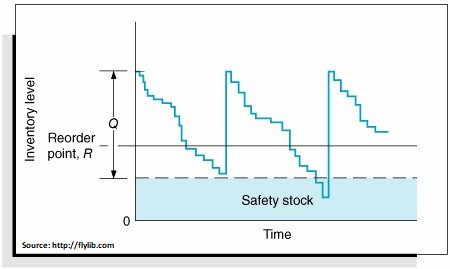 In more technical detail: the forecasts errors that are estimated by this sliding simulation process indicate the level of uncertainty. We use these errors to estimate the standard deviation of the forecasts. Now, with regular demand, we can assume the forecasts (which are estimates of future behavior) are best represented by a bell-shaped probability distribution—what statisticians call the “normal distribution”. The center of that distribution is our point forecast. The width of that distribution is the standard deviation of the “sliding simulation” forecast from the known actual values—we obtain this directly from our forecast error estimates.
Once we know the specific bell shaped curve associated with the forecast, we can easily estimate the safety stock buffer that is needed. The only input from us is the “service level” that is desired, and the safety stock at that service level can be ascertained. (The service level is essentially a measure of how confident we need to be in our inventory stocking levels, with increasing confidence requiring corresponding expenditures on extra inventory.) Notice, we are assuming that the correct distribution to use is the normal distribution. This is correct for most demand series where you have regular demand per period. It fails when demand is sporadic or intermittent.
In the next piece in this series, I’ll discuss how Smart Forecasts deals with estimating safety stock in those cases of intermittent demand, when the assumption of normality is incorrect.
Nelson Hartunian, PhD, co-founded Smart Software, formerly served as President, and currently oversees it as Chairman of the Board. He has, at various times, headed software development, sales and customer service.

In this Videoblog, we will explain how time series forecasting has emerged as a pivotal tool, particularly at the daily level, which Smart Software has been pioneering since its inception over forty years ago. The evolution of business practices from annual to more refined temporal increments like monthly and now daily data analysis illustrates a significant shift in operational strategies.

Demand planning and statistical forecasting software play a pivotal role in effective business management by incorporating features that significantly enhance forecasting accuracy. One key aspect involves the utilization of smoothing-based or extrapolative models, enabling businesses to quickly make predictions based solely on historical data. This foundation rooted in past performance is crucial for understanding trends and patterns, especially in variables like sales or product demand. Forecasting software goes beyond mere data analysis by allowing the blending of professional judgment with statistical forecasts, recognizing that forecasting is not a one-size-fits-all process. This flexibility enables businesses to incorporate human insights and industry knowledge into the forecasting model, ensuring a more nuanced and accurate prediction.
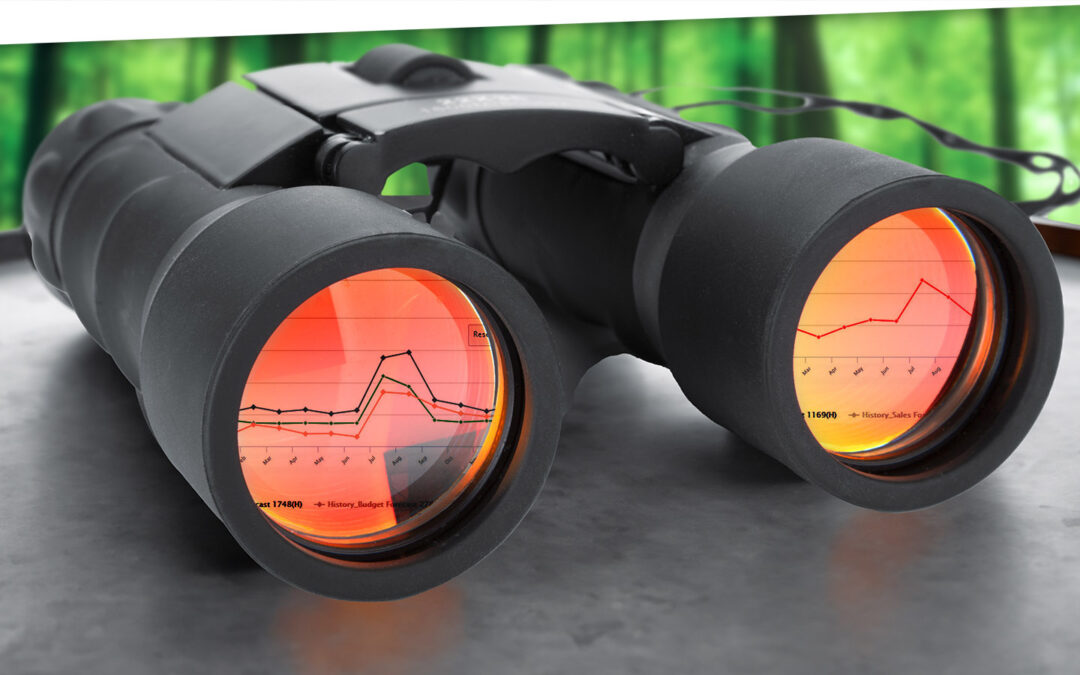
When we try to understand the complex world of logistics, randomness plays a pivotal role. This introduces an interesting paradox: In a reality where precision and certainty are prized, could the unpredictable nature of supply and demand actually serve as a strategic ally?
The quest for accurate forecasts is not just an academic exercise; it’s a critical component of operational success across numerous industries. For demand planners who must anticipate product demand, the ramifications of getting it right—or wrong—are critical. Hence, recognizing and harnessing the power of randomness isn’t merely a theoretical exercise; it’s a necessity for resilience and adaptability in an ever-changing environment.
Smart Software Wins Three Supply Chain Awards for 2013
Supply & Demand Chain Executive and Inbound Logistics Again Select Smart Software for Top 100 Lists and Executive Recognition
Belmont, Mass., July 16, 2013 – Smart Software, Inc., provider of industry-leading demand forecasting, planning and inventory optimization solutions, today announced that three supply chain industry publications have again recognized the company and its president as supply chain leaders. Smart was selected by
Supply & Demand Chain Executive and
Inbound Logistics for the eighth and ninth years, respectively, to be on their “Top 100” lists. In addition,
Supply & Demand Chain Executive also chose Smart’s president and CEO, Nelson Hartunian, as a “Provider Pro to Know.” The competitive awards recognize Smart Software as a leader in the supply chain planning software niche, and highlight the company’s strengths in technical innovation and the ability to meet customers’ needs for forecasting and demand planning solutions.
Supply & Demand Chain Executive 100
Supply & Demand Chain Executive magazine chose Smart Software, from more than 300 entries, for its annual “Supply & Demand Chain Executive 100” announced on May 13, and published in its June 2013 issue. The 2013 Supply & Demand Chain Executive 100 are supply chain solution and service providers that are helping their customers and clients achieve supply chain excellence. They have produced measurable gains in ROI through cost-cutting and increased efficiency in forecasting and demand planning chain.
“Smart Software’s inclusion in this year’s “100” list recognizes its leadership as a solution and service provider in assisting the Supply Chain function and supply chain executives as your customers move toward supply chain excellence,” said Barry Hochfelder, editor,
Supply & Demand Chain Executive.
Top 100 Logistics IT Providers
In its April 2013 issue,
Inbound Logistics’ editors recognized 100 logistics IT companies that support and enable logistics excellence. Chosen from more than 300 companies, the “Top 100 Logistics IT Providers” selected demonstrate leadership by answering Inbound Logistics readers’ needs for scalability, simplicity, fast ROI and ease of implementation.
“Inbound Logistics editors have selected 100 logistics technology companies that enable logistics and supply chain excellence. Smart Software was recognized by Inbound Logistics for leading the way in 2013 and positioning enterprises for the years ahead.” said Felicia Stratton, editor of
Inbound Logistics. “Smart Software excels at providing solutions that drive supply chain excellence and answer IL readers’ need for simplicity, ROI, and efficient implementation. Inbound Logistics is proud to honor Smart Software for continuing to offer our readers solutions that optimize logistics and supply chain excellence.”
Provider Pros to Know
President and CEO, Dr. Nelson Hartunian, has been chosen a “2013 Provider Pro to Know” by
Supply & Demand Chain Executive magazine in its February/March 2013 issue. This well-respected publication’s annual listing of Provider Pros to Know recognizes a select group of individuals, and Dr. Hartunian, a pioneer in developing inventory optimization techniques for intermittent demand, was chosen from more than 400 entries submitted.
“Those working to overcome supply chain challenges and grow the global supply chain at the same time should get the recognition they deserve for their achievements,” said Barry Hochfelder, editor,
Supply & Demand Chain Executive. “Now in its 13th year, the
Supply & Demand Chain Executive “Pros to Know” awards recognize both ends of the supply chain. This includes honoring individuals from software firms, service providers, consultancies or academia who helped their supply chain clients or the supply chain community prepare to meet industry challenges.”
“We work diligently with our customers to achieve their demand planning goals,” said Dr. Hartunian. “Our customers have found that better demand planning, using SmartForecasts, has become a critical strategic element for improving their operations and the productivity of their supply chain. While initially many purchase SmartForecasts
® to achieve tactical goals, they quickly discover strategic benefits. More specifically, the ability to accurately forecast and estimate their inventory stocking levels improves their relationships with both customers and suppliers, especially where their inventories experience a lot of intermittent demand.”
About Smart Software, Inc.
Founded in 1981, Smart Software, Inc. is a leading provider of enterprise-wide demand forecasting, planning and inventory optimization solutions. Smart Software’s flagship product, SmartForecasts, has thousands of users worldwide, including customers at mid-market enterprises and Fortune 500 companies, such as Abbott Laboratories, Metro-North Railroad, Siemens, Disney, Nestle, Nikon, GE and The Coca-Cola Company. Smart Software is headquartered in Belmont, Massachusetts and can be found online at
www.smartsoftware.wpengine.com .
SmartForecasts is a registered trademark of Smart Software, Inc. All other trademarks are the property of their respective owners.
For more information, please contact Smart Software, Inc., Four Hill Road, Belmont, MA 02478.
Phone:
1-800-SMART-99 (800-762-7899); FAX: 1-617-489-2748; E-mail:
info@smartsoftware.wpengine.com
The Average is Not the Answer
Fluctuations in an inventory supply chain are inevitable. Randomness, which can be a source of confusion and frustration, guarantees it. A ship carrying goods from China may be delayed by a storm at sea. A sudden upswing in demand one day can wipe out inventory in a single day, leaving you unable to meet the next day’s demand. Randomness creates frictions that make it hard to do your job.
At first blush, it sometimes seems best to respond to randomness with the ostrich approach: head buried in the sand. You can settle on a prediction and proceed on the assumption that the prediction will always be spot on. The flaw in that approach is that it ignores statistical methods that allow us to make use of a wealth of knowledge about our knowledge itself—how confident we can be in our predictions, and what breadth of possibilities confront us. The efficient approach to tackling the problems that stem from randomness is not to ignore uncertainty, but to embrace it with eyes open.
As a fundamental tenet of Smart Software’s approach to forecasting, we will always provide you with an assessment of the level of uncertainty in forecasts. If you are expecting nothing more than an absolute figure—the demand for widgets in February will be 120 units—you may dismiss the added element of uncertainty as a negative, or lose faith in a forecast you had hoped would be definite. But we argue for what we consider the adult approach; you need to know what you are risking when you commit to a forecast and premise your decision-making upon it.
Your forecasts can have big consequences that go beyond inventory stocking levels. They can determine your raw materials needs or staffing levels—forecasts drive many important resource allocation decisions. If you have too much faith in the most likely outcome, without also specifically considering just how likely it is, you aren’t really understanding the risks you face, and you may put yourself in a precarious position.
The need to make fully informed decisions forces us to see, in a forecast, the plus/minus range of results with a certain likelihood of occurring. In the specific case of forecasts that are going into inventory systems, this is an important part of deliberately planning for contingencies. This is how you determine not only the inventory you need to maintain in order to satisfy typical demand, but also the additional inventory you need on hand to deal with most unexpected outcomes.
This importance only increases when you are trying to maintain a reliable store of critical spare parts. Between the cost of stocking additional inventory, and accounting for the degree of reliability in your forecasts, there is a balance that crystallizes when an airplane that you need in the air is grounded—because you don’t have the replacement for a damaged part.
(While stocking extra inventory relies on the high end of the uncertainty range, if cash flow is tight, it’s the low end of the range that becomes important. Treasury-minded users find value in this other side of uncertainty in scenarios where even minimal overstocking can be more of a problem than a missed sales opportunity, for example. Reliable information about the lowest likely outcomes pays off at this time.)
Inventory theory says that you need to think about the outer ends of likely possibilities and prepare to cope with more scenarios than just what is most likely. Randomness is a reality that can’t be ignored. The average is not the answer.
Thomas Willemain, PhD, co-founded Smart Software and currently serves as Senior Vice President for Research. Dr. Willemain also serves as Professor Emeritus of Industrial and Systems Engineering at Rensselaer Polytechnic Institute and as a member of the research staff at the Center for Computing Sciences, Institute for Defense Analyses.
In this Videoblog, we will explain how time series forecasting has emerged as a pivotal tool, particularly at the daily level, which Smart Software has been pioneering since its inception over forty years ago. The evolution of business practices from annual to more refined temporal increments like monthly and now daily data analysis illustrates a significant shift in operational strategies.
Demand planning and statistical forecasting software play a pivotal role in effective business management by incorporating features that significantly enhance forecasting accuracy. One key aspect involves the utilization of smoothing-based or extrapolative models, enabling businesses to quickly make predictions based solely on historical data. This foundation rooted in past performance is crucial for understanding trends and patterns, especially in variables like sales or product demand. Forecasting software goes beyond mere data analysis by allowing the blending of professional judgment with statistical forecasts, recognizing that forecasting is not a one-size-fits-all process. This flexibility enables businesses to incorporate human insights and industry knowledge into the forecasting model, ensuring a more nuanced and accurate prediction.
When we try to understand the complex world of logistics, randomness plays a pivotal role. This introduces an interesting paradox: In a reality where precision and certainty are prized, could the unpredictable nature of supply and demand actually serve as a strategic ally?
The quest for accurate forecasts is not just an academic exercise; it’s a critical component of operational success across numerous industries. For demand planners who must anticipate product demand, the ramifications of getting it right—or wrong—are critical. Hence, recognizing and harnessing the power of randomness isn’t merely a theoretical exercise; it’s a necessity for resilience and adaptability in an ever-changing environment.