Inventory Planning Processes: Challenges and Opportunities
Smart Software is pleased to introduce our new series of educational webinars, offered exclusively for Epicor Users. In this webinar, Greg Hartunian, CEO at Smart Software, will lead a 45-minute webinar focusing on specific approaches to demand forecasting and inventory planning that will enable you to increase revenue capture, improve service levels, and reduce inventory holding costs. Minimizing excess stock, equipment downtime, and lost sales requires the right planning foundation. Most inventory planning teams rely upon traditional forecasting approaches, rule of thumb methods, and sales feedback. Many companies struggle to keep up, putting businesses at risk when the insulation of a growing top line thins. Our Webinar at EUG discusses these approaches, why they often fail, and how new probabilistic forecasting and optimization methods can make a big difference to your bottom line.
Please join our webinar at Epicor Users Group, featuring Greg Hartunian, CEO of Smart Software, who will identify the main problems of inventory planning processes and show in a live Demo how to solve them.
Smart Inventory Planning and Optimization is an integrated set of native web applications that provides a single, easy to use, scalable, environment with field-proven inventory and forecast modeling that optimizes inventory stocking policy and improves forecast accuracy. Please register to attend the webinar. If you are interested but not can not attend, please register anyway – we will record our session and will send you a link to the replay.
We hope you will be able to join us!
SmartForecasts and Smart IP&O are registered trademarks of Smart Software, Inc. All other trademarks are the property of their respective owners.
For more information, please contact Smart Software,Inc., Four Hill Road, Belmont, MA 02478.
Phone: 1-800-SMART-99 (800-762-7899); E-mail: info@smartcorp.com
Spare Parts Planning Webinar for Public Transit Agencies
Spare Parts Planning in the Age of Covid: Problems and Solutions for Public Transit Agencies
Covid has wreaked havoc on public transit. Plummeting ridership, reduced capacity, unprecedented losses in fare and tax revenue, along with added costs to keep buses and trains safe have resulted in massive transit system budget shortfalls. APTA reports that even with two rounds of emergency funding, public transit agencies will face a projected shortfall of $39.3 Billion through 2023.
This webinar will address the need for transit agencies to reconsider traditional practices, find innovative ways to capture cost savings, and do so without jeopardizing service levels. Greg Hartunian, CEO of Smart Software, will discuss the particular challenge of spare parts planning, why traditional practices used today fail, and how inventory forecasting technology is being harnessed to optimize performance and drive significant financial return.
Greg will highlight the experience of Smart Software’s transit customers, how they’ve generated bottom-line savings, what they are doing to prepare for the rebound, and share a technology demonstration using transit industry data. Please feel free to review the content below. We have provided case studies profiling the use of our technology within public transit and a software review from APICS Magazine.
Transit Specific Content
About Smart Software, Inc.
Founded in 1981, Smart Software, Inc. is a leader in providing businesses with enterprise-wide demand forecasting, planning, and inventory optimization solutions. Smart Software’s demand forecasting and inventory optimization solutions have helped thousands of users worldwide, including customers at mid-market enterprises and Fortune 500 companies, such as Disney, Siemens, Metro Transit, APS, and The American Red Cross. Smart Inventory Planning & Optimization gives demand planners the tools to handle sales seasonality, promotions, new and aging products, multi-dimensional hierarchies, and intermittently demanded service parts and capital goods items. It also provides inventory managers with accurate estimates of the optimal inventory and safety stock required to meet future orders and achieve desired service levels. Smart Software is headquartered in Belmont, Massachusetts, and can be found on the World Wide Web at www.smartcorp.com.
SmartForecasts and Smart IP&O have registered trademarks of Smart Software, Inc. All other trademarks are their respective owners’ property.
For more information, please contact Smart Software, Inc., Four Hill Road, Belmont, MA 02478.
Phone: 1-800-SMART-99 (800-762-7899); FAX: 1-617-489-2748; E-mail: info@smartcorp.com
Gaming Out Your Logistical Response to the Corona Virus
As the world holds its breathe to see how the new corona virus (2019-nCOV) will play out, we cross our fingers for all those currently in quarantine or under treatment and pray that health authorities around the world will soon get the upper hand.
This short note is about one way your business can develop a plan to adjust to one of the likely fallouts from the virus: sudden increases in the time it takes to get inventory replenishment from suppliers. Supply chains around the world are being disrupted. If this happens to you, how can you react in a systematic way?
Reacting to Longer Lead Times
This is a problem that can be solved using advanced supply chain analytics. Presumably, you may have already used this technology to make good choices for the control parameters used in managing all your inventory items, e.g., values for Min and Max or Reorder Point and Order Quantity. The specific technical question addressed here is how to convert an increase in replenishment lead time to changes in those control parameters.
In general, longer lead times require fatter inventories if you want to maintain a high level of customer service. This general rule translates into larger values of Min and/or Max. How much larger depends critically on what new, longer lead time values will appear and their probabilities of occurring.
While many planning software systems assume a fixed lead time, the reality is that almost all lead times have some degree of randomness. Typically, ignoring that randomness increases stockout risk, so having a good estimate of the probability distribution of lead times is important. In normal times, your transactional data can be used to estimate that relationship. But sudden disruptions like 2019-nCOV create unprecedented situations in which you have to make educated guesses about what new delays you will see and how likely they are. We will assume here that you can imagine some such scenarios and want to figure out how to best respond to them.
An Example using Advanced Software
To illustrate this type of prospective planning, consider a hypothetical example. One item, a spare part, has an established pattern of replenishment lead times, with delays of 5, 10 and 15 days occurring with 15%, 70% and 15% probabilities, respectively. Given this distribution and a random demand averaging one unit every 5 days, values of Min = 5 and Max = 10 do a good job. Figure 1 shows a simulation of 10 years of daily operation under this scenario. Fill rate and service level are high, and stockouts are infrequent.
Now suppose that disruptions in the supply chain create a less favorable distribution of lead time, with a 50:50 mix of 15 and 30 days. Figure 2 shows how badly the current values of Min and Max perform in this new scenario. Fill rate and service level plummet due to frequent stockouts. Operating costs more than triple due to penalties for backorders. Only inventory investment (the average dollar value of stock on the shelf) seems to get better, but this happens only because so often there are backorders with nothing left on the shelf. The shift to longer lead times clearly requires new higher values of Min and Max.
Figure 3 shows how the system performs when the Min is increased from 5 to 10 and the Max from 10 to 15. This change compensates for the longer lead times, restoring the previous high levels of fill rate and service level. Inventory investment is necessarily greater, but operating costs are actually lower than before.
Summary
Changes in normal operating conditions require adjustments in the way inventory items are managed. One such change looming large on this date is the potential impact of the 2019-nCOV Corona virus on supply chains, with anticipated increases in replenishment lead times.
Changes in lead times require changes in inventory control parameters such as Min’s and Max’s. These changes are difficult to make with any confidence using pure guesswork. But with some estimate of the increase in lead times, you can use advanced software to learn how to make these adjustments with some confidence.
This note illustrates this point using simulations of the daily operation of an inventory control system.
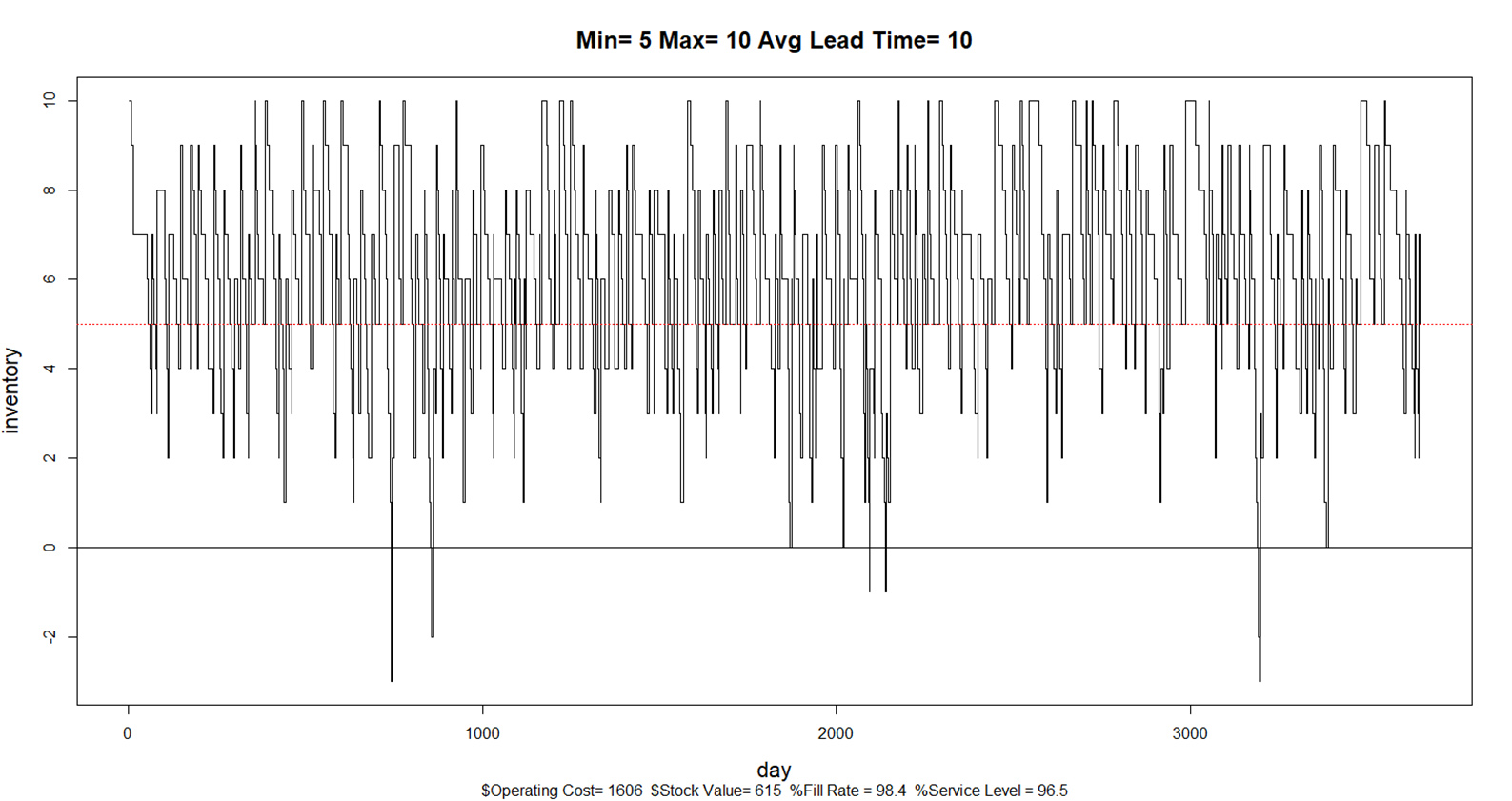
Figure 1 Simulation of normal operations using current replenishment lead times, Min and Max
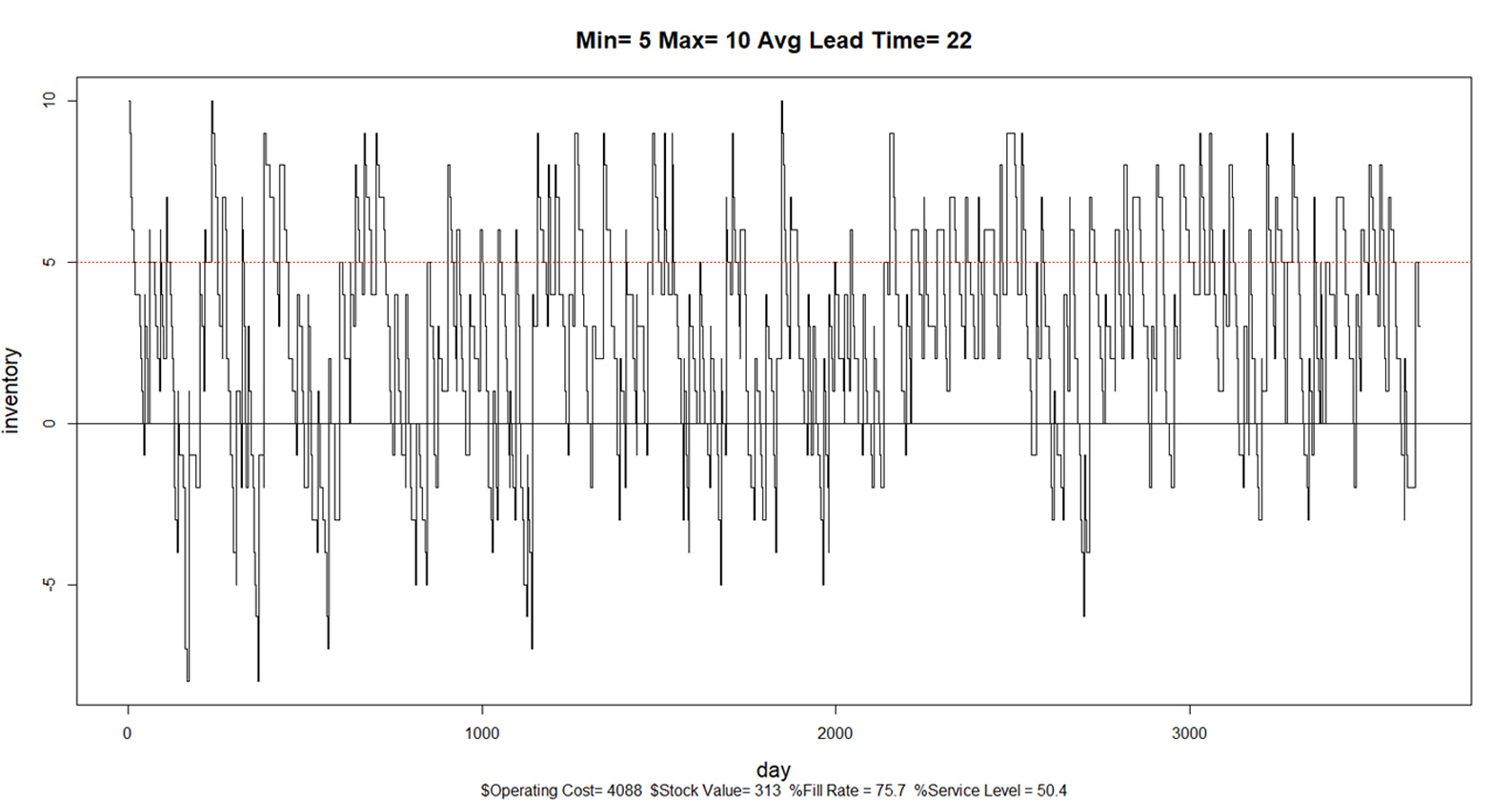
Figure 2 Simulation of abnormal operations using longer lead times and current Min and Max
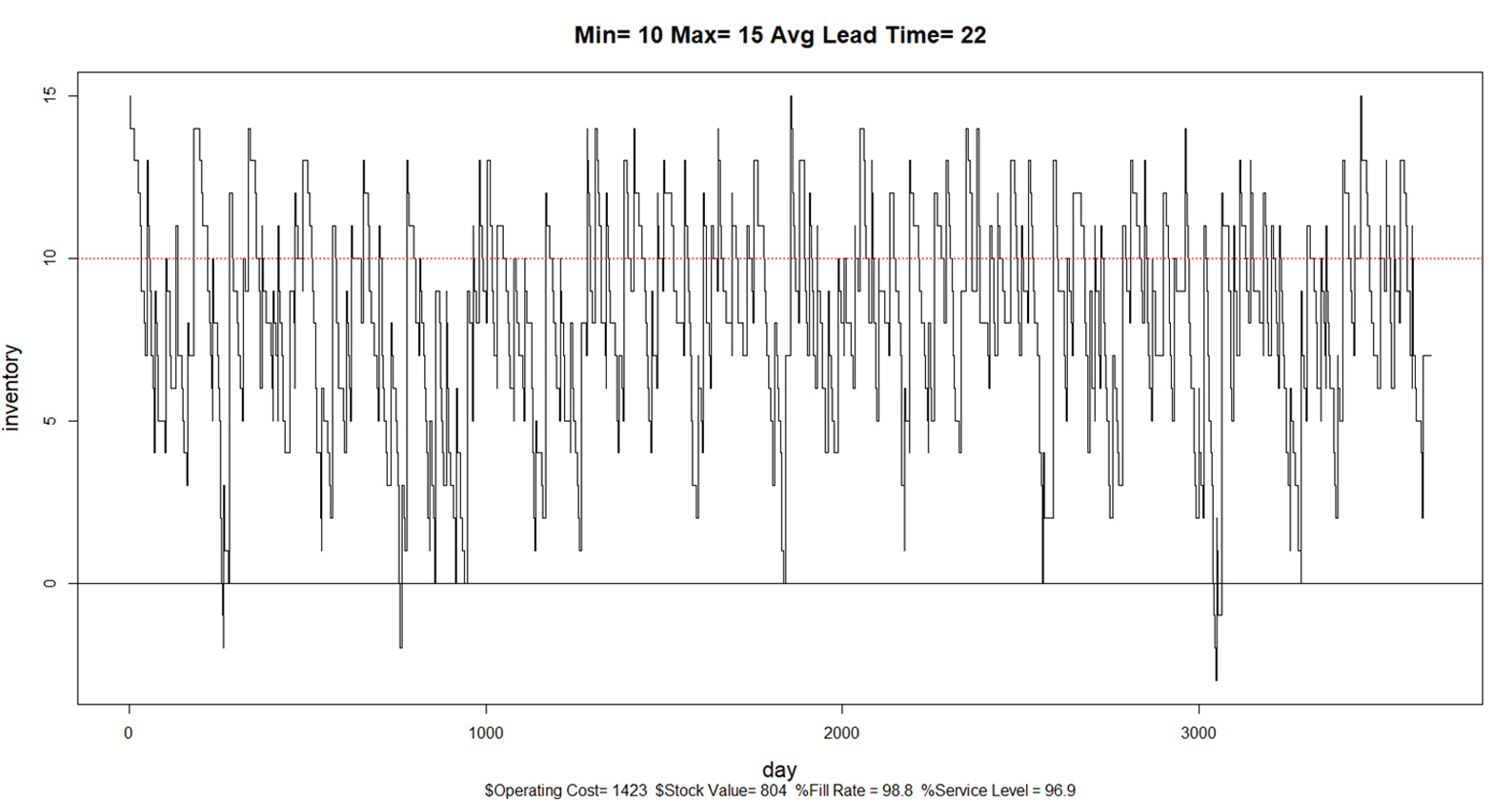
Figure 3 Simulation of abnormal operations using longer lead times and revised Min and Max

The Smart Demand Planning app (SDP) provides demand forecasts. The SDP forecasting engine is also the core of the Smart Inventory Optimization app (SIO), which stress-tests various inventory policies using a number of demand scenarios to find optimal inventory policy settings.

Service Level Driven Planning (SLDP) is an approach to inventory planning based on exposing the tradeoffs between SKU availability and inventory cost that are at the root of all wise inventory decisions. When organizations understand these tradeoffs, they can make better decisions and have greater variability into the risk of stockouts. SLDP unfolds in four steps: Benchmark, Collaborate, Plan, and Track.
Inventory optimization has become an even higher priority in recent months for many of our customers. Some are finding their products in vastly greater demand; more have the opposite problem. In either case, events like the Covid19 pandemic are forcing a reexamination of standard operating conditions, such as choices of reorder points and order quantities.
Smart Software has been named an Epicor platinum partner, the highest designation in the ISV Partner Program
Smart Software named an Epicor platinum partner, the highest designation in the ISV Partner Program
Belmont, Mass., January 2020 – Smart Software is pleased to announce that it has been named an Epicor platinum partner as a leading provider of demand planning and inventory optimization solutions. Epicor ERP customers leverage Smart’s web native platform for Inventory Planning and Optimization (Smart IP&O) to develop consensus forecasts, manage demand, and optimize stocking policies.
“Smart Software helps Epicor ERP customers by delivering business analytics for inventory modeling and forecasting. Having too much or not enough inventory are costly problems that typically require a great deal of manual planning and costs. Using Smart IP&O, our customers are able to automate manual planning processes, forecast demand more accurately, and shape inventory strategy to align with the business objectives.” notes Jennifer Schulze, VP Product Marketing, Epicor
Smart Software’s certified bi-directional integration to Epicor ERP makes all transactional data in Epicor such as shipments, sales orders, supplier receipts, inventory on hand, and more, available in Smart IP&O’s data model for analysis. Smart IP&O leverages field-proven analytics, probabilistic modeling, and the latest advancements in forecasting technology to predict future demand, prescribe optimal stocking policies, and identify opportunities for operational improvement. Users can transfer forecast results, order quantities, and stocking policies to Epicor ERP in a few mouse-clicks.
Greg Hartunian, CEO of
Smart Software stated
“In today’s supply chain, traditional forecast modeling, rule of thumb inventory planning approaches, and Excel spreadsheets just don’t cut it anymore. It’s no longer enough to simply manage your inventory. Customers leveraging Smart IP&O are better able to effectively wield inventory assets, improve their operations, lower costs, improve customer service, and outperform the competition. We look forward to continuing to work closely with Epicor to help our joint customers achieve these key benefits.”
 About Smart Software, Inc.
Founded in 1981, Smart Software, Inc. is a leader in providing businesses with enterprise-wide demand forecasting, planning and inventory optimization solutions. Smart Software’s demand forecasting and inventory optimization solutions have helped thousands of users worldwide, including customers at mid-market enterprises and Fortune 500 companies, such as Mitsubishi, Siemens, Disney, FedEx, MARS, and The Home Depot. Smart Inventory Planning & Optimization gives demand planners the tools to handle sales seasonality, promotions, new and aging products, multi-dimensional hierarchies, and intermittently demanded service parts and capital goods items. It also provides inventory managers with accurate estimates of the optimal inventory and safety stock required to meet future orders and achieve desired service levels. Smart Software is headquartered in Belmont, Massachusetts and can be found on the World Wide Web at
www.smartcorp.com.
For more information, please contact Smart Software, Inc., Four Hill Road, Belmont, MA 02478.
Phone:
1-800-SMART-99 (800-762-7899); FAX: 1-617-489-2748; E-mail: info@smartcorp.com
Otis
Smart Inventory Planning & Optimization to be Showcased at Epicor Insights
Belmont, Mass., May 14 – Smart Software, Inc., provider of industry-leading demand forecasting, planning, and inventory optimization solutions, today announced that Epicor Software will present Epicor Smart IP&O, a joint solution for inventory planning, forecasting, and optimization at Epicor’s annual customer conference in Nashville, TN from May 21 – 24 . Smart Software will also be on hand to profile the solution in booth # 5 in the Solutions Pavilion.
Smart Software and Epicor’s collaboration brings the cloud-based Smart IP&O (Inventory Planning and Optimization) into the latest version of the Epicor enterprise resource planning (ERP) solution. Smart Software’s Chief Technology Officer, Sree Menon states “it’s no longer enough to simply manage inventory. By seamlessly integrating strategic planning with operational execution, Smart IP&O enables Epicor ERP users to continuously predict, respond and plan inventory helping lower costs and improve service.”
The Epicor Sales Engineering team will demonstrate Epicor Smart IP&O in two sessions:
“Introducing Epicor Smart Demand Planning & Inventory Optimization”
Thursday, May 24 at 8:00 AM
Tennessee Ballrom B
“Moderniza las Operaciones de tu Cadena de Suministro con la Plataforma Epicor Smart Inventory Planning and Optimization”
Thursday, May 24 at 10:20 AM
Ryman Studio H/I
Epicor Insights 2018 will bring together more than 3,000 users of Epicor’s industry-specific ERP solutions for the manufacturing, distribution, and service industries. Customers who attend will have dedicated education tracks focused on their specific products and solutions, plus more opportunities to network across products and industries. To learn more, visit https://www.epicor.com/customers/insights/default.aspx
About Smart Software, Inc.
Founded in 1981, Smart Software, Inc. is a leader in providing businesses with enterprise-wide demand forecasting, planning and inventory optimization solutions. Smart Software’s demand forecasting and inventory optimization solutions have helped thousands of users worldwide, including customers at mid-market enterprises and Fortune 500 companies, such as Mitsubishi, Siemens, Disney, FedEx, MARS, and The Home Depot. Smart Inventory Planning & Optimization gives demand planners the tools to handle sales seasonality, promotions, new and aging products, multi-dimensional hierarchies, and intermittently demanded service parts and capital goods items. It also provides inventory managers with accurate estimates of the optimal inventory and safety stock required to meet future orders and achieve desired service levels. Smart Software is headquartered in Belmont, Massachusetts and can be found on the World Wide Web at www.smartcorp.com.
For more information, please contact Smart Software, Inc., Four Hill Road, Belmont, MA 02478.
Phone: 1-800-SMART-99 (800-762-7899); FAX: 1-617-489-2748; E-mail: info@smartcorp.com