
How much time should it take to compute statistical forecasts?
The top factors that impact the speed of your forecast engine 

How long should it take for a demand forecast to be computed using statistical methods?  This question is often asked by customers and prospects.  The answer truly depends.  Forecast results for a single item can be computed in the blink of an eye, in as little as a few hundredths of a second, but sometimes they may require as much as five seconds.  To understand the differences, it’s important to understand that there is more involved than grinding through the forecast arithmetic itself.   Here are six factors that influence the speed of your forecast engine.

1) Forecasting method.  Traditional time-series extrapolative techniques (such as exponential smoothing and moving average methods), when cleverly coded, are lighting fast.  For example, the Smart Forecast automatic forecasting engine that leverages these techniques and powers our demand planning and inventory optimization software can crank out statistical forecasts on 1,000 items in 1 second!  Extrapolative methods produce an expected forecast and a summary measure of forecast uncertainty. However, more complex models in our platform that generate probabilistic demand scenarios take much longer given the same computing resources.  This is partly because they create a much larger volume of output, usually thousands of plausible future demand sequences. More time, yes, but not time wasted, since these results are much more complete and form the basis for downstream optimization of inventory control parameters.

2) Computing resources.  The more resources you throw at the computation, the faster it will be.  However, resources cost money and it may not be economical to invest in these resources.  For example, to make certain types of machine learning-based forecasts work, the system will need to multi-thread computations across multiple servers to deliver results quickly.  So, make sure you understand the assumed compute resources and associated costs. Our computations happen on the Amazon Web Services cloud, so it is possible to pay for a great deal of parallel computation if desired.

3) Number of time-series.  Do you have to forecast only a few hundred items in a single location or many thousands of items across dozens of locations?  The greater the number of SKU x Location combinations, the greater the time required.  However, it is possible to trim the time to get demand forecasts by better demand classification.  For example, it is not important to forecast every single SKU x Location combination. Modern Demand Planning Software can first subset the data based on volume/frequency classifications before running the forecast engine.  We’ve observed situations where over one million SKU x Location combinations existed, but only ten percent had demand in the preceding twelve months.

4) Historical Bucketing.  Are you forecasting using daily, weekly, or monthly time buckets?  The more granular the bucketing, the more time it is going to take to compute statistical forecasts.  Many companies will wonder, “Why would anyone want to forecast on a daily basis?” However, state-of-the-art demand forecasting software can leverage daily data to detect simultaneous day-of-week and week-of-month patterns that would otherwise be obscured with traditional monthly demand buckets. And the speed of business continues to accelerate, threatening the competitive viability of the traditional monthly planning tempo.

5) Amount of History.  Are you limiting the model by only feeding it the most recent demand history, or are you feeding all available history to the demand forecasting software? The more history you feed the model, the more data must be analyzed and the longer it is going to take.

6) Additional analytical processing.  So far, we’ve imagined feeding items’ demand history in and getting forecasts out. But the process can also involve additional analytical steps that can improve results. Examples include:

a) Outlier detection and removal to minimize the distortion caused by one-off events like storm damage.

b) Machine learning that decides how much history should be used for each item by detecting regime change.

c) Causal modeling that identifies how changes in demand drivers (such as price, interest rate, customer sentiment, etc.) impact future demand.

d) Exception reporting that uses data analytics to identify unusual situations that merit further management review.


The Rest of the Story. It’s also critical to understand that the time to get an answer involves more than the speed of forecasting computations per se.  Data must be loaded into memory before computing can begin. Once the forecasts are computed, your browser must load the results so that they may be rendered on screen for you to interact with.  If you re-forecast a product, you may choose to save the results.  If you are working with product hierarchies (aggregating item forecasts up to product families, families up to product lines, etc.), the new forecast is going to impact the hierarchy, and everything must be reconciled.   All of this takes time.

Fast Enough for You? When you are evaluating software to see whether your need for speed will be satisfied, all of this can be tested as part of a proof of concept or trial offered by demand planning software solution providers.  Test it out, and make sure that the compute, load, and save times are acceptable given the volume of data and forecasting methods you want to use to support your process.



Do your statistical forecasts suffer from the wiggle effect?

 What is the wiggle effect? 

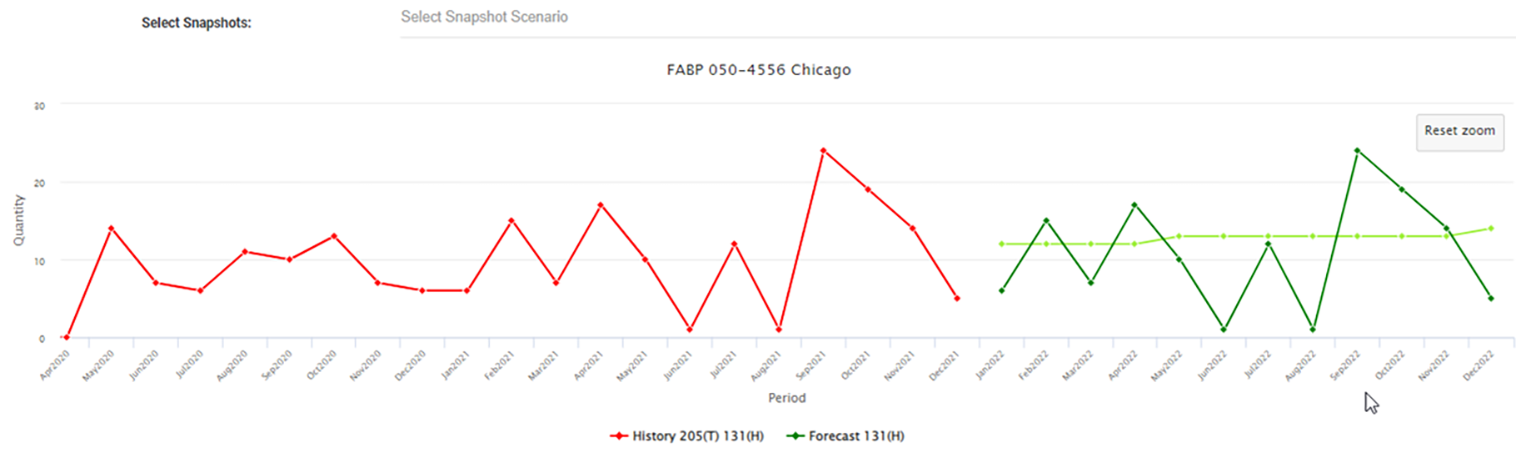
It’s when your statistical forecast incorrectly predicts the ups and downs observed in your demand history when there really isn’t a pattern.  It’s important to make sure your forecasts don’t wiggle unless there is a real pattern.

Here is a transcript from a recent customer where this issue was discussed:

Customer: “The forecast isn’t picking up on the patterns I see in the history.  Why not?” 

Smart:  “If you look closely, the ups and downs you see aren’t patterns.  It’s really noise.”  

Customer:  “But if we don’t predict the highs, we’ll stock out.”

Smart: “If the forecast were to ‘wiggle’ it would be much less accurate.  The system will forecast whatever pattern is evident, in this case a very slight uptrend.  We’ll buffer against the noise with safety stocks. The wiggles are used to set the safety stocks.”

Customer: “Ok. Makes sense now.” 

Do your statistical forecasts suffer from the wiggle effect graphic

The wiggle looks reassuring but, in this case, it is resulting in an incorrect demand forecast. The ups and downs aren’t really occurring at the same times each month.  A better statistical forecast is shown in light green.


How to Handle Statistical Forecasts of Zero

A statistical forecast of zero can cause lots of confusion for forecasters, especially when the historical demand is non-zero.  Sure, it’s obvious that demand is trending downward, but should it trend to zero?  When the older demand is much greater than the more recent demand and the more recent demand is very low volume (i.e., 1,2,3 units demanded), the answer is, statistically speaking, yes.  However, this might not jive with the planner’s business knowledge and expected minimum level of demand.  So, what should a forecaster do to correct this? Here are three suggestions:


  1. Limit the historical data fed to the model. In a down trending situation, the older data is often much greater than the recent data.   When the older much higher volume demand is ignored, the down trend won’t be nearly as significant.  You’ll still forecast a down trend, but results are more likely to be line with business expectations.
  1. Try trend dampening. Smart Demand Planner has a feature called “trend hedging” that enables users to define how a trend should phase out over time. The higher the percentage trend hedge (0-100%), the more pronounced the trend dampening.  This means that a forecasted trend will not continue through the whole forecast horizon.  This means the demand forecast will start to flatten before it hits zero on a downtrend.
  1. Change the forecast model. Switch from a trending method like Double Exponential Smoothing or Linear Moving Average to a non-trending method such as Single Exponential Smoothing or Simple Moving Average. You won’t forecast a downtrend, but at least your forecast won’t be zero and thus more likely to be accepted by the business.


Improve Forecast Accuracy by Managing Error

The Smart Forecaster

 Pursuing best practices in demand planning,

forecasting and inventory optimization

Improve Forecast Accuracy, Eliminate Excess Inventory, & Maximize Service Levels

In this video, Dr. Thomas Willemain, co-Founder and SVP Research, talks about improving Forecast Accuracy by Managing Error. This video is the first in our series on effective methods to Improve Forecast Accuracy.  We begin by looking at how forecast error causes pain and the consequential cost related to it. Then we will explain the three most common mistakes to avoid that can help us increase revenue and prevent excess inventory. Tom concludes by reviewing the methods to improve Forecast Accuracy, the importance of measuring forecast error, and the technological opportunities to improve it.


Forecast error can be consequential

Consider one item of many

  • Product X costs $100 to make and nets $50 profit per unit.
  • Sales of Product X will turn out to be 1,000/month over the next 12 months.
  • Consider one item of many

What is the cost of forecast error?

  • If the forecast is 10% high, end the year with $120,000 of excess inventory.
  • 100 extra/month x 12 months x $100/unit
  • If the forecast is 10% low, miss out on $60,000 of profit.
  • 100 too few/month x 12 months x $50/unit


Three mistakes to avoid

1. Ignoring error.

  • Unprofessional, dereliction of duty.
  • Wishing will not make it so.
  • Treat accuracy assessment as data science, not a blame game.

2. Tolerating more error than necessary.

  • Statistical forecasting methods can improve accuracy at scale.
  • Improving data inputs can help.
  • Collecting and analyzing forecast error metrics can identify weak spots.

3. Wasting time and money going too far trying to eliminate error.

  • Some product/market combinations are inherently more difficult to forecast. After a point, let them be (but be alert for new specialized forecasting methods).
  • Sometimes steps meant to reduce error can backfire (e.g., adjustment).
Leave a Comment

RECENT POSTS

The Next Frontier in Supply Chain Analytics

The Next Frontier in Supply Chain Analytics

We believe the leading edge of supply chain analytics to be the development of digital twins of inventory systems. These twins take the form of discrete event models that use Monte Carlo simulation to generate and optimize over the full range of operational risks. We also assert that we and our colleagues at Smart Software have played an outsized role in forging that leading edge.

Overcoming Uncertainty with Service and Inventory Optimization Technology

Overcoming Uncertainty with Service and Inventory Optimization Technology

In this blog, we will discuss today’s fast-paced and unpredictable market and the constant challenges businesses face in managing their inventory and service levels efficiently. The main subject of this discussion, rooted in the concept of “Probabilistic Inventory Optimization,” focuses on how modern technology can be leveraged to achieve optimal service and inventory targets amidst uncertainty. This approach not only addresses traditional inventory management issues but also offers a strategic edge in navigating the complexities of demand fluctuations and supply chain disruptions.

Centering Act: Spare Parts Timing, Pricing, and Reliability

Centering Act: Spare Parts Timing, Pricing, and Reliability

In this article, we’ll walk you through the process of crafting a spare parts inventory plan that prioritizes availability metrics such as service levels and fill rates while ensuring cost efficiency. We’ll focus on an approach to inventory planning called Service Level-Driven Inventory Optimization. Next, we’ll discuss how to determine what parts you should include in your inventory and those that might not be necessary. Lastly, we’ll explore ways to enhance your service-level-driven inventory plan consistently.

Recent Posts

  • Managing Spare Parts Inventory: Best PracticesManaging Spare Parts Inventory: Best Practices
    In this blog, we’ll explore several effective strategies for managing spare parts inventory, emphasizing the importance of optimizing stock levels, maintaining service levels, and using smart tools to aid in decision-making. Managing spare parts inventory is a critical component for businesses that depend on equipment uptime and service reliability. Unlike regular inventory items, spare parts often have unpredictable demand patterns, making them more challenging to manage effectively. An efficient spare parts inventory management system helps prevent stockouts that can lead to operational downtime and costly delays while also avoiding overstocking that unnecessarily ties up capital and increases holding costs. […]
  • 5 Ways to Improve Supply Chain Decision Speed5 Ways to Improve Supply Chain Decision Speed
    The promise of a digital supply chain has transformed how businesses operate. At its core, it can make rapid, data-driven decisions while ensuring quality and efficiency throughout operations. However, it's not just about having access to more data. Organizations need the right tools and platforms to turn that data into actionable insights. This is where decision-making becomes critical, especially in a landscape where new digital supply chain solutions and AI-driven platforms can support you in streamlining many processes within the decision matrix. […]
  • Two employees checking inventory in temporary storage in a distribution warehouse.12 Causes of Overstocking and Practical Solutions
    Managing inventory effectively is critical for maintaining a healthy balance sheet and ensuring that resources are optimally allocated. Here is an in-depth exploration of the main causes of overstocking, their implications, and possible solutions. […]
  • FAQ Mastering Smart IP&O for Better Inventory ManagementFAQ: Mastering Smart IP&O for Better Inventory Management.
    Effective supply chain and inventory management are essential for achieving operational efficiency and customer satisfaction. This blog provides clear and concise answers to some basic and other common questions from our Smart IP&O customers, offering practical insights to overcome typical challenges and enhance your inventory management practices. Focusing on these key areas, we help you transform complex inventory issues into strategic, manageable actions that reduce costs and improve overall performance with Smart IP&O. […]
  • 7 Key Demand Planning Trends Shaping the Future7 Key Demand Planning Trends Shaping the Future
    Demand planning goes beyond simply forecasting product needs; it's about ensuring your business meets customer demands with precision, efficiency, and cost-effectiveness. Latest demand planning technology addresses key challenges like forecast accuracy, inventory management, and market responsiveness. In this blog, we will introduce critical demand planning trends, including data-driven insights, probabilistic forecasting, consensus planning, predictive analytics, scenario modeling, real-time visibility, and multilevel forecasting. These trends will help you stay ahead of the curve, optimize your supply chain, reduce costs, and enhance customer satisfaction, positioning your business for long-term success. […]

    Inventory Optimization for Manufacturers, Distributors, and MRO

    • Managing Spare Parts Inventory: Best PracticesManaging Spare Parts Inventory: Best Practices
      In this blog, we’ll explore several effective strategies for managing spare parts inventory, emphasizing the importance of optimizing stock levels, maintaining service levels, and using smart tools to aid in decision-making. Managing spare parts inventory is a critical component for businesses that depend on equipment uptime and service reliability. Unlike regular inventory items, spare parts often have unpredictable demand patterns, making them more challenging to manage effectively. An efficient spare parts inventory management system helps prevent stockouts that can lead to operational downtime and costly delays while also avoiding overstocking that unnecessarily ties up capital and increases holding costs. […]
    • Innovating the OEM Aftermarket with AI-Driven Inventory Optimization XLInnovating the OEM Aftermarket with AI-Driven Inventory Optimization
      The aftermarket sector provides OEMs with a decisive advantage by offering a steady revenue stream and fostering customer loyalty through the reliable and timely delivery of service parts. However, managing inventory and forecasting demand in the aftermarket is fraught with challenges, including unpredictable demand patterns, vast product ranges, and the necessity for quick turnarounds. Traditional methods often fall short due to the complexity and variability of demand in the aftermarket. The latest technologies can analyze large datasets to predict future demand more accurately and optimize inventory levels, leading to better service and lower costs. […]
    • Future-Proofing Utilities. Advanced Analytics for Supply Chain OptimizationFuture-Proofing Utilities: Advanced Analytics for Supply Chain Optimization
      Utilities in the electrical, natural gas, urban water, and telecommunications fields are all asset-intensive and reliant on physical infrastructure that must be properly maintained, updated, and upgraded over time. Maximizing asset uptime and the reliability of physical infrastructure demands effective inventory management, spare parts forecasting, and supplier management. A utility that executes these processes effectively will outperform its peers, provide better returns for its investors and higher service levels for its customers, while reducing its environmental impact. […]
    • Centering Act Spare Parts Timing Pricing and ReliabilityCentering Act: Spare Parts Timing, Pricing, and Reliability
      In this article, we'll walk you through the process of crafting a spare parts inventory plan that prioritizes availability metrics such as service levels and fill rates while ensuring cost efficiency. We'll focus on an approach to inventory planning called Service Level-Driven Inventory Optimization. Next, we'll discuss how to determine what parts you should include in your inventory and those that might not be necessary. Lastly, we'll explore ways to enhance your service-level-driven inventory plan consistently. […]

      Four Useful Ways to Measure Forecast Error

      The Smart Forecaster

       Pursuing best practices in demand planning,

      forecasting and inventory optimization

      Improve Forecast Accuracy, Eliminate Excess Inventory, & Maximize Service Levels

      In this video, Dr. Thomas Willemain, co-Founder and SVP Research, talks about improving forecast accuracy by measuring forecast error. We begin by overviewing the various types of error metrics: scale-dependent error, percentage error, relative error, and scale-free error metrics. While some error is inevitable, there are ways to reduce it, and forecast metrics are necessary aids for monitoring and improving forecast accuracy. Then we will explain the special problem of intermittent demand and divide-by-zero problems. Tom concludes by explaining how to assess forecasts of multiple items and how it often makes sense to use weighted averages, weighting items differently by volume or revenue.


      Four general types of error metrics 

      1. Scale-dependent error
      2. Percentage error
      3. Relative error
      4 .Scale-free error

      Remark: Scale-dependent metrics are expressed in the units of the forecasted variable. The other three are expresses as percentages.


      1. Scale-dependent error metrics

      • Mean Absolute Error (MAE) aka Mean Absolute Deviation (MAD)
      • Median Absolute Error (MdAE)
      • Root Mean Square Error (RMSE)
      • These metrics express the error in the original units of the data.
        • Ex: units, cases, barrels, kilograms, dollars, liters, etc.
      • Since forecasts can be too high or too low, the signs of the errors will be either positive or negative, allowing for unwanted cancellations.
        • Ex: You don’t want errors of +50 and -50 to cancel and show “no error”.
      • To deal with the cancellation problem, these metrics take away negative signs by either squaring or using absolute value.


      2. Percentage error metric

      • Mean Absolute Percentage Error (MAPE)
      • This metric expresses the size of the error as a percentage of the actual value of the forecasted variable.
      • The advantage of this approach is that it immediately makes clear whether the error is a big deal or not.
      • Ex: Suppose the MAE is 100 units. Is a typical error of 100 units horrible? ok? great?
      • The answer depends on the size of the variable being forecasted. If the actual value is 100, then a MAE = 100 is as big as the thing being forecasted. But if the actual value is 10,000, then a MAE = 100 shows great accuracy, since the MAPE is only 1% of the actual.


      3. Relative error metric

      • Median Relative Absolute Error (MdRAE)
      • Relative to what? To a benchmark forecast.
      • What benchmark? Usually, the “naïve” forecast.
      • What is the naïve forecast? Next forecast value = last actual value.
      • Why use the naïve forecast? Because if you can’t beat that, you are in tough shape.


      4. Scale-Free error metric

      • Median Relative Scaled Error (MdRSE)
      • This metric expresses the absolute forecast error as a percentage of the natural level of randomness (volatility) in the data.
      • The volatility is measured by the average size of the change in the forecasted variable from one time period to the next.
        • (This is the same as the error made by the naïve forecast.)
      • How does this metric differ from the MdRAE above?
        • They do both use the naïve forecast, but this metric uses errors in forecasting the demand history, while the MdRAE uses errors in forecasting future values.
        • This matters because there are usually many more history values than there are forecasts.
        • In turn, that matters because this metric would “blow up” if all the data were zero, which is less likely when using the demand history.


      Intermittent Demand Planning and Parts Forecasting


      The special problem of intermittent demand

      • “Intermittent” demand has many zero demands mixed in with random non-zero demands.
      • MAPE gets ruined when errors are divided by zero.
      • MdRAE can also get ruined.
      • MdSAE is less likely to get ruined.


      Recap and remarks

      • Forecast metrics are necessary aids for monitoring and improving forecast accuracy.
      • There are two major classes of metrics: absolute and relative.
      • Absolute measures (MAE, MdAE, RMSE) are natural choices when assessing forecasts of one item.
      • Relative measures (MAPE, MdRAE, MdSAE) are useful when comparing accuracy across items or between alternative forecasts of the same item or assessing accuracy relative to the natural variability of an item.
      • Intermittent demand presents divide-by-zero problems which favor MdSAE over MAPE.
      • When assessing forecasts of multiple items, it often makes sense to use weighted averages, weighting items differently by volume or revenue.
      Leave a Comment

      RECENT POSTS

      The Next Frontier in Supply Chain Analytics

      The Next Frontier in Supply Chain Analytics

      We believe the leading edge of supply chain analytics to be the development of digital twins of inventory systems. These twins take the form of discrete event models that use Monte Carlo simulation to generate and optimize over the full range of operational risks. We also assert that we and our colleagues at Smart Software have played an outsized role in forging that leading edge.

      Overcoming Uncertainty with Service and Inventory Optimization Technology

      Overcoming Uncertainty with Service and Inventory Optimization Technology

      In this blog, we will discuss today’s fast-paced and unpredictable market and the constant challenges businesses face in managing their inventory and service levels efficiently. The main subject of this discussion, rooted in the concept of “Probabilistic Inventory Optimization,” focuses on how modern technology can be leveraged to achieve optimal service and inventory targets amidst uncertainty. This approach not only addresses traditional inventory management issues but also offers a strategic edge in navigating the complexities of demand fluctuations and supply chain disruptions.

      Centering Act: Spare Parts Timing, Pricing, and Reliability

      Centering Act: Spare Parts Timing, Pricing, and Reliability

      In this article, we’ll walk you through the process of crafting a spare parts inventory plan that prioritizes availability metrics such as service levels and fill rates while ensuring cost efficiency. We’ll focus on an approach to inventory planning called Service Level-Driven Inventory Optimization. Next, we’ll discuss how to determine what parts you should include in your inventory and those that might not be necessary. Lastly, we’ll explore ways to enhance your service-level-driven inventory plan consistently.

      Recent Posts

      • Managing Spare Parts Inventory: Best PracticesManaging Spare Parts Inventory: Best Practices
        In this blog, we’ll explore several effective strategies for managing spare parts inventory, emphasizing the importance of optimizing stock levels, maintaining service levels, and using smart tools to aid in decision-making. Managing spare parts inventory is a critical component for businesses that depend on equipment uptime and service reliability. Unlike regular inventory items, spare parts often have unpredictable demand patterns, making them more challenging to manage effectively. An efficient spare parts inventory management system helps prevent stockouts that can lead to operational downtime and costly delays while also avoiding overstocking that unnecessarily ties up capital and increases holding costs. […]
      • 5 Ways to Improve Supply Chain Decision Speed5 Ways to Improve Supply Chain Decision Speed
        The promise of a digital supply chain has transformed how businesses operate. At its core, it can make rapid, data-driven decisions while ensuring quality and efficiency throughout operations. However, it's not just about having access to more data. Organizations need the right tools and platforms to turn that data into actionable insights. This is where decision-making becomes critical, especially in a landscape where new digital supply chain solutions and AI-driven platforms can support you in streamlining many processes within the decision matrix. […]
      • Two employees checking inventory in temporary storage in a distribution warehouse.12 Causes of Overstocking and Practical Solutions
        Managing inventory effectively is critical for maintaining a healthy balance sheet and ensuring that resources are optimally allocated. Here is an in-depth exploration of the main causes of overstocking, their implications, and possible solutions. […]
      • FAQ Mastering Smart IP&O for Better Inventory ManagementFAQ: Mastering Smart IP&O for Better Inventory Management.
        Effective supply chain and inventory management are essential for achieving operational efficiency and customer satisfaction. This blog provides clear and concise answers to some basic and other common questions from our Smart IP&O customers, offering practical insights to overcome typical challenges and enhance your inventory management practices. Focusing on these key areas, we help you transform complex inventory issues into strategic, manageable actions that reduce costs and improve overall performance with Smart IP&O. […]
      • 7 Key Demand Planning Trends Shaping the Future7 Key Demand Planning Trends Shaping the Future
        Demand planning goes beyond simply forecasting product needs; it's about ensuring your business meets customer demands with precision, efficiency, and cost-effectiveness. Latest demand planning technology addresses key challenges like forecast accuracy, inventory management, and market responsiveness. In this blog, we will introduce critical demand planning trends, including data-driven insights, probabilistic forecasting, consensus planning, predictive analytics, scenario modeling, real-time visibility, and multilevel forecasting. These trends will help you stay ahead of the curve, optimize your supply chain, reduce costs, and enhance customer satisfaction, positioning your business for long-term success. […]

        Inventory Optimization for Manufacturers, Distributors, and MRO

        • Managing Spare Parts Inventory: Best PracticesManaging Spare Parts Inventory: Best Practices
          In this blog, we’ll explore several effective strategies for managing spare parts inventory, emphasizing the importance of optimizing stock levels, maintaining service levels, and using smart tools to aid in decision-making. Managing spare parts inventory is a critical component for businesses that depend on equipment uptime and service reliability. Unlike regular inventory items, spare parts often have unpredictable demand patterns, making them more challenging to manage effectively. An efficient spare parts inventory management system helps prevent stockouts that can lead to operational downtime and costly delays while also avoiding overstocking that unnecessarily ties up capital and increases holding costs. […]
        • Innovating the OEM Aftermarket with AI-Driven Inventory Optimization XLInnovating the OEM Aftermarket with AI-Driven Inventory Optimization
          The aftermarket sector provides OEMs with a decisive advantage by offering a steady revenue stream and fostering customer loyalty through the reliable and timely delivery of service parts. However, managing inventory and forecasting demand in the aftermarket is fraught with challenges, including unpredictable demand patterns, vast product ranges, and the necessity for quick turnarounds. Traditional methods often fall short due to the complexity and variability of demand in the aftermarket. The latest technologies can analyze large datasets to predict future demand more accurately and optimize inventory levels, leading to better service and lower costs. […]
        • Future-Proofing Utilities. Advanced Analytics for Supply Chain OptimizationFuture-Proofing Utilities: Advanced Analytics for Supply Chain Optimization
          Utilities in the electrical, natural gas, urban water, and telecommunications fields are all asset-intensive and reliant on physical infrastructure that must be properly maintained, updated, and upgraded over time. Maximizing asset uptime and the reliability of physical infrastructure demands effective inventory management, spare parts forecasting, and supplier management. A utility that executes these processes effectively will outperform its peers, provide better returns for its investors and higher service levels for its customers, while reducing its environmental impact. […]
        • Centering Act Spare Parts Timing Pricing and ReliabilityCentering Act: Spare Parts Timing, Pricing, and Reliability
          In this article, we'll walk you through the process of crafting a spare parts inventory plan that prioritizes availability metrics such as service levels and fill rates while ensuring cost efficiency. We'll focus on an approach to inventory planning called Service Level-Driven Inventory Optimization. Next, we'll discuss how to determine what parts you should include in your inventory and those that might not be necessary. Lastly, we'll explore ways to enhance your service-level-driven inventory plan consistently. […]