7 Digital Transformations for Utilities that will Boost MRO Performance

Utilities in the electrical, natural gas, urban water and wastewater, and telecommunications fields are all asset intensive. Generation, production, processing, transmission, and distribution of electricity, natural gas, oil, and water, are all reliant on physical infrastructure that must be properly maintained, updated, and upgraded over time. Maximizing asset uptime and the reliability of physical infrastructure demands effective inventory management, spare parts forecasting, and supplier management.

A utility that executes these processes effectively will outperform its peers, provide better returns for its investors and higher service levels for its customers, while reducing its environmental impact. Impeding these efforts are out-of-date IT systems, evolving security threats, frequent supply chain disruptions, and extreme demand variability.  However, the convergence of these challenges with mature cloud technology and recent advancements in data analytics, probabilistic forecasting, and technologies for data management, present utilities a generational opportunity to digitally transform their enterprise.

Here are seven digital transformations that require relatively small upfront investments but will generate seven-figure returns.

1. Inventory Management is the first step in MRO inventory optimization. It involves analyzing current inventory levels and usage patterns to identify opportunities for improvement. This should include looking for overstocked, understocked, or obsolete items.  New probabilistic forecasting technology will help by simulating future parts usage and predicting how current stocking policies will perform.  Pats planners can use the simulation results to proactively identify where policies should be modified.

2. Accurate forecasting and demand planning are very important in optimizing MRO service parts inventories. An accurate demand forecast is a critical supply chain driver. By understanding demand patterns that result from capital projects and planned and unplanned maintenance, parts planners can more accurately anticipate future inventory needs, budget properly, and better communicate anticipated demand to suppliers. Parts forecasting software can be used to automatically house an accurate set of historical usage that details planned vs. unplanned parts demand.

3. Managing suppliers and lead times are important components of MRO inventory optimization. It involves selecting the best vendors for the job, having backup suppliers that can deliver quickly if the preferred supplier fails, and negotiating favorable terms.  Identifying the right lead time to base stocking policies on is another important component. Probabilistic simulations available in parts planning software can be used to forecast the probability for each possible lead time that will be faced. This will result in a more accurate recommendation of what to stock compared to using a supplier quoted or average lead time.

4. SKU rationalization and master data management removes ineffective or out-of-date SKUs from the product catalog and ERP database. It also identifies different part numbers that have been used for the same SKU. The operating cost and profitability of each product are assessed during this procedure, resulting in a common list of active SKUs.  Master data management software can assess product catalogs and information stored in disparate data bases to identify SKU rationalizations ensuring that inventory policies are based on the common part number.

5.  Inventory control systems are key to synchronizing inventory optimization.    They provide a cost-efficient way for utilities to track, monitor, and manage their inventory. They helps ensure that the utility has the right supplies and materials when and where needed while minimizing inventory costs.

6. Continuous improvement is essential for optimizing MRO inventories. It involves regularly monitoring and adjusting inventory levels and stocking policies to ensure the most efficient use of resources. When operating conditions change, the utility must detect the change and adjust its operations accordingly. This means planning cycles must operate at a tempo high enough to stay up with changing conditions. Leveraging probabilistic forecasting to recalibrate service parts stocking policies each planning cycle ensures that stocking policies (such as min/max levels) are always up-to-date and reflect the latest parts usage and supplier lead times.

7. Planning for intermittent demand with modern Spare Parts Planning Software.  The result is a highly accurate estimate of safety stocks, reorder points, and order quantities, leading to higher service levels and lower inventory costs.   Smart Software’s patented probabilistic spare parts forecasting software simulates the probability for each possible demand, accurately determining how much to stock to achieve a utility’s targeted service levels.  Leveraging software to accurately simulate the inflow and outflow of repairable spare parts will better predict downtime, service levels, and inventory costs associated with any chosen pool size for repairable spares.


Spare Parts Planning Software solutions

Smart IP&O’s service parts forecasting software uses a unique empirical probabilistic forecasting approach that is engineered for intermittent demand. For consumable spare parts, our patented and APICS award winning method rapidly generates tens of thousands of demand scenarios without relying on the assumptions about the nature of demand distributions implicit in traditional forecasting methods. The result is highly accurate estimates of safety stock, reorder points, and service levels, which leads to higher service levels and lower inventory costs. For repairable spare parts, Smart’s Repair and Return Module accurately simulates the processes of part breakdown and repair. It predicts downtime, service levels, and inventory costs associated with the current rotating spare parts pool. Planners will know how many spares to stock to achieve short- and long-term service level requirements and, in operational settings, whether to wait for repairs to be completed and returned to service or to purchase additional service spares from suppliers, avoiding unnecessary buying and equipment downtime.

Contact us to learn more how this functionality has helped our customers in the MRO, Field Service, Utility, Mining, and Public Transportation sectors to optimize their inventory. You can also download the Whitepaper here.


White Paper: What you Need to know about Forecasting and Planning Service Parts


This paper describes Smart Software’s patented methodology for forecasting demand, safety stocks, and reorder points on items such as service parts and components with intermittent demand, and provides several examples of customer success.

 

    Statistical Forecasting: How Automatic method selection works in Smart IP&O

    Smart IP&O offers automated statistical forecasting that selects the right forecast method that best forecasts the data.  It does this for each time-series in the data set.  This blog will help a laymen understand how the forecast methods are chosen automatically.

    Smart makes many methods available including single and double exponential smoothing, linear and simple moving average, and Winters models.  Each model is designed to capture a different sort of pattern.  The criteria to automatically choose one statistical method out of a set of choices is based on which method came closest to correctly predicting held-out history.

    Earlier demand history is passed to each method and the result is compared to actuals to find the one that came closest overall.  That “winning” automatically chosen method is then fed all the history for that item to produce the forecast.

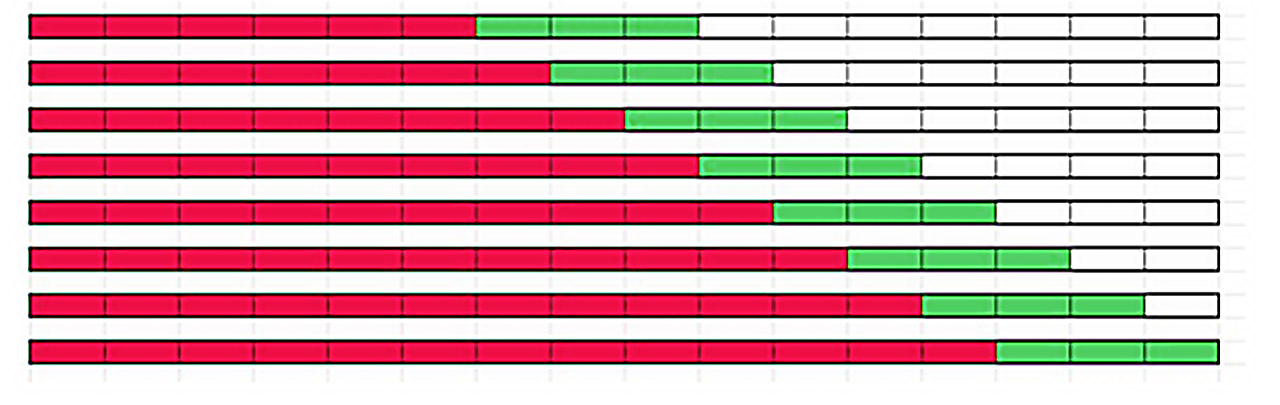
    The overall nature of the demand pattern for the item is captured by holding out different portions of the history so that an occasional outlier does not unduly influence the choice of method.  You can visualize it using the below diagram where each row represents a 3-period forecast in held out history, based on different amounts of the red earlier history.  The variances of each pass are averaged together to determine the method’s overall ranking against all other methods.

    Automatic Forecasting and Statistical Forecasting App

    For most time series, this process can accurately capture trends, seasonality, and average volume accurately. But sometimes a chosen method comes mathematically closest to predicting the held-out history but doesn’t project it forward in a way that makes sense.

    Users can correct this by using the system’s exception reports and filtering features to identify items that merit review.  They can then configure the automatic forecast methods that they wish to be considered for that item.


    How much time should it take to compute statistical forecasts?
    The top factors that impact the speed of your forecast engine 

    How long should it take for a demand forecast to be computed using statistical methods?  This question is often asked by customers and prospects.  The answer truly depends.  Forecast results for a single item can be computed in the blink of an eye, in as little as a few hundredths of a second, but sometimes they may require as much as five seconds.  To understand the differences, it’s important to understand that there is more involved than grinding through the forecast arithmetic itself.   Here are six factors that influence the speed of your forecast engine.

    1) Forecasting method.  Traditional time-series extrapolative techniques (such as exponential smoothing and moving average methods), when cleverly coded, are lighting fast.  For example, the Smart Forecast automatic forecasting engine that leverages these techniques and powers our demand planning and inventory optimization software can crank out statistical forecasts on 1,000 items in 1 second!  Extrapolative methods produce an expected forecast and a summary measure of forecast uncertainty. However, more complex models in our platform that generate probabilistic demand scenarios take much longer given the same computing resources.  This is partly because they create a much larger volume of output, usually thousands of plausible future demand sequences. More time, yes, but not time wasted, since these results are much more complete and form the basis for downstream optimization of inventory control parameters.

    2) Computing resources.  The more resources you throw at the computation, the faster it will be.  However, resources cost money and it may not be economical to invest in these resources.  For example, to make certain types of machine learning-based forecasts work, the system will need to multi-thread computations across multiple servers to deliver results quickly.  So, make sure you understand the assumed compute resources and associated costs. Our computations happen on the Amazon Web Services cloud, so it is possible to pay for a great deal of parallel computation if desired.

    3) Number of time-series.  Do you have to forecast only a few hundred items in a single location or many thousands of items across dozens of locations?  The greater the number of SKU x Location combinations, the greater the time required.  However, it is possible to trim the time to get demand forecasts by better demand classification.  For example, it is not important to forecast every single SKU x Location combination. Modern Demand Planning Software can first subset the data based on volume/frequency classifications before running the forecast engine.  We’ve observed situations where over one million SKU x Location combinations existed, but only ten percent had demand in the preceding twelve months.

    4) Historical Bucketing.  Are you forecasting using daily, weekly, or monthly time buckets?  The more granular the bucketing, the more time it is going to take to compute statistical forecasts.  Many companies will wonder, “Why would anyone want to forecast on a daily basis?” However, state-of-the-art demand forecasting software can leverage daily data to detect simultaneous day-of-week and week-of-month patterns that would otherwise be obscured with traditional monthly demand buckets. And the speed of business continues to accelerate, threatening the competitive viability of the traditional monthly planning tempo.

    5) Amount of History.  Are you limiting the model by only feeding it the most recent demand history, or are you feeding all available history to the demand forecasting software? The more history you feed the model, the more data must be analyzed and the longer it is going to take.

    6) Additional analytical processing.  So far, we’ve imagined feeding items’ demand history in and getting forecasts out. But the process can also involve additional analytical steps that can improve results. Examples include:

    a) Outlier detection and removal to minimize the distortion caused by one-off events like storm damage.

    b) Machine learning that decides how much history should be used for each item by detecting regime change.

    c) Causal modeling that identifies how changes in demand drivers (such as price, interest rate, customer sentiment, etc.) impact future demand.

    d) Exception reporting that uses data analytics to identify unusual situations that merit further management review.


    The Rest of the Story. It’s also critical to understand that the time to get an answer involves more than the speed of forecasting computations per se.  Data must be loaded into memory before computing can begin. Once the forecasts are computed, your browser must load the results so that they may be rendered on screen for you to interact with.  If you re-forecast a product, you may choose to save the results.  If you are working with product hierarchies (aggregating item forecasts up to product families, families up to product lines, etc.), the new forecast is going to impact the hierarchy, and everything must be reconciled.   All of this takes time.

    Fast Enough for You? When you are evaluating software to see whether your need for speed will be satisfied, all of this can be tested as part of a proof of concept or trial offered by demand planning software solution providers.  Test it out, and make sure that the compute, load, and save times are acceptable given the volume of data and forecasting methods you want to use to support your process.


    6 Do’s and Don’ts for Spare Parts Planning

    Managing spare parts inventories can feel impossible. You don’t know what will break and when. Feedback from mechanical departments and maintenance teams is often inaccurate. Planned maintenance schedules are often shifted around, making them anything but “planned.”   Usage (i.e., demand) patterns are most often extremely intermittent, i.e., demand jumps randomly between zero and something else, often a surprisingly big number. Intermittency, combined with the lack of significant trend or seasonal patterns, render traditional time-series forecasting methods inaccurate. The large number of part-by-locations combinations makes it impossible to manually create or even review forecasts for individual parts.   Given all these challenges, we thought it would be helpful to outline a number of do’s (and their associated don’ts).

    1. Do use probabilistic methods to compute a reorder points and Min/Max levels
      Basing stocking decisions on average daily usage isn’t the right answer. Nor is reliance on traditional forecasting methods like exponential smoothing models. Neither approach works when demand is intermittent because they don’t take proper account of demand volatility. Probabilistic methods that simulate thousands of possible demand scenarios work best. They provide a realistic estimate of the demand distribution and can handle all the zeros and random non-zeros. This will ensure the inventory level is right-sized to hit whatever service level target you choose.
       
    2. Do use service levels instead of rule-of-thumb methods to determine stocking levels
      Many parts planning organizations rely on multiples of daily demand and other rules of thumb to determine stocking policies. For example, reorder points are often based on doubling average demand over the lead time or applying some other multiple depending on the importance of the item. However, averages don’t account for how volatile (or noisy) a part is and will lead to overstocking less noisy parts and understocking more noisy parts.
       
    3. Do frequently recompute stocking policies
      Just because demand is intermittent doesn’t mean nothing changes over time. Yet after interviewing hundreds of companies managing spare parts inventory, we find that fewer than 10% recompute stocking policies monthly. Many never recompute stocking policies until there is a “problem.” Across thousands of parts, usage is guaranteed to drift up or down on at least some of the parts. Supplier lead times can also change. Using an outdated reorder point will cause orders to trigger too soon or too late, creating lots of problems. Recomputing policies every planning cycle ensures inventory will be right-sized. Don’t be reactive and wait for a problem to occur before considering whether the Min or Max should be modified. By then it’s too late – it’s like waiting for your brakes to fail before making a repair. Don’t worry about the effort of recomputing Min/Max values for large numbers of SKU’s: modern software does it automatically. Remember: Recalibration of your stocking policies is preventive maintenance against stockout!
       
    4. Do get buy-in on targeted service levels
      Inventory is expensive and should be right-sized based on striking a balance between the organization’s willingness to stock out and its willingness to budget for spares. Too often, planners make decisions in isolation based on pain avoidance or maintenance technicians’ requests without consideration of how spending on one part impacts the organization’s ability to spend on another part. Excess inventory on one part hurts service levels on other parts by disproportionally consuming the inventory budget. Make sure that service level goals and associated inventory costs of achieving the service levels are understood and agreed to.
       
    5. Do run a separate planning process for repairable parts
      Some parts are very expensive to replace, so it is preferable to send them to repair facilities or back to the OEM for repair. Accounting for the supply side randomness of when repairable parts will be returned, and knowing whether to wait for a repair or to purchase an additional spare, are critical to ensuring item availability without inventory bloat. This requires specialized reporting and the use of probabilistic models.  Don’t treat repairable parts like consumable parts when planning.
       
    6. Do count what is purchased against the budget – not just what is consumed
      Many organizations will allocate total part purchases to a separate corporate budget and ding the mechanical or maintenance team’s budget for parts that are used. In most MRO organizations, especially in public transit and utilities, the repair teams dictate what is purchased. If what is purchased doesn’t count against their budget, they will over-buy to ensure there is never any chance of stockout. They have literally zero incentive to get it right, so tens of millions in excess inventory will be purchased. If what is purchased is reflected in the budget, far more attention will be paid to purchasing only what is truly needed. Recognizing that excess inventory hurts service by robbing the organization of cash that could otherwise be used on understocked parts is an important step to ensuring responsible inventory purchasing.

    Spare Parts Planning Software solutions

    Smart IP&O’s service parts forecasting software uses a unique empirical probabilistic forecasting approach that is engineered for intermittent demand. For consumable spare parts, our patented and APICS award winning method rapidly generates tens of thousands of demand scenarios without relying on the assumptions about the nature of demand distributions implicit in traditional forecasting methods. The result is highly accurate estimates of safety stock, reorder points, and service levels, which leads to higher service levels and lower inventory costs. For repairable spare parts, Smart’s Repair and Return Module accurately simulates the processes of part breakdown and repair. It predicts downtime, service levels, and inventory costs associated with the current rotating spare parts pool. Planners will know how many spares to stock to achieve short- and long-term service level requirements and, in operational settings, whether to wait for repairs to be completed and returned to service or to purchase additional service spares from suppliers, avoiding unnecessary buying and equipment downtime.

    Contact us to learn more how this functionality has helped our customers in the MRO, Field Service, Utility, Mining, and Public Transportation sectors to optimize their inventory. You can also download the Whitepaper here.


    White Paper: What you Need to know about Forecasting and Planning Service Parts


    This paper describes Smart Software’s patented methodology for forecasting demand, safety stocks, and reorder points on items such as service parts and components with intermittent demand, and provides several examples of customer success.

     

      Do your statistical forecasts suffer from the wiggle effect?

       What is the wiggle effect? 

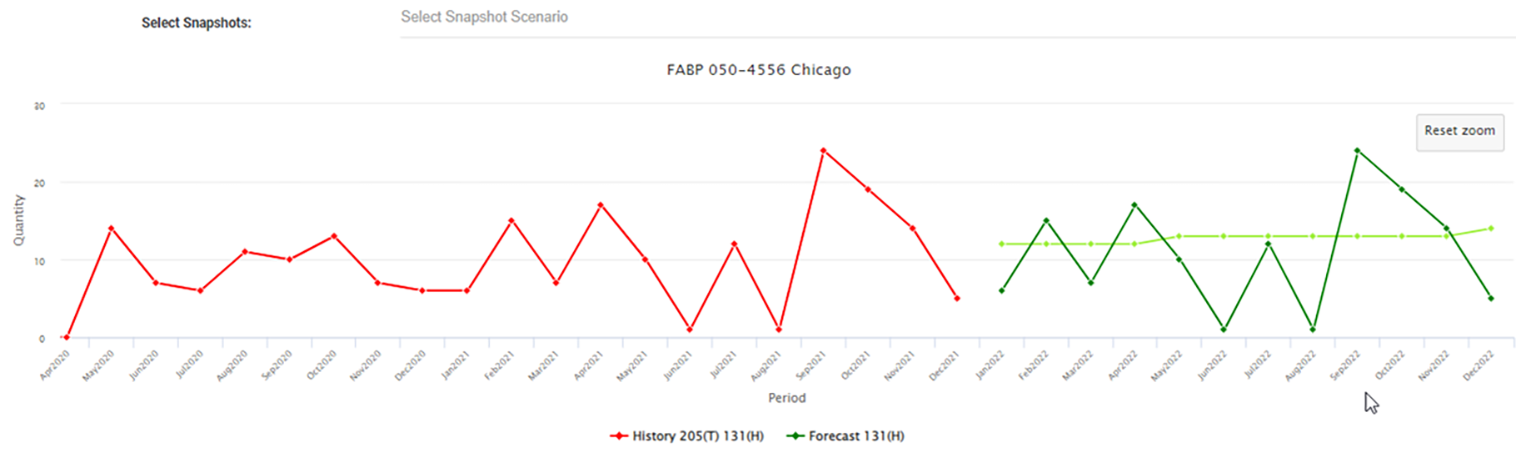
      It’s when your statistical forecast incorrectly predicts the ups and downs observed in your demand history when there really isn’t a pattern.  It’s important to make sure your forecasts don’t wiggle unless there is a real pattern.

      Here is a transcript from a recent customer where this issue was discussed:

      Customer: “The forecast isn’t picking up on the patterns I see in the history.  Why not?” 

      Smart:  “If you look closely, the ups and downs you see aren’t patterns.  It’s really noise.”  

      Customer:  “But if we don’t predict the highs, we’ll stock out.”

      Smart: “If the forecast were to ‘wiggle’ it would be much less accurate.  The system will forecast whatever pattern is evident, in this case a very slight uptrend.  We’ll buffer against the noise with safety stocks. The wiggles are used to set the safety stocks.”

      Customer: “Ok. Makes sense now.” 

      Do your statistical forecasts suffer from the wiggle effect graphic

      The wiggle looks reassuring but, in this case, it is resulting in an incorrect demand forecast. The ups and downs aren’t really occurring at the same times each month.  A better statistical forecast is shown in light green.