Smart Inventory Planning & Optimization to be Showcased at Epicor Insights

Belmont, Mass., May 14  – Smart Software, Inc., provider of industry-leading demand forecasting, planning, and inventory optimization solutions, today announced that Epicor Software will present Epicor Smart IP&O, a joint solution for inventory planning, forecasting, and optimization at Epicor’s annual customer conference in Nashville, TN from May 21 – 24 .  Smart Software will also be on hand to profile the solution in booth # 5 in the Solutions Pavilion.

Smart Software and Epicor’s collaboration  brings the cloud-based Smart IP&O (Inventory Planning and Optimization) into the latest version of the Epicor enterprise resource planning (ERP) solution. Smart Software’s Chief Technology Officer, Sree Menon states “it’s no longer enough to simply manage inventory. By seamlessly integrating strategic planning with operational execution, Smart IP&O enables Epicor ERP users to continuously predict, respond and plan inventory helping lower costs and improve service.”

The Epicor Sales Engineering team will demonstrate Epicor Smart IP&O in two sessions:

“Introducing Epicor Smart Demand Planning & Inventory Optimization”
Thursday, May 24 at 8:00 AM
Tennessee Ballrom B

“Moderniza las Operaciones de tu Cadena de Suministro con la Plataforma Epicor Smart Inventory Planning and Optimization”
Thursday, May 24  at 10:20 AM
Ryman Studio H/I

Epicor Insights 2018 will bring together more than 3,000 users of Epicor’s industry-specific ERP solutions for the manufacturing, distribution, and service industries. Customers who attend will have dedicated education tracks focused on their specific products and solutions, plus more opportunities to network across products and industries. To learn more, visit https://www.epicor.com/customers/insights/default.aspx

About Smart Software, Inc.
Founded in 1981, Smart Software, Inc. is a leader in providing businesses with enterprise-wide demand forecasting, planning and inventory optimization solutions.  Smart Software’s demand forecasting and inventory optimization solutions have helped thousands of users worldwide, including customers at mid-market enterprises and Fortune 500 companies, such as Mitsubishi, Siemens, Disney, FedEx, MARS, and The Home Depot.  Smart Inventory Planning & Optimization gives demand planners the tools to handle sales seasonality, promotions, new and aging products, multi-dimensional hierarchies, and intermittently demanded service parts and capital goods items.  It also provides inventory managers with accurate estimates of the optimal inventory and safety stock required to meet future orders and achieve desired service levels.  Smart Software is headquartered in Belmont, Massachusetts and can be found on the World Wide Web at www.smartcorp.com.


For more information, please contact Smart Software, Inc., Four Hill Road, Belmont, MA 02478.
Phone: 1-800-SMART-99 (800-762-7899); FAX: 1-617-489-2748; E-mail: info@smartcorp.com

Smart Software VP of Research to Present at ISF 2018

Dr. Tom Willemain to lead ISF session on Time Series Dissaggregation

Belmont, Mass., May 14, 2018 – Smart Software, Inc., provider of industry-leading demand forecasting, planning, and inventory optimization solutions, today announced that Tom Willemain, vice president for research, will present at the International Symposium of Forecasting from June 17 – 20 in Boulder, CO.

Dr. Willemain, will present a tutorial on Time Series Dissaggregation and how the approaches he’ll outline can improve the quality of demand forecasts.  Imagine that you must provide daily forecast results but can only obtain historical demand at monthly or weekly levels.   Often times, granular demand data is not available.  How do you proceed?  Converting aggregate quarterly, monthly, or weekly data to daily data is example of the time series dissaggregation problem. Dr. Willemain will discuss current solutions to this problem and press an improved solution.

As the premier, international forecasting conference, the ISF provides the opportunity to interact with the world’s leading forecasting researchers and practitioners. The attendance is large enough so that the best in the field are attracted, yet small enough that you are able to meet and discuss one-on-one. The ISF offers a variety of networking opportunities, through keynote speaker presentations, academic sessions, workshops, meals, and social programs. In addition, representatives of leading publishing, software, and other related companies are on hand to discuss their most recent offerings.

About Dr. Thomas Willemain
Dr. Thomas Reed Willemain served as an Expert Statistical Consultant to the National Security Agency (NSA) at Ft. Meade, MD and as a member of the Adjunct Research Staff at an affiliated think-tank, the Institute for Defense Analyses Center for Computing Sciences (IDA/CCS). He is Professor Emeritus of Industrial and Systems Engineering at Rensselaer Polytechnic Institute, having previously held faculty positions at Harvard’s Kennedy School of Government and Massachusetts Institute of Technology. He is also co-founder and Senior Vice President/Research at Smart Software, Inc. He is a member of the Association of Former Intelligence Officers, the Military Operations Research Society, the American Statistical Association, and several other professional organizations. Willemain received the BSE degree (summa cum laude, Phi Beta Kappa) from Princeton University and the MS and PhD degrees from Massachusetts Institute of Technology. His other books include: Statistical Methods for Planners, Emergency Medical Systems Analysis (with R. C. Larson), and 80 articles in peer-reviewed journals on topics in statistics, operations research, health care and other topics. For more information, email: TomW@SmartCorp.com or visit www.TomWillemain.com.

About Smart Software, Inc.
Founded in 1981, Smart Software, Inc. is a leader in providing businesses with enterprise-wide demand forecasting, planning and inventory optimization solutions.  Smart Software’s demand forecasting and inventory optimization solutions have helped thousands of users worldwide, including customers at mid-market enterprises and Fortune 500 companies, such as Mitsubishi, Siemens, Disney, FedEx, MARS, and The Home Depot.  Smart Inventory Planning & Optimization gives demand planners the tools to handle sales seasonality, promotions, new and aging products, multi-dimensional hierarchies, and intermittently demanded service parts and capital goods items.  It also provides inventory managers with accurate estimates of the optimal inventory and safety stock required to meet future orders and achieve desired service levels.  Smart Software is headquartered in Belmont, Massachusetts and can be found at www.smartcorp.com

SmartForecasts is a registered trademark of Smart Software, Inc.  All other trademarks are the property of their respective owners.


For more information, please contact Smart Software, Inc., Four Hill Road, Belmont, MA 02478.
Phone: 1-800-SMART-99 (800-762-7899); FAX: 1-617-489-2748; E-mail: info@smartcorp.com

Clean, accessible and actionable data under one roof

The Smart Forecaster

Pursuing best practices in demand planning,

forecasting and inventory optimization

Is your data isolated in Excel Silos? Do you have data in many disparate systems? Smart IP&O Solution brings clean, accessible and actionable data under one roof.

Scattering all your data across multiple spreadsheets gets in your way. Pulling all the data together in the Smart Platform on the cloud lets you automatically refresh the data every day and always see the full picture. Then you can run analytics in the Smart Inventory Optimization app to see how you’re doing in terms of multiple cost and performance metrics and how those metrics would change if you changed key drivers, such as supplier lead times.

Leave a Comment

Related Posts

Want to Optimize Inventory? Follow These 4 Steps

Want to Optimize Inventory? Follow These 4 Steps

Service Level Driven Planning (SLDP) is an approach to inventory planning based on exposing the tradeoffs between SKU availability and inventory cost that are at the root of all wise inventory decisions. When organizations understand these tradeoffs, they can make better decisions and have greater variability into the risk of stockouts. SLDP unfolds in four steps: Benchmark, Collaborate, Plan, and Track.

Four Ways to Optimize Inventory

Four Ways to Optimize Inventory

Inventory optimization has become an even higher priority in recent months for many of our customers.  Some are finding their products in vastly greater demand; more have the opposite problem. In either case, events like the Covid19 pandemic are forcing a reexamination of standard operating conditions, such as choices of reorder points and order quantities.

Recent Posts

  • Managing Spare Parts Inventory: Best PracticesManaging Spare Parts Inventory: Best Practices
    In this blog, we’ll explore several effective strategies for managing spare parts inventory, emphasizing the importance of optimizing stock levels, maintaining service levels, and using smart tools to aid in decision-making. Managing spare parts inventory is a critical component for businesses that depend on equipment uptime and service reliability. Unlike regular inventory items, spare parts often have unpredictable demand patterns, making them more challenging to manage effectively. An efficient spare parts inventory management system helps prevent stockouts that can lead to operational downtime and costly delays while also avoiding overstocking that unnecessarily ties up capital and increases holding costs. […]
  • 5 Ways to Improve Supply Chain Decision Speed5 Ways to Improve Supply Chain Decision Speed
    The promise of a digital supply chain has transformed how businesses operate. At its core, it can make rapid, data-driven decisions while ensuring quality and efficiency throughout operations. However, it's not just about having access to more data. Organizations need the right tools and platforms to turn that data into actionable insights. This is where decision-making becomes critical, especially in a landscape where new digital supply chain solutions and AI-driven platforms can support you in streamlining many processes within the decision matrix. […]
  • Two employees checking inventory in temporary storage in a distribution warehouse.12 Causes of Overstocking and Practical Solutions
    Managing inventory effectively is critical for maintaining a healthy balance sheet and ensuring that resources are optimally allocated. Here is an in-depth exploration of the main causes of overstocking, their implications, and possible solutions. […]
  • FAQ Mastering Smart IP&O for Better Inventory ManagementFAQ: Mastering Smart IP&O for Better Inventory Management.
    Effective supply chain and inventory management are essential for achieving operational efficiency and customer satisfaction. This blog provides clear and concise answers to some basic and other common questions from our Smart IP&O customers, offering practical insights to overcome typical challenges and enhance your inventory management practices. Focusing on these key areas, we help you transform complex inventory issues into strategic, manageable actions that reduce costs and improve overall performance with Smart IP&O. […]
  • 7 Key Demand Planning Trends Shaping the Future7 Key Demand Planning Trends Shaping the Future
    Demand planning goes beyond simply forecasting product needs; it's about ensuring your business meets customer demands with precision, efficiency, and cost-effectiveness. Latest demand planning technology addresses key challenges like forecast accuracy, inventory management, and market responsiveness. In this blog, we will introduce critical demand planning trends, including data-driven insights, probabilistic forecasting, consensus planning, predictive analytics, scenario modeling, real-time visibility, and multilevel forecasting. These trends will help you stay ahead of the curve, optimize your supply chain, reduce costs, and enhance customer satisfaction, positioning your business for long-term success. […]

    Inventory Optimization for Manufacturers, Distributors, and MRO

    • Managing Spare Parts Inventory: Best PracticesManaging Spare Parts Inventory: Best Practices
      In this blog, we’ll explore several effective strategies for managing spare parts inventory, emphasizing the importance of optimizing stock levels, maintaining service levels, and using smart tools to aid in decision-making. Managing spare parts inventory is a critical component for businesses that depend on equipment uptime and service reliability. Unlike regular inventory items, spare parts often have unpredictable demand patterns, making them more challenging to manage effectively. An efficient spare parts inventory management system helps prevent stockouts that can lead to operational downtime and costly delays while also avoiding overstocking that unnecessarily ties up capital and increases holding costs. […]
    • Innovating the OEM Aftermarket with AI-Driven Inventory Optimization XLInnovating the OEM Aftermarket with AI-Driven Inventory Optimization
      The aftermarket sector provides OEMs with a decisive advantage by offering a steady revenue stream and fostering customer loyalty through the reliable and timely delivery of service parts. However, managing inventory and forecasting demand in the aftermarket is fraught with challenges, including unpredictable demand patterns, vast product ranges, and the necessity for quick turnarounds. Traditional methods often fall short due to the complexity and variability of demand in the aftermarket. The latest technologies can analyze large datasets to predict future demand more accurately and optimize inventory levels, leading to better service and lower costs. […]
    • Future-Proofing Utilities. Advanced Analytics for Supply Chain OptimizationFuture-Proofing Utilities: Advanced Analytics for Supply Chain Optimization
      Utilities in the electrical, natural gas, urban water, and telecommunications fields are all asset-intensive and reliant on physical infrastructure that must be properly maintained, updated, and upgraded over time. Maximizing asset uptime and the reliability of physical infrastructure demands effective inventory management, spare parts forecasting, and supplier management. A utility that executes these processes effectively will outperform its peers, provide better returns for its investors and higher service levels for its customers, while reducing its environmental impact. […]
    • Centering Act Spare Parts Timing Pricing and ReliabilityCentering Act: Spare Parts Timing, Pricing, and Reliability
      In this article, we'll walk you through the process of crafting a spare parts inventory plan that prioritizes availability metrics such as service levels and fill rates while ensuring cost efficiency. We'll focus on an approach to inventory planning called Service Level-Driven Inventory Optimization. Next, we'll discuss how to determine what parts you should include in your inventory and those that might not be necessary. Lastly, we'll explore ways to enhance your service-level-driven inventory plan consistently. […]

      The Trouble With Turns

      The Smart Forecaster

       Pursuing best practices in demand planning,

      forecasting and inventory optimization

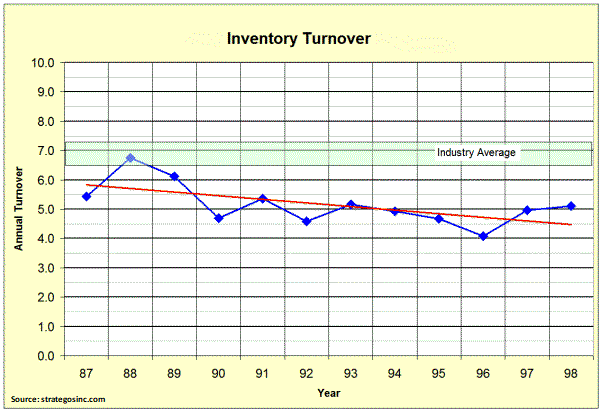
      In our travels around the industrial scene, we notice that many companies pay more attention to inventory Turns than they should. We would like to deflect some of this attention to more consequential performance metrics.

      Recall the definition: Turns = Annual dollar cost of goods sold / Average dollar value of inventory. If you sell $1 million of stuff in a year and have an average of $100,000 of stuff on the shelf each day, you are running at an impressive 10 Turns (Walmart runs at around 8). Supposedly, having high Turns signals efficient management, and keeping your Turns higher than competitors’ signals competitive advantage.

      But as happens with most performance metrics, there is more to the story. Turns may be very salient to the CFO, but they can be a straightjacket to the COO. This is because Turns are not directly related to customer service; in fact, high Turns can be synonymous with low service levels and fill rates. S&OP consultant Darrin Oliver calls Turns his “pet peeve metric” because “the customer doesn’t care about Turns.”

      Suppose you are unhappy with your current Turns value. What can you do to boost the number? Since Turns is a ratio, you can increase it by either increasing the numerator (goods sold) or decreasing the denominator (inventory). Increasing sales is more difficult because it requires the cooperation of the customer. Decreasing inventory is easier because it’s completely under your control: just make smaller replenishment orders, which also saves money in the short run. Indeed, you can get very enthusiastic and cut inventory to the bone. You end up with a better looking number for Turns—and a serious problem with stockouts, backorders, lost sales, lost customer good will and lost market share. Who’s sorry now?

      Here’s a lightly edited version of a story on this topic told by a very wise practitioner. “Back in my other life they were all about improving Turns. Why, I have no idea. So I pointed out the risks that you run. And they really weren’t interested. So we took our global inventories down to [a lower level], and then were breaking on stock left and right on a daily basis. Our turns were great, but we weren’t making any money, because we couldn’t get anything out the door, because we didn’t own it. The higher your turns, the lower your inventory’s going to have to be, or you’re just going to have really good flow. And in our industry that’s a very, very difficult thing to achieve. So if we can have reasonable Turns but still be in stock, I think that’s what we want to do. It can be very frustrating in an operations world to try to explain what we do every day and what the risks to the business are when the financial people are just looking at one or two metrics. They’re basically trying to plan the business in a vacuum, and it’s very difficult and very risky to do that.”
      Thomas Willemain, PhD, co-founded Smart Software and currently serves as Senior Vice President for Research. Dr. Willemain also serves as Professor Emeritus of Industrial and Systems Engineering at Rensselear Polytechnic Institute and as a member of the research staff at the Center for Computing Sciences, Institute for Defense Analyses.

      Leave a Comment

      Related Posts

      No Results Found

      The page you requested could not be found. Try refining your search, or use the navigation above to locate the post.

      Recent Posts

      • Managing Spare Parts Inventory: Best PracticesManaging Spare Parts Inventory: Best Practices
        In this blog, we’ll explore several effective strategies for managing spare parts inventory, emphasizing the importance of optimizing stock levels, maintaining service levels, and using smart tools to aid in decision-making. Managing spare parts inventory is a critical component for businesses that depend on equipment uptime and service reliability. Unlike regular inventory items, spare parts often have unpredictable demand patterns, making them more challenging to manage effectively. An efficient spare parts inventory management system helps prevent stockouts that can lead to operational downtime and costly delays while also avoiding overstocking that unnecessarily ties up capital and increases holding costs. […]
      • 5 Ways to Improve Supply Chain Decision Speed5 Ways to Improve Supply Chain Decision Speed
        The promise of a digital supply chain has transformed how businesses operate. At its core, it can make rapid, data-driven decisions while ensuring quality and efficiency throughout operations. However, it's not just about having access to more data. Organizations need the right tools and platforms to turn that data into actionable insights. This is where decision-making becomes critical, especially in a landscape where new digital supply chain solutions and AI-driven platforms can support you in streamlining many processes within the decision matrix. […]
      • Two employees checking inventory in temporary storage in a distribution warehouse.12 Causes of Overstocking and Practical Solutions
        Managing inventory effectively is critical for maintaining a healthy balance sheet and ensuring that resources are optimally allocated. Here is an in-depth exploration of the main causes of overstocking, their implications, and possible solutions. […]
      • FAQ Mastering Smart IP&O for Better Inventory ManagementFAQ: Mastering Smart IP&O for Better Inventory Management.
        Effective supply chain and inventory management are essential for achieving operational efficiency and customer satisfaction. This blog provides clear and concise answers to some basic and other common questions from our Smart IP&O customers, offering practical insights to overcome typical challenges and enhance your inventory management practices. Focusing on these key areas, we help you transform complex inventory issues into strategic, manageable actions that reduce costs and improve overall performance with Smart IP&O. […]
      • 7 Key Demand Planning Trends Shaping the Future7 Key Demand Planning Trends Shaping the Future
        Demand planning goes beyond simply forecasting product needs; it's about ensuring your business meets customer demands with precision, efficiency, and cost-effectiveness. Latest demand planning technology addresses key challenges like forecast accuracy, inventory management, and market responsiveness. In this blog, we will introduce critical demand planning trends, including data-driven insights, probabilistic forecasting, consensus planning, predictive analytics, scenario modeling, real-time visibility, and multilevel forecasting. These trends will help you stay ahead of the curve, optimize your supply chain, reduce costs, and enhance customer satisfaction, positioning your business for long-term success. […]

        Inventory Optimization for Manufacturers, Distributors, and MRO

        • Managing Spare Parts Inventory: Best PracticesManaging Spare Parts Inventory: Best Practices
          In this blog, we’ll explore several effective strategies for managing spare parts inventory, emphasizing the importance of optimizing stock levels, maintaining service levels, and using smart tools to aid in decision-making. Managing spare parts inventory is a critical component for businesses that depend on equipment uptime and service reliability. Unlike regular inventory items, spare parts often have unpredictable demand patterns, making them more challenging to manage effectively. An efficient spare parts inventory management system helps prevent stockouts that can lead to operational downtime and costly delays while also avoiding overstocking that unnecessarily ties up capital and increases holding costs. […]
        • Innovating the OEM Aftermarket with AI-Driven Inventory Optimization XLInnovating the OEM Aftermarket with AI-Driven Inventory Optimization
          The aftermarket sector provides OEMs with a decisive advantage by offering a steady revenue stream and fostering customer loyalty through the reliable and timely delivery of service parts. However, managing inventory and forecasting demand in the aftermarket is fraught with challenges, including unpredictable demand patterns, vast product ranges, and the necessity for quick turnarounds. Traditional methods often fall short due to the complexity and variability of demand in the aftermarket. The latest technologies can analyze large datasets to predict future demand more accurately and optimize inventory levels, leading to better service and lower costs. […]
        • Future-Proofing Utilities. Advanced Analytics for Supply Chain OptimizationFuture-Proofing Utilities: Advanced Analytics for Supply Chain Optimization
          Utilities in the electrical, natural gas, urban water, and telecommunications fields are all asset-intensive and reliant on physical infrastructure that must be properly maintained, updated, and upgraded over time. Maximizing asset uptime and the reliability of physical infrastructure demands effective inventory management, spare parts forecasting, and supplier management. A utility that executes these processes effectively will outperform its peers, provide better returns for its investors and higher service levels for its customers, while reducing its environmental impact. […]
        • Centering Act Spare Parts Timing Pricing and ReliabilityCentering Act: Spare Parts Timing, Pricing, and Reliability
          In this article, we'll walk you through the process of crafting a spare parts inventory plan that prioritizes availability metrics such as service levels and fill rates while ensuring cost efficiency. We'll focus on an approach to inventory planning called Service Level-Driven Inventory Optimization. Next, we'll discuss how to determine what parts you should include in your inventory and those that might not be necessary. Lastly, we'll explore ways to enhance your service-level-driven inventory plan consistently. […]

          Demand Forecasting in a “Build to Order” Company

          The Smart Forecaster

          Pursuing best practices in demand planning,

          forecasting and inventory optimization

          We often come into contact with potential customers who claim that they cannot use a forecasting system since they are a “build-to-order” manufacturing operation. I find this a puzzling perspective, because whatever these organizations build requires lower level raw materials or intermediate goods. If those lower level inputs are not available when an order for the finished good is received, the order cannot be built. Consequently, the order could be canceled and the associated revenue lost.

          I agree that in such an environment, forecasting the finished good is not always possible or particularly helpful. Sometimes it’s helpful, but not sufficient. In any case, it is critical to make sure that the underlying raw materials and intermediate goods that go into the finished good are available. Demand for these can certainly be forecasted.

          The organization’s goal would be to maintain service level inventories for these intermediate goods that are high but not unaffordable. Planners will need to set optimal stocking levels for these materials, balancing service level requirements against available budget. Since a given intermediate good could serve as an input to more than one finished good, the volatility of the demand for the intermediate good would be less than the volatility of the demand for a specific finished good. Hence, the safety stocks necessary to keep high service level inventories of the intermediate goods would be relatively lean.

          Three companies, all users of SmartForecasts, serve as interesting examples. The first is a chemical company, Bedoukian Research, which manufactures custom chemicals for various clients. Each of these “finished goods” is a unique combination of intermediate chemical compounds. Bedoukian begins its demand planning with a finished goods forecast, which drives the production schedule and allocation of essential production resources. This requires exercising considerable judgment, as finished goods demand changes dynamically.

          Once these finished good forecasts are created, raw material requirements can be estimated via a bill of material disaggregation. Bedoukian combines these results with safety stock estimates, based on actual utilization rates and service level objectives to be achieved, to generate the complete, service level-driven forecast for raw materials. This has allowed Bedoukian meet its production requirements with significantly less inventory.

          The second company manufactures the internal components for mobile phones, where finished goods are specialized combinations of these components. For example, an order may call for a certain number of phones with unique labels on the case. This is the finished good for this order. Everything that goes into that order, except for the label, is built out of standard components. Again, SmartForecasts will be used to keep lean, high service level inventories of the components. This company thought that the only way to manage component inventories was via bill of material aggregations. They are now looking at the actual utilization rate for the components and setting much leaner inventories while maintaining high component availability.

          A third company, NKK Switches, which explored this topic in their recent webinar (see CFO Bud Schultz’ guest blog post), considered their products to be “unforecastable”. You can read more about it below, but overall NKK Switches was able to forecast components and meaningful aggregations of product families. By tracking forecast vs. actuals over several months, NKK was able to demonstrate the accuracy of its forecasts to its Asian factory suppliers, and convince them to shift from a “build-to-order” model to “build-to-forecast.” This change has resulted in dramatic reductions in lead times, in many cases cutting them in half, increasing customer satisfaction and the overall sales close rate.

          The bottom line here is that there is a perfectly viable—I would say essential—method of demand forecasting for build-to-order businesses, setting high service levels for pivotal input resources. If you would like to know more, please drop me a note, at nelsonh at smartcorp dot com.

          Nelson Hartunian, PhD, co-founded Smart Software, formerly served as President, and currently oversees it as Chairman of the Board. He has, at various times, headed software development, sales and customer service.

          Leave a Comment

          Related Posts

          No Results Found

          The page you requested could not be found. Try refining your search, or use the navigation above to locate the post.

          Recent Posts

          • Managing Spare Parts Inventory: Best PracticesManaging Spare Parts Inventory: Best Practices
            In this blog, we’ll explore several effective strategies for managing spare parts inventory, emphasizing the importance of optimizing stock levels, maintaining service levels, and using smart tools to aid in decision-making. Managing spare parts inventory is a critical component for businesses that depend on equipment uptime and service reliability. Unlike regular inventory items, spare parts often have unpredictable demand patterns, making them more challenging to manage effectively. An efficient spare parts inventory management system helps prevent stockouts that can lead to operational downtime and costly delays while also avoiding overstocking that unnecessarily ties up capital and increases holding costs. […]
          • 5 Ways to Improve Supply Chain Decision Speed5 Ways to Improve Supply Chain Decision Speed
            The promise of a digital supply chain has transformed how businesses operate. At its core, it can make rapid, data-driven decisions while ensuring quality and efficiency throughout operations. However, it's not just about having access to more data. Organizations need the right tools and platforms to turn that data into actionable insights. This is where decision-making becomes critical, especially in a landscape where new digital supply chain solutions and AI-driven platforms can support you in streamlining many processes within the decision matrix. […]
          • Two employees checking inventory in temporary storage in a distribution warehouse.12 Causes of Overstocking and Practical Solutions
            Managing inventory effectively is critical for maintaining a healthy balance sheet and ensuring that resources are optimally allocated. Here is an in-depth exploration of the main causes of overstocking, their implications, and possible solutions. […]
          • FAQ Mastering Smart IP&O for Better Inventory ManagementFAQ: Mastering Smart IP&O for Better Inventory Management.
            Effective supply chain and inventory management are essential for achieving operational efficiency and customer satisfaction. This blog provides clear and concise answers to some basic and other common questions from our Smart IP&O customers, offering practical insights to overcome typical challenges and enhance your inventory management practices. Focusing on these key areas, we help you transform complex inventory issues into strategic, manageable actions that reduce costs and improve overall performance with Smart IP&O. […]
          • 7 Key Demand Planning Trends Shaping the Future7 Key Demand Planning Trends Shaping the Future
            Demand planning goes beyond simply forecasting product needs; it's about ensuring your business meets customer demands with precision, efficiency, and cost-effectiveness. Latest demand planning technology addresses key challenges like forecast accuracy, inventory management, and market responsiveness. In this blog, we will introduce critical demand planning trends, including data-driven insights, probabilistic forecasting, consensus planning, predictive analytics, scenario modeling, real-time visibility, and multilevel forecasting. These trends will help you stay ahead of the curve, optimize your supply chain, reduce costs, and enhance customer satisfaction, positioning your business for long-term success. […]

            Inventory Optimization for Manufacturers, Distributors, and MRO

            • Managing Spare Parts Inventory: Best PracticesManaging Spare Parts Inventory: Best Practices
              In this blog, we’ll explore several effective strategies for managing spare parts inventory, emphasizing the importance of optimizing stock levels, maintaining service levels, and using smart tools to aid in decision-making. Managing spare parts inventory is a critical component for businesses that depend on equipment uptime and service reliability. Unlike regular inventory items, spare parts often have unpredictable demand patterns, making them more challenging to manage effectively. An efficient spare parts inventory management system helps prevent stockouts that can lead to operational downtime and costly delays while also avoiding overstocking that unnecessarily ties up capital and increases holding costs. […]
            • Innovating the OEM Aftermarket with AI-Driven Inventory Optimization XLInnovating the OEM Aftermarket with AI-Driven Inventory Optimization
              The aftermarket sector provides OEMs with a decisive advantage by offering a steady revenue stream and fostering customer loyalty through the reliable and timely delivery of service parts. However, managing inventory and forecasting demand in the aftermarket is fraught with challenges, including unpredictable demand patterns, vast product ranges, and the necessity for quick turnarounds. Traditional methods often fall short due to the complexity and variability of demand in the aftermarket. The latest technologies can analyze large datasets to predict future demand more accurately and optimize inventory levels, leading to better service and lower costs. […]
            • Future-Proofing Utilities. Advanced Analytics for Supply Chain OptimizationFuture-Proofing Utilities: Advanced Analytics for Supply Chain Optimization
              Utilities in the electrical, natural gas, urban water, and telecommunications fields are all asset-intensive and reliant on physical infrastructure that must be properly maintained, updated, and upgraded over time. Maximizing asset uptime and the reliability of physical infrastructure demands effective inventory management, spare parts forecasting, and supplier management. A utility that executes these processes effectively will outperform its peers, provide better returns for its investors and higher service levels for its customers, while reducing its environmental impact. […]
            • Centering Act Spare Parts Timing Pricing and ReliabilityCentering Act: Spare Parts Timing, Pricing, and Reliability
              In this article, we'll walk you through the process of crafting a spare parts inventory plan that prioritizes availability metrics such as service levels and fill rates while ensuring cost efficiency. We'll focus on an approach to inventory planning called Service Level-Driven Inventory Optimization. Next, we'll discuss how to determine what parts you should include in your inventory and those that might not be necessary. Lastly, we'll explore ways to enhance your service-level-driven inventory plan consistently. […]