Inventory Planning Becomes More Interesting

The Smart Forecaster

 Pursuing best practices in demand planning,

forecasting and inventory optimization

Taiichi Ohno of Toyota is credited with inventing Just-In-Time (JIT) manufacturing in the 1950s. JIT ensures that a manufacturer produces only what is needed, only when required, and only in the necessary amount. That innovation has since had major impacts, some good, some less so.

A recent New York Times article “How the World Ran out of Everything” describes some of the “less so” impacts.  For example, JIT has kept inventory costs very low improving return on assets.  This in turn is rewarded by Wall Street, so many companies have spent the last few decades reducing their inventories dramatically. Focused as they were on financials, many companies ignored the risks inherent in reducing inventories to the point that “lean” began to border on “emaciated.” Combined with increased globalization and new risks of supply interruption, stock-outs have abounded.

Some industries have gone too far, leaving them exposed to disruption. In a competition to get to the lowest cost, companies have inadvertently concentrated their risk, been interrupted by shortages of raw materials or components, and sometimes forced to halt assembly lines. Wall Street does not look kindly on production halts.

We all know that random events have added to the problem. First among them has been the Covid pandemic. As the pandemic has hindered factory operations and spread disarray in global shipping, many economies worldwide have been tormented by shortages of an immense range of goods — from computer chips to lumber to clothing.

The damage is compounded when more unexpected things go wrong. The Suez Canal Blockage is a prime example, obstructing the main trade route between Europe and Asia. Recently, cyberattacks have added another layer of disruption.

The reaction creates its own problems, just as the cyberattack on the Colonial Pipeline created gas shortages through panic buying. Suppliers start filling orders more slowly than usual. Manufacturers and distributors reverse course and increase inventories and diversify their suppliers to avoid future stockouts. Simply expanding warehouses may not deliver the solution, and the need to determine how much inventory to keep is more urgent every day.Manager In Warehouse With Inventory Management Software

So how can you execute a real-world plan for JIT inventory amidst all this risk and uncertainty? The foundation of your response is your corporate data. Uncertainty has two sources: supply and demand. You need the facts for both.

On the supply side, exploit the data you have on recent supplier lead times, which reflect the current turbulence. Don’t use average values when you can use probability distributions that reflect the full range of contingencies. Consider this comparison. Supplier A is now reliably filling orders in exactly 10 days. Supplier B also averages 10 days but does with a 78%/22% mix of 7 and 21 days. Both A and B have an average replenishment delay of 10 days, but the operational results they provide will be very different. You can only recognize this if you use probability models of inventory performance.

On the demand side, similar considerations apply. First, recognize that there may have been a major shift in the character of item demand (statisticians call this a “regime change”), so purge from your analysis any data that represent the “good old days.” Then, again, stop thinking in terms of averages. While the average demand is important, it is not a sufficient descriptor of the problem you face. Equally important is the volatility of demand. Volatility is the reason you keep inventory in the first place. If demand were completely predictable, you would have neither stockouts nor excess inventory. Just as you need to estimate the full probability distribution of replenishment lead times, you need the full distribution of demand values.

Once you understand the range of variability in both supply and demand, probabilistic forecasting will allow you to account for disruptions and unusual events. Software will convert your data on demand and lead times into huge numbers of scenarios representing how your next planning period might play out. Given those scenarios, the software can determine how best to meet your goals for such metrics as inventory costs and stockout rates. Using solutions such as Smart Inventory Optimization , you will confidently plan based on your targeted stockout risk with minimal inventory carrying cost. You may also consider letting the solution prescribe optimal service level targets by assessing the costs of additional inventory vs. stockout cost.

In inventory planning, as in science, we cannot escape the reality of uncertainty and the impact of unusual events. We must plan accordingly: using inventory optimization software helps you identify the least-cost service level. This creates a coherent, company-wide effort that combines visibility into current operations with mathematically correct assessments of future risks and conditions.

Inventory planning has become more “interesting” and requires a greater degree of risk awareness and agility. The right software can help.
 

Leave a Comment

Related Posts

No Results Found

The page you requested could not be found. Try refining your search, or use the navigation above to locate the post.

Recent Posts

  • Managing Spare Parts Inventory: Best PracticesManaging Spare Parts Inventory: Best Practices
    In this blog, we’ll explore several effective strategies for managing spare parts inventory, emphasizing the importance of optimizing stock levels, maintaining service levels, and using smart tools to aid in decision-making. Managing spare parts inventory is a critical component for businesses that depend on equipment uptime and service reliability. Unlike regular inventory items, spare parts often have unpredictable demand patterns, making them more challenging to manage effectively. An efficient spare parts inventory management system helps prevent stockouts that can lead to operational downtime and costly delays while also avoiding overstocking that unnecessarily ties up capital and increases holding costs. […]

  • 5 Ways to Improve Supply Chain Decision Speed5 Ways to Improve Supply Chain Decision Speed
    The promise of a digital supply chain has transformed how businesses operate. At its core, it can make rapid, data-driven decisions while ensuring quality and efficiency throughout operations. However, it's not just about having access to more data. Organizations need the right tools and platforms to turn that data into actionable insights. This is where decision-making becomes critical, especially in a landscape where new digital supply chain solutions and AI-driven platforms can support you in streamlining many processes within the decision matrix. […]

  • Two employees checking inventory in temporary storage in a distribution warehouse.12 Causes of Overstocking and Practical Solutions
    Managing inventory effectively is critical for maintaining a healthy balance sheet and ensuring that resources are optimally allocated. Here is an in-depth exploration of the main causes of overstocking, their implications, and possible solutions. […]

  • FAQ Mastering Smart IP&O for Better Inventory ManagementFAQ: Mastering Smart IP&O for Better Inventory Management.
    Effective supply chain and inventory management are essential for achieving operational efficiency and customer satisfaction. This blog provides clear and concise answers to some basic and other common questions from our Smart IP&O customers, offering practical insights to overcome typical challenges and enhance your inventory management practices. Focusing on these key areas, we help you transform complex inventory issues into strategic, manageable actions that reduce costs and improve overall performance with Smart IP&O. […]

  • 7 Key Demand Planning Trends Shaping the Future7 Key Demand Planning Trends Shaping the Future
    Demand planning goes beyond simply forecasting product needs; it's about ensuring your business meets customer demands with precision, efficiency, and cost-effectiveness. Latest demand planning technology addresses key challenges like forecast accuracy, inventory management, and market responsiveness. In this blog, we will introduce critical demand planning trends, including data-driven insights, probabilistic forecasting, consensus planning, predictive analytics, scenario modeling, real-time visibility, and multilevel forecasting. These trends will help you stay ahead of the curve, optimize your supply chain, reduce costs, and enhance customer satisfaction, positioning your business for long-term success. […]

    Inventory Optimization for Manufacturers, Distributors, and MRO

    • Managing Spare Parts Inventory: Best PracticesManaging Spare Parts Inventory: Best Practices
      In this blog, we’ll explore several effective strategies for managing spare parts inventory, emphasizing the importance of optimizing stock levels, maintaining service levels, and using smart tools to aid in decision-making. Managing spare parts inventory is a critical component for businesses that depend on equipment uptime and service reliability. Unlike regular inventory items, spare parts often have unpredictable demand patterns, making them more challenging to manage effectively. An efficient spare parts inventory management system helps prevent stockouts that can lead to operational downtime and costly delays while also avoiding overstocking that unnecessarily ties up capital and increases holding costs. […]

    • Innovating the OEM Aftermarket with AI-Driven Inventory Optimization XLInnovating the OEM Aftermarket with AI-Driven Inventory Optimization
      The aftermarket sector provides OEMs with a decisive advantage by offering a steady revenue stream and fostering customer loyalty through the reliable and timely delivery of service parts. However, managing inventory and forecasting demand in the aftermarket is fraught with challenges, including unpredictable demand patterns, vast product ranges, and the necessity for quick turnarounds. Traditional methods often fall short due to the complexity and variability of demand in the aftermarket. The latest technologies can analyze large datasets to predict future demand more accurately and optimize inventory levels, leading to better service and lower costs. […]

    • Future-Proofing Utilities. Advanced Analytics for Supply Chain OptimizationFuture-Proofing Utilities: Advanced Analytics for Supply Chain Optimization
      Utilities in the electrical, natural gas, urban water, and telecommunications fields are all asset-intensive and reliant on physical infrastructure that must be properly maintained, updated, and upgraded over time. Maximizing asset uptime and the reliability of physical infrastructure demands effective inventory management, spare parts forecasting, and supplier management. A utility that executes these processes effectively will outperform its peers, provide better returns for its investors and higher service levels for its customers, while reducing its environmental impact. […]
    • Centering Act Spare Parts Timing Pricing and ReliabilityCentering Act: Spare Parts Timing, Pricing, and Reliability
      In this article, we'll walk you through the process of crafting a spare parts inventory plan that prioritizes availability metrics such as service levels and fill rates while ensuring cost efficiency. We'll focus on an approach to inventory planning called Service Level-Driven Inventory Optimization. Next, we'll discuss how to determine what parts you should include in your inventory and those that might not be necessary. Lastly, we'll explore ways to enhance your service-level-driven inventory plan consistently. […]
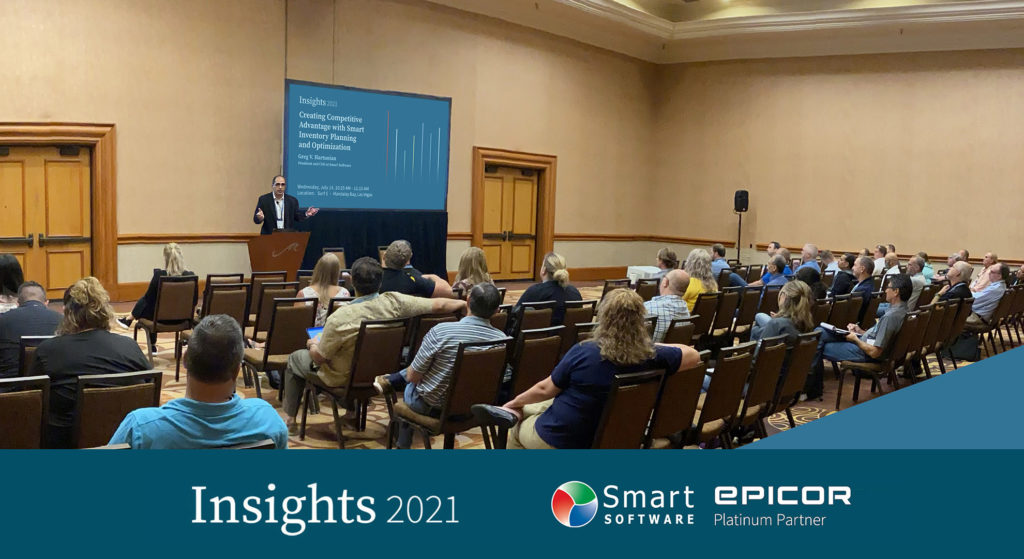
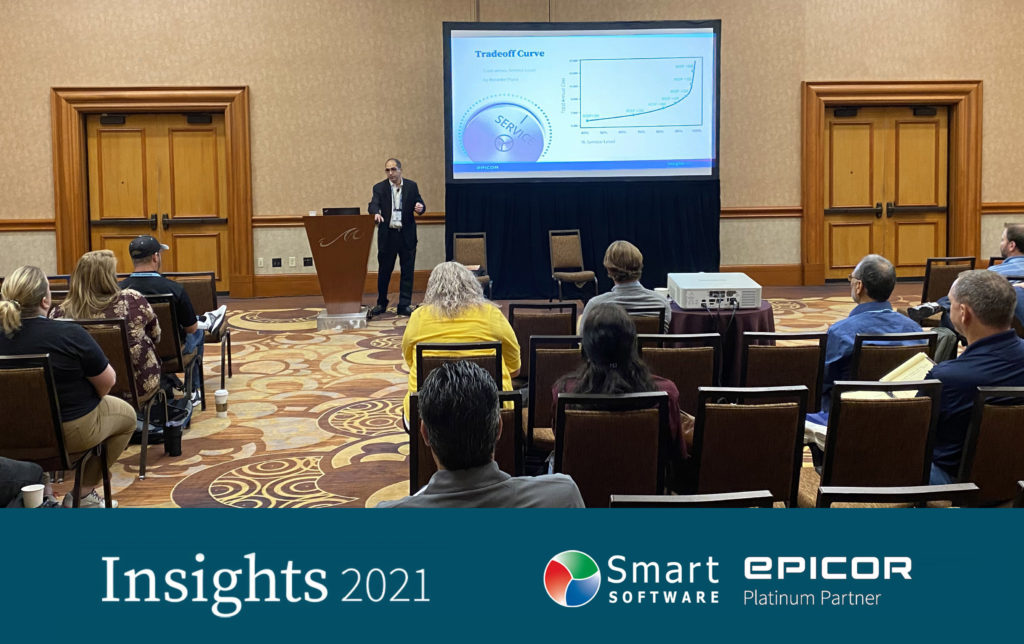
      Smart Software to Present at Epicor Insights 2021
      Smart Software President and CEO to present Epicor Insights 2021 Breakout Session on Creating Competitive Advantage with Smart Inventory Planning and Optimization   Belmont, MA, June, 2021 – Smart Software, Inc., provider of industry-leading demand forecasting, planning, and inventory optimization solutions, today announced that it will present at Epicor Insights 2021. Greg Hartunian, CEO of Smart Software, will present “Creating Competitive Advantage with Smart Inventory Planning and Optimization.” Greg will explain how to empower planning teams to reduce inventory, improve service levels, and increase operational efficiency. Most inventory planning teams rely upon traditional forecasting approaches, rule of thumb methods, and sales feedback on demand. Our Breakout Session at Epicor Insights discusses these approaches, why they often fail, and how new probabilistic forecasting and optimization methods can make a big difference to your bottom line.
      • The presentation is scheduled for Wed July 14th 10:25 -11:15 AM  (PST) 
      1 Epicor Inventory Mangement Platinum Partner Epicor Insights 2021 will bring together more than 2,000 users of Epicor’s industry-specific ERP solutions for the manufacturing, distribution, and service industries.  To learn more, visit INSIGHTS 2021.

       Join us at Mandalay Bay in Las Vegas, at the Solution Pavilion,  Booth #1.

      3 Epicor Inventory Mangement Platinum Partner   2 Epicor Inventory Mangement Platinum Partner   Smart Software is an Epicor Platinum Partner and leading provider of demand planning, forecasting, inventory optimization, and analytics solutions. Our web platform, Smart IP&O, leverages probabilistic forecast modeling, machine learning, and collaborative demand planning to optimize inventory levels and increase forecast accuracy. You’ll use Smart IP&O to create accurate forecasts and optimal stocking policies that drive automated ordering in Epicor. The platform includes bi-directional integrations to both Epicor ERP and Prophet 21.     About Smart Software, Inc. Founded in 1981, Smart Software, Inc. is a leader in providing businesses with enterprise-wide demand forecasting, planning and inventory optimization solutions.  Smart Software’s demand forecasting and inventory optimization solutions have helped thousands of users worldwide, including customers at mid-market enterprises and Fortune 500 companies, such as Mitsubishi, Siemens, Disney, FedEx, MARS, and The Home Depot.  Smart Inventory Planning & Optimization gives demand planners the tools to handle sales seasonality, promotions, new and aging products, multi-dimensional hierarchies, and intermittently demanded service parts and capital goods items.  It also provides inventory managers with accurate estimates of the optimal inventory and safety stock required to meet future orders and achieve desired service levels.  Smart Software is headquartered in Belmont, Massachusetts and can be found on the World Wide Web at www.smartcorp.com.  
      For more information, please contact Smart Software, Inc., Four Hill Road, Belmont, MA 02478. Phone: 1-800-SMART-99 (800-762-7899); FAX: 1-617-489-2748; E-mail: info@smartcorp.com    
      Increasing Revenue by Increasing Spare Part Availability

      The Smart Forecaster

       Pursuing best practices in demand planning,

      forecasting and inventory optimization

      Let’s start by recognizing that increased revenue is a good thing for you, and that increasing the availability of the spare parts you provide is a good thing for your customers.

      But let’s also recognize that increasing item availability will not necessarily lead to increased revenue. If you plan incorrectly and end up carrying excess inventory, the net effect may be good for your customers but will definitely be bad for you. There must be some right way to make this a win-win, if only it can be recognized.

      To make the right decision here, you have to think systematically about the problem. That requires that you use probabilistic models of the inventory control process.


      A Scenario

      Let’s consider a specific, realistic scenario. Quite a number of factors have an influence on the results:

      • The item: A specific low-volume spare part.
      • Demand mean: Averaging 0.1 units per day (so, highly “intermittent”)
      • Demand standard deviation: 0.35 units per day (so, highly variable or “overdispersed”).
      • Supplier average lead time: 5 days.
      • Unit cost: $100.
      • Holding cost per year as % of unit cost: 10%.
      • Ordering cost per PO cut: $25.
      • Stockout consequences: Lost sales (so, a competitive market, no backorders).
      • Shortage cost per lost sale: $100.
      • Service level target: 85% (so, 15% chance of a stockout in any replenishment cycle).
      • Inventory control policy: Periodic-review/Order-up-to (also called at (T,S) policy)


      Inventory Control Policy

      A word about the inventory control policy. The (T,S) policy is one of several that are common in practice. Though there are other more efficient policies (e.g., they don’t wait for T days to go by before making adjustment to stock), (T,S) is one of the simplest and so it is quite popular. It works this way: Every T days, you check how many units you have in stock, say X units. Then you order S-X units, which appear after the supplier lead time (in this case, 5 days). The T in (T,S) is the “order interval”, the number of days between orders; the S is the “order-up-to level”, the number of units you want to have on hand at the start of each replenishment cycle.

      To get the most out of this policy, you must wisely pick values of T and S. Picking wisely means you cannot win by guessing or using simple rule-of-thumb guides like “Keep an average of 3 x average demand on hand.”  Poor choices of T and S hurt both your customers and your bottom line. And sticking too long with choices that were once good can result in poor performance should any of the factors above change significantly, so the values of T and S should be recalculated now and then.

      The smart way to pick the right values of T and S is to use probabilistic models encoded in advanced software. Using software is essential when you have to scale up and pick values of T and S that are right for not one item but hundreds or thousands.


      Analysis of Scenario

      Let’s think about how to make money in this scenario. What’s the upside? If there were no expenses, this item could generate an average of $3,650 per year: 0.1 units/day x 365 days x $100/unit. Subtracted from that will be operating costs, comprised of holding, ordering and shortage costs. Each of those will depend on your choices of T and S.

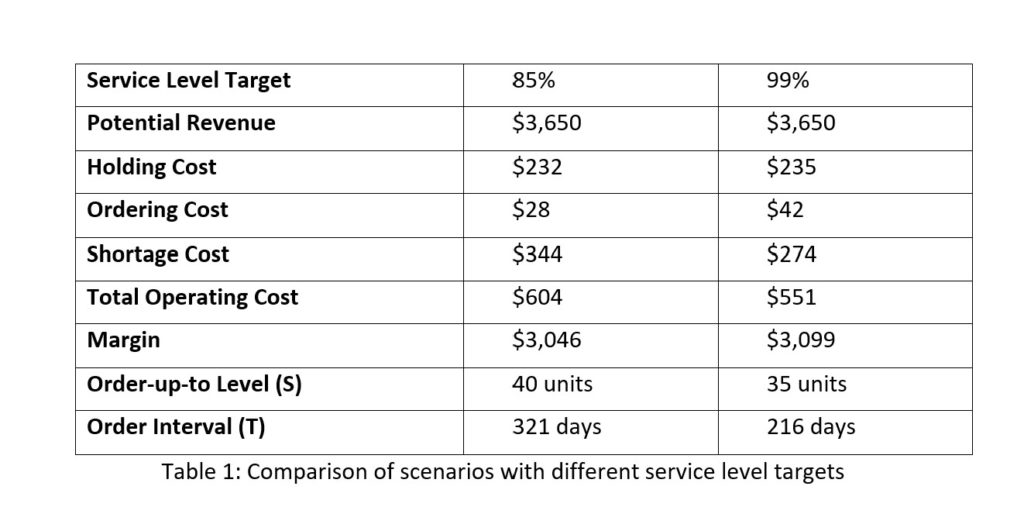
      The software provides specific numbers: Setting T = 321 days and S = 40 units will result in average annual operating costs of $604, giving an expected margin of $3,650 – $604 = $3,046. See Table 1, left column. This use of software is called “predictive analytics” because it translates system design inputs into estimates of a key performance indicator, margin.

      Now think about whether you can do better. The service level target in this scenario is 85%, which is a somewhat relaxed standard that is not going to turn any heads. What if you could offer your customers a 99% service level? That sounds like a distinct competitive advantage, but would it reduce your margin? Not if you properly adjust the values of T and S.

      Setting T = 216 days and S = 35 units will reduce average annual operating costs to $551 and increase expected margin to $3,650 – $551 = $3,099. See Table 1, right column. Here is the win-win we wanted: higher customer satisfaction and roughly 2% more revenue. This use of the software is called “sensitivity analysis” because it shows how sensitive the margin is to the choice of service level target.

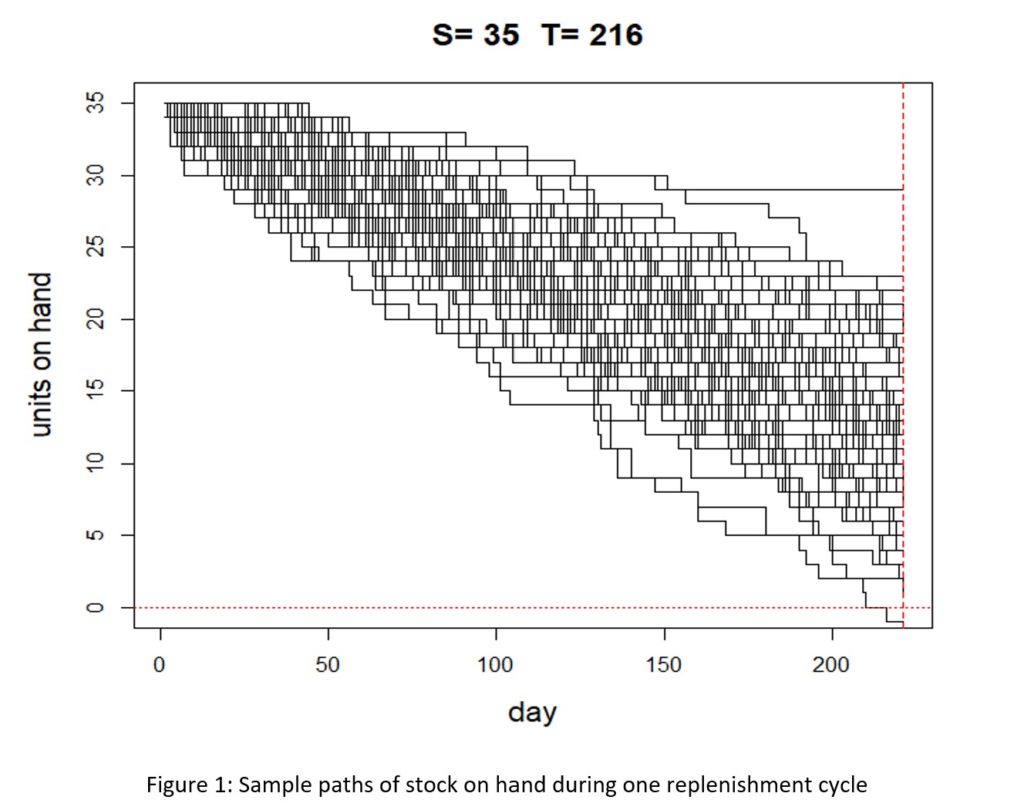
      Software can also help you visualize the complex, random dynamics of inventory movements. A by-product of the analysis that populated Table 1 are graphs showing the random paths taken by stock as it decreases over a replenishment cycle. Figure 1 shows a selection of 100 random scenarios for the scenario in which the service level target is 99%. In the figure, only 1 of the 100 scenarios resulted in a stockout, confirming the accuracy of the choice of order-up-to-level.


      Summary

      Management of spare parts inventories is often done haphazardly using gut instinct, habit, or obsolete rule-of-thumb. Winging it this way is not a reliable and reproducible path to higher margin or higher customer satisfaction. Probability theory, distilled into probability models then encoded in advanced software, is the basis for coherent, efficient guidance about how to manage spare parts based on facts: demand characteristics, lead times, service level targets, costs and the other factors. The scenarios analyzed here illustrate that it is possible to achieve both higher service levels and higher margin. A multitude of scenarios not shown here offer ways to achieve higher service levels but lose margin. Use the software.

      Scenarios with different service level targets

      Stock on hand during one replenishment cycle


      Leave a Comment

      Related Posts

      No Results Found

      The page you requested could not be found. Try refining your search, or use the navigation above to locate the post.

      Recent Posts

      • Managing Spare Parts Inventory: Best PracticesManaging Spare Parts Inventory: Best Practices
        In this blog, we’ll explore several effective strategies for managing spare parts inventory, emphasizing the importance of optimizing stock levels, maintaining service levels, and using smart tools to aid in decision-making. Managing spare parts inventory is a critical component for businesses that depend on equipment uptime and service reliability. Unlike regular inventory items, spare parts often have unpredictable demand patterns, making them more challenging to manage effectively. An efficient spare parts inventory management system helps prevent stockouts that can lead to operational downtime and costly delays while also avoiding overstocking that unnecessarily ties up capital and increases holding costs. […]
      • 5 Ways to Improve Supply Chain Decision Speed5 Ways to Improve Supply Chain Decision Speed
        The promise of a digital supply chain has transformed how businesses operate. At its core, it can make rapid, data-driven decisions while ensuring quality and efficiency throughout operations. However, it's not just about having access to more data. Organizations need the right tools and platforms to turn that data into actionable insights. This is where decision-making becomes critical, especially in a landscape where new digital supply chain solutions and AI-driven platforms can support you in streamlining many processes within the decision matrix. […]
      • Two employees checking inventory in temporary storage in a distribution warehouse.12 Causes of Overstocking and Practical Solutions
        Managing inventory effectively is critical for maintaining a healthy balance sheet and ensuring that resources are optimally allocated. Here is an in-depth exploration of the main causes of overstocking, their implications, and possible solutions. […]
      • FAQ Mastering Smart IP&O for Better Inventory ManagementFAQ: Mastering Smart IP&O for Better Inventory Management.
        Effective supply chain and inventory management are essential for achieving operational efficiency and customer satisfaction. This blog provides clear and concise answers to some basic and other common questions from our Smart IP&O customers, offering practical insights to overcome typical challenges and enhance your inventory management practices. Focusing on these key areas, we help you transform complex inventory issues into strategic, manageable actions that reduce costs and improve overall performance with Smart IP&O. […]
      • 7 Key Demand Planning Trends Shaping the Future7 Key Demand Planning Trends Shaping the Future
        Demand planning goes beyond simply forecasting product needs; it's about ensuring your business meets customer demands with precision, efficiency, and cost-effectiveness. Latest demand planning technology addresses key challenges like forecast accuracy, inventory management, and market responsiveness. In this blog, we will introduce critical demand planning trends, including data-driven insights, probabilistic forecasting, consensus planning, predictive analytics, scenario modeling, real-time visibility, and multilevel forecasting. These trends will help you stay ahead of the curve, optimize your supply chain, reduce costs, and enhance customer satisfaction, positioning your business for long-term success. […]

        Inventory Optimization for Manufacturers, Distributors, and MRO

        • Managing Spare Parts Inventory: Best PracticesManaging Spare Parts Inventory: Best Practices
          In this blog, we’ll explore several effective strategies for managing spare parts inventory, emphasizing the importance of optimizing stock levels, maintaining service levels, and using smart tools to aid in decision-making. Managing spare parts inventory is a critical component for businesses that depend on equipment uptime and service reliability. Unlike regular inventory items, spare parts often have unpredictable demand patterns, making them more challenging to manage effectively. An efficient spare parts inventory management system helps prevent stockouts that can lead to operational downtime and costly delays while also avoiding overstocking that unnecessarily ties up capital and increases holding costs. […]
        • Innovating the OEM Aftermarket with AI-Driven Inventory Optimization XLInnovating the OEM Aftermarket with AI-Driven Inventory Optimization
          The aftermarket sector provides OEMs with a decisive advantage by offering a steady revenue stream and fostering customer loyalty through the reliable and timely delivery of service parts. However, managing inventory and forecasting demand in the aftermarket is fraught with challenges, including unpredictable demand patterns, vast product ranges, and the necessity for quick turnarounds. Traditional methods often fall short due to the complexity and variability of demand in the aftermarket. The latest technologies can analyze large datasets to predict future demand more accurately and optimize inventory levels, leading to better service and lower costs. […]
        • Future-Proofing Utilities. Advanced Analytics for Supply Chain OptimizationFuture-Proofing Utilities: Advanced Analytics for Supply Chain Optimization
          Utilities in the electrical, natural gas, urban water, and telecommunications fields are all asset-intensive and reliant on physical infrastructure that must be properly maintained, updated, and upgraded over time. Maximizing asset uptime and the reliability of physical infrastructure demands effective inventory management, spare parts forecasting, and supplier management. A utility that executes these processes effectively will outperform its peers, provide better returns for its investors and higher service levels for its customers, while reducing its environmental impact. […]
        • Centering Act Spare Parts Timing Pricing and ReliabilityCentering Act: Spare Parts Timing, Pricing, and Reliability
          In this article, we'll walk you through the process of crafting a spare parts inventory plan that prioritizes availability metrics such as service levels and fill rates while ensuring cost efficiency. We'll focus on an approach to inventory planning called Service Level-Driven Inventory Optimization. Next, we'll discuss how to determine what parts you should include in your inventory and those that might not be necessary. Lastly, we'll explore ways to enhance your service-level-driven inventory plan consistently. […]

          Smart Software Celebrates 40 years

          40 years of Innovation for Demand Forecasting, Inventory Planning, and Supply Chain Analytics

            Belmont, MA, June 1, 2021 – Today marks the 40th anniversary for Smart Software, a leading innovator of demand planning, statistical forecasting, inventory management, and supply chain analytics software. Company CEO, Greg Hartunian remarked “Our success is built on continuous innovation. Our mission follows the path that our founders initiated 40 years ago; we provide cutting-edge analytical solutions that help our customers maximize sales and minimize waste.  We are enormously grateful to our customers who have given us their support, confidence, and trust.  Thank you to our partner community of resellers and consultants who have mobilized our growth and shared their expertise with us.  We are also indebted to our many employees, past and present, local and abroad, whose creativity and dedication have produced systems that are benefitting so many great companies worldwide.” Smart, Hartunian, and Willemain was incorporated in June 1981 by Charles Smart, Nelson Hartunian, and Thomas Willemain, our visionary founders. The firm later incorporated as Smart Software, Inc in 1984 reflecting their shift from boutique consultancy to software.  Over the years, their pioneering work produced the first-ever automatic statistical forecasting system for the personal computer, a patented APICS award-winning method for intermittent demand planning, and most recently a cloud-native probabilistic forecasting platform. All have produced major inventory cost reductions and service level improvements for our customers.  To learn more about Smart Software’s roots and journey, please click here:     Smart Software Company History   

          Smart Software Logo 40 years

            “Smart gives us good information to work with.  The service level planning method has led to productive conversations between sales and supply chain and given us a common ground from which we base our discussions. People are feeling comfortable with numbers, and through our S&OP process we’ve been able to create buy-in across the company.” Rod Cardenas  – Purchasing Manager, Forum Energy   “It was deployed as part of our implementation of a new centralized distribution model and highlighted significant blind spots in the original project plan. The accurate forecasts of stocking levels and SKU count provided fact-based data that allowed us to strategically phase the consolidation effort where warehouse space was at a premium.” Eric Nelson – CPA, CMA. Manager, Parts Supply and Logistics. BC Transit   “Its easy for us to give suppliers information they never had before. Our suppliers can plan their production and work with their suppliers. That visibility has been invaluable. That’s where the real payoff will come. Not just reducing inventory or saving time on people managing the inventory but being more responsive to customers’ needs. To me, that’s the overarching benefit of this software.” Bud Schultz – Vice President of Finance  NKK Switches        
            SmartForecasts and Smart IP&O have registered trademarks of Smart Software, Inc.  All other trademarks are their respective owners’ property. For more information, please contact Smart Software, Inc., Four Hill Road, Belmont, MA 02478. Phone: 1-800-SMART-99 (800-762-7899); FAX: 1-617-489-2748; E-mail: info@smartcorp.com    
          Prophet 21 User Group Webinar: Inventory Planning Processes

          Smart Software is pleased to introduce our new webinar, offered exclusively for Prophet 21 Users. In this webinar, Greg Hartunian, CEO at Smart Software, will lead a 45-minute webinar focusing on specific approaches to demand forecasting and inventory planning that will enable you to increase revenue capture, improve service levels, and reduce inventory holding costs.  Minimizing excess stock, equipment downtime, and lost sales requires the right planning foundation. Most inventory planning teams rely upon traditional forecasting approaches, rule of thumb methods, and sales feedback. Many companies struggle to keep up, putting businesses at risk when the insulation of a growing top line thins. Our Webinar at EUG discusses these approaches, why they often fail, and how new probabilistic forecasting and optimization methods can make a big difference to your bottom line.


          Please contact us to request access to the webinar. During the webinar, we will outline the challenges associated with traditional inventory planning processes and show how Smart Software can help. You’ll see a live demo of the Epicor Smart IP&O platform including the bi-directional P21 integration.


          Smart Inventory Planning and Optimization is an integrated set of native web applications that provides a single, easy-to-use, scalable, environment with field-proven inventory and forecast modeling that optimizes inventory stocking policy and improves forecast accuracy. We hope you will be able to join us!


          SmartForecasts and Smart IP&O are registered trademarks of Smart Software, Inc.  All other trademarks are the property of their respective owners.

          For more information, please contact Smart Software,Inc., Four Hill Road, Belmont, MA 02478.
          Phone: 1-800-SMART-99 (800-762-7899); E-mail: info@smartcorp.com