
Future-Proofing Utilities: Advanced Analytics for Supply Chain Optimization

Utilities have unique supply chain optimization requirements, primarily ensuring high uptime by keeping all critical machines running continuously. Achieving this involves maintaining a high availability of spare parts to guarantee a consistent, reliable, and safe supply. Additionally, as regulated entities, utilities must also carefully manage and control costs.

Managing supply chains efficiently

To maintain a reliable electricity supply at 99.99%+ service levels, for example, utilities must be able to respond quickly to changes in demand in the near term and accurately anticipate future demand. To do so, they must have a well-organized supply chain that allows them to purchase the necessary equipment, materials, and services from the right suppliers at the right time, in the right quantities, and at the right price.

Doing so has become increasingly more challenging in the last 3 years.

  • Requirements for safety, reliability, and service delivery are more stringent.
  • Supply chain disruptions, unpredictable supplier lead times, intermittent spikes in parts usage have always been problematic, but now they are more the rule than the exception.
  • Deregulation in the early 2000’s removed spare parts from the list of directly reimbursed items, forcing utilities to pay for spares directly from revenues[1]
  • The constant need for capital combined with aggressively climbing interest rates mean costs are scrutinized more than ever.

As a result, Supply Chain Optimization (SCO) has become an increasingly mission-critical business practice for utilities.  To contend with these challenges, utilities can no longer simply manage their supply chain — they must optimize it.  And to do that, investments in new processes and systems will be required.

[1] Scala et al. “Risk and Spare Parts Inventory in Electric Utilities”. Proceedings of the Industrial Engineering Research Conference.

Advanced Analytics and Optimization: Future-Proofing Utility Supply Chains

Inventory Planning and Optimization   

Targeted investments in inventory optimization technology offer a path forward for every utility.  Inventory Optimization solutions should be prioritized because they:

  1. Can be implemented in a fraction of the time required for initiatives in other areas, such as warehouse management, supply chain design,  and procurement consolidations. It is not uncommon to start generating benefit after 90 days and to have a full software deployment in less than 180 days.
  2. Can generate massive ROI, yielding 20x returns and seven figure financial benefits annually. By better forecasting parts usage, utilities will reduce costs by purchasing only the necessary inventory while controlling the risk of stockouts that lead to downtime and poor service levels.
  3. Provide foundational support for other initiatives. A strong supply chain rests on the foundation of solid usage forecasts and inventory purchasing plans.

Using predictive analytics and advanced algorithms, inventory optimization helps utilities maximize service levels and reduce operational costs by optimizing inventory levels for spare parts. For example, an electric utility might use statistical forecasting to predict future parts usage, conduct inventory audits to identify excess inventory, and leverage analytical results to identify where inventory optimization efforts should focus first. By doing this, the utility can ensure that machines are running at optimal levels and reduce the risk of costly delays due to a lack of spares.

By using analytics and data, you can identify which spare parts and equipment are most likely to be needed and order only the necessary items. This helps to ensure that equipment has high up-time. It rewards regular monitoring and adjusting of inventory levels so that when operating conditions change, you can detect the change and adjust accordingly. This implies that planning cycles must operate at a tempo high enough to keep up with changing conditions. Leveraging probabilistic forecasting to recalibrate spares stocking policies for each planning cycle ensures that stocking policies (such as min/max levels) are always up-to-date and reflect the latest parts usage and supplier lead times.


Service Levels and the Tradeoff Curve

The Service Level Tradeoff Curve relates inventory investment to item availability as measured by service level. Service level is the probability that no shortages occur between when you order more stock and when it arrives on the shelf. Surprisingly few companies have data on this important metric across their whole fleet of spare parts.

The Service Level Tradeoff Curve exposes the link between the costs associated with different levels of service and the inventory requirements needed to achieve them.  Knowing which components are important to maintaining high service levels is key to the optimization process and is determined by several factors, including inventory item standardization, criticality, historical usage, and known future repair orders. By understanding this relationship, utilities can better allocate resources, as when using the curves to identify areas where costs can be reduced without hurting system reliability.
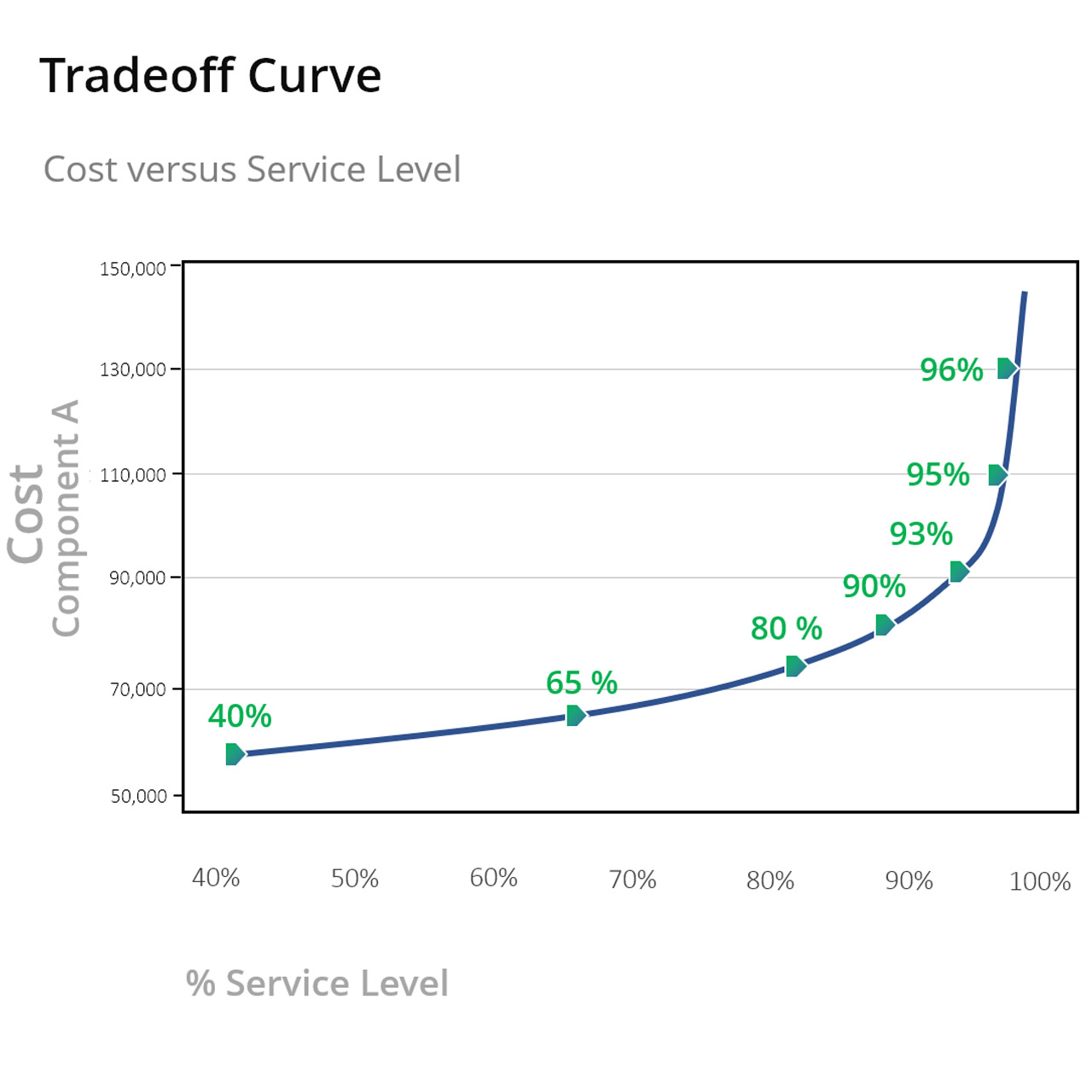
Service Level tradeoff curve utilities costs inventory requirements Software

With inventory optimization software, setting stocking policies is pure guesswork: It is possible to know how any given increase or decrease will impact service levels other than rough cut estimates.  How the changes will play out in terms of inventory investment, operating costs, and shortage costs, is something no one really knows.  Most utilities rely on rule of thumb methods and arbitrarily adjust stocking policies in a reactive manner after something has gone wrong such as a large stockout or inventory write off.  When adjustments are made this way, there is no fact-based analysis detailing how this change is expected to impact the metrics that matter:  service levels and inventory values.

Inventory Optimization software can compute the detailed, quantitative tradeoff curves required to make informed inventory policy choices or even recommend the target service level that results in the lowest overall operating cost (the sum of holding, ordering, and stock-out costs).  Using this analysis, large increases in stock levels may be mathematically justified when the predicted reduction in shortage costs exceeds the increase in inventory investment and associated holding costs.  By setting appropriate service levels and recalibrating policies across all active parts once every planning cycle (at least once monthly), utilities can minimize the risk of outages while controlling expenditures.

Perhaps the most critical aspects of the response to equipment breakdown are those relating to achieving a first-time fix as rapidly as possible. Having the proper spares available can be the difference between completing a single trip and increasing the mean time to repair, bearing the costs associated with several visits, and causing customer relationships to degrade.

Using modern software, you can benchmark past performance and leverage probabilistic forecasting methods to simulate future performance. By stress-testing your current inventory stocking policies against all plausible scenarios of future parts usage, you will know ahead of time how current and proposed stocking policies are likely to perform. Check out our blog post on how to measure the accuracy of your service level forecast to help you assess the accuracy of inventory recommendations that software providers will purport to provide benefit.

 

Optimizing Utility Supply Chains Advanced Analytics for Future Readiness


Leveraging Advanced Analytics and AI

When introducing automation, each utility company has its own goals to pursue, but you should begin with assessing present operations to identify areas that may be made more effective. Some companies may prioritize financial issues, but others may prioritize regulatory demands such as clean energy spending or industry-wide changes such as smart grids. Each company’s difficulties are unique, but modern software can point the way to a more effective inventory management system that minimizes excess inventory and places the correct components in the right places at the right times.

Overall, Supply Chain Optimization initiatives are essential for utilities looking to maximize their efficiency and reduce their costs. Technology allows us to make the integration process seamless, and you don’t need to replace your current ERP or EAM system by doing it.  You just need to make better use of the data you already have.

For example, one large utility launched a strategic Supply Chain Optimization (SCO) initiative and added best-in-class capabilities through the selection and integration of commercial off-the-shelf applications.  Chief among these was the Smart Inventory Planning and Optimization system (Smart IP&O), comprising Parts Forecasting / Demand Planning and Inventory Optimization functionality. Within just 90 days the software system was up and running, soon reducing inventory by $9,000,000 while maintaining spares availability at a high level. You can read the case study here Electric Utility Goes with Smart IP&O.

Utilities can ensure that they are able to manage their spare parts supplies in an efficient and cost-effective manner better preparing them for the future.  Over time, this balance between supply and demand translates to a significant edge. Understanding the Service Level Tradeoff Curve helps to understand the costs associated with different levels of service and the inventory requirements needed to achieve them. This leads to reduced operational costs, optimized inventory, and assurance that you can meet your customers’ needs.


Spare Parts Planning Software solutions

Smart IP&O’s service parts forecasting software uses a unique empirical probabilistic forecasting approach that is engineered for intermittent demand. For consumable spare parts, our patented and APICS award winning method rapidly generates tens of thousands of demand scenarios without relying on the assumptions about the nature of demand distributions implicit in traditional forecasting methods. The result is highly accurate estimates of safety stock, reorder points, and service levels, which leads to higher service levels and lower inventory costs. For repairable spare parts, Smart’s Repair and Return Module accurately simulates the processes of part breakdown and repair. It predicts downtime, service levels, and inventory costs associated with the current rotating spare parts pool. Planners will know how many spares to stock to achieve short- and long-term service level requirements and, in operational settings, whether to wait for repairs to be completed and returned to service or to purchase additional service spares from suppliers, avoiding unnecessary buying and equipment downtime.

Contact us to learn more how this functionality has helped our customers in the MRO, Field Service, Utility, Mining, and Public Transportation sectors to optimize their inventory. You can also download the Whitepaper here.


White Paper: What you Need to know about Forecasting and Planning Service Parts


This paper describes Smart Software’s patented methodology for forecasting demand, safety stocks, and reorder points on items such as service parts and components with intermittent demand, and provides several examples of customer success.
 

    Centering Act: Spare Parts Timing, Pricing, and Reliability

    Just as the renowned astronomer Copernicus transformed our understanding of astronomy by placing the sun at the center of our universe, today, we invite you to re-center your approach to inventory management. And while not quite as enlightening, this advice will help your company avoid being caught in the gravitational pull of inventory woes—constantly orbiting between stockouts, surplus gravity, and the unexpected cosmic expenses of expediting?

    In this article, we’ll walk you through the process of crafting a spare parts inventory plan that prioritizes availability metrics such as service levels and fill rates while ensuring cost efficiency. We’ll focus on an approach to inventory planning called Service Level-Driven Inventory Optimization. Next, we’ll discuss how to determine what parts you should include in your inventory and those that might not be necessary. Lastly, we’ll explore ways to enhance your service-level-driven inventory plan consistently.

    In service-oriented businesses, the consequences of stockouts are often very significant.  Achieving high service levels depends on having the right parts at the right time. However, having the right parts isn’t the only factor. Your Supply Chain Team must develop a consensus inventory plan for every part, then continuously update it to reflect real-time changes in demand, supply, and financial priorities.


    Managing inventory with Service-level-driven planning combines the ability to plan thousands of items with high-level strategic modeling. This requires addressing core issues facing inventory executives:

    • Lack of control over supply and associated lead times.
    • Unpredictable intermittent demand.
    • Conflicting priorities between maintenance/mechanical teams and Materials Management.
    • Reactive “wait and see” approach to planning.
    • Misallocated inventory, causing stockouts and excess.
    • Lack of trust in systems and processes.

    The key to optimal service parts management is to grasp the balance between providing excellent service and controlling costs. To do this, we must compare the costs of stockout with the cost of carrying additional spare parts inventory. The costs of a stockout will be higher for critical or emergency spares, when there is a service level agreement with external customers, for parts used in multiple assets, for parts with longer supplier lead times, and for parts with a single supplier. The cost of inventory may be assessed by considering the unit costs, interest rates, warehouse space that will be consumed, and potential for obsolescence (parts used on a soon-to-be-retired fleet have a higher obsolescence risk, for example).

    To arbitrate how much stock should be put on the shelf for each part, it is critical to establish consensus on the desired key metrics that expose the tradeoffs the business must make to achieve the desired KPIs. These KPIs will include Service Levels that tell you how often you meet usage needs without falling short on stock, Fill Rates that tell you what percentage of demand is filled, and Ordering costs detail the expenses incurred when you place and receive replenishment orders. You also have Holding costs, which encompass expenses like obsolescence, taxes, and warehousing, and Shortage costs that pertain to expenses incurred when stockouts happen.

    An MRO business or Aftermarket Parts Planning team might desire a 99% service level across all parts – i.e., the minimum stockout risk that they are willing to accept is 1%. But what if the amount of inventory needed to support that service level is too expensive? To make an informed decision on whether there is going to be a return on that additional inventory investment, you’ll need to know the stockout costs and compare that to the inventory costs. To get stockout costs, multiply two key elements: the cost per stockout and the projected number of stockouts. To get inventory value, multiply the units required by the unit cost of each part. Then determine the annual holding costs (typically 25-35% of the unit cost). Choose the option that yields a total lower cost. In other words, if the benefit associated with adding more stock (reduced shortage costs) outweighs the cost (higher inventory holding costs), then go for it. A thorough understanding of these metrics and the associated tradeoffs serves as the compass for decision-making.

    Modern software aids in this process by allowing you to simulate a multitude of future scenarios. By doing so, you can assess how well your current inventory stocking strategies are likely to perform in the face of different demand and supply patterns. If anything falls short or goes awry, it’s time to recalibrate your approach, factoring in current data on usage history, supplier lead times, and costs to prevent both stockouts and overstock situations.


    Enhance your service-level-driven inventory plan consistently.

    In conclusion, it’s crucial to assess your service-level-driven plan continuously. By systematically constructing and refining performance scenarios, you can define key metrics and goals, benchmark expected performance, and automate the calculation of stocking policies for all items. This iterative process involves monitoring, revising, and repeating each planning cycle.

    The depth of your analysis within these stocking policies relies on the data at your disposal and the configuration capabilities of your planning system. To achieve optimal outcomes, it’s imperative to maintain ongoing data analysis. This implies that a manual approach to data examination is typically insufficient for the needs of most organizations.

    For information on how Smart Software can help you meet your service supply chain goals with service-driven planning and more, visit the following blogs.

    –   “Explaining What  Service-Level Means in Your Inventory Optimization Software”  Stocking recommendations can be puzzling, especially when they clash with real-world needs.  In this post, we’ll break down what that 99% service level means and why it’s crucial for managing inventory effectively and keeping customers satisfied in today’s competitive landscape.

    –  “Service-Level-Driven Planning for Service Parts Businesses” Service-Level-Driven Service Parts Planning is a four-step process that extends beyond simplified forecasting and rule-of-thumb safety stocks. It provides service parts planners with data-driven, risk-adjusted decision support.

    –   “How to Choose a Target Service Level.” This is a strategic decision about inventory risk management, considering current service levels and fill rates, replenishment lead times, and trade-offs between capital, stocking and opportunity costs.  Learn approaches that can help.

    –   “The Right Forecast Accuracy Metric for Inventory Planning.”  Just because you set a service level target doesn’t mean you’ll actually achieve it. If you are interested in optimizing stock levels, focus on the accuracy of the service level projection. Learn how.


    Spare Parts Planning Software solutions

    Smart IP&O’s service parts forecasting software uses a unique empirical probabilistic forecasting approach that is engineered for intermittent demand. For consumable spare parts, our patented and APICS award winning method rapidly generates tens of thousands of demand scenarios without relying on the assumptions about the nature of demand distributions implicit in traditional forecasting methods. The result is highly accurate estimates of safety stock, reorder points, and service levels, which leads to higher service levels and lower inventory costs. For repairable spare parts, Smart’s Repair and Return Module accurately simulates the processes of part breakdown and repair. It predicts downtime, service levels, and inventory costs associated with the current rotating spare parts pool. Planners will know how many spares to stock to achieve short- and long-term service level requirements and, in operational settings, whether to wait for repairs to be completed and returned to service or to purchase additional service spares from suppliers, avoiding unnecessary buying and equipment downtime.

    Contact us to learn more how this functionality has helped our customers in the MRO, Field Service, Utility, Mining, and Public Transportation sectors to optimize their inventory. You can also download the Whitepaper here.


    White Paper: What you Need to know about Forecasting and Planning Service Parts


    This paper describes Smart Software’s patented methodology for forecasting demand, safety stocks, and reorder points on items such as service parts and components with intermittent demand, and provides several examples of customer success.


      Daily Demand Scenarios

      In this Videoblog, we will explain how time series forecasting has emerged as a pivotal tool, particularly at the daily level, which Smart Software has been pioneering since its inception over forty years ago. The evolution of business practices from annual to more refined temporal increments like monthly and now daily data analysis illustrates a significant shift in operational strategies.

      Initially, during the 1980s, the usual practice of using annual data for forecasting and the introduction of monthly data was considered innovative. This period marked the beginning of a trend toward increasing the resolution of data analysis, enabling businesses to capture and react to faster shifts in market dynamics. As we progressed into the 2000s, the norm of monthly data analysis was well-established, but the ‘cool kids’—innovators at the edge of business analytics—began experimenting with weekly data. This shift was driven by the need to synchronize business operations with increasingly volatile market conditions and consumer behaviors that demanded more rapid responses than monthly cycles could provide. Today, in the 2020s, while monthly data analysis remains common, the frontier has shifted again, this time towards daily data analysis, with some pioneers even venturing into hourly analytics.

      The real power of daily data analysis lies in its ability to provide a detailed view of business operations, capturing daily fluctuations that might be overlooked by monthly or weekly data.  However, the complexities of daily data necessitate advanced analytical approaches to extract meaningful insights. At this level, understanding demand requires grappling with concepts like intermittency, seasonality, trend, and volatility. Intermittency, or the occurrence of zero-demand days, becomes more pronounced at a daily granularity and demands specialized forecasting techniques like Croston’s method for accurate predictions. Seasonality at a daily level can reveal multiple patterns—such as increased sales on weekends or holidays—that monthly data would mask. Trends can be observed as short-term increases or decreases in demand, demanding agile adjustment strategies. Finally, volatility at the daily level is accentuated, showing more significant swings in demand than seen in monthly or weekly analyses, which can affect inventory management strategies and the need for buffer stock. This level of complexity underscores the need for sophisticated analytical tools and expertise in daily data analysis.

      In conclusion, the evolution from less frequent to daily time series forecasting marks a substantial shift in how businesses approach data analysis. This transition not only reflects the accelerating pace of business but also highlights the requirement for tools that can handle increased data granularity. Smart Software’s dedication to refining its analytical capabilities to manage daily data highlights the industry’s broader move towards more dynamic, responsive, and data-driven decision-making. This shift is not merely about keeping pace with time but about leveraging detailed insights to forge competitive advantages in an ever-changing business environment.


      Why MRO Businesses Need Add-on Service Parts Planning & Inventory Software

      MRO organizations exist in a wide range of  industries, including public transit, electrical utilities, wastewater, hydro power, aviation, and mining. To get their work done, MRO professionals use Enterprise Asset Management (EAM) and Enterprise Resource Planning (ERP) systems. These systems are designed to do a lot of jobs. Given their features, cost, and extensive implementation requirements, there is an assumption that EAM and ERP systems can do it all.

      For example, at a recent Maximo Utilities Working Group event, several prospects stated that “Our EAM will do that” when asked about requirements for forecasting usage, netting out supply plans, and optimizing inventory policies. They were surprised to learn it did not and wanted to know more.

      In this post, we summarize the need for add-on software that addresses specialized analytics for inventory optimization, forecasting, and service parts planning.   

      EAM Systems

      EAM systems can’t ingest forecasts of future usage – these systems simply aren’t designed to conduct supply planning and many don’t even have a place to hold forecasts. So, when an MRO business needs to net out known requirements for planned production or capital projects, an add-on application like Smart IP&O is needed.

      Inventory Optimization software with features that support planning known future demand will take project-based data not maintained in the EAM system (including project start dates, duration, and when each part is expected to be needed) and compute a period-by-period forecast over any planning horizon. That “planned” forecast can be projected alongside statistical forecasts of “unplanned” demand arising from normal wear and tear. At that point, parts planning software can net out the supply and identify gaps between supply and demand. This ensures that these gaps won’t go unnoticed and result in shortages that would otherwise delay the completion of the projects. It also minimizes excess stock that would otherwise be ordered too soon and needlessly consumes cash and warehouse space. Again, MRO businesses sometimes mistakenly assume that these capabilities are addressed by their EAM package.

      ERP Systems

      ERP systems, on the other hand, typically do include an MRP module that is designed to ingest a forecast and net out material requirements. Processing will consider current on hand inventory, open sales orders, scheduled jobs, incoming purchase orders, any bill of materials, and items in transit while transferring between sites. It will compare those current state values to the replenishment policy fields plus any monthly or weekly forecasts to determine when to suggest replenishment (a date) and how much to replenish (a quantity).

      So, why not use the ERP system alone to net out the supply plan to prevent shortages and excess? First, while ERP systems have a placeholder for a forecast and some systems can net out supply using their MRP modules, they don’t make it easy to reconcile planned demand requirements associated with capital projects. Most of the time, the data on when planned projects will occur is maintained outside of the ERP, especially the project’s bill of materials detailing what parts will be needed to support the project. Second, many ERP systems don’t offer anything effective when it comes to predictive capabilities, relying instead on simple math that just won’t work for service parts due to the high prevalence of intermittent demand. Finally, ERP systems don’t have flexible user-friendly interfaces that support interacting with the forecasts and supply plan.

      Reorder Point Logic

      Both ERP and EAM have placeholders for reorder point replenishment methods such as Min/Max levels. You can use inventory optimization software to populate these fields with the risk-adjusted reorder point policies. Then within the ERP or EAM systems, orders are triggered whenever actual (not forecasted) demand drives on-hand stock below the Min. This type of policy doesn’t use a traditional forecast that projects demand week-over-week or month-over-month and is often referred to as “demand driven replenishment” (since orders only occur when actual demand drives stock below a user defined threshold).

      But just because it isn’t using a period-over-period forecast doesn’t mean it isn’t being predictive. Reorder point policies should be based on a prediction of demand over a replenishment lead time plus a buffer to protect against demand and supply variability. MRO businesses need to know the stockout risk they are incurring with any given stocking policy. After all, inventory management is risk management – especially in MRO businesses when the cost of stockout is so high. Yet, ERP and EAM do not offer any capabilities to risk-adjust stocking policies. They force users to manually generate these policies externally or to use basic rule of thumb math that doesn’t detail the risks associated with the choice of policy.

      Summary

      Supply chain planning functionality such as inventory optimization isn’t the core focus of EAM  and ERP. You should leverage add-on planning platforms, like Smart IP&O, that support statistical forecasting, planned project management, and inventory optimization. Smart IP&O will develop forecasts and stocking policies that can be input to an EAM or ERP system to drive daily ordering.


      Spare Parts Planning Software solutions

      Smart IP&O’s service parts forecasting software uses a unique empirical probabilistic forecasting approach that is engineered for intermittent demand. For consumable spare parts, our patented and APICS award winning method rapidly generates tens of thousands of demand scenarios without relying on the assumptions about the nature of demand distributions implicit in traditional forecasting methods. The result is highly accurate estimates of safety stock, reorder points, and service levels, which leads to higher service levels and lower inventory costs. For repairable spare parts, Smart’s Repair and Return Module accurately simulates the processes of part breakdown and repair. It predicts downtime, service levels, and inventory costs associated with the current rotating spare parts pool. Planners will know how many spares to stock to achieve short- and long-term service level requirements and, in operational settings, whether to wait for repairs to be completed and returned to service or to purchase additional service spares from suppliers, avoiding unnecessary buying and equipment downtime.

      Contact us to learn more how this functionality has helped our customers in the MRO, Field Service, Utility, Mining, and Public Transportation sectors to optimize their inventory. You can also download the Whitepaper here.


      White Paper: What you Need to know about Forecasting and Planning Service Parts


      This paper describes Smart Software’s patented methodology for forecasting demand, safety stocks, and reorder points on items such as service parts and components with intermittent demand, and provides several examples of customer success.


        Warning Signs that You Have a Supply Chain Analytics Gap

        “Business is war” may be an overdone metaphor but it’s not without validity. Like the “Bomber Gap” and the “Missile Gap,” worries about falling behind the competition, and the resulting threat of annihilation, always lurk in the minds of business executives, If they don’t, they should, because not all gaps are imaginary (the Bomber Gap and the Missile Gap were shown to not exist between the US and the USSR, but the 1980’s gap between Japanese and American productivity was all too real). The difference between paranoia and justified concern is converting fear into facts. This post is about organizing your attention toward possible gaps in your company’s supply chain analytics.

        Surveillance Gaps

        The US Army has a saying: “Time spent on reconnaissance is never wasted.” Now and then, our Smart Forecaster blog has a post that helps you get your head on a swivel to see what’s going on around you. An example is our post on digital twins, which is a hot topic throughout the engineering world.  To recap: using demand and supply simulations to probe for weaknesses in your inventory plan is a form of supply chain reconnaissance.  Closing this surveillance gap enables businesses to take corrective action before an actual problem emerges.

        Situational Awareness Gaps

        A military commander needs to keep track of what is available for use and how well it is being used. The reports available in Smart Operational Analytics keep you current on your inventory counts, your forecasting accuracy, your suppliers’ responsiveness, and trends in these and other operational areas.  You’ll know exactly where you stand on a variety of supply chain KPIs such as service level, fill rates, and inventory turns.  You’ll know whether actual performance is aligned with planned performance and whether the inventory plan (i.e., what to order, when, from whom, and why) is being adhered to or ignored.

        Agility Gaps

        The business environment can change rapidly. All it takes is a tanker stuck sideways in the Suez Canal, a few anti-ship ballistic missiles in the Red Sea, or a region-wide weather event. These catastrophes may fall as much on your competitors’ heads as on yours, but which of you is agile enough to react first? Exception reporting in Demand Planner and Smart Operational Analytics can detect major changes in the character of demand so you can quickly filter out obsolete demand data before they poison all your calculations for demand forecasts or inventory optimization. Smart Demand Planner can give advance warning of a pending increase or decrease in demand. Smart Inventory Optimization can help you adjust your inventory replenishment tactics to reflect these shifts in demand.


        Innovation Gaps

        Whether you refer to your competition as “The Other Guys” or “Everybody Else” or something unprintable, the ones you have to worry about are the ones always looking for an edge. When you choose Smart as your partner, we’ll give you that edge with innovative but field proven predictive solutions.  Smart Software has been innovating predictive modeling since birth over 40 years ago.

        • Our first products introduced multiple technical innovations: assessment of forecast quality by looking into the future not the past; automatic selection of the best among a set of competing methodologies, exploiting the graphics in the first PCs to allow easy management overrides of statistical forecasts.
        • Later we invented and patented a radically different approach to forecasting the intermittent demand that is characteristic of both spare parts and big-ticket durable goods. Our technology was patented, received multiple awards for dramatically improving the management of inventory.  The solution is now a field proven approach used by many leading businesses in service parts, MRO, aftermarket parts, and field service.
        • More recently, Smart’s cloud platform for demand forecasting, predictive modeling, inventory optimization, and analytics, takes all relevant data otherwise locked in your ERP or EAM systems, external files, and other disparate data sources, organizes it in the Smart Data Pipeline, structures it into our common data model, and processes it in our AWS cloud.  Smart uses the power of our patented probabilistic demand simulations in Smart Inventory Optimization to stress test and optimize the rules you use to manage each of your inventory items.

        It’s my job, along with my cofounder Dr. Nelson Hartunian, our data science team, and academic consultants, to continue to push the envelope of supply chain analytics and bring the benefits back to you by continuously rolling out new versions of our products so you don’t get stuck in an innovation gap – or any of the others.