5 Steps to Improve the Financial Impact of Spare Parts Planning

In today’s competitive business landscape, companies are constantly seeking ways to improve their operational efficiency and drive increased revenue. Optimizing service parts management is an often-overlooked aspect that can have a significant financial impact. Companies can improve overall efficiency and generate significant financial returns by effectively managing spare parts inventory. This article will explore the economic implications of optimized service parts management and how investing in Inventory Optimization and Demand Planning Software can provide a competitive advantage.

The Importance of Optimized Service Parts Planning:

Optimized service parts management plays a vital role in mitigating inventory risks and ensuring critical spare parts availability. While subjective planning may work on a small scale, it becomes insufficient when managing large inventories of intermittently demanded spare parts. Traditional forecasting approaches simply fail to accurately account for the extreme demand variability and frequent periods of zero demand that is so common with spare parts.  This results in large misallocations of stock, higher costs, and poor service levels.

The key to optimized service parts management lies in understanding the trade-off between service and cost. Inventory Optimization and Demand Planning Software powered by probabilistic forecasting and Machine learning Algorithms can help companies better understand the cost vs. benefit of each inventory decision and wield inventory as a competitive asset. By generating accurate demand forecasts and optimal stocking policies such as Min/Max, Safety Stock Levels, and Reorder Points in seconds, companies can know how much is too much and when to add more. By wielding inventory as a competitive asset, companies can drive up service levels and drive down costs.

Improve the Financial Outcome of Spare Parts Planning

  1. Accurate forecasting is crucial to optimize inventory planning and meet customer demand effectively. State-of-the-art demand planning software accurately predicts inventory requirements, even for intermittent demand patterns. By automating forecasting, companies can save time, money, and resources while improving accuracy.
  2. Meeting customer demand is a critical aspect of service parts management. Companies can enhance customer satisfaction, loyalty, and increase their chances of winning future contracts for the asset-intensive equipment they sell by ensuring the availability of spare parts when needed. Through effective demand planning and inventory optimization, organizations can reduce lead times, minimize stockouts, and maintain service levels, thereby improving the financial impact of all decisions.
  3. Financial gains can be achieved through optimized service parts planning, including the reduction of inventory and product costs. Excess storage and obsolete inventory can be significant cost burdens for organizations. By implementing best-of-breed inventory optimization software, companies can identify cost-effective solutions, driving up service levels and reducing costs. This leads to improved inventory turnover, reduced carrying costs, and increased profitability.
  4. Procurement planning is another essential aspect of service parts management. Organizations can optimize inventory levels, reduce lead times, and avoid stockouts by aligning procurement and the associated order quantities with accurate demand forecasts. For example, accurate forecasts can be shared with suppliers so that blanket purchase commitments can be made. This provides the supplier revenue certainty and, in exchange, can hold more inventory, thereby reducing lead times.
  5. Intermittent demand planning is a particular challenge in spare parts management. Conventional rule-of-thumb approaches fall short in handling demand variability effectively. This is because traditional approaches assume demand is normally distributed when in reality, it is anything but normal. Spare parts demand random bursts of large demand intersperse many period of zero demand.  Smart Software’s solution incorporates advanced statistical models and machine learning algorithms to analyze historical demand patterns, enabling accurate planning for intermittent demand. Companies can significantly reduce stockout costs and improve efficiency by addressing this challenge.

Evidence from Smart Software’s Customers:

Investing in Smart Software’s Inventory Optimization and Demand Planning Software enables companies to unlock cost savings, elevate customer service levels, and enhance operational efficiency. Through accurate demand forecasting, optimized inventory management, and streamlined procurement processes, organizations can achieve financial savings, meet customer demands effectively, and improve overall business performance.

  • Metro-North Railroad (MNR) experienced an 8% reduction in parts inventory, reaching a record high customer service level of 98.7%, and reduced inventory growth for new equipment from a projected 10% to only 6%. Smart Software played a crucial role in identifying multi-year service part needs, reducing administrative lead times, formulating stock reduction plans for retiring fleets, and identifying inactive inventory for disposal. MNR saved costs, maximized disposal benefits, improved service levels, and gained accurate insights for informed decision-making, ultimately improving their bottom line and customer satisfaction.
  • Seneca Companies, an industry leader in automotive petroleum services, adopted Smart Software to model customer demand, control inventory performance, and drive replenishment. Field service technicians embraced its use, and total inventory investment decreased by more than 25%, from $11 million to $8 million, while maintaining first-time fix rates of 90%+.
  • A leading Electric Utility implemented Smart IP&O in just 3 months and then used the software to optimize its reorder points and order quantities for over 250,000 spare parts. During the first phase of the implementation, the platform helped the Utility reduce inventory by $9,000,000 while maintaining service levels. The implementation was part of the company’s strategic supply chain optimization initiative.

Optimizing Service Parts Planning for Competitive Advantage

Optimized service parts management is crucial for companies seeking to improve efficiency, reduce costs, and ensure the availability of necessary spare parts. Organizations can unlock significant value in this field by investing in Smart Software’s Inventory Optimization and Demand Planning Software. Companies can achieve better financial performance and gain a competitive edge in their respective markets through improved data analysis, automation, and inventory planning.

Smart Software is designed for the modern marketplace, which is volatile and always changing. It can handle SKU proliferation, longer supply chains, less predictable lead times, and more intermittent and less forecastable demand patterns. It can also integrate with virtually every ERP solution on the market, by field-proven seamless connections or using a simple import/export process supported by Smart Software’s data model and data processing engine. By using Smart Software, companies can leverage inventory as a competitive asset, enhance customer satisfaction, drive up service levels, push down costs, and save substantial money.


Spare Parts Planning Software solutions

Smart IP&O’s service parts forecasting software uses a unique empirical probabilistic forecasting approach that is engineered for intermittent demand. For consumable spare parts, our patented and APICS award winning method rapidly generates tens of thousands of demand scenarios without relying on the assumptions about the nature of demand distributions implicit in traditional forecasting methods. The result is highly accurate estimates of safety stock, reorder points, and service levels, which leads to higher service levels and lower inventory costs. For repairable spare parts, Smart’s Repair and Return Module accurately simulates the processes of part breakdown and repair. It predicts downtime, service levels, and inventory costs associated with the current rotating spare parts pool. Planners will know how many spares to stock to achieve short- and long-term service level requirements and, in operational settings, whether to wait for repairs to be completed and returned to service or to purchase additional service spares from suppliers, avoiding unnecessary buying and equipment downtime.

Contact us to learn more how this functionality has helped our customers in the MRO, Field Service, Utility, Mining, and Public Transportation sectors to optimize their inventory. You can also download the Whitepaper here.


White Paper: What you Need to know about Forecasting and Planning Service Parts


This paper describes Smart Software’s patented methodology for forecasting demand, safety stocks, and reorder points on items such as service parts and components with intermittent demand, and provides several examples of customer success.

 

    Procon Pumps Uses Smart Demand Planner to Keep Business Flowing

    Introduction:
    Procon, an industry leading pump manufacturer, uses Smart IP&O’s demand planning and inventory optimization modules from Smart Software to make sure they have the products their customers need, when they need them.  You might not have heard of their products, but if you’ve ever eaten at McDonalds or sipped a coffee at Starbucks, you have been served by Procon.  Procon’s broad portfolio of over 7,000 SKUs is supplied to more than 70 countries worldwide through their direct sales channel and an extensive distributor network.  Procon operates manufacturing facilities in the US, Mexico, Ireland, and through a licensed manufacturing partner in Japan.  We spoke with Procon’s Shankar Suman, Director of Sales, and Emer Horan, Global Supply Chain Manager, to learn more.

    The Challenge
    If Procon cannot ship a required product, their customers cannot ship theirs.  Accurate forecasting is a key driver of supply chain success and customer satisfaction. Procon’s monthly planning establishes the consensus demand plan that drives procurement, production, and stocking policies.  But they found they had a gap between sales and procurement, which historically led to missed deliveries and excess inventory.  What Procon needed was a robust demand forecasting and inventory optimization tool that was easy to use, enabled collaborative planning with their sales team and partners, and integrated with their  ERP system to drive procurement and production planning.

    The Solution:
    They found this in Smart IP&O,  web-based platform for statistical forecasting, demand planning, and inventory optimization.

    • Shankar Suman cited a broad mix of capabilities that convinced them to utilize Smart. Chief among them were:
    •   Smart Demand Planner supports the easy, orchestrated flow of information that yields an accurate consensus plan.  Presenting performance history and statistical forecast by product, territory, and partner, SDP provide the sales team with perspective that they can complement – adjusting for expected opportunities or demand shifts.
    • Forecast accuracy. Smart is an industry leader in statistical analytics, leveraging innovations developed over its forty-plus year history.  This combined with robust forecast vs. actuals analysis helps Procon continually improve the quality of their forecasts.
    • Transparent connectivity with Procon’s enterprise software, Epicor Kinetic. Daily sales and shipment data are automatically pulled into the Smart platform, fueling Smart’s forecasting engine, and results are easily pushed back to the ERP (MRP) via an API based integration to drive ordering and production planning.

    Results:
    Emer Horan explained how this plays out over the course of each month.   Emer provides forecasts for each of their five sales managers, they meet to compare statistical and sales forecasts, and agree on a revised 12-month consensus plan.  The sales managers have a good sense for the top accounts that represent 80% of revenue, often including direct input from customers themselves, and the statistical forecast fills in the gaps.  Next month they use the forecast vs. actual analytics to help improve accuracy, then repeat the process.

    “Our sales team is incentivized to maintain and improve sales forecast accuracy,” said Emer, “and we have the tools to help them succeed.  This not only ensures optimal inventory levels but also contributes to improved on-time delivery and higher customer satisfaction.”

    “Our journey with Smart Software has been quite remarkable,” added Shankar. “We began with an initial idea of the functionality and interface, and it has continually evolved from there. The Smart team has shown tremendous support and patience with our scope changes, delivering the product exactly the way we needed and wanted it.  We have been using Smart for over three years now, and this journey is ongoing. We continue to receive excellent support from the Smart team and truly enjoy working with them.”


    Extend Epicor BisTrack with Smart IP&O’s Dynamic Reorder Point Planning & Forecasting

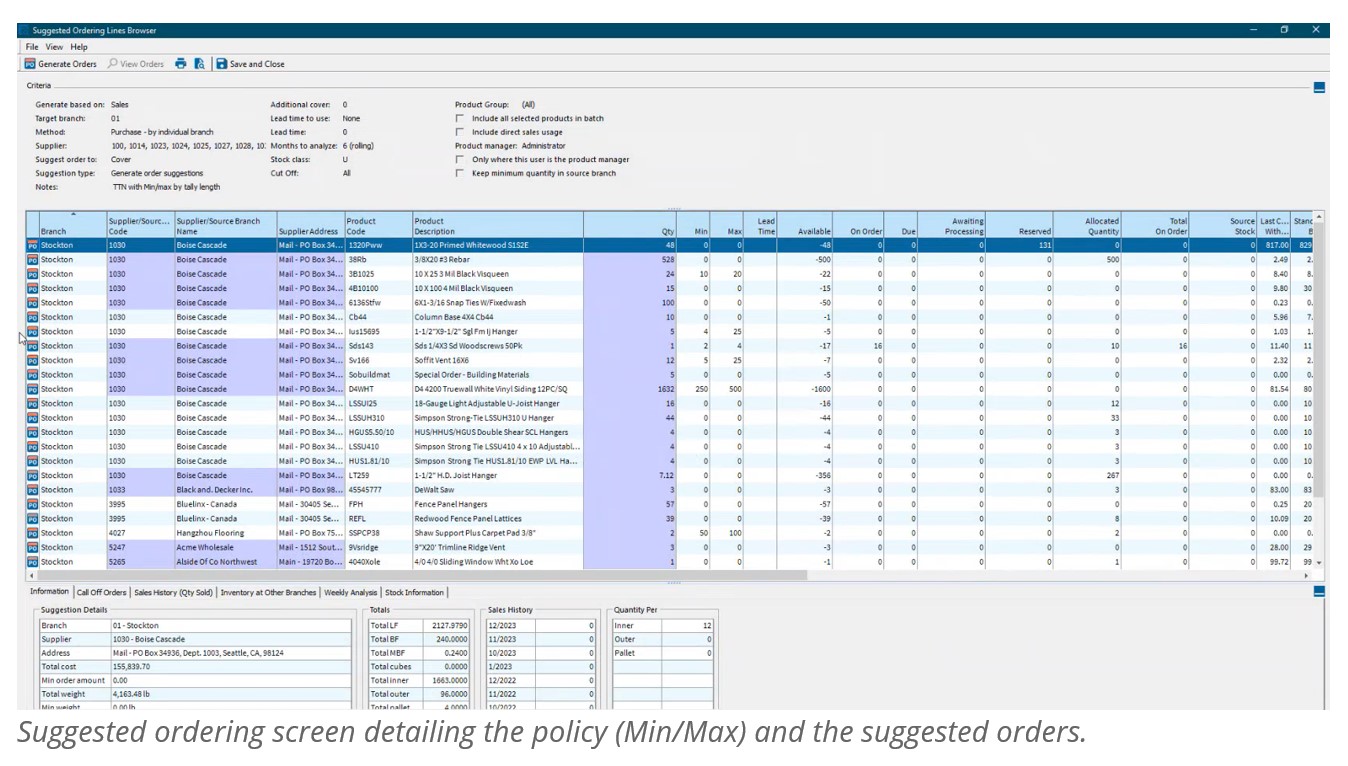
    In this article, we will review the “suggested orders” functionality in Epicor BisTrack, explain its limitations, and summarize how Smart Inventory Planning & Optimization (Smart IP&O) can help reduce inventory & minimize stock-outs by accurately assessing the tradeoffs between stockout risks and inventory costs.

    Automating Replenishment in Epicor BisTrack
    Epicor BisTrack’s “Suggested Ordering” can manage replenishment by suggesting what to order and when via reorder point-based policies such as min-max and/or manually specified weeks of supply. BisTrack contains some basic functionality to compute these parameters based on average usage or sales, supplier lead time, and/or user-defined seasonal adjustments. Alternatively, reorder points can be specified completely manually. BisTrack will then present the user with a list of suggested orders by reconciling incoming supply, current on hand, outgoing demand, and stocking policies.

    How Epicor BisTrack “Suggested Ordering” Works
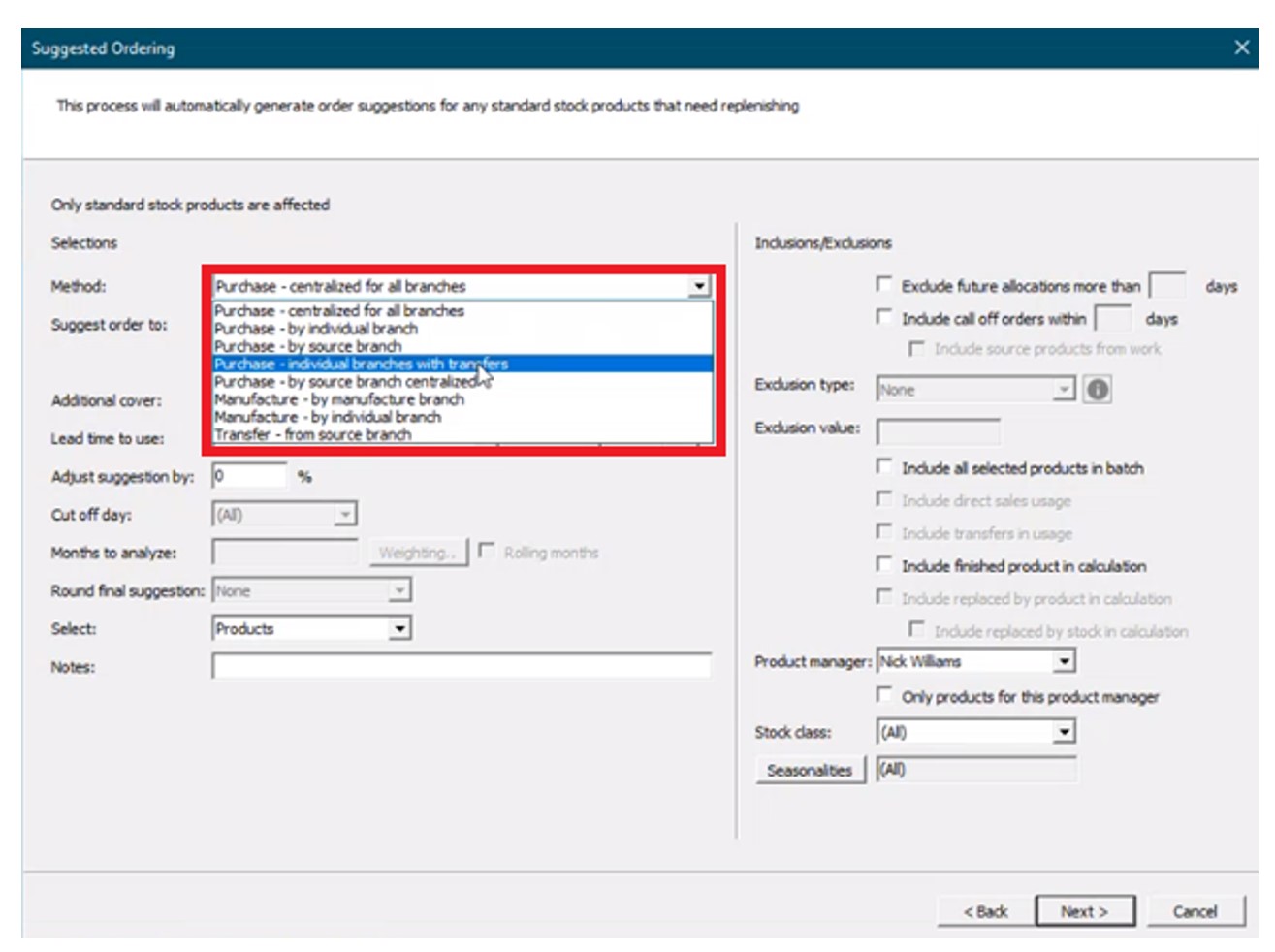
    To get a list of suggested orders, users specify the methods behind the suggestions, including locations for which to place orders and how to determine the inventory policies that govern when a suggestion is made and in what quantity.

    Extend Epicor BisTrack Planning and Forecasting

    First, the “method” field is specified from the following options to determine what kind of suggestion is generated and for which location(s):

    Purchase – Generate purchase order recommendations.

    1. Centralized for all branches – Generates suggestions for a single location that buys for all other locations.
    2. By individual branch – Generates suggestions for multiple locations (vendors would ship directly to each branch).
    3. By source branch – Generates suggestions for a source branch that will transfer material to branches that it services (“hub and spoke”).
    4. Individual branches with transfers – Generates suggestions for an individual branch that will transfer material to branches that it services (“hub and spoke”, where the “hub” does not need to be a source branch).

    Manufacture – Generate work order suggestions for manufactured goods.

    1. By manufacture branch.
    2. By individual branch.

    Transfer from source branch – Generate transfer suggestions from a given branch to other branches.

    Extend Epicor BisTrack Planning and Forecasting 2222

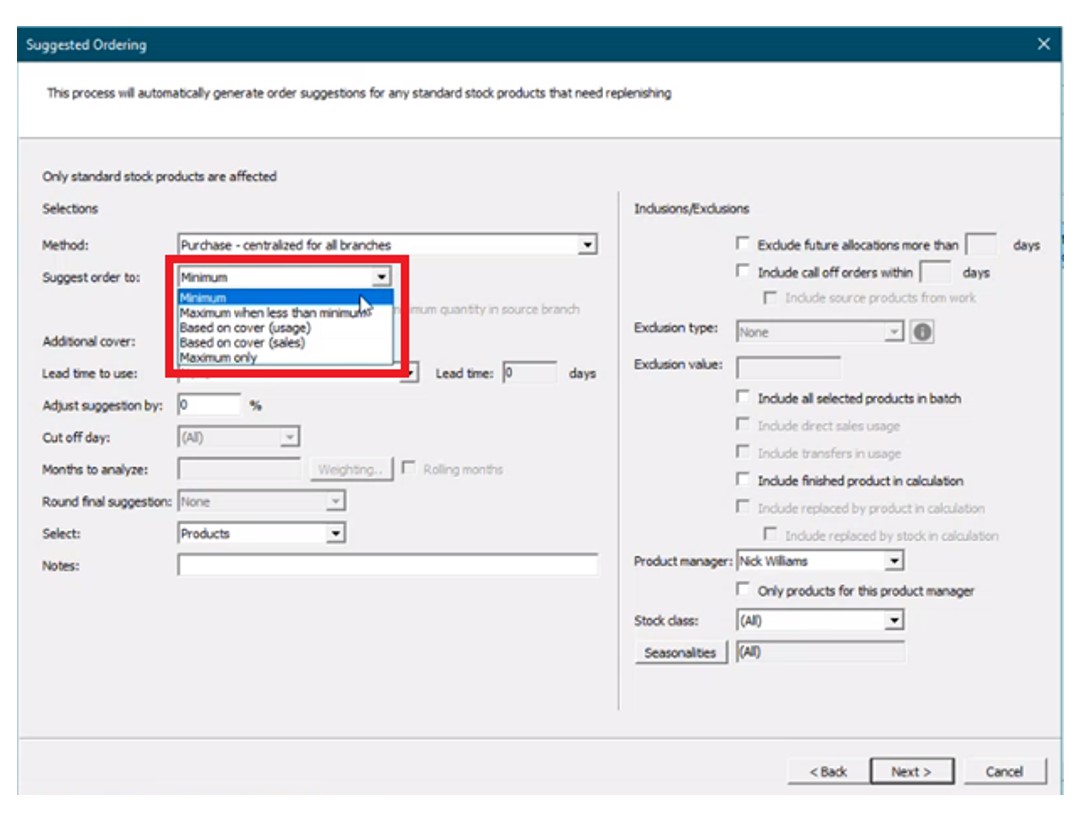
    Next, the “suggest order to” is specified from the following options:

    1. Minimum – Suggests orders “up to” the minimum on hand quantity (“min”). For any item where supply is less than the min, BisTrack will suggest an order suggestion to replenish up to this quantity.
    2. Maximum when less than min – Suggests orders “up to” a maximum on-hand quantity when the minimum on-hand quantity is breached (e.g. a min-max inventory policy).
    1. Based on cover (usage) – Suggests orders based on coverage for a user-defined number of weeks of supply with respect to a specified lead time. Given internal usage as demand, BisTrack will recommend orders where supply is less than the desired coverage to cover the difference.
    1. Based on over (sales) – Suggests orders based on coverage for a user-defined number of weeks of supply with respect to a specified lead time. Given sales orders as demand, BisTrack will recommend orders where supply is less than the desired coverage to cover the difference.
    1. Maximum only – Suggests orders “up to” a maximum on-hand quantity where supply is less than this max.

    Finally, if allowing BisTrack to determine the reorder thresholds, users can specify additional inventory coverage as buffer stock, lead times, how many months of historical demand to consider, and can also manually define period-by-period weighting schemes to approximate seasonality. The user will be handed a list of suggested orders based on the defined criteria. A buyer can then generate POs for suppliers with the click of a button.

    Extend Epicor BisTrack Planning and Forecasting

    Limitations

    Rule-of-thumb Methods

    While BisTrack enables organizations to generate reorder points automatically, these methods rely on simple averages that do not capture seasonality, trends, or the volatility in an item’s demand. Averages will always lag behind these patterns and are unable to pick up on trends. Consider a highly seasonal product like a snow shovel—if we take an average of Summer/Fall demand as we approach the Winter season instead of looking ahead, then the recommendations will be based on the slower periods instead of anticipating upcoming demand. Even if we consider an entire years’ worth of history or more, the recommendations will overcompensate during the slower months and underestimate the busy season without manual intervention.

    Rule of thumb methods also fail when used to buffer against supply and demand variability.  For example, the average demand over the lead time might be 20 units.  However, a planner would often want to stock more than 20 units to avoid stocking out if lead times are longer than expected or demand is higher than the average.  BisTrack allows users to specify the reorder points based on multiples of the averages.  However, because the multiples don’t account for the level of predictability and variability in the demand, you’ll always overstock predictable items and understock unpredictable ones.   Read this article to learn more about why multiples of the average fail when it comes to developing the right reorder point.

    Manual Entry
    Speaking of seasonality referenced earlier, BisTrack does allow the user to approximate it through the use of manually entered “weights” for each period. This forces the user to have to decide what that seasonal pattern looks like—for every item. Even beyond that, the user must dictate how many extra weeks of supply to carry to buffer against stockouts, and must specify what lead time to plan around. Is 2 weeks extra supply enough? Is 3 enough? Or is that too much? There is no way to know without guessing, and what makes sense for one item might not be the right approach for all items.

    Intermittent Demand
    Many BisTrack customers may consider certain items “unforecastable” because of the intermittent or “lumpy” nature of their demand. In other words, items that are characterized by sporadic demand, large spikes in demand, and periods of little or no demand at all. Traditional methods—and rule-of-thumb approaches especially—won’t work for these kinds of items. For example, 2 extra weeks of supply for a highly predictable, stable item might be way too much; for an item with highly volatile demand, this same rule might not be enough. Without a reliable way to objectively assess this volatility for each item, buyers are left guessing when to buy and how much.

    Reverting to Spreadsheets
    The reality is most BisTrack users tend to do the bulk of their planning off-line, in Excel. Spreadsheets aren’t purpose-built for forecasting and inventory optimization. Users will often bake in user-defined rule of thumb methods that often do more harm than good.  Once calculated, users must input the information back into BisTrack manually. The time consuming nature of the process leads companies to infrequently compute their inventory policies – Many months and on occasion years go by in between mass updates leading to a “set it and forget it” reactive approach, where the only time a buyer/planner reviews inventory policy is at the time of order.  When policies are reviewed after the order point is already breached, it is too late.  When the order point is deemed too high, manual interrogation is required to review history, calculate forecasts, assess buffer positions, and to recalibrate.  The sheer volume of orders means that buyers will just release orders rather than take the painstaking time to review everything, leading to significant excess stock.  If the reorder point is too low, it’s already too late.  An expedite may now be required, driving up costs, assuming the customer doesn’t simply go elsewhere.

    Epicor is Smarter
    Epicor has partnered with Smart Software and offers Smart IP&O as a cross platform add-on to its ERP solutions including BisTrack, a speciality ERP for the Lumber, hardware, and building material industry.  The Smart IP&O solution comes complete with a bidirectional integration to BisTrack.  This enables Epicor customers to leverage built-for-purpose best of breed inventory optimization applications.  With Epicor Smart IP&O you can generate forecasts that capture trend and seasonality without manual configurations.  You will be able to automatically recalibrate inventory policies using field proven, cutting-edge statistical and probabilistic models that were engineered to accurately plan for intermittent demand.   Safety stocks will accurately account for demand and supply variability, business conditions, and priorities.  You can leverage service level driven planning so you have just enough stock or turn on optimization methods that prescribe the most profitable stocking policies and service levels that consider the real cost of carrying inventory. You can support commodity buys with accurate demand forecasting over longer horizons, and run “what-if” scenarios to assess alternative strategies before execution of the plan.

    Smart IP&O customers routinely realize 7 figure annual returns from reduced expedites, increased sales, and less excess stock, all the while gaining a competitive edge by differentiating themselves on improved customer service. To see a recorded webinar hosted by the Epicor Users Group that profiles Smart’s Demand Planning and Inventory Optimization platform, please register here.


    The Forecast Matters, but Maybe Not the Way You Think

    True or false: The forecast doesn’t matter to spare parts inventory management.

    At first glance, this statement seems obviously false. After all, forecasts are crucial for planning stock levels, right?

    It depends on what you mean by a “forecast”. If you mean an old-school single-number forecast (“demand for item CX218b will be 3 units next week and 6 units the week after”), then no. If you broaden the meaning of forecast to include a probability distribution taking account of uncertainties in both demand and supply, then yes.

    The key reality is that many items, especially spare and service parts, have unpredictable, intermittent demand. (Supplier lead times can also be erratic, especially when parts are sourced from a backlogged OEM.)  We have observed that while manufacturers and distributors typically experience intermittent demand on just 20% or more of their items the percentage grows to 80%+ for MRO based businesses.  This means historical data often show periods of zero demand interspersed with random periods of non-zero demand. Sometimes, these non-zero demands are as low as 1 or 2 units, while at other times, they unexpectedly spike to quantities several times larger than their average.

    This isn’t like the kind of data usually faced by your peer “demand planners” in retail, consumer products, and food and beverage. Those folks usually deal with larger quantities having proportionately less randomness. And they can surf on prediction-enhancing features like trends and stable seasonal patterns. Instead, spare parts usage is much more random, throwing a monkey wrench into the planning process, even in the minority of cases in which there are detectable seasonal variations.

    In the realm of intermittent demand, the best forecast available will significantly deviate from the actual demand. Unlike consumer products with medium to high volume and frequency, a service part’s forecast can miss the mark by hundreds of percentage points. A forecast of one or two units, on average, will always miss when the actual demand is zero. Even with advanced business intelligence or machine learning algorithms, the error in forecasting the non-zero demands will still be substantial.

    Perhaps because of the difficulty of statistical forecasting in the inventory domain, inventory planning in practice often relies on intuition and planner knowledge. Unfortunately, this approach doesn’t scale across tens of thousands of parts. Intuition just cannot cope with the full range of demand and lead time possibilities, let alone accurately estimate the  probability of each possible scenario. Even if your company has one or two exceptional intuitive forecasters, personnel retirements and product line reorganizations mean that intuitive forecasting can’t be relied on going forward.

    The solution lies in shifting focus from traditional forecasts to predicting probabilities for each potential demand and lead time scenario. This shift transforms the conversation from an unrealistic “one number plan” to a range of numbers with associated probabilities. By predicting probabilities for each demand and lead time possibility, you can better align stock levels with the risk tolerance for each group of parts.

    Software that generates demand and lead time scenarios, repeating this process tens of thousands of times, can accurately simulate how current stocking policies will perform against these policies. If the performance in the simulation falls short and you are predicted to stock out more often than you are comfortable with or you are left with excess inventory, conducting what-if scenarios allows adjustments to policies. You can then predict how these revised policies will fare against random demands and lead times. You can conduct this process iteratively and refine it with each new what-if scenario or lean on system prescribed policies that optimally strike a balance between risk and costs.

    So, if you are planning service and spare parts inventories, stop worrying about predicting demand the way traditional retail and CPG demand planners do it. Focus instead on how your stocking policies will withstand the randomness of the future, adjusting them based on your risk tolerance. To do this, you’ll need the right set of decision support software, and this is how Smart Software can help.


    Spare Parts Planning Software solutions

    Smart IP&O’s service parts forecasting software uses a unique empirical probabilistic forecasting approach that is engineered for intermittent demand. For consumable spare parts, our patented and APICS award winning method rapidly generates tens of thousands of demand scenarios without relying on the assumptions about the nature of demand distributions implicit in traditional forecasting methods. The result is highly accurate estimates of safety stock, reorder points, and service levels, which leads to higher service levels and lower inventory costs. For repairable spare parts, Smart’s Repair and Return Module accurately simulates the processes of part breakdown and repair. It predicts downtime, service levels, and inventory costs associated with the current rotating spare parts pool. Planners will know how many spares to stock to achieve short- and long-term service level requirements and, in operational settings, whether to wait for repairs to be completed and returned to service or to purchase additional service spares from suppliers, avoiding unnecessary buying and equipment downtime.

    Contact us to learn more how this functionality has helped our customers in the MRO, Field Service, Utility, Mining, and Public Transportation sectors to optimize their inventory. You can also download the Whitepaper here.


    White Paper: What you Need to know about Forecasting and Planning Service Parts


    This paper describes Smart Software’s patented methodology for forecasting demand, safety stocks, and reorder points on items such as service parts and components with intermittent demand, and provides several examples of customer success.
     

      Why Inventory Planning Shouldn’t Rely Exclusively on Simple Rules of Thumb

      For too many companies, a critical piece of data fact-finding ― the measurement of demand uncertainty ― is handled by simple but inaccurate rules of thumb.  For example, demand planners will often compute safety stock by a user-defined multiple of the forecast or historical average.  Or they may configure their ERP to order more when on hand inventory gets to 2 x the average demand over the lead time for important items and 1.5 x for less important ones. This is a huge mistake with costly consequences.

      The choice of multiple ends up being a guessing game.  This is because no human being can compute exactly how much inventory to stock considering all the uncertainties.  Multiples of the average lead time demand are simple to use but you can never know whether the multiple used is too large or too small until it is too late.  And once you know, all the information has changed, so you must guess again and then wait and see how the latest guess turns out.  With each new day, you have new demand, new details on lead times, and the costs may have changed.  Yesterday’s guess, no more matter how educated is no longer relevant today.  Proper inventory planning should be void of inventory and forecast guesswork.  Decisions must be made with incomplete information but guessing is not the way to go.

      Knowing how much to buffer requires a fact-based statistical analysis that can accurately answer questions such as:

      • How much extra stock is needed to improve service levels by 5%
      • What the hit to on-time delivery will be if inventory is reduced by 5%
      • What service level target is most profitable.
      • How will the stockout risk be impacted by the random lead times we face.

      Intuition can’t answer these questions, doesn’t scale across thousands of parts, and is often wrong.  Data, probability math and modern software are much more effective. Winging it is not the path to sustained excellence.