Why MRO Businesses Should Care About Excess Inventory

Do MRO companies genuinely prioritize reducing excess spare parts inventory? From an organizational standpoint, our experience suggests not necessarily. Boardroom discussions typically revolve around expanding fleets, acquiring new customers, meeting service level agreements (SLAs), modernizing infrastructure, and maximizing uptime. In industries where assets supported by spare parts cost hundreds of millions or generate significant revenue (e.g., mining or oil & gas), the value of the inventory just doesn’t raise any eyebrows, and organizations tend to overlook massive amounts of excessive inventory.

Consider a public transit agency.  In most major cities, the annual operating budgets will exceed $3 billion.  Capital expenses for trains, subway cars, and infrastructure may reach hundreds of millions annually. Consequently, a spare parts inventory valued at $150 million might not grab the attention of the CFO or general manager, as it represents a small percentage of the balance sheet.  Moreover, in MRO-based industries, many parts need to support equipment fleets for a decade or more, making additional stock a necessary asset. In some sectors like utilities, holding extra stock can even be incentivized to ensure that equipment is kept in a state of good repair.

We have seen concerns about excess stock arise when warehouse space is limited. I recall, early in my career, witnessing a public transit agency’s rail yard filled with rusted axles valued at over $100,000 each.  I was told the axles were forced to be exposed to the elements due to insufficient warehouse space. The opportunity cost associated with the space consumed by extra stock becomes a consideration when warehouse capacity is exhausted. The primary consideration that trumps all other decisions is how the stock ensures high service levels for internal and external customers.  Inventory planners worry far more about blowback from stockouts than they do from overbuying.  When a missing part leads to an SLA breach or downed production line, resulting in millions in penalties and unrecoverable production output, it is understandable.

Asset-intensive companies are missing one giant point. That is, the extra stock doesn’t insulate against stockouts; it contributes to them. The more excess you have, the lower your overall service level because the cash needed to purchase parts is finite, and cash spent on excess stock means there isn’t cash available for the parts that need it.  Even publicly funded MRO businesses, like utilities and transit agencies, acknowledge the need to optimize spending, now more than ever.  As one materials manager shared, “We can no longer fix problems with bags of cash from Washington.”  So, they must do more with less, ensuring optimal allocation across the tens of thousands of parts they manage.

This is where state-of-the-art inventory optimization software comes in, predicting the required inventory for targeted service levels, identifying when stock levels yield negative returns, and recommending reallocations for improved overall service levels.  Smart Software has helped asset intensive MRO based businesses optimize reorder levels across each part for decades. Give us a call to learn more. 


Spare Parts Planning Software solutions

Smart IP&O’s service parts forecasting software uses a unique empirical probabilistic forecasting approach that is engineered for intermittent demand. For consumable spare parts, our patented and APICS award winning method rapidly generates tens of thousands of demand scenarios without relying on the assumptions about the nature of demand distributions implicit in traditional forecasting methods. The result is highly accurate estimates of safety stock, reorder points, and service levels, which leads to higher service levels and lower inventory costs. For repairable spare parts, Smart’s Repair and Return Module accurately simulates the processes of part breakdown and repair. It predicts downtime, service levels, and inventory costs associated with the current rotating spare parts pool. Planners will know how many spares to stock to achieve short- and long-term service level requirements and, in operational settings, whether to wait for repairs to be completed and returned to service or to purchase additional service spares from suppliers, avoiding unnecessary buying and equipment downtime.

Contact us to learn more how this functionality has helped our customers in the MRO, Field Service, Utility, Mining, and Public Transportation sectors to optimize their inventory. You can also download the Whitepaper here.


White Paper: What you Need to know about Forecasting and Planning Service Parts


This paper describes Smart Software’s patented methodology for forecasting demand, safety stocks, and reorder points on items such as service parts and components with intermittent demand, and provides several examples of customer success.

 

    Finding Your Spot on the Tradeoff Curve

    Balancing Act

    Managing inventory, like managing anything, involves balancing competing priorities. Do you want a lean inventory? Yes! Do you want to be able to say “It’s in stock” when a customer wants to buy something? Yes!

    But can you have it both ways? Only to a degree. If you lean into leaning your inventory too aggressively, you risk stockouts. If you stamp out stockouts, you create inventory bloat. You are forced to find a satisfactory balance between the two competing goals of lean inventory and high item availability.

    Striking a Balance

    How do you strike that balance? Too many inventory planners “guestimate” their way to some kind of answer. Or they work out a smart answer once and hope that it has a distant sell-by date and keep using it while they focus on other problems. Unfortunately, shifts in demand and/or changes in supplier performance and/or shifts in your own company’s priorities will obsolete old inventory plans and put you right back where you started.

    It is inevitable that every plan has a shelf life and has to be updated. However, it is definitely not best practice to replace one guess with another. Instead, each planning cycle should exploit modern supply chain software to replace guesswork with fact-based analysis using probability math.

    Know Thyself

    The one thing that software cannot do is compute a best answer without knowing your priorities. How much do you prioritize lean inventory over item availability? Software will predict the levels of inventory and availability caused by any decisions you make about how to manage each item in your inventory, but only you can decide whether any given set of key performance indicators is consistent with what you want.

    Knowing what you want in a general sense is easy: you want it all. But knowing what you prefer when comparing specific scenarios is more difficult. It helps to be able to see a range of realizable possibilities and mull over which seems best when they are laid out side by side.

    See What’s Next

    Supply chain software can give you a view of the tradeoff curve. You know in general that lean inventory and high item availability trade off against each other, but seeing item-specific tradeoff curves sharpens your focus.

    Why is there a curve? Because you have choices about how to manage each item. For instance, if you check inventory status continuously, what values will you assign to the Min and Max values that govern when to order replenishments and how much to order. The tradeoff curve arises because choosing different Min and Max values leads to different levels of on hand inventory and different levels of item availability, e.g., as measured by fill rate.


    A Scenario for Analysis

    To illustrate these ideas, I used a digital twin  to estimate how various values of Min and Max would perform in a particular scenario. The scenario focused on a notional spare part with purely random demand having a moderately high level of intermittency (37% of days having zero demand). Replenishment lead times were a coin flip between 7 and 14 days. The Min and Max values were systematically varied: Min from 20 to 40 units, Max from Min+1 units to 2xMin units. Each (Min,Max) pair was simulated for 365 days of operation a total of 1,000 times, then the results averaged to estimate both the average number of on hand units and the fill rate, i.e., percentage of daily demands that were satisfied immediately from stock. If stock was not available, it was backordered.


    Results

    The experiment produced two types of results:

    • Plots showing the relationship between Min and Max values and two key performance indicators: Fill rate and average units on hand.
    • A tradeoff curve showing how the fill rate and units on hand trade off against each other.

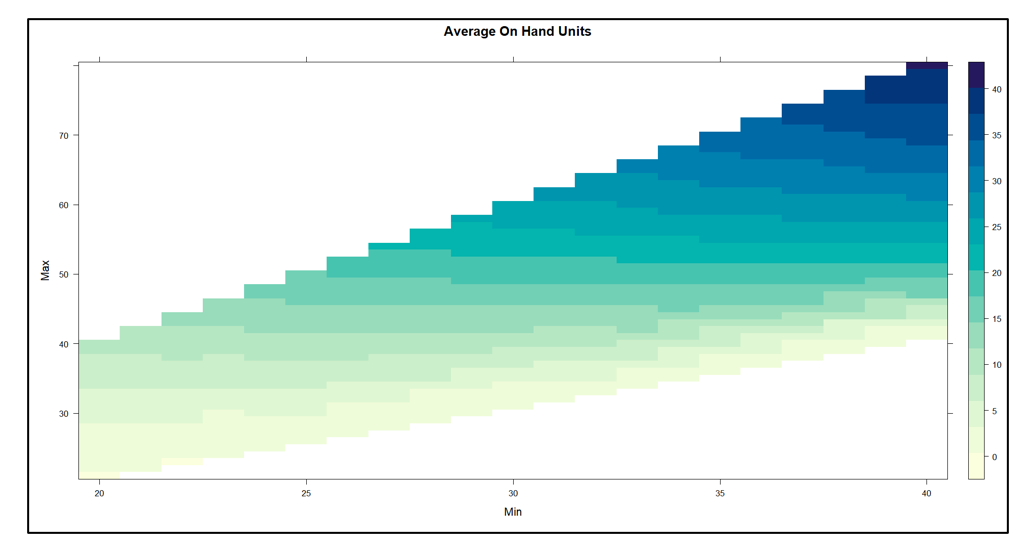
    Figure 1 plots on hand inventory as a function of the values of Min and Max. The experiment yielded on hand levels ranging from near 0 to about 40 units.  In general, keeping Min constant and increasing Max results in more units on hand. The relationship with Min is more complex: keeping Max constant,  increasing Min first adds to inventory but at some point reduces it.

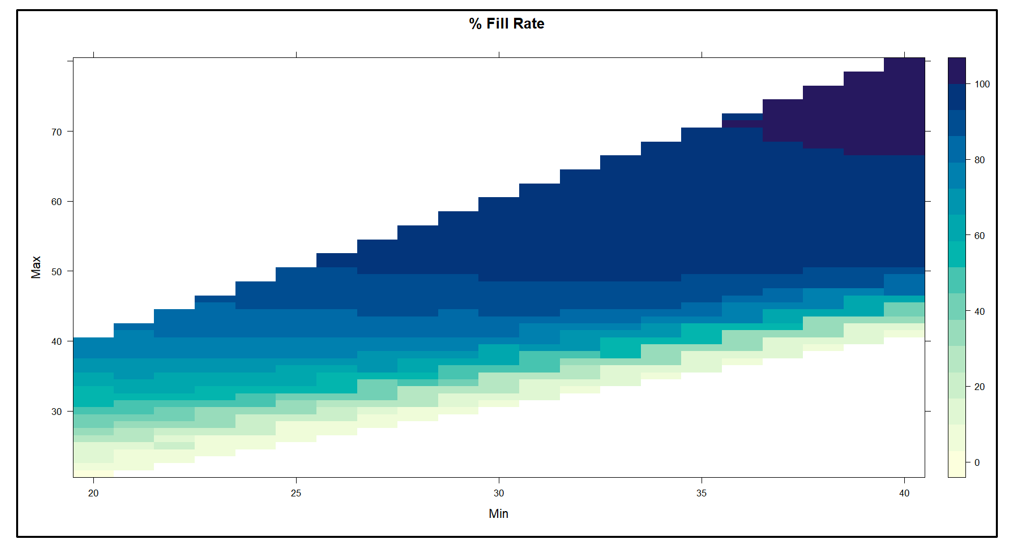
    Figure 2 plots fill rate as a function of the values of Min and Max.  The experiment yielded fill rate levels ranging from near 0% to 100%.  In general, the functional relationships between the fill rate and the values of Min and Max mirrored those in Figure1.

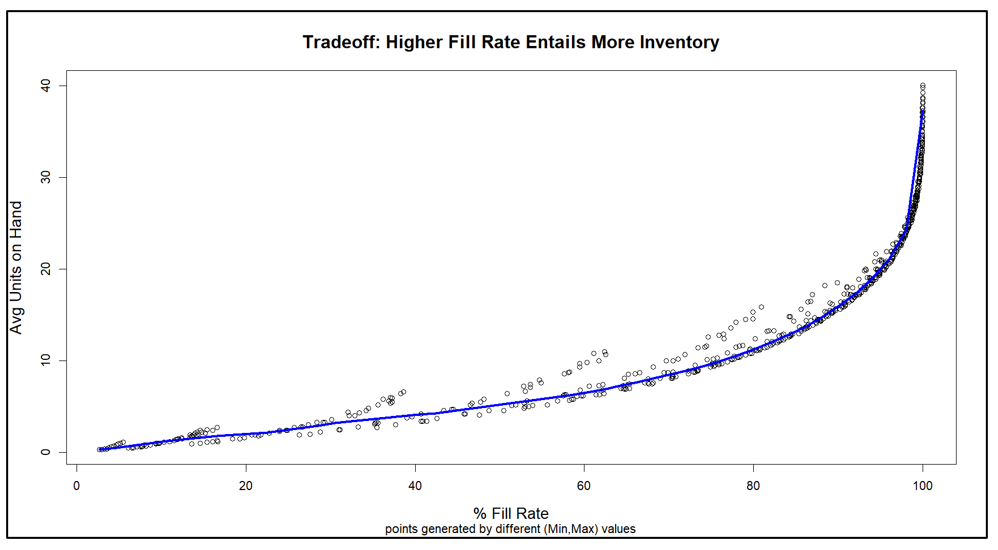
    Figure 3 makes the key point, showing how varying Min and Max produces a perverse pairing of the key performance indicators. Generally speaking, the values of Min and Max that maximize item availability (fill rate)  are the same values that maximize inventory cost (average units on hand). This general pattern is represented by the blue curve. The experiments also produced some offshoots from the blue curve that are associated with poor choices of Min and Max, in the sense that other choices dominate them by producing the same fill rate with lower inventory.


    Conclusions

    Figure 3 makes clear that your choice of how to manage an inventory item forces you to trade off inventory cost and item availability. You can avoid some inefficient combinations of Min and Max values, but you cannot escape the tradeoff.

    The good side of this reality is that you do not have to guess what will happen if you change your current values of Min and Max to something else. The software will tell you what that move will buy you and what it will cost you. You can take off your Guestimator hat and do your thing with confidence.

    Figure 1 On Hand Inventory as a function of Min and Max values

    Figure 1 On Hand Inventory as a function of Min and Max values


    Figure 2 Fill Rate as a function of Min and Max values

    Figure 2 Fill Rate as a function of Min and Max values


    Figure 3 Tradeoff curve between Fill Rate and On Hand Inventory

    Figure 3 Tradeoff curve between Fill Rate and On Hand Inventory


    Rethinking forecast accuracy: A shift from accuracy to error metrics

    Measuring the accuracy of forecasts is an undeniably important part of the demand planning process. This forecasting scorecard could be built based on one of two contrasting viewpoints for computing metrics. The error viewpoint asks, “how far was the forecast from the actual?” The accuracy viewpoint asks, “how close was the forecast to the actual?” Both are valid, but error metrics provide more information.

    Accuracy is represented as a percentage between zero and 100, while error percentages start at zero but have no upper limit. Reports of MAPE (mean absolute percent error) or other error metrics can be titled “forecast accuracy” reports, which blurs the distinction.  So, you may want to know how to convert from the error viewpoint to the accuracy viewpoint that your company espouses.  This blog describes how with some examples.

    Accuracy metrics are computed such that when the actual equals the forecast then the accuracy is 100% and when the forecast is either double or half of the actual, then accuracy is 0%. Reports that compare the forecast to the actual often include the following:

    • The Actual
    • The Forecast
    • Unit Error = Forecast – Actual
    • Absolute Error = Absolute Value of Unit Error
    • Absolute % Error = Abs Error / Actual, as a %
    • Accuracy % = 100% – Absolute % Error

    Look at a couple examples that illustrate the difference in the approaches. Say the Actual = 8 and the forecast is 10.

    Unit Error is 10 – 8 = 2

    Absolute % Error = 2 / 8, as a % = 0.25 * 100 = 25%

    Accuracy = 100% – 25% = 75%.

    Now let’s say the actual is 8 and the forecast is 24.

    Unit Error is 24– 8 = 16

    Absolute % Error = 16 / 8 as a % = 2 * 100 = 200%

    Accuracy = 100% – 200% = negative is set to 0%.

    In the first example, accuracy measurements provide the same information as error measurements since the forecast and actual are already relatively close. But when the error is more than double the actual, accuracy measurements bottom out at zero. It does correctly indicate the forecast was not at all accurate. But the second example is more accurate than a third, where the actual is 8 and the forecast is 200. That’s a distinction a 0 to 100% range of accuracy doesn’t register. In this final example:

    Unit Error is 200 – 8 = 192

    Absolute % Error = 192 / 8, as a % = 24 * 100 = 2,400%

    Accuracy = 100% – 2,400% = negative is set to 0%.

    Error metrics continue to provide information on how far the forecast is from the actual and arguably better represent forecast accuracy.

    We encourage adopting the error viewpoint. You simply hope for a small error percentage to indicate the forecast was not far from the actual, instead of hoping for a large accuracy percentage to indicate the forecast was close to the actual.  This shift in mindset offers the same insights while eliminating distortions.


    Using Key Performance Predictions to Plan Stocking Policies

    I can’t imagine being an inventory planner in spare parts, distribution, or manufacturing and having to create safety stock levels, reorder points, and order suggestions without using key performance predictions of service levels, fill rates, and inventory costs:

    Using Key Performance Predictions to Plan Stocking Policies Iventory

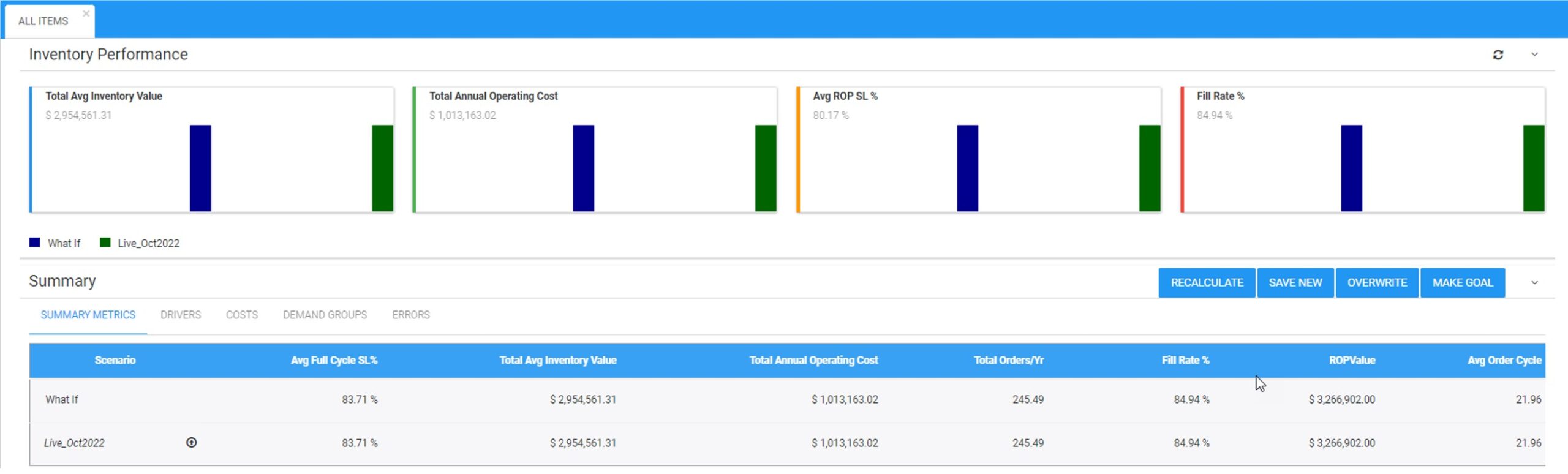
    Smart’s Inventory Optimization solution generates out-of-the-box key performance predictions that dynamically simulate how your current stocking policies will perform against possible future demands.  It reports on how often you’ll stock out, the size of the stockouts, the value of your inventory, holding costs, and more.  It lets you proactively identify problems before they occur so you can take corrective action in the short term. You can create what-if scenarios by setting targeted service levels and modifying lead times so you an see the predicted impact of these changes before committing to it.

    For example,

    • You can see if a proposed move from the current service level of 90% to a targeted service level of 97% is financially advantageous
    • You can automatically identify if a different service level target is even more profitable to your business that the proposed target.
    • You can see exactly how much you’ll need to increase your reorder points to accommodate a longer lead time.


    If you aren’t equipping planners with the right tools, they’ll be forced to set stocking policies, safety stock levels, and create demand forecasts in Excel or with outdated ERP functionality.   Not knowing how policies are predicted to perform will leave your company ill equipped to properly allocate inventory.  Contact us today to learn how we can help!


    Every Forecasting Model is Good for What it is Designed for

    ​When you should use traditional extrapolative forecasting techniques.

    With so much hype around new Machine Learning (ML) and probabilistic forecasting methods, the traditional “extrapolative” or “time series” statistical forecasting methods seem to be getting the cold shoulder.  However, it is worth remembering that these traditional techniques (such as single and double exponential smoothing, linear and simple moving averaging, and Winters models for seasonal items) often work quite well for higher volume data. Every method is good for what it was designed to do.  Just apply each appropriately, as in don’t bring a knife to a gunfight and don’t use a jackhammer when a simple hand hammer will do. 

    Extrapolative methods perform well when demand has high volume and is not too granular (i.e., demand is bucketed monthly or quarterly). They are also very fast and do not use as many computing resources as probabilistic and ML methods. This makes them very accessible.

    Are the traditional methods as accurate as newer forecasting methods?  Smart has found that extrapolative methods do very poorly when demand is intermittent. However, when demand is higher volume, they only do slightly worse than our new probabilistic methods when demand is bucketed monthly.  Given their accessibility, speed, and the fact you are going to apply forecast overrides based on business knowledge, the baseline accuracy difference here will not be material.

    The advantage of more advanced models like Smart’s GEN2 probabilistic methods is when you need to predict patterns using more granular buckets like daily (or even weekly) data.  This is because probabilistic models can simulate day of the week, week of the month, and month of the year patterns that are going to be lost with simpler techniques.  Have you ever tried to predict daily seasonality with a Winter’s model? Here is a hint: It’s not going to work and requires lots of engineering.

    Probabilistic methods also provide value beyond the baseline forecast because they generate scenarios to use in stress-testing inventory control models. This makes them more appropriate for assessing, say, how a change in reorder point will impact stockout probabilities, fill rates, and other KPIs. By simulating thousands of possible demands over many lead times (which are themselves presented in scenario form), you’ll have a much better idea of how your current and proposed stocking policies will perform. You can make better decisions on where to make targeted stock increases and decreases.

    So, don’t throw out the old for the new just yet. Just know when you need a hammer and when you need a jackhammer.