Thoughts on Spare Parts Planning for Public Transit

The Covid19 pandemic has placed unusual stress on public transit agencies. This stress forces agencies to look again at their spare parts planning processes, which is a key driver up ensuring uptime and balancing service parts inventory costs.

This blog focuses on bus systems and their practices for spare parts management and planning. However, there are lessons here for other types of public transit, including rail and light rail.

Back in 1995, the Transportation Research Board (TRB) of the National Research Council published a report that still has relevance. System-Specific Spare Bus Ratios: A Synthesis of Transit Practice stated

The purpose of this study was to document and examine the critical site-specific variables that affect the number of spare vehicles that bus systems need to maintain maximum service requirements. … Although transit managers generally acknowledged that right-sizing the fleet actually improves operations and lowers cost, many reported difficulties in achieving and consistently maintaining a 20 percent spare ratio as recommended by FTA… The respondents to the survey advocated that more emphasis be placed on developing improved and innovative bus maintenance techniques, which would assist them in minimizing downtime and improving vehicle availability, ultimately leading to reduced spare vehicles and labor and material costs.

Grossly simplified guidelines like “keep 20% spare buses” are easy to understand and measure but grossly mask more detailed tactics that can provide more tailored policies that better steward taxpayer dollars spent on spare parts while ensuring the highest levels of availability. If operational reliability can be improved for each bus, then fewer spares are needed.

One way to keep each bus up and running more often is to improve the management of inventories of spare parts – specifically by forecasting service parts usage and the required replenishment policies more accurately. Here is where modern supply chain management can make a significant contribution. The TRB noted this in their report:

Many agencies have been successful in limiting reliance on excess spare vehicles. Those transit officials agree that several factors and initiatives have led to their success and are critical to the success of any program [including] … Effective use of advanced technology to manage critical maintenance functions, including the orderly and timely replacement of parts… Failure to have available service parts and other components when they are needed will adversely affect any maintenance program.

As long as managers are cognizant of the issues and vigilant about what tools are available to them, the probability of buses [being] ‘out for no stock’ will greatly diminish.”

Effective spare parts inventory management requires a balance between “having enough” and “having too much.” What modern service parts planning software can do is make visible the tradeoff between these two goals so that transit managers can make fact-based decisions about spare parts inventories.

There are enough complications in finding the right balance to require moving beyond simple rules of thumb such as “keep ten days’ worth of demand on hand” or “reorder when you are down to five units in stock.” Factors that drive these decisions include both the average demand for a part, the volatility of that demand, the average replenishment lead time (which can be a problem when the part arrives by slow boat from Germany), the variability in lead time, and several cost factors: holding costs, ordering costs, and shortage costs (e.g., lost fares, loss of public goodwill).

Innovative supply chain analytics and spare parts planning software uses advanced probabilistic forecasting and stochastic optimization methods to manage these complexities and provide greater parts availability at lower cost. For instance, Minnesota’s Metro Transit documented a 4x increase in return on investment in the first six months of implementing a new system. To read more about how public transit agencies are exploiting innovative supply chain analytics, see:


Leave a Comment
Related Posts
TOP 3 COMMON INVENTORY POLICIES

TOP 3 COMMON INVENTORY POLICIES

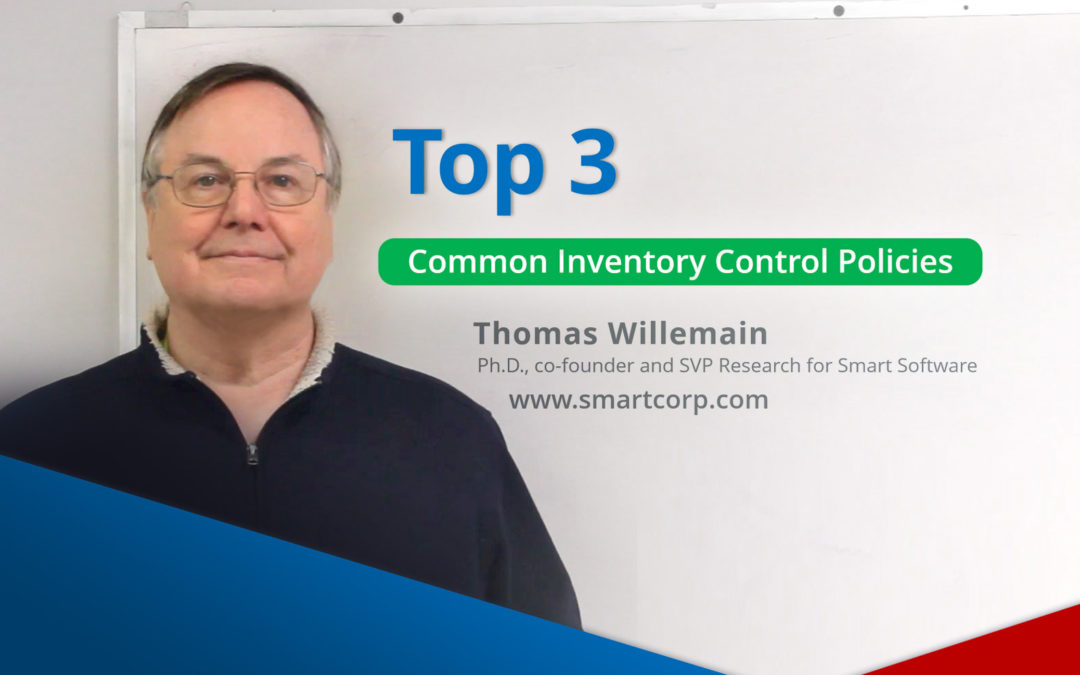
In this Video Dr. Thomas Willemain, co–Founder and SVP Research, defines and compares the three most used inventory control policies. These policies are divided into two groups, periodic review and continuous review. There is also a fourth policy called MRP logic or forecast based inventory planning which is the subject of a separate video blog that you can see here. These videos explain each policy, how they are used in practice and the pros and cons of each approach.

Backing into Safety Stock is the Safe Play

Backing into Safety Stock is the Safe Play

Safety stock is a critical component in any system of inventory management. Indeed, some inventory software treats safety stock as the key decision variable in the quest to balance inventory cost against item availability. Unfortunately, that approach is not the best way to strike the balance.

Managing the Inventory of Promoted Items

Managing the Inventory of Promoted Items

In a previous post, I discussed one of the thornier problems demand planners sometimes face: working with product demand data characterized by what statisticians call skewness—a situation that can necessitate costly inventory investments. This sort of problematic data is found in several different scenarios. In at least one, the combination of intermittent demand and very effective sales promotions, the problem lends itself to an effective solution.

Smart Software VP of Research to Present at Business Analytics Conference, INFORMS 2022

Dr. Tom Willemain to lead INFORMS sessionDominating The Inventory Battlefield: Fighting Randomness With Randomness.”

Belmont, Mass., March 2022 – Smart Software, Inc., provider of industry-leading demand forecasting, planning, and inventory optimization solutions, today announced that Tom Willemain, Vice President for Research, will present at the INFORMS Business Analytics Conference, April 3-5, 2022, in Houston, TX.

Dr. Willemain will present a session on how next-generation analytics arms supply chain leaders in manufacturing, distribution, and MRO with tools to fight against randomness in demand and supply. During his session he will detail the following technologies:

(1) Regime change filtering to maintain data relevance against sudden shifts in the operating environment.

(2) Bootstrapping methods to generate large numbers of realistic demand and lead time scenarios to fuel models.

(3) Discrete event simulations to process the input scenarios and expose the links between management actions and key performance indicators.

(4) Stochastic optimization based on simulation experiments to tune each item for best results.

Without the analytics, inventory owners have two choices: sticking with rigid operating policies usually based on outdated and invalid rules of thumb or resorting to subjective, gut-feel guesswork that may not help and does not scale.

As the leading Business Analytics Conference, INFORMS provides the opportunity to interact with the world’s top forecasting researchers and practitioners. The attendance is large enough so that the best in the field are attracted, yet small enough that you can meet and discuss one-on-one. In addition, the conference features content from leading analytics professionals who share and showcase top analytics applications that save lives, save money, and solve problems.


About Dr. Thomas Willemain

Dr. Thomas Reed Willemain served as an Expert Statistical Consultant to the National Security Agency (NSA) at Ft. Meade, MD, and as a member of the Adjunct Research Staff at an affiliated think-tank, the Institute for Defense Analyses Center for Computing Sciences (IDA/CCS). He is Professor Emeritus of Industrial and Systems Engineering at Rensselaer Polytechnic Institute, having previously held faculty positions at Harvard’s Kennedy School of Government and Massachusetts Institute of Technology. He is also co-founder and Senior Vice President/Research at Smart Software, Inc. He is a member of the Association of Former Intelligence Officers, the Military Operations Research Society, the American Statistical Association, and several other professional organizations. Willemain received the BSE degree (summa cum laude, Phi Beta Kappa) from Princeton University and the MS and Ph.D. degrees from Massachusetts Institute of Technology. His other books include: Statistical Methods for Planners, Emergency Medical Systems Analysis (with R. C. Larson), and 80 articles in peer-reviewed journals on statistics, operations research, health care, and other topics. For more information, email: TomW@SmartCorp.com or visit www.TomWillemain.com.


About Smart Software, Inc.

Founded in 1981, Smart Software, Inc. is a leader in providing businesses with enterprise-wide demand forecasting, planning, and inventory optimization solutions.  Smart Software’s demand forecasting and inventory optimization solutions have helped thousands of users worldwide, including customers at mid-market enterprises and Fortune 500 companies, such as Disney, Arizona Public Service, and Ameren.  Smart Inventory Planning & Optimization gives demand planners the tools to handle sales seasonality, promotions, new and aging products, multi-dimensional hierarchies, and intermittently demanded service parts and capital goods items.  It also provides inventory managers with accurate estimates of the optimal inventory and safety stock required to meet future orders and achieve desired service levels.  Smart Software is headquartered in Belmont, Massachusetts, and can be found on the World Wide Web at www.smartcorp.com.


SmartForecasts and Smart IP&O have registered trademarks of Smart Software, Inc.  All other trademarks are their respective owners’ property.

For more information, please contact Smart Software, Inc., Four Hill Road, Belmont, MA 02478.
Phone: 1-800-SMART-99 (800-762-7899); FAX: 1-617-489-2748; E-mail: info@smartcorp.com


Smart Software to Present at Epicor Insights 2022

Smart Software President and CEO to present Epicor Insights 2022 Sessions on Creating Competitive Advantage with Smart Inventory Planning and Optimization


Belmont, MA, May, 2022 – Smart Software, Inc., provider of industry-leading demand forecasting, planning, and inventory optimization solutions, today announced that it will present at Epicor Insights 2022.

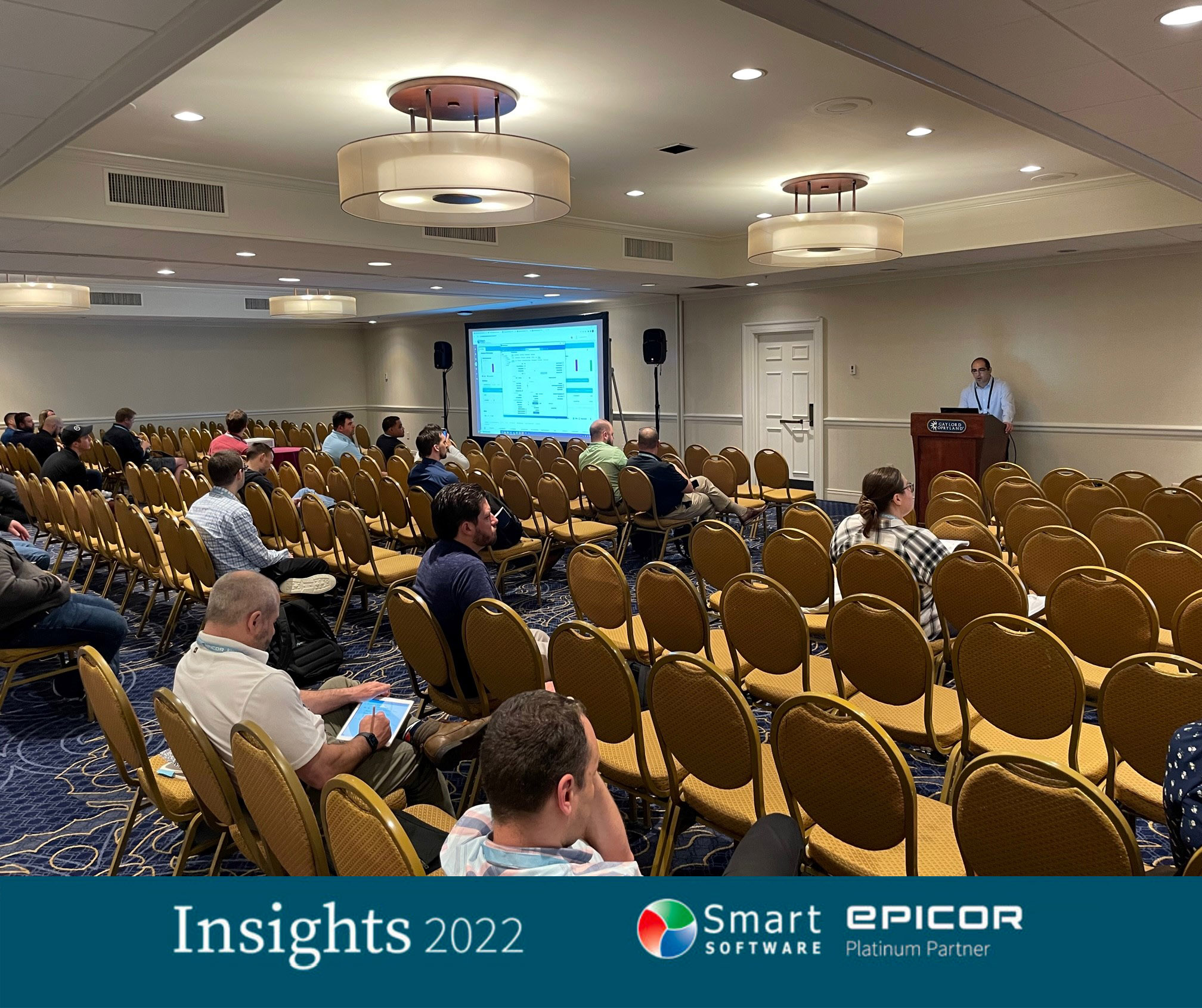
Greg Hartunian, CEO of Smart Software, will present two sessions and will explain Epicor Smart Inventory Planning and Optimization at this year’s Epicor Insights event in Nashville, TN. Greg will show how to empower planning teams to reduce inventory, improve service levels, and increase operational efficiency.

  • The Prophet 21 presentation is scheduled for Wed May 25th, 11:30 am -12:15 pm  (CST) 

Prophet 21 Smart Software to present at Epicor Insights 2022

Smart Software Kinetic 21 Session Greg CEO

  • The Kinetic presentation is scheduled for Wed May 25th, 2:30 pm – 3:20 pm (CST) 

Kinetic Smart Software to present at Epicor Insights 2022


If you plan to attend this year, please join us at either session below and learn more about Smart Inventory Planning and Optimization as we highlight valuable features in our solutions. Epicor Insights 2022 will bring together more than 2,000 users of Epicor’s industry-specific ERP solutions for the manufacturing, distribution, and service industries.  To learn more, visit INSIGHTS 2022.

Insights Team at work

Smart Software is an Epicor Platinum Partner and leading provider of demand planning, forecasting, inventory optimization, and analytics solutions. Our web platform, Smart IP&O, leverages probabilistic forecast modeling, machine learning, and collaborative demand planning to optimize inventory levels and increase forecast accuracy. You’ll use Smart IP&O to create accurate forecasts and optimal stocking policies that drive automated ordering in Epicor. The platform includes bi-directional integrations to both Epicor ERP and Prophet 21.


About Smart Software, Inc.
Founded in 1981, Smart Software, Inc. is a leader in providing businesses with enterprise-wide demand forecasting, planning and inventory optimization solutions.  Smart Software’s demand forecasting and inventory optimization solutions have helped thousands of users worldwide, including customers at mid-market enterprises and Fortune 500 companies, such as Disney, Arizona Public Service, and Ameren.  Smart Inventory Planning & Optimization gives demand planners the tools to handle sales seasonality, promotions, new and aging products, multi-dimensional hierarchies, and intermittently demanded service parts and capital goods items.  It also provides inventory managers with accurate estimates of the optimal inventory and safety stock required to meet future orders and achieve desired service levels.  Smart Software is headquartered in Belmont, Massachusetts and can be found on the World Wide Web at www.smartcorp.com.


For more information, please contact Smart Software, Inc., Four Hill Road, Belmont, MA 02478.
Phone: 1-800-SMART-99 (800-762-7899); FAX: 1-617-489-2748; E-mail: info@smartcorp.com


Drive Operational Efficiency and Boost Operational Excellence

Smart Software is pleased to introduce our new series of educational webinars, offered exclusively for Epicor Users. Greg Hartunian, CEO at Smart Software, will lead 45-minute webinar focusing on specific approaches to demand forecasting and inventory planning that will enable you to increase profitability, improve service levels, and reduce inventory holding costs. The presentation will outline the challenges associated with traditional inventory planning and demand forecasting processes and how new probabilistic forecasting and optimization methods will make a big difference to your bottom line. Finally, the presentation will conclude by showing how to increase profitability with software-enhanced inventory planning processes in a Live Demo.

WEBINAR REGISTRATION FORM


Please register to attend the webinar. If you are interested but not cannot attend, please register anyway – we will record our session and will send you a link to the replay.

We hope you will be able to join us!


SmartForecasts and Smart IP&O are registered trademarks of Smart Software, Inc.  All other trademarks are the property of their respective owners.


For more information, please contact Smart Software,Inc., Four Hill Road, Belmont, MA 02478.
Phone: 1-800-SMART-99 (800-762-7899); E-mail: info@smartcorp.com


Stay the course


I’ve stood in front of thousands of students. They’ve been more or less young, more or less technical, more or less experienced – and more or less interested.  I’ve done this as a university faculty member since 1972, first at Massachusetts Institute of Technology, then at Harvard University, finally in the School of Engineering at Rensselaer Polytechnic Institute. Between Harvard and RPI I dropped out of academia temporarily to co-found Smart Software with Charlie Smart and Nelson Hartunian. So since then, I’ve also been busy training business users to exploit the power of advanced analytics for forecasting and inventory optimization.

As I write this, I’ve just returned to my office at RPI after introducing first-year Industrial Engineering students to the basic concepts of inventory management. If they stick with the program, they will go on to take required courses in supply chain, system simulation, statistical analysis, and optimization. I told them stories about how useful they will be to their companies should they decide to make a career in the world of supply chain. If I’d had more time, I would have mentioned how capable they will be when they graduate relative to many of their corporate peers. These freshmen and ready and willing to stay the course, soaking up all the techniques and theories we can throw at them, and honing their practical skills in summer jobs or coop assignments.

What I didn’t tell them is that many of them will have to work to keep their intensity when they are on the job. It’s a sad truth that, for whatever reason, many inventory practitioners settle into a kind of stasis that impedes their companies’ ability to exploit the latest technologies, such as cloud-based advanced demand forecasting and inventory optimization. Gather enough of such people in one place and agility and improved efficiency go out the window.

I think one of the factors that dulls people is that the process of implementation frequently feels painfully incremental and prolonged. It often begins with a sobering inventory of relevant data, its correctness, and its currency. Then it moves to an often-awkward discovery that there really is no systematic process in place and the subsequent need to design a good one going forward. Next is the need to learn to use a new software suite. That step involves learning new vocabulary, some level of probabilistic thought, an ability to interpret new graphs and tables, not to mention a new software interface.  All this takes time and effort.


Forecast accuracy provides a statistically sound


We’ve found that a few things help new customers stay the course. One is having a champion among management, an executive sponsor, who can vouch for the commercial importance of a successful implementation while ensuring the users are supported with continuing education.  A second is identifying and training a super-user or two having unusual combinations of technical and communication skills.  A third is breaking the training into bite-sized chunks and testing for comprehension after each chunk and repeating this process until it is clear that the new concepts, vocabulary, and process are fully absorbed. But all those maneuvers will come to naught without management being all-in and ready to stay the course.  Inventory planning practices in place for many years are not going to be replaced entirely over a three-month implementation process.  You’ve got to want it to get it.


Leave a Comment
Related Posts
TOP 3 COMMON INVENTORY POLICIES

TOP 3 COMMON INVENTORY POLICIES

In this Video Dr. Thomas Willemain, co–Founder and SVP Research, defines and compares the three most used inventory control policies. These policies are divided into two groups, periodic review and continuous review. There is also a fourth policy called MRP logic or forecast based inventory planning which is the subject of a separate video blog that you can see here. These videos explain each policy, how they are used in practice and the pros and cons of each approach.

Backing into Safety Stock is the Safe Play

Backing into Safety Stock is the Safe Play

Safety stock is a critical component in any system of inventory management. Indeed, some inventory software treats safety stock as the key decision variable in the quest to balance inventory cost against item availability. Unfortunately, that approach is not the best way to strike the balance.

Managing the Inventory of Promoted Items

Managing the Inventory of Promoted Items

In a previous post, I discussed one of the thornier problems demand planners sometimes face: working with product demand data characterized by what statisticians call skewness—a situation that can necessitate costly inventory investments. This sort of problematic data is found in several different scenarios. In at least one, the combination of intermittent demand and very effective sales promotions, the problem lends itself to an effective solution.