Why Spare Parts Tradeoff Curves are Mission-Critical for Parts Planning

I’ll bet your maintenance and repair teams would be ok with incurring higher stock out risks one some spare parts if they knew that the inventory reduction savings would be used to spread out the inventory investment more effectively to other parts and boost overall service levels.

I’ll double down that your Finance team, despite always being challenged with lowering costs, would support a healthy inventory increase if they could clearly see that the revenue benefits from increased uptime, fewer expedites, and service level improvements clearly outweighed the additional inventory costs and risk.

A spare parts tradeoff curve will enable service parts planning teams to properly communicate the risks and costs of each inventory decision.  It is mission critical for parts planning and the only way to adjust stocking parameters proactively and accurately for each part.  Without it, planners, for all intents and purposes, are “planning” with blinders on because they won’t be able to communicate the true tradeoffs associated with stocking decisions.

For example, if a proposed increase to the min/max levels of an important commodity group of service parts is recommended, how do you know whether the increase is too high or too low or just right?  How can you fine-tune the change for thousands of spares?  You won’t and you can’t.  Your inventory decision making will rely on reactive, gut feel, and broad-brush decisions causing service levels to suffer and inventory costs to balloon.

So, what exactly is a spare parts tradeoff curve anyway?

It’s a fact-based, numerically driven prediction that details how changes in stocking levels will influence inventory value, holding costs, and service levels.  For each unit change in inventory level there is a cost and a benefit.  The spare parts tradeoff curve identifies these costs and benefits across different stocking levels. It lets planners discover the stock level that best balances the costs and benefits for each individual item.

Here are two simplified examples. In Figure 1, the spare parts tradeoff curve shows how the service level (probability of not stocking out) changes depending on the reorder level.  The higher the reorder level, the lower the stockout risk.  It is critical to know how much service you are gaining given the inventory investment.  Here you may be able to justify that an inventory increase from a reorder point of 35 to 45 is well worth the investment of 10 additional units of stock because service levels jumps from just under 70% to 90%, cutting your stockout risk for the spare part from 30% to 10%!


Cost vs Service Levels for inventory planning

Figure 1: Cost versus Service Level


Size of Inventory vs Service Levels for MRO

Figure 2: Service Level versus Size of Inventory

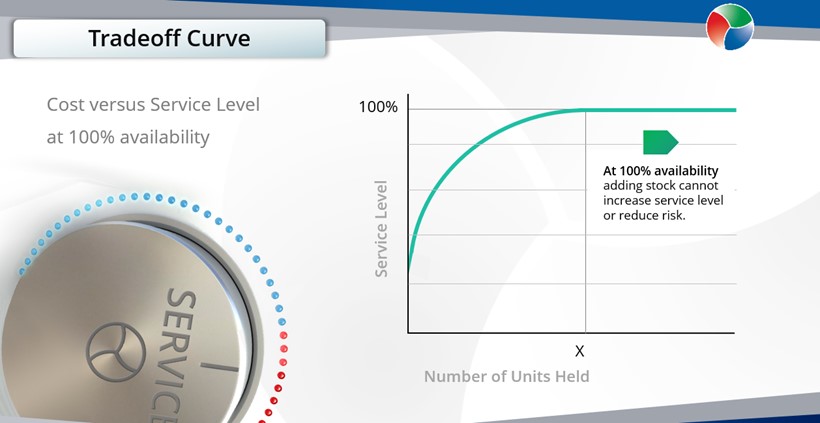
In this example (Figure 2), the tradeoff curve exposes a common problem with spare parts inventory.  Often stock levels are so high that they generate negative returns.  After a certain stocking quantity, each additional unit of stock does not buy more benefit in the form of a higher service level.  Inventory decreases can be justified when it is clear the stock level is well past the point of diminishing returns. An accurate tradeoff curve will expose the point where it is no longer advantageous to add stock.

By leveraging #probabilisticforecasting to drive parts planning, you can communicate these tradeoffs accurately, do so at scale across hundreds of thousands of parts, avoid bad inventory decisions, and balance service levels and costs.  At Smart Software, we specialize in helping spare parts planners, Directors of Materials Management, and financial executives managing MRO, spare parts, and aftermarket parts to understand and exploit these relationships.


Spare Parts Planning Software solutions

Smart IP&O’s service parts forecasting software uses a unique empirical probabilistic forecasting approach that is engineered for intermittent demand. For consumable spare parts, our patented and APICS award winning method rapidly generates tens of thousands of demand scenarios without relying on the assumptions about the nature of demand distributions implicit in traditional forecasting methods. The result is highly accurate estimates of safety stock, reorder points, and service levels, which leads to higher service levels and lower inventory costs. For repairable spare parts, Smart’s Repair and Return Module accurately simulates the processes of part breakdown and repair. It predicts downtime, service levels, and inventory costs associated with the current rotating spare parts pool. Planners will know how many spares to stock to achieve short- and long-term service level requirements and, in operational settings, whether to wait for repairs to be completed and returned to service or to purchase additional service spares from suppliers, avoiding unnecessary buying and equipment downtime.

Contact us to learn more how this functionality has helped our customers in the MRO, Field Service, Utility, Mining, and Public Transportation sectors to optimize their inventory. You can also download the Whitepaper here.


White Paper: What you Need to know about Forecasting and Planning Service Parts


This paper describes Smart Software’s patented methodology for forecasting demand, safety stocks, and reorder points on items such as service parts and components with intermittent demand, and provides several examples of customer success.

 

    Electric Utilities’ Problems with Spare Parts

    Every organization that runs equipment needs spare parts. All of them must cope with issues that are generic no matter what their business. Some of the problems, however, are industry specific. This post discusses one universal problem that manifested in a nuclear plant and one that is especially acute for any electric utility.

    The Universal Problem of Data Quality

    We often post about the benefits of converting parts usage data into smart inventory management decisions. Advanced probability modeling supports generation of realistic demand scenarios that feed into detailed Monte Carlo simulations that expose the consequences of decisions such as choices of Min and Max governing the replenishment of spares.

    However, all that new and shiny analytical tech requires quality data as fuel for the analysis. For some public utilities of all kinds, record keeping is not a strong suit, so the raw material going into analysis can be corrupted and misleading. We recently chanced upon documentation of a stark example of this problem at a nuclear power plant (see Scala, ­­­­­­­Needy and Rajgopal: Decision making and tradeoffs in the management of spare parts inventory at utilities. American Association of Engineering Management, 30th ASEM National Conference, Springfield, MO. October 2009). Scala et al. documented the usage history of a critical part whose absence would result in either a facility de-rate or a shutdown. The plant’s usage record for that part spanned more than eight years of data. During that time, the official usage history reported nine events in which positive demand occurred with sizes ranging from one to six units each. There were also five events marked by negative demands (i.e., returns to warehouse) ranging from one to three units each. Careful sleuthing discovered that the true usage occurred in just two events, both with demand of two units. Obviously, calculating the best Min/Max values for this item requires accurate demand data.

    The Special Problem of Health and Safety

    In the context of “regular” businesses, shortages of spare parts can damage both current revenue and future revenue (related to reputation as a reliable supplier). For an electric utility, however, Scala et al. noted a much greater level of consequence attached to stockouts of spare parts. These include not only a heightened financial and reputational risk but also risks to health and safety: Ramifications of not having a part in stock include the possibility of having to reduce output or quite possibly, even a plant shut down. From a more long-term perspective, doing so might interrupt the critical service of power to residential, commercial, and/or industrial customers, while damaging the company’s reputation, reliability, and profitability. An electric utility makes and sells only one product: electricity. Losing the ability to sell electricity can be seriously damaging to the company’s bottom line as well its long-term viability.”

    All the more reason for electric utilities to be leaders rather than laggards in the deployment of the most advanced probability models for demand forecasting and inventory optimization.


    Spare Parts Planning Software solutions

    Smart IP&O’s service parts forecasting software uses a unique empirical probabilistic forecasting approach that is engineered for intermittent demand. For consumable spare parts, our patented and APICS award winning method rapidly generates tens of thousands of demand scenarios without relying on the assumptions about the nature of demand distributions implicit in traditional forecasting methods. The result is highly accurate estimates of safety stock, reorder points, and service levels, which leads to higher service levels and lower inventory costs. For repairable spare parts, Smart’s Repair and Return Module accurately simulates the processes of part breakdown and repair. It predicts downtime, service levels, and inventory costs associated with the current rotating spare parts pool. Planners will know how many spares to stock to achieve short- and long-term service level requirements and, in operational settings, whether to wait for repairs to be completed and returned to service or to purchase additional service spares from suppliers, avoiding unnecessary buying and equipment downtime.

    Contact us to learn more how this functionality has helped our customers in the MRO, Field Service, Utility, Mining, and Public Transportation sectors to optimize their inventory. You can also download the Whitepaper here.


    White Paper: What you Need to know about Forecasting and Planning Service Parts


    This paper describes Smart Software’s patented methodology for forecasting demand, safety stocks, and reorder points on items such as service parts and components with intermittent demand, and provides several examples of customer success.

     

      How to Forecast Spare Parts with Low Usage

      What do you do when you are forecasting an intermittently demanded item, such as a spare part, with average demand of less than one unit per month?  Most of the time the demand is zero, but the part is significant in a business sense; it can’t be ignored and must be forecasted to be sure you have adequate stock.

      Your choices tend to center around a few options:

      Option 1:  Round up to 1 each month, so your annual forecast is 12.

      Option 2:  Round down to 0 each month, so your annual forecast is 0.

      Option 3:  Forecast “same as same month last year” method so the forecast matches last year’s actual.

      There are obvious disadvantages to each option and not much advantage to any of them.  Option 1 often results in a significant over forecast.  Option 2 often results in a significant under-forecast.  Option 3 results in a forecast that is almost guaranteed to miss the actual significantly since the demand isn’t likely to spike in the exact same period. If you MUST forecast the item, then we would normally recommend option 3 since it is the most likely answer that the rest of the business would understand. 

      But a better way is to not forecast it at all in the usual sense and instead use a “predictive reorder point“ keyed to your desired service level. To calculate a predictive reorder point, you can use Smart Software’s patented Markov bootstrap algorithm to simulate all possible demands that could occur over the lead time, then identify the reorder point that will yield your target service level.

      You can then configure your ERP system to order more when on-hand inventory breaches the reorder point rather than when you are forecasted to hit zero (or whatever safety stock buffer is entered). 

      This makes for more common-sense ordering without the unneeded assumptions that are required to forecast an intermittently demanded, low-volume part.


      Spare Parts Planning Software solutions

      Smart IP&O’s service parts forecasting software uses a unique empirical probabilistic forecasting approach that is engineered for intermittent demand. For consumable spare parts, our patented and APICS award winning method rapidly generates tens of thousands of demand scenarios without relying on the assumptions about the nature of demand distributions implicit in traditional forecasting methods. The result is highly accurate estimates of safety stock, reorder points, and service levels, which leads to higher service levels and lower inventory costs. For repairable spare parts, Smart’s Repair and Return Module accurately simulates the processes of part breakdown and repair. It predicts downtime, service levels, and inventory costs associated with the current rotating spare parts pool. Planners will know how many spares to stock to achieve short- and long-term service level requirements and, in operational settings, whether to wait for repairs to be completed and returned to service or to purchase additional service spares from suppliers, avoiding unnecessary buying and equipment downtime.

      Contact us to learn more how this functionality has helped our customers in the MRO, Field Service, Utility, Mining, and Public Transportation sectors to optimize their inventory. You can also download the Whitepaper here.


      White Paper: What you Need to know about Forecasting and Planning Service Parts


      This paper describes Smart Software’s patented methodology for forecasting demand, safety stocks, and reorder points on items such as service parts and components with intermittent demand, and provides several examples of customer success.
       

        What Silicon Valley Bank Can Learn from Supply Chain Planning

        ​If you had your head up lately, you may have noticed some additional madness off the basketball court: The failure of Silicon Valley Bank. Those of us in the supply chain world may have dismissed the bank failure as somebody else’s problem, but that sorry episode holds a big lesson for us, too: The importance of stress testing done right.

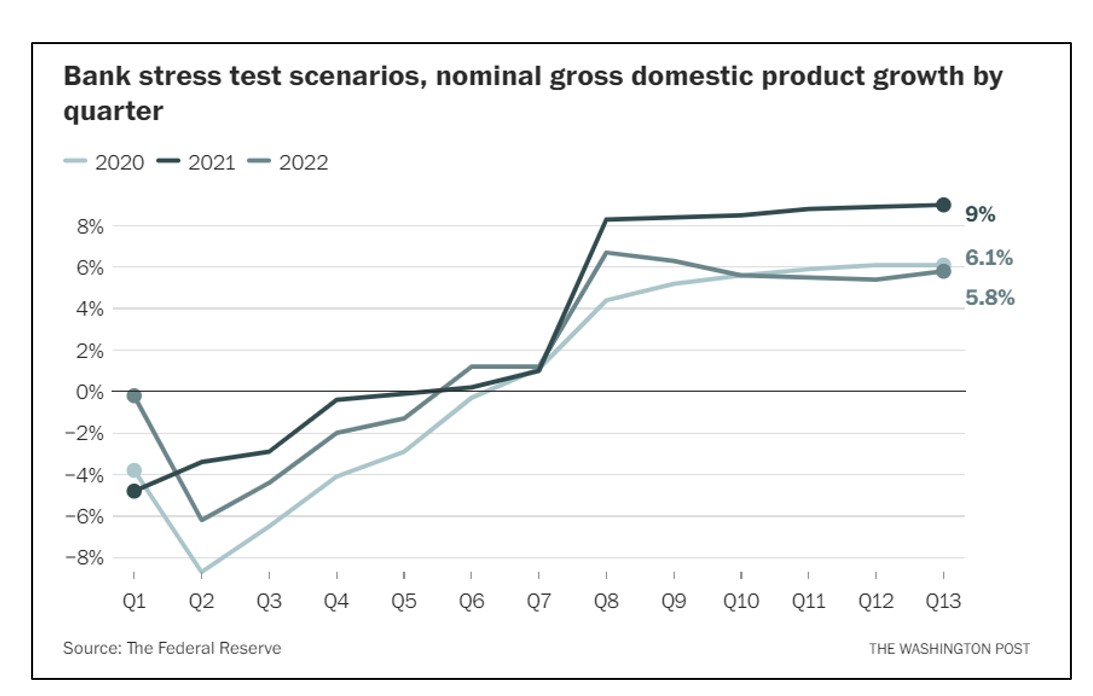
        The Washington Post recently carried an opinion piece by Natasha Sarin called “Regulators missed Silicon Valley Bank’s problems for months. Here’s why.” Sarin outlined the flaws in the stress testing regime imposed on the bank by the Federal Reserve. One problem is that the stress tests are too static. The Fed’s stress factor for nominal GDP growth was a single scenario listing presumed values over the next 13 quarters (see Figure 1). Those 13 quarterly projections might be somebody’s consensus view of what a bad hair day would look like, but that’s not the only way things could play out.  As a society, we are being taught to appreciate a better way to display contingencies every time the National Weather Service shows us projected hurricane tracks (see Figure 2). Each scenario represented by a different colored line shows a possible storm path, with the concentrated lines representing the most likely.  By exposing the lower probability paths, risk planning is improved.

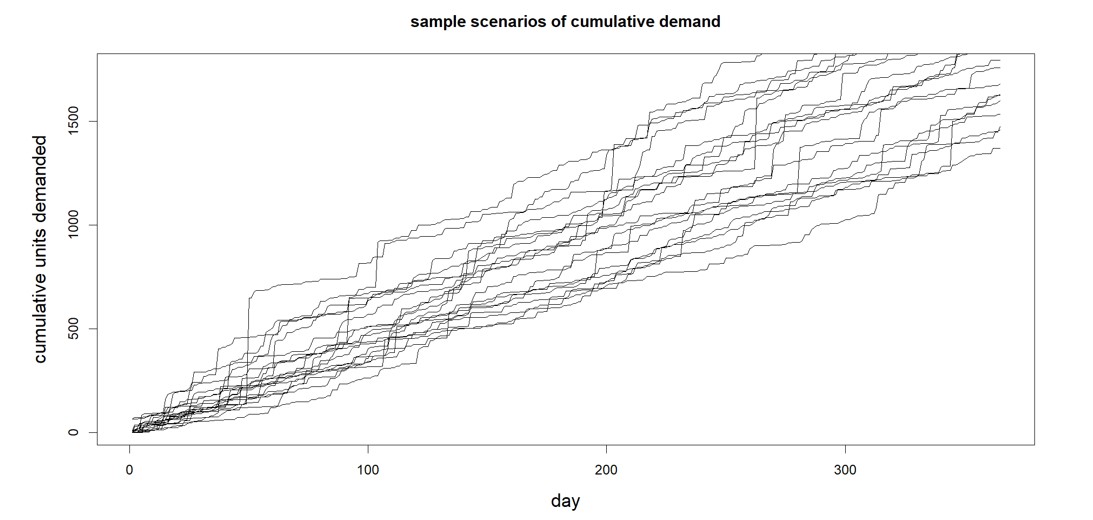
        When stress testing the supply chain, we need realistic scenarios of possible future demands that might occur, even extreme demands.   Smart provides this in our software (with considerable improvements in our Gen2 methods).  The software generates a huge number of credible demand scenarios, enough to expose the full scope of risks (see Figure 3). Stress testing is all about generating massive numbers of planning scenarios, and Smart’s probabilistic methods are a radical departure from previous deterministic S&OP applications, being entirely scenario based.

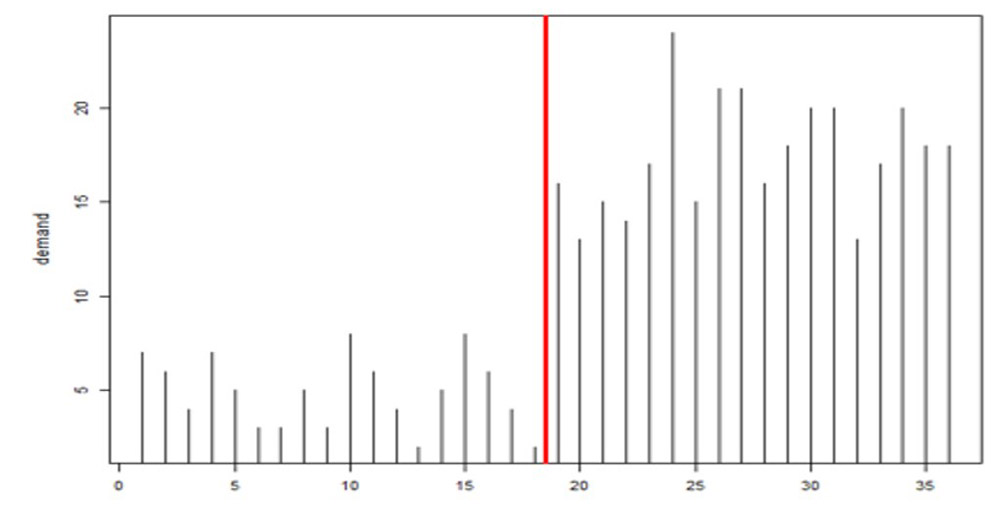
        The other flaw in the Fed’s stress tests was that they were designed months in advance but never updated for changing conditions.  Demand planners and inventory managers intuitively appreciate that key variables like item demand and supplier lead time are not only highly random even when things are stable but also subject to abrupt shifts that should require rapid rewriting of planning scenarios (see Figure 4, where the average demand jumps up dramatically between observations 19 and 20). Smart’s Gen2 products include new tech for detecting such “regime changes”  and automatically changing scenarios accordingly.

        Banks are forced to undergo stress tests, however flawed they may be, to protect their depositors. Supply chain professionals now have a way to protect their supply chains by using modern software to stress test their demand plans and inventory management decisions.

        1 Scenarios used the Fed to stress test banks Software

        Figure 1: Scenarios used the Fed to stress test banks.


        2 Scenarios used by the National Weather Service to predict hurricane tracks

        Figure 2: Scenarios used by the National Weather Service to predict hurricane tracks


        3 Demand scenarios of the type generated by Smart Demand Planner

        Figure 3: Demand scenarios of the type generated by Smart Demand Planner


        4 Example of regime change in product demand after observation #19

        Figure 4: Example of regime change in product demand after observation #19


        Spare Parts, Replacement Parts, Rotables, and Aftermarket Parts

        What’s the difference, and why it matters for inventory planning.

        Those new to the parts planning game are often confused by the many variations in the names of parts. This blog points out distinctions that do or do not have operational significance for someone managing a fleet of spare parts and how those differences impact inventory planning.

        For instance, what is the difference between “spare” parts and “replacement” parts? In this case, the difference is their source. A spare part would be purchased from the equipment’s manufacturer, whereas a replacement part would be purchased from a different company. For someone managing a fleet of spares, the difference would be two different entries in their parts database: the source would be different, and the unit price would probably be different. It is possible that there would also be a difference in the useful life of the parts from the two sources. The “OEM” parts might be more durable than the cheaper “aftermarket” parts. (Now we have four different terms describing these parts.) These distinctions would be salient for optimizing an inventory of spares. Software that computes optimal reorder points and order quantities would arrive at different answers for parts with different unit costs and different rates of replacement.

        Perhaps the largest distinction is between “consumable” and “repairable” or “rotable” parts. The key distinction between them is their cost. It is foolish to try to repair a stripped screw; just throw it out and use another one. But it is also foolish to throw out a $50,000 component if it can be repaired for $5,000. Optimizing the management of inventory for fleets of each type of part requires very different math. With consumables, the parts can be regarded as anonymous and interchangeable. With “rotatables”, each part must essentially be modeled individually. We treat each as cycling through states of “operational,” “under repair,” and “standby/spare.” Decisions about repairable parts are often handled by a capital budgeting process, and the salient analytical question is, “what should be the size of our spares pool?”

        There are other distinctions that can be drawn among parts. Criticality is an important attribute. The consequences of part failure can range from “we can take our time to get a replacement” to “this is an emergency; get those machines back in action pronto”. When working out how to manage parts, we must always strike a balance between the benefits of having a larger stock of parts and the dollar costs. Criticality shifts the balance toward playing it safe with larger inventories. In turn, this dictates higher planning targets for part availability metrics such as service levels and fill rates, which will lead to larger reorder points and/or order quantities.

        If you Google “types of spare parts”, you will discover other classifications and distinctions. From our perspective at Smart Software, the words matter less than the numbers associated with parts: unit costs, mean time before failure, mean time to repair and other technical inputs to our products that work out how to manage the parts for maximum benefit.


        Spare Parts Planning Software solutions

        Smart IP&O’s service parts forecasting software uses a unique empirical probabilistic forecasting approach that is engineered for intermittent demand. For consumable spare parts, our patented and APICS award winning method rapidly generates tens of thousands of demand scenarios without relying on the assumptions about the nature of demand distributions implicit in traditional forecasting methods. The result is highly accurate estimates of safety stock, reorder points, and service levels, which leads to higher service levels and lower inventory costs. For repairable spare parts, Smart’s Repair and Return Module accurately simulates the processes of part breakdown and repair. It predicts downtime, service levels, and inventory costs associated with the current rotating spare parts pool. Planners will know how many spares to stock to achieve short- and long-term service level requirements and, in operational settings, whether to wait for repairs to be completed and returned to service or to purchase additional service spares from suppliers, avoiding unnecessary buying and equipment downtime.

        Contact us to learn more how this functionality has helped our customers in the MRO, Field Service, Utility, Mining, and Public Transportation sectors to optimize their inventory. You can also download the Whitepaper here.


        White Paper: What you Need to know about Forecasting and Planning Service Parts


        This paper describes Smart Software’s patented methodology for forecasting demand, safety stocks, and reorder points on items such as service parts and components with intermittent demand, and provides several examples of customer success.