
5 Steps to Improve the Financial Impact of Spare Parts Planning

In today’s competitive business landscape, companies are constantly seeking ways to improve their operational efficiency and drive increased revenue. Optimizing service parts management is an often-overlooked aspect that can have a significant financial impact. Companies can improve overall efficiency and generate significant financial returns by effectively managing spare parts inventory. This article will explore the economic implications of optimized service parts management and how investing in Inventory Optimization and Demand Planning Software can provide a competitive advantage.

The Importance of Optimized Service Parts Planning:

Optimized service parts management plays a vital role in mitigating inventory risks and ensuring critical spare parts availability. While subjective planning may work on a small scale, it becomes insufficient when managing large inventories of intermittently demanded spare parts. Traditional forecasting approaches simply fail to accurately account for the extreme demand variability and frequent periods of zero demand that is so common with spare parts.  This results in large misallocations of stock, higher costs, and poor service levels.

The key to optimized service parts management lies in understanding the trade-off between service and cost. Inventory Optimization and Demand Planning Software powered by probabilistic forecasting and Machine learning Algorithms can help companies better understand the cost vs. benefit of each inventory decision and wield inventory as a competitive asset. By generating accurate demand forecasts and optimal stocking policies such as Min/Max, Safety Stock Levels, and Reorder Points in seconds, companies can know how much is too much and when to add more. By wielding inventory as a competitive asset, companies can drive up service levels and drive down costs.

Improve the Financial Outcome of Spare Parts Planning

  1. Accurate forecasting is crucial to optimize inventory planning and meet customer demand effectively. State-of-the-art demand planning software accurately predicts inventory requirements, even for intermittent demand patterns. By automating forecasting, companies can save time, money, and resources while improving accuracy.
  2. Meeting customer demand is a critical aspect of service parts management. Companies can enhance customer satisfaction, loyalty, and increase their chances of winning future contracts for the asset-intensive equipment they sell by ensuring the availability of spare parts when needed. Through effective demand planning and inventory optimization, organizations can reduce lead times, minimize stockouts, and maintain service levels, thereby improving the financial impact of all decisions.
  3. Financial gains can be achieved through optimized service parts planning, including the reduction of inventory and product costs. Excess storage and obsolete inventory can be significant cost burdens for organizations. By implementing best-of-breed inventory optimization software, companies can identify cost-effective solutions, driving up service levels and reducing costs. This leads to improved inventory turnover, reduced carrying costs, and increased profitability.
  4. Procurement planning is another essential aspect of service parts management. Organizations can optimize inventory levels, reduce lead times, and avoid stockouts by aligning procurement and the associated order quantities with accurate demand forecasts. For example, accurate forecasts can be shared with suppliers so that blanket purchase commitments can be made. This provides the supplier revenue certainty and, in exchange, can hold more inventory, thereby reducing lead times.
  5. Intermittent demand planning is a particular challenge in spare parts management. Conventional rule-of-thumb approaches fall short in handling demand variability effectively. This is because traditional approaches assume demand is normally distributed when in reality, it is anything but normal. Spare parts demand random bursts of large demand intersperse many period of zero demand.  Smart Software’s solution incorporates advanced statistical models and machine learning algorithms to analyze historical demand patterns, enabling accurate planning for intermittent demand. Companies can significantly reduce stockout costs and improve efficiency by addressing this challenge.

Evidence from Smart Software’s Customers:

Investing in Smart Software’s Inventory Optimization and Demand Planning Software enables companies to unlock cost savings, elevate customer service levels, and enhance operational efficiency. Through accurate demand forecasting, optimized inventory management, and streamlined procurement processes, organizations can achieve financial savings, meet customer demands effectively, and improve overall business performance.

  • Metro-North Railroad (MNR) experienced an 8% reduction in parts inventory, reaching a record high customer service level of 98.7%, and reduced inventory growth for new equipment from a projected 10% to only 6%. Smart Software played a crucial role in identifying multi-year service part needs, reducing administrative lead times, formulating stock reduction plans for retiring fleets, and identifying inactive inventory for disposal. MNR saved costs, maximized disposal benefits, improved service levels, and gained accurate insights for informed decision-making, ultimately improving their bottom line and customer satisfaction.
  • Seneca Companies, an industry leader in automotive petroleum services, adopted Smart Software to model customer demand, control inventory performance, and drive replenishment. Field service technicians embraced its use, and total inventory investment decreased by more than 25%, from $11 million to $8 million, while maintaining first-time fix rates of 90%+.
  • A leading Electric Utility implemented Smart IP&O in just 3 months and then used the software to optimize its reorder points and order quantities for over 250,000 spare parts. During the first phase of the implementation, the platform helped the Utility reduce inventory by $9,000,000 while maintaining service levels. The implementation was part of the company’s strategic supply chain optimization initiative.

Optimizing Service Parts Planning for Competitive Advantage

Optimized service parts management is crucial for companies seeking to improve efficiency, reduce costs, and ensure the availability of necessary spare parts. Organizations can unlock significant value in this field by investing in Smart Software’s Inventory Optimization and Demand Planning Software. Companies can achieve better financial performance and gain a competitive edge in their respective markets through improved data analysis, automation, and inventory planning.

Smart Software is designed for the modern marketplace, which is volatile and always changing. It can handle SKU proliferation, longer supply chains, less predictable lead times, and more intermittent and less forecastable demand patterns. It can also integrate with virtually every ERP solution on the market, by field-proven seamless connections or using a simple import/export process supported by Smart Software’s data model and data processing engine. By using Smart Software, companies can leverage inventory as a competitive asset, enhance customer satisfaction, drive up service levels, push down costs, and save substantial money.


Spare Parts Planning Software solutions

Smart IP&O’s service parts forecasting software uses a unique empirical probabilistic forecasting approach that is engineered for intermittent demand. For consumable spare parts, our patented and APICS award winning method rapidly generates tens of thousands of demand scenarios without relying on the assumptions about the nature of demand distributions implicit in traditional forecasting methods. The result is highly accurate estimates of safety stock, reorder points, and service levels, which leads to higher service levels and lower inventory costs. For repairable spare parts, Smart’s Repair and Return Module accurately simulates the processes of part breakdown and repair. It predicts downtime, service levels, and inventory costs associated with the current rotating spare parts pool. Planners will know how many spares to stock to achieve short- and long-term service level requirements and, in operational settings, whether to wait for repairs to be completed and returned to service or to purchase additional service spares from suppliers, avoiding unnecessary buying and equipment downtime.

Contact us to learn more how this functionality has helped our customers in the MRO, Field Service, Utility, Mining, and Public Transportation sectors to optimize their inventory. You can also download the Whitepaper here.


White Paper: What you Need to know about Forecasting and Planning Service Parts


This paper describes Smart Software’s patented methodology for forecasting demand, safety stocks, and reorder points on items such as service parts and components with intermittent demand, and provides several examples of customer success.

 

    Head to Head: Which Service Parts Inventory Policy is Best?

    Our customers have usually settled into one way to manage their service parts inventory. The professor in me would like to think that the chosen inventory policy was a reasoned choice among considered alternatives, but more likely it just sort of happened. Maybe the inventory honcho from long ago had a favorite and that choice stuck. Maybe somebody used an EAM or ERP system that offered only one choice. Perhaps there were some guesses made, based on the conditions at the time.

    The Competitors

    Too seldom, businesses make these choices in haphazard ways. But modern service parts planning software lets you be more systematic about your choices. This post demonstrates that proposition by making objective comparisons among three popular inventory policies:  Order Up To, Reorder Point/Order Quantity, and Min/Max.  I discussed each of these policies in this video blog.

    • Order Up To. This is a periodic review policy where every T days, on-hand inventory is tallied and an order of random size is placed to bring the stock level back up to S units.
    • Q, R or Reorder Point/Order Quantity. Q, R is a continuous review policy where every day, inventory is tallied. If there are Q or fewer units on hand, an order of fixed size is placed for R more units.
    • Min, Max is another continuous review policy where every day, inventory is tallied. If there are Min or fewer units on hand, an order is placed to bring the stock level back up to Max units.

    Inventory theory says these choices are listed in increasing order of effectiveness. The first option, Order Up To, is clearly the simplest and cheapest to implement, but it closes its eyes to what’s going on for long periods of time.  Imposing a specified passage of time in between orders makes it, in theory, less flexible. In contrast, the two continuous review options keep an eye on what’s happening all the time, so they can react to potential stockouts quicker. The Min/Max option is, in theory, more flexible than the option that uses a fixed reorder quantity because the size of the order dynamically changes to accommodate the demand.

    That’s the theory. This post examines evidence from head-to-head comparisons to check the theory and put concrete numbers on the relative performance of the three policies.

    The Meaning of “Best”

    How should we keep score in this tournament? If you are a regular reader of this Smart Forecaster blog, you know that the core of inventory planning is a tug-of-war between two opposing objectives: keeping inventory lean vs keeping item availability metrics such as service level high.

    To simplify things, we will compute “one number to rule them all”: the average operating cost. The winning policy will be the one with the lowest average.

    This average is the sum of three components: the cost of holding inventory (“holding cost”), the cost of ordering replenishment units (“ordering cost”) and the cost of losing a sale (“shortage cost”). To make things concrete, we used the following assumptions:

    • Each service part is valued at $1,000.
    • Annual holding cost is 10% of item value, or $100 per year per unit.
    • Processing each replenishment order costs $20 per order.
    • Each unit demanded but not provided costs the value of the part, $1,000.

    For simplicity, we will refer to the average operating cost as simply “the cost”.

    Of course, the lowest average cost can be achieved by getting out of the business. So the competition required a performance constraint on item availability: Each option had to achieve a fill rate of at least 99%.

    The Alternatives Duke it Out

    A key element of context is whether stockouts result in losses or backorders. Assuming that the service part in question is critical, we assumed that unfilled orders are lost, which means that a competitor fills the order. In an MRO environment, this will mean additional downtime due to stockout.

    To compare the alternatives, we used our predictive modeling engine to run a large number of Monte Carlo simulations.  Each simulation involved specifying the parameter values of each policy (e.g., Min and Max values), generating a demand scenario, feeding that into the logic of the policy, and measuring the resulting cost averaged over 365 days of operation. Repeating this process 1,000 times and averaging the 1,000 resulting costs gave the final result for each policy.  

    To make the comparison fair, each alternative had to be designed for its best performance. So we searched the “design space” of each policy to find the design with the lowest cost. This required repeating the process described in the previous paragraph for many pairs of parameter values and identifying the pair yielding the lost average annual operating cost.

    Using the algorithms in Smart Inventory Optimization (SIOTM) we made head-to-head-to-head comparisons under the following assumptions about demand and supply:

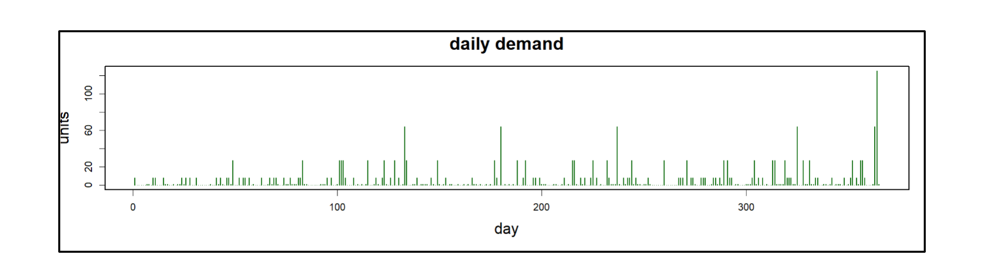
    • Item demand was assumed to be intermittent and highly variable but relatively simple in that there was neither trend nor seasonality, as is often true for service parts. Daily mean demand was 5 units with a large standard deviation of 13 units. Figure 1 shows a sample of one year’s demand. We have chosen a very challenging demand pattern, in which some days have 10 to even 20 times the average demand.

    Daily part demand was assumed to be intermittent and very spikey.

    Figure 1: Daily part demand was assumed to be intermittent and very spikey.

    ​​

    • Suppliers’ replenishment lead times were 14 days 75% of the time and 21 days otherwise. This reflects the fact that there is always uncertainty in the supply chain.


    And the Winner Is…

    Was the theory right? Kinda’ sorta’.

    Table 1 shows the results of the simulation experiments. For each of the three competing policies, it shows the average annual operating cost, the margin of error (technically, an approximate 95% confidence interval for the mean cost), and the apparent best choices for parameter values.

    Results of the simulated comparisons

    Table 1: Results of the simulated comparisons

    For example, the average cost for the (T,S) policy when T is fixed at 30 days was $41,680. But the Plus/Minus implies that the results are compatible with a “true” cost (i.e., the estimate from an infinite number of simulations) of anywhere between $39,890 and $43,650. The reason there is so much statistical uncertainty is the extremely spikey nature of demand in this example.

    Table 1 says that, in this example, the three policies fall in line with expectations. However, more useful conclusions would be:

    1. The three policies are remarkably similar in average cost. By clever choice of parameter values, one can get good results out of any of the three policies.
    2. Not shown in Table 1, but clear from the detailed simulation results, is that poor choices for parameter values can be disastrous for any policy.
    3. It is worth noting that the periodic review (T,S) policy was not allowed to optimize over possible values of T. We fixed T at 30 to mimic what is common in practice, but those who use the periodic review policy should consider other review periods. An additional experiment fixed the review period at T = 7 days. The average cost in this scenario was minimized at $36,551 ± $1,668 with S = 343. This result is better than that using T = 30 days.
    4. We should be careful about over-generalizing these results. They depend on the assumed values of the three cost parameters (holding, ordering and shortage) and the character of the demand process.
    5. It is possible to run experiments like those shown here automatically in Smart Inventory Optimization. This means that you too would be able to explore design choices in a rigorous way.


    Leveraging ERP Planning BOMs with Smart IP&O to Forecast the Unforecastable

    ​In a highly configurable manufacturing environment, forecasting finished goods can become a complex and daunting task. The number of possible finished products will skyrocket when many components are interchangeable. A traditional MRP would force us to forecast every single finished product which can be unrealistic or even impossible. Several leading ERP solutions introduce the concept of the “Planning BOM”, which allows the use of forecasts at a higher level in the manufacturing process. In this article, we will discuss this functionality in ERP, and how you can take advantage of it with Smart Inventory Planning and Optimization (Smart IP&O) to get ahead of your demand in the face of this complexity.

    Why Would I Need a Planning BOM?

    Traditionally, each finished product or SKU would have a rigidly defined bill of materials. If we stock that product and want to plan around forecasted demand, we would forecast demand for those products and then feed MRP to blow this forecasted demand from the finished good level down to its components via the BOM.

    Many companies, however, offer highly configurable products where customers can select options on the product they are buying. As an example, recall the last time you bought a personal computer. You chose a brand and model, but from there, you were likely presented with options: what speed of CPU do you want? How much RAM do you want? What kind of hard drive and how much space? If that business wants to have these computers ready and available to ship to you in a reasonable time, suddenly they are no longer just anticipating demand for that model—they must forecast that model for every type of CPU, for all quantities of RAM, for all types of hard drive, and all possible combinations of those as well! For some manufacturers, these configurations can compound to hundreds or thousands of possible finished good permutations.

    Planning BOM emphasizing the large numbers of permutations Laptops Factory Components

    There may be so many possible customizations that the demand at the finished product level is completely unforecastable in a traditional sense. Thousands of those computers may sell every year, but for each possible configuration, the demand may be extremely low and sporadic—perhaps certain combinations sell once and never again.

    This often forces these companies to plan reorder points and safety stock levels mostly at the component level, while largely reacting to firm demand at the finished good level via MRP. While this is a valid approach, it lacks a systematic way to leverage forecasts that may account for anticipated future activity such as promotions, upcoming projects, or sales opportunities. Forecasting at the “configured” level is effectively impossible, and trying to weave in these forecast assumptions at the component level isn’t feasible either.


    Planning BOM Explained

    This is where Planning BOMs come in. Perhaps the sales team is working a big b2b opportunity for that model, or there’s a planned promotion for Cyber Monday. While trying to work in those assumptions for every possible configuration isn’t realistic, doing it at the model level is totally doable—and tremendously valuable.

    The Planning BOM can use a forecast at a higher level and then blow demand down based on predefined proportions for its possible components. For example, the computer manufacturer may know that most people opt for 16GB of RAM, and far fewer opt for the upgrades to 32 or 64. The planning BOM allows the organization to (for example) blow 60% of the demand down to the 16GB option, 30% to the 32GB option, and 10% to the 64GB option. They could do the same for CPUs, hard drives, or any other customizations available.  

    Planning BOM Explained with computer random access memory ram close hd


    The business can now focus their forecast at this model level, leaving the Planning BOM to figure out the component mix. Clearly, defining these proportions requires some thought, but Planning BOMs effectively allow businesses to forecast what would otherwise be unforecastable.


    The Importance of a Good Forecast

    Of course, we still need a good forecast to load into an ERP system. As explained in this article, while ERP  can import a forecast, it often cannot generate one and when it does it tends to require a great deal of hard to use configurations that don’t often get revisited resulting in inaccurate forecasts.  It is therefore up to the business to come up with their own sets of forecasts, often manually produced in Excel. Forecasting manually generally presents a number of challenges, including but not limited to:

    • The inability to identify demand patterns like seasonality or trend
    • Overreliance on customer or sales forecasts
    • Lack of accuracy or performance tracking

    No matter how well configured the MRP is with your carefully considered Planning BOMs, a poor forecast means poor MRP output and mistrust in the system—garbage in, garbage out. Continuing along with the “computer company” example, without a systematic way of capturing key demand patterns and/or domain knowledge in the forecast, MRP can never see it.


    Extend ERP  with Smart IP&O

    Smart IP&O is designed to extend your ERP system with a number of integrated demand planning and inventory optimization solutions. For example, it can generate statistical forecasts automatically for large numbers of items, allows for intuitive forecast adjustments, tracks forecast accuracy, and ultimately allows you to generate true consensus-based forecasts to better anticipate the needs of your customers.

    Thanks to highly flexible product hierarchies, Smart IP&O is perfectly suited to forecasting at the Planning BOM level so you can capture key patterns and incorporate business knowledge at the levels that matter most. Furthermore you can analyze and deploy optimal safety stock levels at any level of your BOM.


    The Forecast Matters, but Maybe Not the Way You Think

    True or false: The forecast doesn’t matter to spare parts inventory management.

    At first glance, this statement seems obviously false. After all, forecasts are crucial for planning stock levels, right?

    It depends on what you mean by a “forecast”. If you mean an old-school single-number forecast (“demand for item CX218b will be 3 units next week and 6 units the week after”), then no. If you broaden the meaning of forecast to include a probability distribution taking account of uncertainties in both demand and supply, then yes.

    The key reality is that many items, especially spare and service parts, have unpredictable, intermittent demand. (Supplier lead times can also be erratic, especially when parts are sourced from a backlogged OEM.)  We have observed that while manufacturers and distributors typically experience intermittent demand on just 20% or more of their items the percentage grows to 80%+ for MRO based businesses.  This means historical data often show periods of zero demand interspersed with random periods of non-zero demand. Sometimes, these non-zero demands are as low as 1 or 2 units, while at other times, they unexpectedly spike to quantities several times larger than their average.

    This isn’t like the kind of data usually faced by your peer “demand planners” in retail, consumer products, and food and beverage. Those folks usually deal with larger quantities having proportionately less randomness. And they can surf on prediction-enhancing features like trends and stable seasonal patterns. Instead, spare parts usage is much more random, throwing a monkey wrench into the planning process, even in the minority of cases in which there are detectable seasonal variations.

    In the realm of intermittent demand, the best forecast available will significantly deviate from the actual demand. Unlike consumer products with medium to high volume and frequency, a service part’s forecast can miss the mark by hundreds of percentage points. A forecast of one or two units, on average, will always miss when the actual demand is zero. Even with advanced business intelligence or machine learning algorithms, the error in forecasting the non-zero demands will still be substantial.

    Perhaps because of the difficulty of statistical forecasting in the inventory domain, inventory planning in practice often relies on intuition and planner knowledge. Unfortunately, this approach doesn’t scale across tens of thousands of parts. Intuition just cannot cope with the full range of demand and lead time possibilities, let alone accurately estimate the  probability of each possible scenario. Even if your company has one or two exceptional intuitive forecasters, personnel retirements and product line reorganizations mean that intuitive forecasting can’t be relied on going forward.

    The solution lies in shifting focus from traditional forecasts to predicting probabilities for each potential demand and lead time scenario. This shift transforms the conversation from an unrealistic “one number plan” to a range of numbers with associated probabilities. By predicting probabilities for each demand and lead time possibility, you can better align stock levels with the risk tolerance for each group of parts.

    Software that generates demand and lead time scenarios, repeating this process tens of thousands of times, can accurately simulate how current stocking policies will perform against these policies. If the performance in the simulation falls short and you are predicted to stock out more often than you are comfortable with or you are left with excess inventory, conducting what-if scenarios allows adjustments to policies. You can then predict how these revised policies will fare against random demands and lead times. You can conduct this process iteratively and refine it with each new what-if scenario or lean on system prescribed policies that optimally strike a balance between risk and costs.

    So, if you are planning service and spare parts inventories, stop worrying about predicting demand the way traditional retail and CPG demand planners do it. Focus instead on how your stocking policies will withstand the randomness of the future, adjusting them based on your risk tolerance. To do this, you’ll need the right set of decision support software, and this is how Smart Software can help.


    Spare Parts Planning Software solutions

    Smart IP&O’s service parts forecasting software uses a unique empirical probabilistic forecasting approach that is engineered for intermittent demand. For consumable spare parts, our patented and APICS award winning method rapidly generates tens of thousands of demand scenarios without relying on the assumptions about the nature of demand distributions implicit in traditional forecasting methods. The result is highly accurate estimates of safety stock, reorder points, and service levels, which leads to higher service levels and lower inventory costs. For repairable spare parts, Smart’s Repair and Return Module accurately simulates the processes of part breakdown and repair. It predicts downtime, service levels, and inventory costs associated with the current rotating spare parts pool. Planners will know how many spares to stock to achieve short- and long-term service level requirements and, in operational settings, whether to wait for repairs to be completed and returned to service or to purchase additional service spares from suppliers, avoiding unnecessary buying and equipment downtime.

    Contact us to learn more how this functionality has helped our customers in the MRO, Field Service, Utility, Mining, and Public Transportation sectors to optimize their inventory. You can also download the Whitepaper here.


    White Paper: What you Need to know about Forecasting and Planning Service Parts


    This paper describes Smart Software’s patented methodology for forecasting demand, safety stocks, and reorder points on items such as service parts and components with intermittent demand, and provides several examples of customer success.

     

      Why MRO Businesses Should Care About Excess Inventory

      Do MRO companies genuinely prioritize reducing excess spare parts inventory? From an organizational standpoint, our experience suggests not necessarily. Boardroom discussions typically revolve around expanding fleets, acquiring new customers, meeting service level agreements (SLAs), modernizing infrastructure, and maximizing uptime. In industries where assets supported by spare parts cost hundreds of millions or generate significant revenue (e.g., mining or oil & gas), the value of the inventory just doesn’t raise any eyebrows, and organizations tend to overlook massive amounts of excessive inventory.

      Consider a public transit agency.  In most major cities, the annual operating budgets will exceed $3 billion.  Capital expenses for trains, subway cars, and infrastructure may reach hundreds of millions annually. Consequently, a spare parts inventory valued at $150 million might not grab the attention of the CFO or general manager, as it represents a small percentage of the balance sheet.  Moreover, in MRO-based industries, many parts need to support equipment fleets for a decade or more, making additional stock a necessary asset. In some sectors like utilities, holding extra stock can even be incentivized to ensure that equipment is kept in a state of good repair.

      We have seen concerns about excess stock arise when warehouse space is limited. I recall, early in my career, witnessing a public transit agency’s rail yard filled with rusted axles valued at over $100,000 each.  I was told the axles were forced to be exposed to the elements due to insufficient warehouse space. The opportunity cost associated with the space consumed by extra stock becomes a consideration when warehouse capacity is exhausted. The primary consideration that trumps all other decisions is how the stock ensures high service levels for internal and external customers.  Inventory planners worry far more about blowback from stockouts than they do from overbuying.  When a missing part leads to an SLA breach or downed production line, resulting in millions in penalties and unrecoverable production output, it is understandable.

      Asset-intensive companies are missing one giant point. That is, the extra stock doesn’t insulate against stockouts; it contributes to them. The more excess you have, the lower your overall service level because the cash needed to purchase parts is finite, and cash spent on excess stock means there isn’t cash available for the parts that need it.  Even publicly funded MRO businesses, like utilities and transit agencies, acknowledge the need to optimize spending, now more than ever.  As one materials manager shared, “We can no longer fix problems with bags of cash from Washington.”  So, they must do more with less, ensuring optimal allocation across the tens of thousands of parts they manage.

      This is where state-of-the-art inventory optimization software comes in, predicting the required inventory for targeted service levels, identifying when stock levels yield negative returns, and recommending reallocations for improved overall service levels.  Smart Software has helped asset intensive MRO based businesses optimize reorder levels across each part for decades. Give us a call to learn more. 


      Spare Parts Planning Software solutions

      Smart IP&O’s service parts forecasting software uses a unique empirical probabilistic forecasting approach that is engineered for intermittent demand. For consumable spare parts, our patented and APICS award winning method rapidly generates tens of thousands of demand scenarios without relying on the assumptions about the nature of demand distributions implicit in traditional forecasting methods. The result is highly accurate estimates of safety stock, reorder points, and service levels, which leads to higher service levels and lower inventory costs. For repairable spare parts, Smart’s Repair and Return Module accurately simulates the processes of part breakdown and repair. It predicts downtime, service levels, and inventory costs associated with the current rotating spare parts pool. Planners will know how many spares to stock to achieve short- and long-term service level requirements and, in operational settings, whether to wait for repairs to be completed and returned to service or to purchase additional service spares from suppliers, avoiding unnecessary buying and equipment downtime.

      Contact us to learn more how this functionality has helped our customers in the MRO, Field Service, Utility, Mining, and Public Transportation sectors to optimize their inventory. You can also download the Whitepaper here.


      White Paper: What you Need to know about Forecasting and Planning Service Parts


      This paper describes Smart Software’s patented methodology for forecasting demand, safety stocks, and reorder points on items such as service parts and components with intermittent demand, and provides several examples of customer success.