Call an Audible to Proactively Counter Supply Chain Noise


You know the situation: You work out the best way to manage each inventory item by computing the proper reorder points and replenishment targets, then average demand increases or decreases, or demand volatility changes, or suppliers’ lead times change, or your own costs change. Now your old policies (reorder points, safety stocks, Min/Max levels, etc.)  have been obsoleted – just when you think you’d got them right.   Leveraging advanced planning and inventory optimization software gives you the ability to proactively address ever-changing outside influences on your inventory and demand.  To do so, you’ll need to regularly recalibrate stocking parameters based on ever-changing demand and lead times.

Recently, some potential customers have expressed concern that by regularly modifying inventory control parameters they are introducing “noise” and adding complication to their operations. A visitor to our booth at last week’s Microsoft Dynamics User Group Conference commented:

“We don’t want to jerk around the operations by changing the policies too often and introducing noise into the system. That noise makes the system nervous and causes confusion among the buying team.”

This view is grounded in yesterday’s paradigms.  While you should generally not change an immediate production run, ignoring near-term changes to the policies that drive future production planning and order replenishment will wreak havoc on your operations.   Like it or not, the noise is already there in the form of extreme demand and supply chain variability.  Fixing replenishment parameters, updating them infrequently, or only reviewing at the time of order means that your Supply Chain Operations will only be able to react to problems rather than proactively identify them and take corrective action.

Modifying the policies with near-term recalibrations is adapting to a fluid situation rather than being captive to it.  We can look to this past weekend’s NFL games for a simple analogy. Imagine the quarterback of your favorite team consistently refusing to call an audible (change the play just before the ball is snapped) after seeing the defensive formation.  This would result in lots of missed opportunities, inefficiency, and stalled drives that could cost the team a victory.  What would you want your quarterback to do?

Demand, lead times, costs, and business priorities often change, and as these last 18 months have proved they often change considerably.  As a Supply Chain leader, you have a choice:  keep parameters fixed resulting in lots of knee-jerk expedites and order cancellations, or proactively modify inventory control parameters.  Calling the audible by recalibrating your policies as demand and supply signals change is the right move.

Here is an example. Suppose you are managing a critical item by controlling its reorder point (ROP) at 25 units and its order quantity (OQ) at 48. You may feel like a rock of stability by holding on to those two numbers, but by doing so you may be letting other numbers fluctuate dramatically.  Specifically, your future service levels, fill rates, and operating costs could all be resetting out of sight while you fixate on holding onto yesterday’s ROP and OQ.  When the policy was originally determined, demand was stable and lead times were predictable, yielding service levels of 99% on an important item.   But now demand is increasing and lead times are longer.  Are you really going to expect the same outcome (99% service level) using the same sets of inputs now that demand and lead times are so different?  Of course not.  Suppose you knew that given the recent changes in demand and lead time, in order to achieve the same service level target of 99%, you had to increase the ROP to 35 units.  If you were to keep the ROP at 25 units your service level would fall to 92%.  Is it better to know this in advance or to be forced to react when you are facing stockouts?

What inventory optimization and planning software does is make visible the connections between performance metrics like service rate and control parameters like ROP and ROQ. The invisible becomes visible, allowing you to make reasoned adjustments that keep your metrics where you need them to be by adjusting the control levers available for your use.  Using probabilistic forecasting methods will enable you to generate Key Performance Predictions (KPPs) of performance and costs while identifying near-term corrective actions such as targeted stock movements that help avoid problems and take advantage of opportunities. Not doing so puts your supply chain planning in a straightjacket, much like the quarterback who refuses to audible.

Admittedly, a constantly-changing business environment requires constant vigilance and occasional reaction. But the right inventory optimization and demand forecasting software can recompute your control parameters at scale with a few mouse clicks and clue your ERP system how to keep everything on course despite the constant turbulence.  The noise is already in your system in the form of demand and supply variability.  Will you proactively audible or stick to an older plan and cross your fingers that things will work out fine?



Leave a Comment
Related Posts
How to Forecast Inventory Requirements

How to Forecast Inventory Requirements

Forecasting inventory requirements is a specialized variant of forecasting that focuses on the high end of the range of possible future demand. Traditional methods often rely on bell-shaped demand curves, but this isn’t always accurate. In this article, we delve into the complexities of this practice, especially when dealing with intermittent demand.

Explaining What “Service Level” Means in Your Inventory Optimization Software

Explaining What “Service Level” Means in Your Inventory Optimization Software

Navigating the intricacies of stocking recommendations can often lead to questions about their accuracy and significance. A recent inquiry from one of our customers prompted an insightful discussion on the nuances of service levels and reorder points. During a team meeting, we identified unusual gaps between our Smart-suggested reorder points (ROP) at a 99% service level and the customer’s current ROP. In this post, we unravel the concept of a “99% service level” and its implications for inventory optimization, shedding light on how timing and immediate stock availability play pivotal roles in meeting customer expectations and remaining competitive in diverse industries.

Don’t blame shortages on problematic lead times.

Don’t blame shortages on problematic lead times.

Lead time delays and supply variability are supply chain facts of life, yet inventory-carrying organizations are often caught by surprise when a supplier is late. An effective inventory planning process embraces this fact of life and develops policies that effectively account for this uncertainty. Sure, there will be times when lead time delays come out of nowhere and cause a shortage. But most often, the shortages result from:

Thoughts on Spare Parts Planning for Public Transit

The Covid19 pandemic has placed unusual stress on public transit agencies. This stress forces agencies to look again at their spare parts planning processes, which is a key driver up ensuring uptime and balancing service parts inventory costs.

This blog focuses on bus systems and their practices for spare parts management and planning. However, there are lessons here for other types of public transit, including rail and light rail.

Back in 1995, the Transportation Research Board (TRB) of the National Research Council published a report that still has relevance. System-Specific Spare Bus Ratios: A Synthesis of Transit Practice stated

The purpose of this study was to document and examine the critical site-specific variables that affect the number of spare vehicles that bus systems need to maintain maximum service requirements. … Although transit managers generally acknowledged that right-sizing the fleet actually improves operations and lowers cost, many reported difficulties in achieving and consistently maintaining a 20 percent spare ratio as recommended by FTA… The respondents to the survey advocated that more emphasis be placed on developing improved and innovative bus maintenance techniques, which would assist them in minimizing downtime and improving vehicle availability, ultimately leading to reduced spare vehicles and labor and material costs.

Grossly simplified guidelines like “keep 20% spare buses” are easy to understand and measure but grossly mask more detailed tactics that can provide more tailored policies that better steward taxpayer dollars spent on spare parts while ensuring the highest levels of availability. If operational reliability can be improved for each bus, then fewer spares are needed.

One way to keep each bus up and running more often is to improve the management of inventories of spare parts – specifically by forecasting service parts usage and the required replenishment policies more accurately. Here is where modern supply chain management can make a significant contribution. The TRB noted this in their report:

Many agencies have been successful in limiting reliance on excess spare vehicles. Those transit officials agree that several factors and initiatives have led to their success and are critical to the success of any program [including] … Effective use of advanced technology to manage critical maintenance functions, including the orderly and timely replacement of parts… Failure to have available service parts and other components when they are needed will adversely affect any maintenance program.

As long as managers are cognizant of the issues and vigilant about what tools are available to them, the probability of buses [being] ‘out for no stock’ will greatly diminish.”

Effective spare parts inventory management requires a balance between “having enough” and “having too much.” What modern service parts planning software can do is make visible the tradeoff between these two goals so that transit managers can make fact-based decisions about spare parts inventories.

There are enough complications in finding the right balance to require moving beyond simple rules of thumb such as “keep ten days’ worth of demand on hand” or “reorder when you are down to five units in stock.” Factors that drive these decisions include both the average demand for a part, the volatility of that demand, the average replenishment lead time (which can be a problem when the part arrives by slow boat from Germany), the variability in lead time, and several cost factors: holding costs, ordering costs, and shortage costs (e.g., lost fares, loss of public goodwill).

Innovative supply chain analytics and spare parts planning software uses advanced probabilistic forecasting and stochastic optimization methods to manage these complexities and provide greater parts availability at lower cost. For instance, Minnesota’s Metro Transit documented a 4x increase in return on investment in the first six months of implementing a new system. To read more about how public transit agencies are exploiting innovative supply chain analytics, see:


Leave a Comment
Related Posts
How to Forecast Inventory Requirements

How to Forecast Inventory Requirements

Forecasting inventory requirements is a specialized variant of forecasting that focuses on the high end of the range of possible future demand. Traditional methods often rely on bell-shaped demand curves, but this isn’t always accurate. In this article, we delve into the complexities of this practice, especially when dealing with intermittent demand.

Explaining What “Service Level” Means in Your Inventory Optimization Software

Explaining What “Service Level” Means in Your Inventory Optimization Software

Navigating the intricacies of stocking recommendations can often lead to questions about their accuracy and significance. A recent inquiry from one of our customers prompted an insightful discussion on the nuances of service levels and reorder points. During a team meeting, we identified unusual gaps between our Smart-suggested reorder points (ROP) at a 99% service level and the customer’s current ROP. In this post, we unravel the concept of a “99% service level” and its implications for inventory optimization, shedding light on how timing and immediate stock availability play pivotal roles in meeting customer expectations and remaining competitive in diverse industries.

Don’t blame shortages on problematic lead times.

Don’t blame shortages on problematic lead times.

Lead time delays and supply variability are supply chain facts of life, yet inventory-carrying organizations are often caught by surprise when a supplier is late. An effective inventory planning process embraces this fact of life and develops policies that effectively account for this uncertainty. Sure, there will be times when lead time delays come out of nowhere and cause a shortage. But most often, the shortages result from:
Stay the course


I’ve stood in front of thousands of students. They’ve been more or less young, more or less technical, more or less experienced – and more or less interested.  I’ve done this as a university faculty member since 1972, first at Massachusetts Institute of Technology, then at Harvard University, finally in the School of Engineering at Rensselaer Polytechnic Institute. Between Harvard and RPI I dropped out of academia temporarily to co-found Smart Software with Charlie Smart and Nelson Hartunian. So since then, I’ve also been busy training business users to exploit the power of advanced analytics for forecasting and inventory optimization.

As I write this, I’ve just returned to my office at RPI after introducing first-year Industrial Engineering students to the basic concepts of inventory management. If they stick with the program, they will go on to take required courses in supply chain, system simulation, statistical analysis, and optimization. I told them stories about how useful they will be to their companies should they decide to make a career in the world of supply chain. If I’d had more time, I would have mentioned how capable they will be when they graduate relative to many of their corporate peers. These freshmen and ready and willing to stay the course, soaking up all the techniques and theories we can throw at them, and honing their practical skills in summer jobs or coop assignments.

What I didn’t tell them is that many of them will have to work to keep their intensity when they are on the job. It’s a sad truth that, for whatever reason, many inventory practitioners settle into a kind of stasis that impedes their companies’ ability to exploit the latest technologies, such as cloud-based advanced demand forecasting and inventory optimization. Gather enough of such people in one place and agility and improved efficiency go out the window.

I think one of the factors that dulls people is that the process of implementation frequently feels painfully incremental and prolonged. It often begins with a sobering inventory of relevant data, its correctness, and its currency. Then it moves to an often-awkward discovery that there really is no systematic process in place and the subsequent need to design a good one going forward. Next is the need to learn to use a new software suite. That step involves learning new vocabulary, some level of probabilistic thought, an ability to interpret new graphs and tables, not to mention a new software interface.  All this takes time and effort.


Forecast accuracy provides a statistically sound


We’ve found that a few things help new customers stay the course. One is having a champion among management, an executive sponsor, who can vouch for the commercial importance of a successful implementation while ensuring the users are supported with continuing education.  A second is identifying and training a super-user or two having unusual combinations of technical and communication skills.  A third is breaking the training into bite-sized chunks and testing for comprehension after each chunk and repeating this process until it is clear that the new concepts, vocabulary, and process are fully absorbed. But all those maneuvers will come to naught without management being all-in and ready to stay the course.  Inventory planning practices in place for many years are not going to be replaced entirely over a three-month implementation process.  You’ve got to want it to get it.


Leave a Comment
Related Posts
How to Forecast Inventory Requirements

How to Forecast Inventory Requirements

Forecasting inventory requirements is a specialized variant of forecasting that focuses on the high end of the range of possible future demand. Traditional methods often rely on bell-shaped demand curves, but this isn’t always accurate. In this article, we delve into the complexities of this practice, especially when dealing with intermittent demand.

Explaining What “Service Level” Means in Your Inventory Optimization Software

Explaining What “Service Level” Means in Your Inventory Optimization Software

Navigating the intricacies of stocking recommendations can often lead to questions about their accuracy and significance. A recent inquiry from one of our customers prompted an insightful discussion on the nuances of service levels and reorder points. During a team meeting, we identified unusual gaps between our Smart-suggested reorder points (ROP) at a 99% service level and the customer’s current ROP. In this post, we unravel the concept of a “99% service level” and its implications for inventory optimization, shedding light on how timing and immediate stock availability play pivotal roles in meeting customer expectations and remaining competitive in diverse industries.

Don’t blame shortages on problematic lead times.

Don’t blame shortages on problematic lead times.

Lead time delays and supply variability are supply chain facts of life, yet inventory-carrying organizations are often caught by surprise when a supplier is late. An effective inventory planning process embraces this fact of life and develops policies that effectively account for this uncertainty. Sure, there will be times when lead time delays come out of nowhere and cause a shortage. But most often, the shortages result from:
Goldilocks Inventory Levels

You may remember the story of Goldilocks from your long-ago youth. Sometimes the porridge was too hot, sometimes it was too cold, but just once it was just right. Now that we are adults, we can translate that fairy tale into a professional principle for inventory planning: There can be too little or too much inventory, and there is some Goldilocks level that is “just right.” This blog is about finding that sweet spot.

To illustrate our supply chain fable, consider this example. Imagine that you sell service parts to keep your customers systems up and running. You offer a particular service part that costs you $100 to make but sells for a 20% markup. You can make $20 on each unit you sell, but you don’t get to keep the whole $20 because of the inventory operating costs you bear to be able to sell the part. There are holding costs to keep the part in good repair while in stock and ordering costs to replenish units you sell. Finally, sometimes you lose revenue from lost sales due to stockouts.  

These operating costs can be directly related to the way you manage the part in inventory. For our example, assume you use a (Q,R) inventory policy, where Q is the replenishment order quantity and R is the reorder point. Assume further that the reason you are not making $30 per unit is that you have competitors, and customers will get the part from them if they can’t get it from you.

Both your revenue and your costs depend in complex ways on your choices for Q and R. These will determine how much you order, when and therefore how often you order, how often you stock out and therefore how many sales you lose, and how much cash you tie up in inventory. It is impossible to cost out these relationships by guesswork, but modern software can make the relationships visible and calculate the dollar figures you need to guide your choice of values for Q and R. It does this by running detailed, fact-based, probabilistic simulations that predict costs and performance by averaging over a large number of realistic demand scenarios.  

With these results in hand, you can work out the margin associated with (Q,R) values using the simple formula

Margin = (Demand – Lost Sales) x Profit per unit sold – Ordering Costs – Holding Costs.

In this formula, Lost Sales, Ordering Costs and Holding Costs are dependent on reorder point R and order quantity Q.

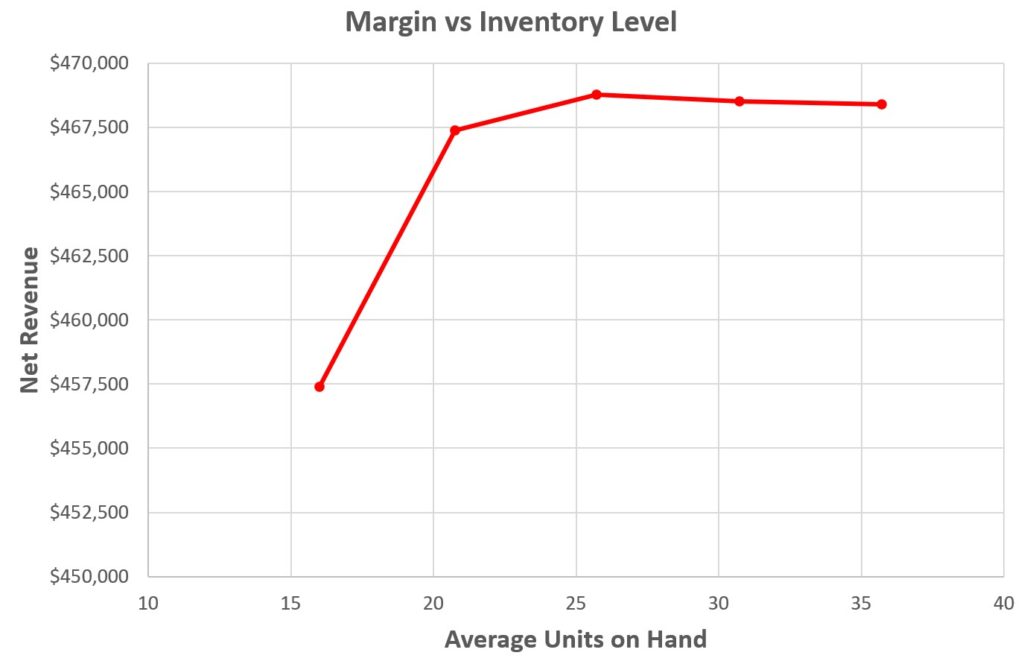
Figure 1 shows the result of simulations that fixed Q at 25 units and varied R from 10 to 30 in steps of 5. While the curve is rather flat on top, you would make the most money by keeping on-hand inventory around 25 units (which corresponds to setting R = 20). More inventory, despite a higher service level and fewer lost sales, would make a little less money (and ties up a lot more cash), and less inventory would make a lot less.


Margins vs Inventory Level Business

Figure 1: Showing that there can be too little or too much inventory on hand


Without relying on the inventory simulation software, we would not be able to discover

  • a) that it is possible to carry too little and too much inventory
  • b) what the best level of inventory is
  • c) how to get there by proper choices of reorder point R and order quantity Q.


Without an explicit understanding of the above, companies will make daily inventory decisions relying on gut feel and averaging based rule of thumb methods. The tradeoffs described here are not exposed and the resulting mix of inventory yields a far lower return forfeiting hundreds of thousands to millions per year in lost profits.  So be like Goldilocks.  With the right systems and software tools, you too can get it just right!    


Leave a Comment
Related Posts
How to Forecast Inventory Requirements

How to Forecast Inventory Requirements

Forecasting inventory requirements is a specialized variant of forecasting that focuses on the high end of the range of possible future demand. Traditional methods often rely on bell-shaped demand curves, but this isn’t always accurate. In this article, we delve into the complexities of this practice, especially when dealing with intermittent demand.

Explaining What “Service Level” Means in Your Inventory Optimization Software

Explaining What “Service Level” Means in Your Inventory Optimization Software

Navigating the intricacies of stocking recommendations can often lead to questions about their accuracy and significance. A recent inquiry from one of our customers prompted an insightful discussion on the nuances of service levels and reorder points. During a team meeting, we identified unusual gaps between our Smart-suggested reorder points (ROP) at a 99% service level and the customer’s current ROP. In this post, we unravel the concept of a “99% service level” and its implications for inventory optimization, shedding light on how timing and immediate stock availability play pivotal roles in meeting customer expectations and remaining competitive in diverse industries.

Don’t blame shortages on problematic lead times.

Don’t blame shortages on problematic lead times.

Lead time delays and supply variability are supply chain facts of life, yet inventory-carrying organizations are often caught by surprise when a supplier is late. An effective inventory planning process embraces this fact of life and develops policies that effectively account for this uncertainty. Sure, there will be times when lead time delays come out of nowhere and cause a shortage. But most often, the shortages result from:
An Example of Simulation-Based Multiechelon Inventory Optimization

Managing the inventory in a single facility is difficult enough, but the problem becomes much more complex when there are multiple facilities arrayed in multiple echelons. The complexity arises from the interactions among the echelons, with demands at the lower levels bubbling up and any shortages at the higher levels cascading down.

If each of the facilities were to be managed in isolation, standard methods could be used, without regard to interactions, to set inventory control parameters such as reorder points and order quantities. However, ignoring the interactions between levels can lead to catastrophic failures. Experience and trial and error allow the design of stable systems, but that stability can be shattered by changes in demand patterns or lead times or by the addition of new facilities. Coping with such changes is greatly aided by advanced supply chain analytics, which provide a safe “sandbox” within which to test out proposed system changes before deploying them. This blog illustrates that point.


The Scenario

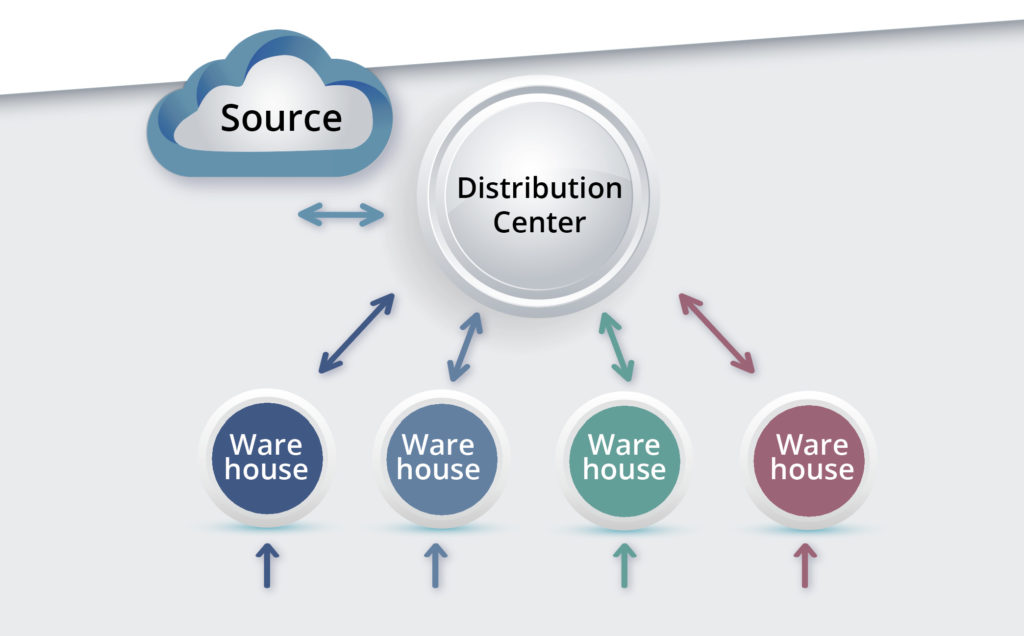
To have some hope of discussing this problem usefully, this blog will simplify the problem by considering the two-level hierarchy pictured in Figure 1. Imagine the facilities at the lower level to be warehouses (WHs) from which customer demands are meant to be satisfied, and that the inventory items at each WH are service parts sold to a wide range of external customers.


Fact and Fantasy in Multiechelon Inventory Optimization

Figure 1: General structure of one type of two-level inventory system

Imagine the higher level to consist of a single distribution center (DC) which does not service customers directly but does replenish the WHs. For simplicity, assume the DC itself is replenished from a Source that always has (or makes) sufficient stock to immediately ship parts to the DC, though with some delay. (Alternatively, we could consider the system to have retail stores supplied by one warehouse).

Each level can be described in terms of demand levels (treated as random), lead times (random), inventory control parameters (here, Min and Max values) and shortage policy (here, backorders allowed).


The Method of Analysis

The academic literature has made progress on this problem, though usually at the cost of simplifications necessary to facilitate a purely mathematical solution. Our approach here is more accessible and flexible: Monte Carlo simulation. That is, we build a computer program that incorporates the logic of the system operation. The program “creates” random demand at the WH level, processes the demand according to the logic of a chosen inventory policy, and creates demand for the DC by pooling the random requests for replenishment made by the WHs. This approach lets us observe many simulated days of system operation while watching for significant events like stockouts at either level.


An Example

To illustrate an analysis, we simulated a system consisting of four WHs and one DC. Average demand varied across the WHs. Replenishment from the DC to any WH took from 4 to 7 days, averaging 5.15 days. Replenishment of the DC from the Source took either 7, 14, 21 or 28 days, but 90% of the time it was either 21 or 28 days, making the average 21 days. Each facility had Min and Max values set by analyst judgement after some rough calculations.

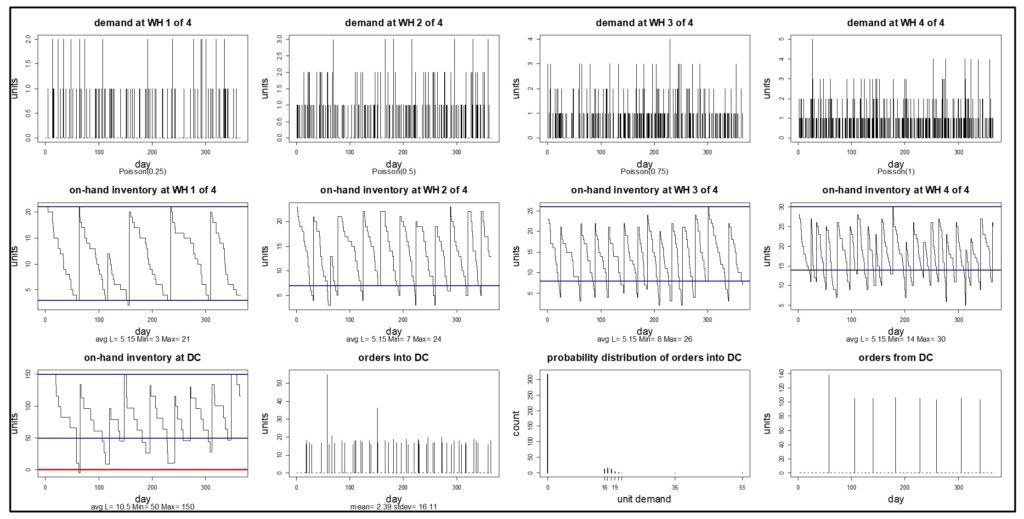
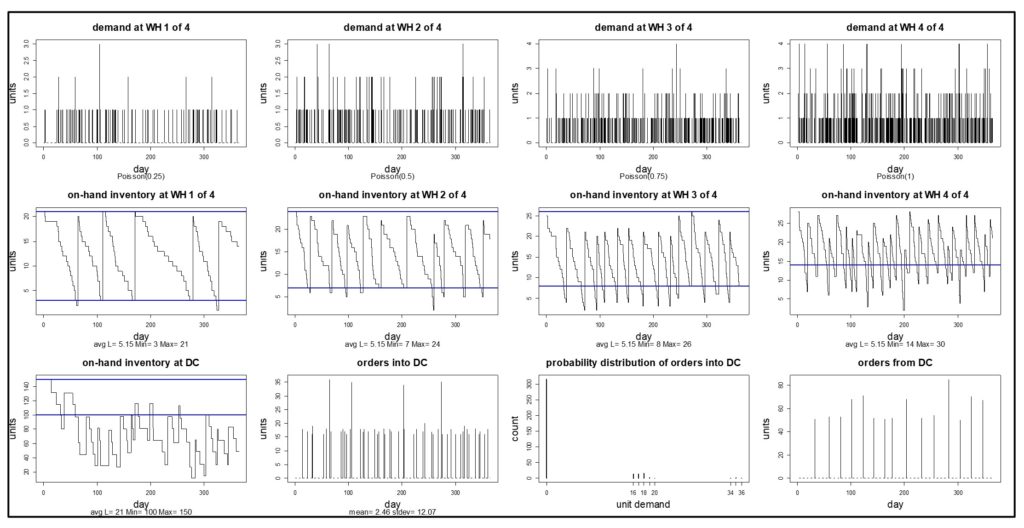
Figure 2 shows the results of one year of simulated daily operation of this system. The first row in the figure shows the daily demand for the item at each WH, which was assumed to be “purely random”, meaning it had a Poisson distribution. The second row shows the on-hand inventory at the end of each day, with Min and Max values indicated by blue lines. The third row describes operations at the DC.  Contrary to the assumption of much theory, the demand into the DC was not close to being Poisson, nor was the demand out of the DC to the Source. In this scenario, Min and Max values were sufficient to keep item availability was high at each WH and at the DC, with no stockouts observed at any of the five facilities.


Click here to enlarge the image

Figure 2 - Simulated year of operation of a system with four WHs and one DC.

Figure 2 – Simulated year of operation of a system with four WHs and one DC.


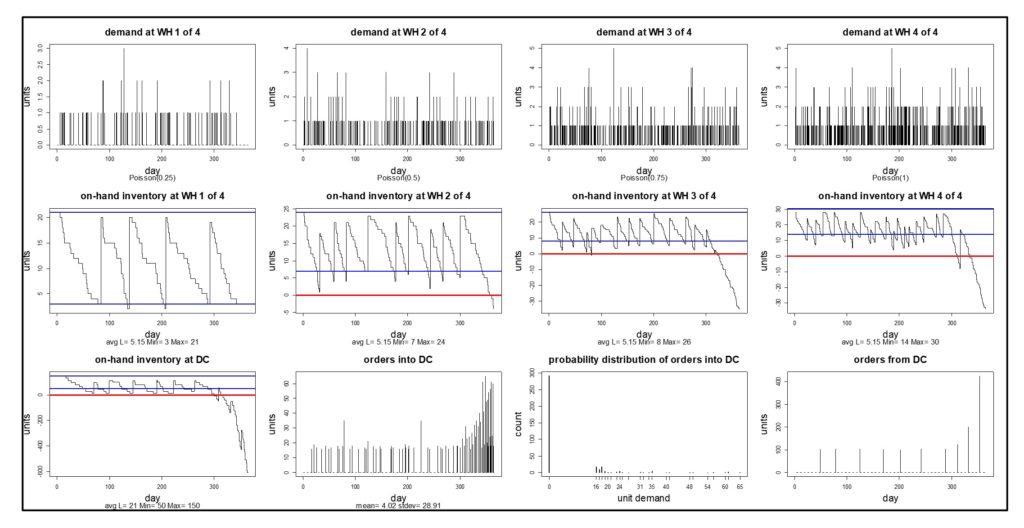
Now let’s vary the scenario. When stockouts are extremely rare, as in Figure 2, there is often excess inventory in the system. Suppose somebody suggests that the inventory level at the DC looks a bit fat and thinks it would be good idea to save money there. Their suggestion for reducing the stock at the DC is to reduce the value of the Min at the DC from 100 to 50. What happens? You could guess, or you could simulate.

Figure 3 shows the simulation – the result is not pretty. The system runs fine for much of the year, then the DC runs out of stock and cannot catch up despite sending successively larger replenishment orders to the Source. Three of the four WHs descend into death spirals by the end of the year (and WH1 follows thereafter). The simulation has highlighted a sensitivity that cannot be ignored and has flagged a bad decision.


Click here to enlarge image

Figure 3 - Simulated effects of reducing the Min at the DC.

Figure 3 – Simulated effects of reducing the Min at the DC.


Now the inventory managers can go back to the drawing board and test out other possible ways to reduce the investment in inventory at the DC level. One move that always helps, if you and your supplier can jointly make it happen, is to create a more agile system by reducing replenishment lead time. Working with the Source to insure that the DC always gets its replenishments in either 7 or 14 days stabilizes the system, as shown in Figure 4.


Click here to enlarge image

Figure 4 - Simulated effects of reducing the lead time for replenishing the DC.

Figure 4 – Simulated effects of reducing the lead time for replenishing the DC.


Unfortunately, the intent of reducing the inventory at the DC has not been achieved. The original daily inventory count was about 80 units and remains about 80 units after reducing the DC’s Min and drastically improving the Source-to-DC lead time. But with the simulation model, the planning team can try out other ideas until they arrive at a satisfactory redesign. Or, given that Figure 4 shows the DC inventory starting to flirt with zero, they might think it prudent to accept the need for an average of about 80 units at the DC and look for ways to trim inventory investment at the WHs instead.


The Takeaways

  1. Multiechelon inventory optimization (MEIO) is complex. Many factors interact to produce system behaviors that can be surprising in even simple two-level systems.
  2. Monte Carlo simulation is a useful tool for planners who need to design new systems or tweak existing systems.


Leave a Comment
Related Posts
How to Forecast Inventory Requirements

How to Forecast Inventory Requirements

Forecasting inventory requirements is a specialized variant of forecasting that focuses on the high end of the range of possible future demand. Traditional methods often rely on bell-shaped demand curves, but this isn’t always accurate. In this article, we delve into the complexities of this practice, especially when dealing with intermittent demand.

Explaining What “Service Level” Means in Your Inventory Optimization Software

Explaining What “Service Level” Means in Your Inventory Optimization Software

Navigating the intricacies of stocking recommendations can often lead to questions about their accuracy and significance. A recent inquiry from one of our customers prompted an insightful discussion on the nuances of service levels and reorder points. During a team meeting, we identified unusual gaps between our Smart-suggested reorder points (ROP) at a 99% service level and the customer’s current ROP. In this post, we unravel the concept of a “99% service level” and its implications for inventory optimization, shedding light on how timing and immediate stock availability play pivotal roles in meeting customer expectations and remaining competitive in diverse industries.

Don’t blame shortages on problematic lead times.

Don’t blame shortages on problematic lead times.

Lead time delays and supply variability are supply chain facts of life, yet inventory-carrying organizations are often caught by surprise when a supplier is late. An effective inventory planning process embraces this fact of life and develops policies that effectively account for this uncertainty. Sure, there will be times when lead time delays come out of nowhere and cause a shortage. But most often, the shortages result from: