Daily Demand Scenarios

In this Videoblog, we will explain how time series forecasting has emerged as a pivotal tool, particularly at the daily level, which Smart Software has been pioneering since its inception over forty years ago. The evolution of business practices from annual to more refined temporal increments like monthly and now daily data analysis illustrates a significant shift in operational strategies.

Initially, during the 1980s, the usual practice of using annual data for forecasting and the introduction of monthly data was considered innovative. This period marked the beginning of a trend toward increasing the resolution of data analysis, enabling businesses to capture and react to faster shifts in market dynamics. As we progressed into the 2000s, the norm of monthly data analysis was well-established, but the ‘cool kids’—innovators at the edge of business analytics—began experimenting with weekly data. This shift was driven by the need to synchronize business operations with increasingly volatile market conditions and consumer behaviors that demanded more rapid responses than monthly cycles could provide. Today, in the 2020s, while monthly data analysis remains common, the frontier has shifted again, this time towards daily data analysis, with some pioneers even venturing into hourly analytics.

The real power of daily data analysis lies in its ability to provide a detailed view of business operations, capturing daily fluctuations that might be overlooked by monthly or weekly data.  However, the complexities of daily data necessitate advanced analytical approaches to extract meaningful insights. At this level, understanding demand requires grappling with concepts like intermittency, seasonality, trend, and volatility. Intermittency, or the occurrence of zero-demand days, becomes more pronounced at a daily granularity and demands specialized forecasting techniques like Croston’s method for accurate predictions. Seasonality at a daily level can reveal multiple patterns—such as increased sales on weekends or holidays—that monthly data would mask. Trends can be observed as short-term increases or decreases in demand, demanding agile adjustment strategies. Finally, volatility at the daily level is accentuated, showing more significant swings in demand than seen in monthly or weekly analyses, which can affect inventory management strategies and the need for buffer stock. This level of complexity underscores the need for sophisticated analytical tools and expertise in daily data analysis.

In conclusion, the evolution from less frequent to daily time series forecasting marks a substantial shift in how businesses approach data analysis. This transition not only reflects the accelerating pace of business but also highlights the requirement for tools that can handle increased data granularity. Smart Software’s dedication to refining its analytical capabilities to manage daily data highlights the industry’s broader move towards more dynamic, responsive, and data-driven decision-making. This shift is not merely about keeping pace with time but about leveraging detailed insights to forge competitive advantages in an ever-changing business environment.


Finding Your Spot on the Inventory Tradeoff Curve

This video blog holds essential insights for those working with the complexities of inventory management. The session focuses on striking the right balance within the inventory tradeoff curve, inviting viewers to understand the deep-seated importance of this equilibrium. If you’ve ever had to manage stock, you’ll know it feels like a bit of a tug-of-war. On one side, you’re pulling towards less inventory, which is great for saving money but can leave your customers high and dry. On the other, you’re considering more inventory, which keeps your customers happy but can be a pain for your budget. To make a smart choice in this ongoing tug-of-war, you need to understand where your current inventory decisions place you on this tradeoff curve. Are you at a point where you can handle the pressure, or do you need to shuffle along to a more comfortable spot?

If you can’t answer this question, it means that you still rely on outdated methods, risking the potential for surplus inventory or unmet customer needs. Watch the video so you can see exactly where you are on this curve and understand better about whether you want to stay put or move to a more optimal position.


And if you decide to move, we’ve got the tools to guide you. Smart IP&O’s advanced “what-if” analysis enables businesses to precisely evaluate the impact of different inventory strategies, such as adjustments to safety stock levels or changes in reorder points, on their balance between holding costs and service levels. By simulating demand scenarios and inventory policies, Smart IP&O provides a clear visualization of potential financial outcomes and service level implications, allowing for data-driven strategic decisions. This powerful tool ensures businesses can achieve an optimal balance, minimizing excess inventory and related costs while maintaining high service levels to meet customer demand efficiently.  


The Three Types of Supply Chain Analytics

​In this video blog, we explore the critical roles of Descriptive, Predictive, and Prescriptive Analytics in inventory management, highlighting their essential contributions to driving supply chain optimization through strategic foresight and insightful data analysis.


​These analytics foster a dynamic, responsive, and efficient inventory management ecosystem by enabling inventory managers to monitor current operations, anticipate future developments, and formulate optimal responses. We’ll walk you through how Descriptive Analytics keeps you informed about current operations, Predictive Analytics helps you anticipate future demands, and Prescriptive Analytics guides your strategic decisions for maximum efficiency and cost-effectiveness.

By the end of the video, you’ll have a solid understanding of how to leverage these analytics to enhance your inventory management strategies. These are not just tools but a new way of thinking about and approaching inventory optimization with the support of modern software.


Warning Signs that You Have a Supply Chain Analytics Gap

“Business is war” may be an overdone metaphor but it’s not without validity. Like the “Bomber Gap” and the “Missile Gap,” worries about falling behind the competition, and the resulting threat of annihilation, always lurk in the minds of business executives, If they don’t, they should, because not all gaps are imaginary (the Bomber Gap and the Missile Gap were shown to not exist between the US and the USSR, but the 1980’s gap between Japanese and American productivity was all too real). The difference between paranoia and justified concern is converting fear into facts. This post is about organizing your attention toward possible gaps in your company’s supply chain analytics.

Surveillance Gaps

The US Army has a saying: “Time spent on reconnaissance is never wasted.” Now and then, our Smart Forecaster blog has a post that helps you get your head on a swivel to see what’s going on around you. An example is our post on digital twins, which is a hot topic throughout the engineering world.  To recap: using demand and supply simulations to probe for weaknesses in your inventory plan is a form of supply chain reconnaissance.  Closing this surveillance gap enables businesses to take corrective action before an actual problem emerges.

Situational Awareness Gaps

A military commander needs to keep track of what is available for use and how well it is being used. The reports available in Smart Operational Analytics keep you current on your inventory counts, your forecasting accuracy, your suppliers’ responsiveness, and trends in these and other operational areas.  You’ll know exactly where you stand on a variety of supply chain KPIs such as service level, fill rates, and inventory turns.  You’ll know whether actual performance is aligned with planned performance and whether the inventory plan (i.e., what to order, when, from whom, and why) is being adhered to or ignored.

Agility Gaps

The business environment can change rapidly. All it takes is a tanker stuck sideways in the Suez Canal, a few anti-ship ballistic missiles in the Red Sea, or a region-wide weather event. These catastrophes may fall as much on your competitors’ heads as on yours, but which of you is agile enough to react first? Exception reporting in Demand Planner and Smart Operational Analytics can detect major changes in the character of demand so you can quickly filter out obsolete demand data before they poison all your calculations for demand forecasts or inventory optimization. Smart Demand Planner can give advance warning of a pending increase or decrease in demand. Smart Inventory Optimization can help you adjust your inventory replenishment tactics to reflect these shifts in demand.


Innovation Gaps

Whether you refer to your competition as “The Other Guys” or “Everybody Else” or something unprintable, the ones you have to worry about are the ones always looking for an edge. When you choose Smart as your partner, we’ll give you that edge with innovative but field proven predictive solutions.  Smart Software has been innovating predictive modeling since birth over 40 years ago.

  • Our first products introduced multiple technical innovations: assessment of forecast quality by looking into the future not the past; automatic selection of the best among a set of competing methodologies, exploiting the graphics in the first PCs to allow easy management overrides of statistical forecasts.
  • Later we invented and patented a radically different approach to forecasting the intermittent demand that is characteristic of both spare parts and big-ticket durable goods. Our technology was patented, received multiple awards for dramatically improving the management of inventory.  The solution is now a field proven approach used by many leading businesses in service parts, MRO, aftermarket parts, and field service.
  • More recently, Smart’s cloud platform for demand forecasting, predictive modeling, inventory optimization, and analytics, takes all relevant data otherwise locked in your ERP or EAM systems, external files, and other disparate data sources, organizes it in the Smart Data Pipeline, structures it into our common data model, and processes it in our AWS cloud.  Smart uses the power of our patented probabilistic demand simulations in Smart Inventory Optimization to stress test and optimize the rules you use to manage each of your inventory items.

It’s my job, along with my cofounder Dr. Nelson Hartunian, our data science team, and academic consultants, to continue to push the envelope of supply chain analytics and bring the benefits back to you by continuously rolling out new versions of our products so you don’t get stuck in an innovation gap – or any of the others.


Head to Head: Which Service Parts Inventory Policy is Best?

Our customers have usually settled into one way to manage their service parts inventory. The professor in me would like to think that the chosen inventory policy was a reasoned choice among considered alternatives, but more likely it just sort of happened. Maybe the inventory honcho from long ago had a favorite and that choice stuck. Maybe somebody used an EAM or ERP system that offered only one choice. Perhaps there were some guesses made, based on the conditions at the time.

The Competitors

Too seldom, businesses make these choices in haphazard ways. But modern service parts planning software lets you be more systematic about your choices. This post demonstrates that proposition by making objective comparisons among three popular inventory policies:  Order Up To, Reorder Point/Order Quantity, and Min/Max.  I discussed each of these policies in this video blog.

  • Order Up To. This is a periodic review policy where every T days, on-hand inventory is tallied and an order of random size is placed to bring the stock level back up to S units.
  • Q, R or Reorder Point/Order Quantity. Q, R is a continuous review policy where every day, inventory is tallied. If there are Q or fewer units on hand, an order of fixed size is placed for R more units.
  • Min, Max is another continuous review policy where every day, inventory is tallied. If there are Min or fewer units on hand, an order is placed to bring the stock level back up to Max units.

Inventory theory says these choices are listed in increasing order of effectiveness. The first option, Order Up To, is clearly the simplest and cheapest to implement, but it closes its eyes to what’s going on for long periods of time.  Imposing a specified passage of time in between orders makes it, in theory, less flexible. In contrast, the two continuous review options keep an eye on what’s happening all the time, so they can react to potential stockouts quicker. The Min/Max option is, in theory, more flexible than the option that uses a fixed reorder quantity because the size of the order dynamically changes to accommodate the demand.

That’s the theory. This post examines evidence from head-to-head comparisons to check the theory and put concrete numbers on the relative performance of the three policies.

The Meaning of “Best”

How should we keep score in this tournament? If you are a regular reader of this Smart Forecaster blog, you know that the core of inventory planning is a tug-of-war between two opposing objectives: keeping inventory lean vs keeping item availability metrics such as service level high.

To simplify things, we will compute “one number to rule them all”: the average operating cost. The winning policy will be the one with the lowest average.

This average is the sum of three components: the cost of holding inventory (“holding cost”), the cost of ordering replenishment units (“ordering cost”) and the cost of losing a sale (“shortage cost”). To make things concrete, we used the following assumptions:

  • Each service part is valued at $1,000.
  • Annual holding cost is 10% of item value, or $100 per year per unit.
  • Processing each replenishment order costs $20 per order.
  • Each unit demanded but not provided costs the value of the part, $1,000.

For simplicity, we will refer to the average operating cost as simply “the cost”.

Of course, the lowest average cost can be achieved by getting out of the business. So the competition required a performance constraint on item availability: Each option had to achieve a fill rate of at least 99%.

The Alternatives Duke it Out

A key element of context is whether stockouts result in losses or backorders. Assuming that the service part in question is critical, we assumed that unfilled orders are lost, which means that a competitor fills the order. In an MRO environment, this will mean additional downtime due to stockout.

To compare the alternatives, we used our predictive modeling engine to run a large number of Monte Carlo simulations.  Each simulation involved specifying the parameter values of each policy (e.g., Min and Max values), generating a demand scenario, feeding that into the logic of the policy, and measuring the resulting cost averaged over 365 days of operation. Repeating this process 1,000 times and averaging the 1,000 resulting costs gave the final result for each policy.  

To make the comparison fair, each alternative had to be designed for its best performance. So we searched the “design space” of each policy to find the design with the lowest cost. This required repeating the process described in the previous paragraph for many pairs of parameter values and identifying the pair yielding the lost average annual operating cost.

Using the algorithms in Smart Inventory Optimization (SIOTM) we made head-to-head-to-head comparisons under the following assumptions about demand and supply:

  • Item demand was assumed to be intermittent and highly variable but relatively simple in that there was neither trend nor seasonality, as is often true for service parts. Daily mean demand was 5 units with a large standard deviation of 13 units. Figure 1 shows a sample of one year’s demand. We have chosen a very challenging demand pattern, in which some days have 10 to even 20 times the average demand.
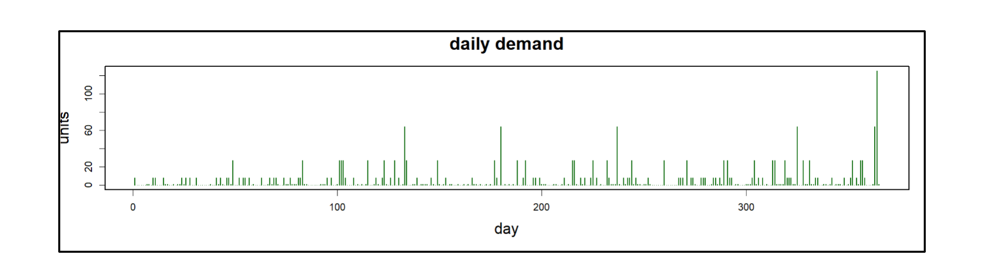
Daily part demand was assumed to be intermittent and very spikey.

Figure 1: Daily part demand was assumed to be intermittent and very spikey.

​​

  • Suppliers’ replenishment lead times were 14 days 75% of the time and 21 days otherwise. This reflects the fact that there is always uncertainty in the supply chain.


And the Winner Is…

Was the theory right? Kinda’ sorta’.

Table 1 shows the results of the simulation experiments. For each of the three competing policies, it shows the average annual operating cost, the margin of error (technically, an approximate 95% confidence interval for the mean cost), and the apparent best choices for parameter values.

Results of the simulated comparisons

Table 1: Results of the simulated comparisons

For example, the average cost for the (T,S) policy when T is fixed at 30 days was $41,680. But the Plus/Minus implies that the results are compatible with a “true” cost (i.e., the estimate from an infinite number of simulations) of anywhere between $39,890 and $43,650. The reason there is so much statistical uncertainty is the extremely spikey nature of demand in this example.

Table 1 says that, in this example, the three policies fall in line with expectations. However, more useful conclusions would be:

  1. The three policies are remarkably similar in average cost. By clever choice of parameter values, one can get good results out of any of the three policies.
  2. Not shown in Table 1, but clear from the detailed simulation results, is that poor choices for parameter values can be disastrous for any policy.
  3. It is worth noting that the periodic review (T,S) policy was not allowed to optimize over possible values of T. We fixed T at 30 to mimic what is common in practice, but those who use the periodic review policy should consider other review periods. An additional experiment fixed the review period at T = 7 days. The average cost in this scenario was minimized at $36,551 ± $1,668 with S = 343. This result is better than that using T = 30 days.
  4. We should be careful about over-generalizing these results. They depend on the assumed values of the three cost parameters (holding, ordering and shortage) and the character of the demand process.
  5. It is possible to run experiments like those shown here automatically in Smart Inventory Optimization. This means that you too would be able to explore design choices in a rigorous way.