Simple is Good, Except When It Isn’t

In this blog, we are steering the conversation towards the transformative potential of technology in inventory management. The discussion centers around the limitations of simple thinking in managing inventory control processes and the necessity of adopting systematic software solutions. Dr. Tom Willemain highlights the contrast between Smart Software and the basic, albeit comfortable, approaches commonly employed by many businesses. These elementary methods, often favored for their ease of use and zero cost, are scrutinized for their inadequacies in addressing the dynamic challenges of inventory management.

​The importance of this subject lies in the critical role inventory management plays in a business’s operational efficiency and its direct impact on customer satisfaction and profitability. Dr. Tom Willemain points out the common pitfalls of relying on oversimplified rules of thumb, such as the whimsical nursery rhyme used by one company to determine reorder points, or the gut feel method, which depends on unquantifiable intuition rather than data. These approaches, while appealing in their simplicity, fail to adapt to market fluctuations, supplier reliability, or changes in demand, thus posing significant risks to the business. The video also critiques the practice of setting reorder points based on multiples of average demand, highlighting its disregard for demand volatility, a fundamental consideration in inventory theory.

Concluding, the presenter advocates for a more sophisticated, data-driven approach to inventory management. By leveraging advanced software solutions like those offered by Smart Software, businesses can accurately model complex demand patterns and stress-test inventory rules against numerous future scenarios. This scientific method allows for the setting of reorder points that account for real-world variability, thereby minimizing the risk of stockouts and the associated costs. The video emphasizes that while simple heuristics may be tempting for their ease of use, they are inadequate for today’s dynamic market conditions. The presenter encourages viewers to embrace technological solutions that offer professional-grade accuracy and adaptability, ensuring sustainable business success.


Leveraging Epicor Kinetic Planning BOMs with Smart IP&O to Forecast Accurately

​​In a highly configurable manufacturing environment, forecasting finished goods can become a complex and daunting task. The number of possible finished products skyrockets when many components are interchangeable. A traditional MRP would force us to forecast every single finished product, which can be unrealistic or even impossible. Several leading solutions introduce the concept of the “Planning BOM,” which allows the use of forecasts at a higher level in the manufacturing process. In this article, we will discuss this functionality in Epicor Kinetic and how you can take advantage of it with Epicor Smart Inventory Planning and Optimization (Smart IP&O) to get ahead of your demand in the face of this complexity.

Why Would I Need a Planning BOM?

Traditionally, each finished product or SKU would have a rigidly defined bill of materials. If we stock that product and want to plan around forecasted demand, we will forecast demand for those products and then feed MRP to blow this forecasted demand from the finished good level down to its components via the BOM.

Many companies, however, offer highly configurable products where customers can select options on the product they buy. As an example, recall the last time you bought a cellphone. You chose a brand and model, but from there, you were likely presented with options: what screen size do you want? How much storage do you want? What color do you prefer? If that business wants to have these cellphones ready and available to ship to you in a reasonable time, suddenly, they are no longer just anticipating demand for that model—they must forecast that model for every type of screen size, for all storage capacities, for all colors, and all possible combinations of those as well! For some manufacturers, these configurations can compound to hundreds or thousands of possible finished good permutations.

There may be so many possible customizations that the demand at the finished product level is completely unforecastable in a traditional sense. Thousands of those cellphones may sell every year, but for each possible configuration, the demand may be extremely low and sporadic—perhaps certain combinations sell once and never again.

This often forces these companies to plan reorder points and safety stock levels mostly at the component level, while largely reacting to firm demand at the finished good level via MRP. While this is a valid approach, it lacks a systematic way to leverage forecasts that may account for anticipated future activity such as promotions, upcoming projects, or sales opportunities. Forecasting at the “configured” level is effectively impossible, and trying to weave in these forecast assumptions at the component level isn’t feasible either.

Planning BOM Explained This is where Planning BOMs come in. Perhaps the sales team is working on a big B2B opportunity for that model, or there’s a planned promotion for Cyber Monday. While trying to work in those assumptions for every possible configuration isn’t realistic, doing it at the model level is totally doable—and tremendously valuable.

The Planning BOM can use a forecast at a higher level and then blow demand down based on predefined proportions for its possible components. For example, the cellphone manufacturer may know that most people opt for 128GB of storage, and far fewer opt for upgrades to 256GB or 512GB. The planning BOM allows the organization to (for example) blow 60% of the demand down to the 128GB option, 30% to the 256GB option, and 10% to the 512GB option. They could do the same for screen sizes, colors, or other available customizations.

The business can now focus its forecast at this model level, leaving the Planning BOM to determine the component mix. Clearly, defining these proportions requires some thought, but Planning BOMs effectively allows businesses to forecast what would otherwise be unforecastable.

The Importance of a Good Forecast

Of course, we still need a good forecast to load into Epicor Kinetic. As explained in this article, while Epicor Kinetic can import a forecast, it often cannot generate one, and when it does it tends to require a great deal of hard-to-use configurations that don’t often get revisited, resulting in inaccurate forecasts. It is, therefore, up to the business to come up with its own sets of forecasts, often manually produced in Excel. Forecasting manually generally presents a number of challenges, including but not limited to:

  • The inability to identify demand patterns like seasonality or trend.
  • Overreliance on customer or sales forecasts.
  • Lack of accuracy or performance tracking.

No matter how well configured the MRP is with your carefully considered Planning BOMs, a poor forecast means poor MRP output and mistrust in the system—garbage in, garbage out. Continuing along with the “cellphone company” example, without a systematic way of capturing key demand patterns and/or domain knowledge in the forecast, MRP can never see it.


Smart IP&O: A Comprehensive Solution

Smart IP&O supports planning at all levels of your BOM, though the “blowing out” is handled via MRP inside Epicor Kinetic. Here is the method we use for our Epicor Kinetic customers, which is straightforward and effective:

  • Smart Demand Planner: The platform contains a purpose-built forecasting application called Smart Demand Planner that you will use to forecast demand for your manufactured products (usually finished goods). It generates statistical forecasts, enables planners to make adjustments and/or weave in other forecasts (such as sales or customer forecasts), and tracks accuracy. The output of this is a forecast that goes into forecast entry inside Epicor Kinetic, where MRP will pick it up. MRP will subsequently use demand at the finished good level, and also blow out material requirements through the BOM, so that demand is recognized at lower levels as well.
  • Smart Inventory Optimization: You simultaneously use Smart Inventory Optimization to set min/max/safety levels both for any finished goods you make to stock (if applicable; some of our customers operate purely make-to-order off of firm demand), as well as for raw materials. The key here is that at the raw material level, Smart will leverage job usage demand, supplier lead times, etc., to optimize these parameters while at the same time using sales orders/shipments as demand at the finished good level. Smart handles these multiple inputs of demand elegantly via the bidirectional integration with Epicor Kinetic.

When MRP runs, it nets out supply & demand (which, once again, includes raw material demand blown out from the finished good forecast) against the min/max/safety levels you have established to suggest PO and job suggestions.


Extend Epicor Kinetic with Smart IP&O

Smart IP&O is designed to extend your Epicor Kinetic system with many integrated demand planning and inventory optimization solutions. For example, it can generate statistical forecasts automatically for large numbers of items, allows for intuitive forecast adjustments, tracks forecast accuracy, and ultimately allows you to generate true consensus-based forecasts to better anticipate the needs of your customers.

Thanks to highly flexible product hierarchies, Smart IP&O is perfectly suited to forecasting at the Planning BOM level, so you can capture key patterns and incorporate business knowledge at the levels that matter most. Furthermore, you can analyze and deploy optimal safety stock levels at any level of your BOM.

Leveraging Epicor Kinetic’s Planning BOM capabilities alongside Smart IP&O’s advanced forecasting and inventory optimization features ensures that you can meet demand efficiently and accurately, regardless of the complexity of your product configurations. This synergy not only enhances forecast accuracy but also strengthens overall operational efficiency, helping you stay ahead in a competitive market.


The Next Frontier in Supply Chain Analytics

We believe the leading edge of supply chain analytics to be the development of digital twins of inventory systems. These twins take the form of discrete event models that use Monte Carlo simulation to generate and optimize over the full range of operational risks. We also assert that we and our colleagues at Smart Software have played an outsized role in forging that leading edge. But we are not alone: there are a small number of other software firms around the globe who are catching up.

So, what’s next for supply chain analytics? Where is the next frontier? It might involve some sort of neural network model of a distribution system. But we’d give better odds on an extension of our leading-edge models of “single echelon” inventory systems to “multi-echelon” inventory systems.

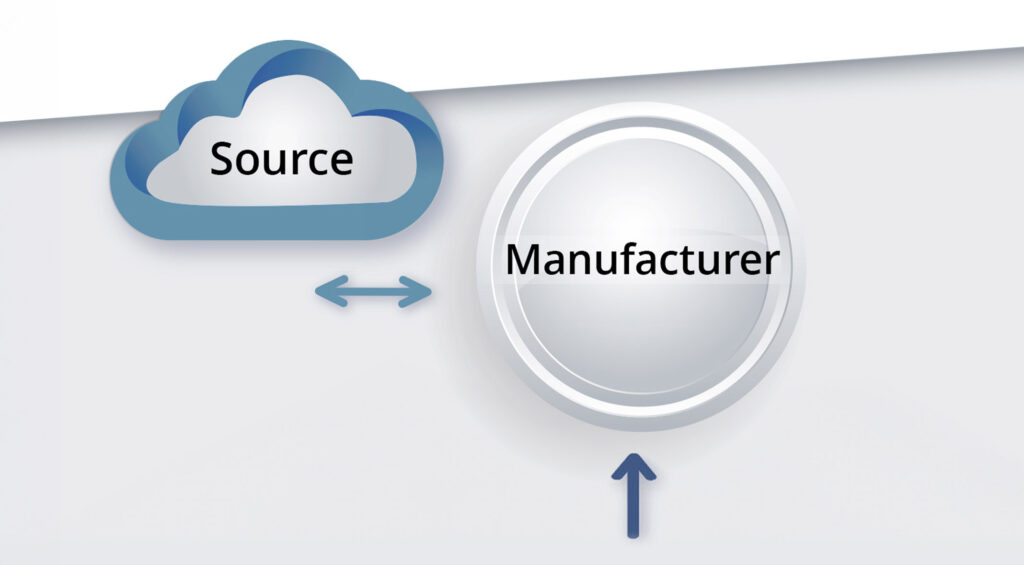
Figures 1 and 2 illustrate the distinction between single and multiple echelon systems. Figure 1 depicts a manufacturer that relies on a Source to replenish its stock of spare parts or components. When stockouts loom, the manufacturer orders replenishment stock from the Source.

Single Multiechelon Inventory Optimization Software AI

Figure 1: A single-echelon inventory system


Single echelon models do not explicitly include details of the Source. It remains mysterious, an invisible ghost whose only relevant feature is the random time it takes to respond to a replenishment request. Importantly, the Source is implicitly assumed to never itself stock out. That assumption may be “good enough” for many purposes, but it cannot be literally true. It gets handled by stuffing supplier stockout events into the replenishment lead time distribution. Pushing back on that assumption is the rationale for multiechelon modeling.

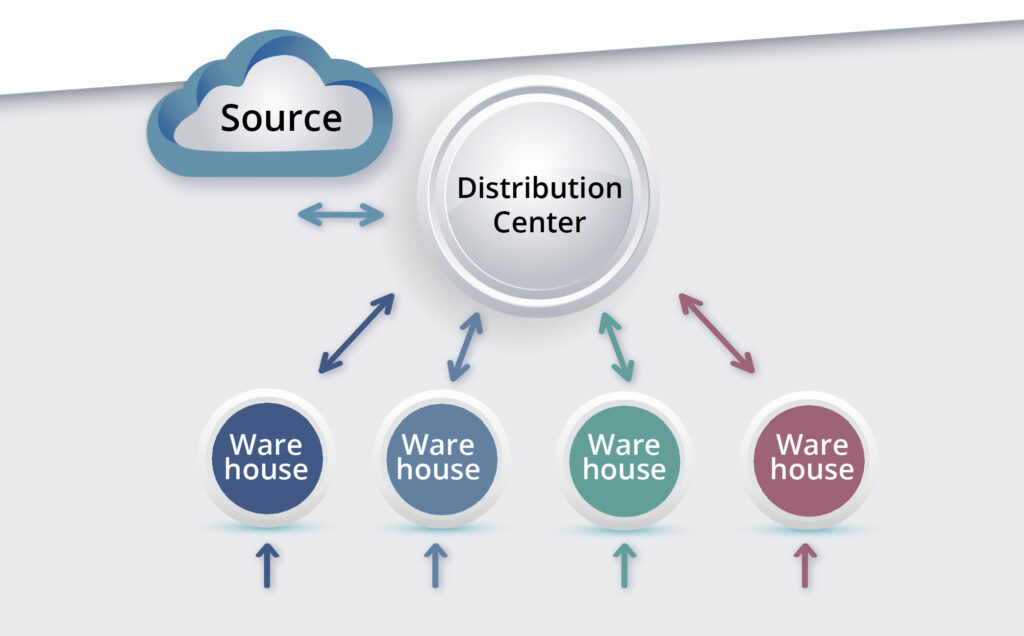
Figure 2 depicts a simple two-echelon inventory system. It shifts domains from manufacturing to distribution. There are multiple warehouses (WH’s) dependent on a distribution center (DC) for resupply. Now the DC is an explicit part of the model. It has a finite capacity to process orders and requires its own reordering protocols. The DC gets its replenishment from higher up the chain from a Source. The Source might be the manufacturer of the inventory item or perhaps a “regional DC” or something similar, but – guess what? – it is another ghost. As in the single-echelon model, this ghost has one visible characteristic: the probability distribution of its replenishment lead time. (The punch line of a famous joke in physics is “But madame, it’s turtles all the way down.” In our case, “It’s ghosts all the way up.”)

Two Multiechelon Inventory Optimization Software AI

Figure 2: A two-echelon inventory system


The problem of process design and optimization is much harder with two levels. The difficulty is not just the addition of two more control parameters for every WH (e.g., a Min and a Max for each) plus the same two parameters for the DC. Rather, the tougher part is modeling the interaction among the WH’s. In the single-level model, each WH operates in its own little world and never hears “Sorry, we’re stocked out” from the ghostly Source. But in a two-level system, there are multiple WH’s all competing for resupply from their shared DC. This competition creates the main analytical difficulty: the WH’s cannot be modeled in isolation but must be analyzed simultaneously. For instance, if one DC services ten WH’s, there are 2+10×2 = 22 inventory control parameters whose values need to be calculated. In nerd-speak: It is not trivial to solve a 22-variable constrained discrete optimization problem having a stochastic objective function.

If we choose the wrong system design, we discover a new phenomenon inherent in multi-echelon systems, which we informally call “meltdown” or “catastrophe.” In this phenomenon, the DC cannot keep up with the replenishment demands of the WH’s, so it eventually creates stockouts at the warehouse level. Then the WH’s increasingly frantic replenishment requests exhaust the inventory at the DC, which starts its own panicked requests for replenishment from the regional DC. If the regional DC takes too long to refill the DC, then the whole system dissolves into a stockout tragedy.

One solution to the meltdown problem is to overdesign the DC so it almost never runs out, but that can be very expensive, which is why there is a regional DC in the first place. So any affordable system design has a DC that is just good enough to last a long time between meltdowns. This perspective implies a new type of key performance indicator (KPI), such as “Probability of Meltdown within X years is less than Y percent.”

The next frontier will require new methods and new metrics but will offer a new way to design and optimize distribution systems. Our skunk works is already generating prototypes. Watch this space.


Overcoming Uncertainty with Service and Inventory Optimization Technology

In this blog, we will discuss today’s fast-paced and unpredictable market and the constant challenges businesses face in managing their inventory and service levels efficiently. The main subject of this discussion, rooted in the concept of “Probabilistic Inventory Optimization,” focuses on how modern technology can be leveraged to achieve optimal service and inventory targets amidst uncertainty. This approach not only addresses traditional inventory management issues but also offers a strategic edge in navigating the complexities of demand fluctuations and supply chain disruptions.

Understanding and implementing inventory optimization technology is important for several reasons. First, it directly impacts a company’s ability to meet customer demands promptly, thereby affecting customer satisfaction and loyalty. Second, effective inventory management controls operational costs, reducing unnecessary stock holding and minimizing the risk of stockouts or overstocking. In an era where market conditions change rapidly, having a robust system to manage these aspects can be the difference between thriving and merely surviving.

At the heart of inventory management lies a paradox: the need to be prepared for fluctuating demand without succumbing to the pitfalls of overstocking, which can lead to increased holding costs, obsolescence, and wasted resources. Conversely, understocking can result in stockouts, lost sales, and diminished customer satisfaction, ultimately impacting a company’s reputation and bottom line. The unpredictable nature of market demands, compounded by potential supply chain disruptions and changing consumer behavior, adds complexity to this balancing act.

Technology plays a pivotal role here. Modern inventory optimization software integrates probabilistic models, sophisticated forecasting algorithms, and simulation capabilities. These systems help companies respond swiftly to changing market conditions. Furthermore, adopting such technology fosters a culture of data-driven decision-making, ensuring businesses are not merely reacting to uncertainties but proactively strategizing to mitigate their impacts.

Here are brief discussions of the relevant algorithmic technologies.

Probabilistic Inventory Optimization: Traditional inventory management approaches rely on deterministic models that assume a static, predictable world. These models falter in the face of variability and uncertainty. Enter probabilistic inventory optimization, a paradigm that embraces the randomness inherent in supply chain processes. This approach employs statistical models to represent the uncertainties in demand and supply, enabling businesses to account for a full range of possible outcomes.

Advanced Forecasting:  A cornerstone of effective inventory optimization is the ability to anticipate future demand accurately. Advanced forecasting techniques, such as [we don’t sell this outside of SmartForecasts or maybe not even there anymore, so don’t mention it], time series analysis, and machine learning, extract exploitable patterns from historical data.

Safety Stock Calculation: A Shield Against Uncertainty:

Forecasts that include estimates of their own uncertainty enable safety stock calculations. Safety stock acts as a buffer against the unpredictability of demand and supply lead times. Determining the optimal level of safety stock is a critical challenge that probabilistic models address adeptly. With the right safety stock levels, businesses can maintain high service levels, ensuring product availability without the burden of excessive inventory.

Scenario Planning: Preparing for Multiple Futures:

The future is inherently uncertain, and a single forecast can never capture all possible scenarios. Advanced methods that create a range of realistic demand scenarios are the essential form of probabilistic inventory optimization. These techniques allow businesses to explore the implications of multiple futures, from best-case to worst-case situations. By planning against these scenarios, companies can enhance their resilience in the face of market volatility.

Navigating the Future with Confidence

The uncertain landscape of today’s business environment necessitates a shift from traditional inventory management practices to more sophisticated, probabilistic approaches. By embracing the principles of probabilistic inventory optimization, companies can strike a durable balance between service excellence and cost efficiency. Integrating advanced forecasting techniques, strategic safety stock calculations, and scenario planning, supported by Smart Inventory Planning and Optimization (Smart IP&O), equips businesses to transform uncertainty from a challenge into an opportunity. Companies that embrace this approach report significant improvements in service levels, reductions in inventory costs, and enhanced supply chain agility.

For example, less critical Items forecasted to achieve 99%+ service levels represent opportunities to reduce inventory. By targeting lower service levels on less critical items, inventory will be “the right size” over time to the new equilibrium, decreasing holding costs and the value of inventory on hand. A major public transit system reduced inventory by over $4,000,000 while improving service levels.

Optimizing Inventory Levels also means savings realized on one subset of items can be reallocated to carry a broader portfolio of “in stock” items, allowing revenues to be captured that would otherwise be lost sales. A leading distributor was able to stock a broader portfolio of parts with savings used from inventory reductions and increased part availability by 18%.


Centering Act: Spare Parts Timing, Pricing, and Reliability

Just as the renowned astronomer Copernicus transformed our understanding of astronomy by placing the sun at the center of our universe, today, we invite you to re-center your approach to inventory management. And while not quite as enlightening, this advice will help your company avoid being caught in the gravitational pull of inventory woes—constantly orbiting between stockouts, surplus gravity, and the unexpected cosmic expenses of expediting?

In this article, we’ll walk you through the process of crafting a spare parts inventory plan that prioritizes availability metrics such as service levels and fill rates while ensuring cost efficiency. We’ll focus on an approach to inventory planning called Service Level-Driven Inventory Optimization. Next, we’ll discuss how to determine what parts you should include in your inventory and those that might not be necessary. Lastly, we’ll explore ways to enhance your service-level-driven inventory plan consistently.

In service-oriented businesses, the consequences of stockouts are often very significant.  Achieving high service levels depends on having the right parts at the right time. However, having the right parts isn’t the only factor. Your Supply Chain Team must develop a consensus inventory plan for every part, then continuously update it to reflect real-time changes in demand, supply, and financial priorities.


Managing inventory with Service-level-driven planning combines the ability to plan thousands of items with high-level strategic modeling. This requires addressing core issues facing inventory executives:

  • Lack of control over supply and associated lead times.
  • Unpredictable intermittent demand.
  • Conflicting priorities between maintenance/mechanical teams and Materials Management.
  • Reactive “wait and see” approach to planning.
  • Misallocated inventory, causing stockouts and excess.
  • Lack of trust in systems and processes.

The key to optimal service parts management is to grasp the balance between providing excellent service and controlling costs. To do this, we must compare the costs of stockout with the cost of carrying additional spare parts inventory. The costs of a stockout will be higher for critical or emergency spares, when there is a service level agreement with external customers, for parts used in multiple assets, for parts with longer supplier lead times, and for parts with a single supplier. The cost of inventory may be assessed by considering the unit costs, interest rates, warehouse space that will be consumed, and potential for obsolescence (parts used on a soon-to-be-retired fleet have a higher obsolescence risk, for example).

To arbitrate how much stock should be put on the shelf for each part, it is critical to establish consensus on the desired key metrics that expose the tradeoffs the business must make to achieve the desired KPIs. These KPIs will include Service Levels that tell you how often you meet usage needs without falling short on stock, Fill Rates that tell you what percentage of demand is filled, and Ordering costs detail the expenses incurred when you place and receive replenishment orders. You also have Holding costs, which encompass expenses like obsolescence, taxes, and warehousing, and Shortage costs that pertain to expenses incurred when stockouts happen.

An MRO business or Aftermarket Parts Planning team might desire a 99% service level across all parts – i.e., the minimum stockout risk that they are willing to accept is 1%. But what if the amount of inventory needed to support that service level is too expensive? To make an informed decision on whether there is going to be a return on that additional inventory investment, you’ll need to know the stockout costs and compare that to the inventory costs. To get stockout costs, multiply two key elements: the cost per stockout and the projected number of stockouts. To get inventory value, multiply the units required by the unit cost of each part. Then determine the annual holding costs (typically 25-35% of the unit cost). Choose the option that yields a total lower cost. In other words, if the benefit associated with adding more stock (reduced shortage costs) outweighs the cost (higher inventory holding costs), then go for it. A thorough understanding of these metrics and the associated tradeoffs serves as the compass for decision-making.

Modern software aids in this process by allowing you to simulate a multitude of future scenarios. By doing so, you can assess how well your current inventory stocking strategies are likely to perform in the face of different demand and supply patterns. If anything falls short or goes awry, it’s time to recalibrate your approach, factoring in current data on usage history, supplier lead times, and costs to prevent both stockouts and overstock situations.


Enhance your service-level-driven inventory plan consistently.

In conclusion, it’s crucial to assess your service-level-driven plan continuously. By systematically constructing and refining performance scenarios, you can define key metrics and goals, benchmark expected performance, and automate the calculation of stocking policies for all items. This iterative process involves monitoring, revising, and repeating each planning cycle.

The depth of your analysis within these stocking policies relies on the data at your disposal and the configuration capabilities of your planning system. To achieve optimal outcomes, it’s imperative to maintain ongoing data analysis. This implies that a manual approach to data examination is typically insufficient for the needs of most organizations.

For information on how Smart Software can help you meet your service supply chain goals with service-driven planning and more, visit the following blogs.

–   “Explaining What  Service-Level Means in Your Inventory Optimization Software”  Stocking recommendations can be puzzling, especially when they clash with real-world needs.  In this post, we’ll break down what that 99% service level means and why it’s crucial for managing inventory effectively and keeping customers satisfied in today’s competitive landscape.

–  “Service-Level-Driven Planning for Service Parts Businesses” Service-Level-Driven Service Parts Planning is a four-step process that extends beyond simplified forecasting and rule-of-thumb safety stocks. It provides service parts planners with data-driven, risk-adjusted decision support.

–   “How to Choose a Target Service Level.” This is a strategic decision about inventory risk management, considering current service levels and fill rates, replenishment lead times, and trade-offs between capital, stocking and opportunity costs.  Learn approaches that can help.

–   “The Right Forecast Accuracy Metric for Inventory Planning.”  Just because you set a service level target doesn’t mean you’ll actually achieve it. If you are interested in optimizing stock levels, focus on the accuracy of the service level projection. Learn how.


Spare Parts Planning Software solutions

Smart IP&O’s service parts forecasting software uses a unique empirical probabilistic forecasting approach that is engineered for intermittent demand. For consumable spare parts, our patented and APICS award winning method rapidly generates tens of thousands of demand scenarios without relying on the assumptions about the nature of demand distributions implicit in traditional forecasting methods. The result is highly accurate estimates of safety stock, reorder points, and service levels, which leads to higher service levels and lower inventory costs. For repairable spare parts, Smart’s Repair and Return Module accurately simulates the processes of part breakdown and repair. It predicts downtime, service levels, and inventory costs associated with the current rotating spare parts pool. Planners will know how many spares to stock to achieve short- and long-term service level requirements and, in operational settings, whether to wait for repairs to be completed and returned to service or to purchase additional service spares from suppliers, avoiding unnecessary buying and equipment downtime.

Contact us to learn more how this functionality has helped our customers in the MRO, Field Service, Utility, Mining, and Public Transportation sectors to optimize their inventory. You can also download the Whitepaper here.


White Paper: What you Need to know about Forecasting and Planning Service Parts


This paper describes Smart Software’s patented methodology for forecasting demand, safety stocks, and reorder points on items such as service parts and components with intermittent demand, and provides several examples of customer success.


    Daily Demand Scenarios

    In this Videoblog, we will explain how time series forecasting has emerged as a pivotal tool, particularly at the daily level, which Smart Software has been pioneering since its inception over forty years ago. The evolution of business practices from annual to more refined temporal increments like monthly and now daily data analysis illustrates a significant shift in operational strategies.

    Initially, during the 1980s, the usual practice of using annual data for forecasting and the introduction of monthly data was considered innovative. This period marked the beginning of a trend toward increasing the resolution of data analysis, enabling businesses to capture and react to faster shifts in market dynamics. As we progressed into the 2000s, the norm of monthly data analysis was well-established, but the ‘cool kids’—innovators at the edge of business analytics—began experimenting with weekly data. This shift was driven by the need to synchronize business operations with increasingly volatile market conditions and consumer behaviors that demanded more rapid responses than monthly cycles could provide. Today, in the 2020s, while monthly data analysis remains common, the frontier has shifted again, this time towards daily data analysis, with some pioneers even venturing into hourly analytics.

    The real power of daily data analysis lies in its ability to provide a detailed view of business operations, capturing daily fluctuations that might be overlooked by monthly or weekly data.  However, the complexities of daily data necessitate advanced analytical approaches to extract meaningful insights. At this level, understanding demand requires grappling with concepts like intermittency, seasonality, trend, and volatility. Intermittency, or the occurrence of zero-demand days, becomes more pronounced at a daily granularity and demands specialized forecasting techniques like Croston’s method for accurate predictions. Seasonality at a daily level can reveal multiple patterns—such as increased sales on weekends or holidays—that monthly data would mask. Trends can be observed as short-term increases or decreases in demand, demanding agile adjustment strategies. Finally, volatility at the daily level is accentuated, showing more significant swings in demand than seen in monthly or weekly analyses, which can affect inventory management strategies and the need for buffer stock. This level of complexity underscores the need for sophisticated analytical tools and expertise in daily data analysis.

    In conclusion, the evolution from less frequent to daily time series forecasting marks a substantial shift in how businesses approach data analysis. This transition not only reflects the accelerating pace of business but also highlights the requirement for tools that can handle increased data granularity. Smart Software’s dedication to refining its analytical capabilities to manage daily data highlights the industry’s broader move towards more dynamic, responsive, and data-driven decision-making. This shift is not merely about keeping pace with time but about leveraging detailed insights to forge competitive advantages in an ever-changing business environment.